Updated
SRV-DS-IC
Support for deals
Dealing with the foreign side in the language of the deal
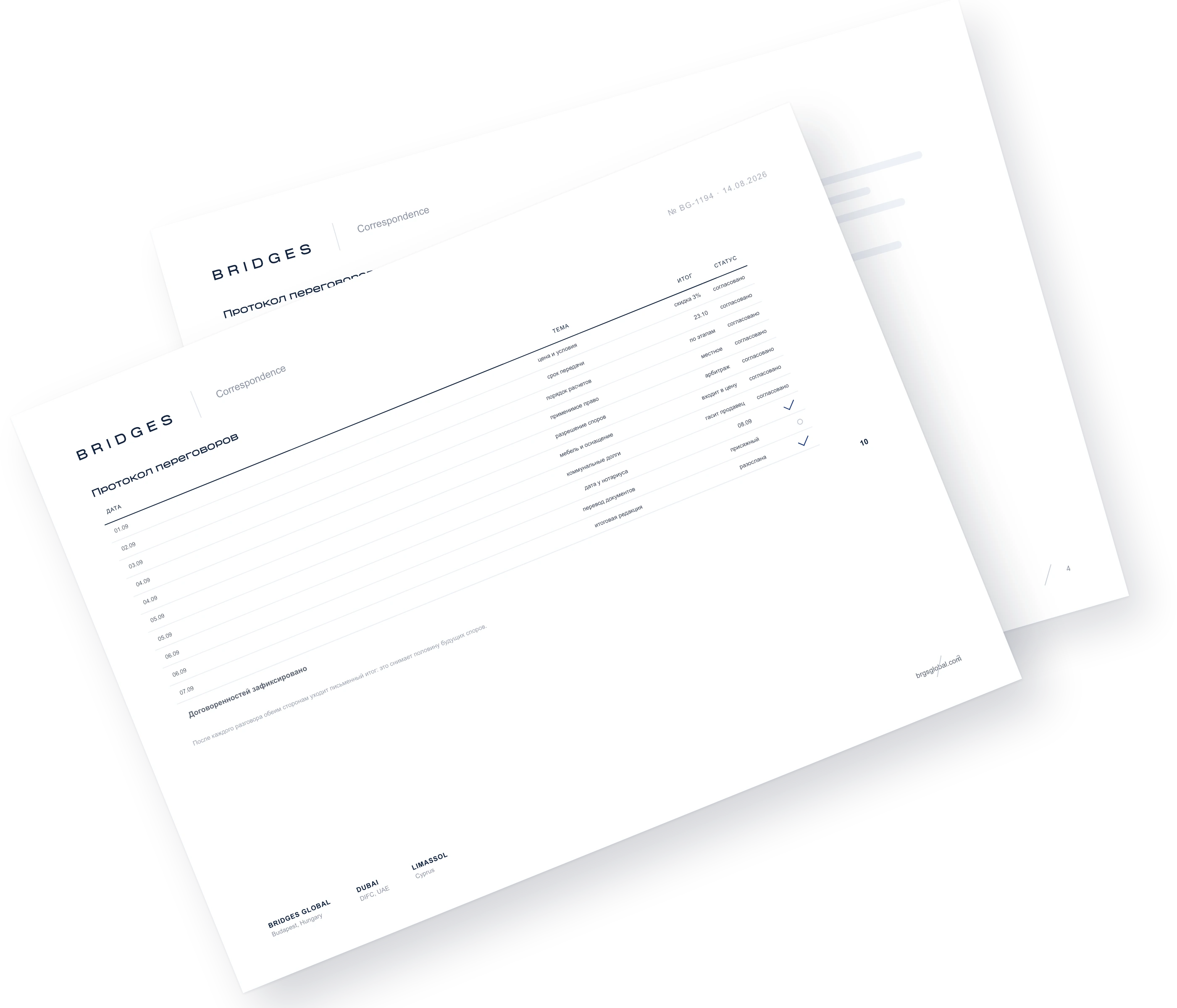
A word-for-word translation often carries the words and loses the meaning: in one country “we will consider it” means yes, in another it is a polite no. We run the correspondence and the negotiations with the foreign side so that you are understood correctly and so that you understand them correctly.
- We correspond on your behalf and in your interest
- We explain not only the words but the business context of the country
- We arrange sworn and notarised translations of documents
01 / The service
Where communication breaks down
Deals rarely collapse because words were not known. They collapse because a position was misread: people part convinced they have agreed, and a week later it turns out otherwise.
Different business cultures
Directness that fits in one country reads as rudeness in another, and a polite yes may mean nothing at all. That affects the outcome of a negotiation more than vocabulary does.
Terms with no exact equivalent
Escrow, completion, due diligence, a notarial deed — these have no single equivalent in Russian, and an approximate translation changes the meaning of the obligation.
Verbal agreements go unrecorded
After a call each side remembers its own version. A written note straight after the conversation removes half the future arguments.
Official documents
Banks, notaries and registrars need not just any translation but a sworn or notarised one — and each has its own requirements.
02 / Situations
When this is needed
Situations where what matters is not the speed of translation but the accuracy of the result.
Negotiating price and terms
The position has to be put firmly without wrecking the relationship with the other side.
Correspondence with a bank
Compliance frames its requests in a particular way, and an imprecise answer breeds three new questions.
Work with a notary
Notarial procedures abroad call for precise wording and an understanding of what each formulation entails.
A dispute
Once a disagreement has arisen, the price of a misread sentence multiplies.
Documents for official bodies
You need a translation that will be accepted: sworn, notarised, apostilled.
You are not ready to lead the meeting yourself
A language at everyday level is not the language of negotiating over money.
03 / Honest limits
The limits of the work
What we do not take on.
We do not negotiate instead of you
The position and the decisions are yours. We convey them precisely and explain the other side’s reaction.
We do not soften awkward facts
If the other side’s position is hard, we pass it on as it is. Dressing it up harms the deal.
We do not certify translations ourselves
A sworn translation is made by an authorised translator and notarisation by a notary. What we answer for is the arrangement and the timing.
We do not replace the local lawyer
On questions of local law we bring in a specialist from the country and see that their position reaches you in a form you can act on.
04 / Scope of work
What the work covers
From a letter to attending the meeting and the official translations.
Running the correspondence
We write and reply on your behalf, agreeing the position with you on every point of substance.
Attending calls and meetings
We take part in the conversation, see that both sides understand each other and record the outcome.
Written notes
After every conversation, a short letter with what was agreed, sent to both sides.
Going through incoming documents
We do not only translate them but explain what the document means and what is expected of you.
Official translations
We arrange sworn and notarised translations, the apostille and the delivery of the originals.
Preparing for negotiations
Before the meeting we go through the other side’s position, their interests and their likely arguments.
05 / Cost
What the cost depends on
It is calculated by the format of the work and the language.
The format
A one-off translation of a letter, running the correspondence on a deal or taking part in negotiations are different amounts of work.
The language
English and the main European languages cost less; rare languages call for specialists to be brought in.
Official translations
A sworn translation and an apostille are paid at the actual rates — we show them separately.
The intensity
Daily correspondence at the closing stage takes more involvement than occasional letters.
Most often this service runs as part of the support for a deal rather than on its own — that way it costs less and works better.
06 / How it works
How it works
We start from your position, not from the text of a letter.
The briefing
What the deal is about, who we are dealing with, what has been discussed and what result is needed.
1 day
Agreeing the position
What you are ready to give up, what is a matter of principle, what tone the dealings should take.
1 day
Running the dealings
Correspondence, calls, meetings — with the outcomes recorded in writing.
the whole term of the deal
Translating the documents
Official translations and legalisation as they are needed.
3–10 days
The final handover
The archive of correspondence and agreements in the form that suits you.
07 / Preparation
What we will need from you
Above all a clear position and the right to speak on your behalf.
Authority to correspond
Written confirmation that we conduct the communication on your behalf.
The history of the dealings
What has been discussed and where things stand — so as not to start from nothing.
Your priorities
What is critical and what can be given up. Without that no negotiating position can be built.
Being available for decisions
In negotiations there are moments when an answer is needed within the hour.
08 / Team
Who runs the dealings
A particular person, familiar with your deal, answers for the communication.
 Viktoria LebedevaManaging Director, Private ClientsCorrespondence, calls and recording what is agreed
 Irina ShternHead of Hungary OfficeLegal wording and work with notaries
 Nikos PappasBanking Relations SpecialistRequests from counterparties and banks about documents
 Anna KovalevskayaHead of Legal12 years of practice
10 / Questions
Answers to common questions
No. A translator carries the words; we conduct the communication on the substance of the deal: we understand what lies behind a formulation, warn about the risks and record what is agreed in writing. The official translations are made by sworn translators — we arrange them.
Yes, video meetings and negotiations at a notary’s included, where that is permitted. After every conversation we send both sides a short letter setting out what was agreed — that keeps all the participants disciplined.
It is a translation made by a translator authorised by the court or a state body of the country. Banks, notaries and registrars require such translations. They will not accept an ordinary one, so we check the requirements with the recipient in advance.
English is the main language of international deals. For the European and Gulf languages we bring in specialists we have checked, and we say so in advance along with the cost and the timing.
You can. But where a deal is concerned it makes more sense to take the dealings whole: an isolated translation of one document without the context often turns out accurate in its words and wrong in its meaning.
In working hours, within a few hours; on urgent questions about the deal, faster. Answers of substance we agree with you; the technical correspondence we run ourselves.
In yours, on written confirmation of authority. To the other side we introduce ourselves as your advisers — that is normal practice and it strengthens the negotiating position.
The rate depends on the language and the volume, and it is paid at the translator’s actual cost with no mark-up from us. We show the estimate before it is ordered.
Record the verbal agreements in your own letter straight after the conversation. That is standard business practice: the absence of any objection to such a letter carries weight in itself.
Yes, where the procedure allows. Notarial wording calls for precision, and its consequences are better explained before the signing than after.
INITIAL ASSESSMENT
Tell us what outcome your family needs
We will design a solution for your case, choose the country and the right status, and take the whole process through to the result.
