








Updated

US-L1A

Residency through business

The L-1A visa to the United States for a business owner

You own a working company in any country. You open its branch in the United States, the company appoints you to run it, and you and your family live in America on a work visa. After a year of the office operating, you can apply for a green card.

Check the company
  • Legal basis: section 101(a)(15)(L) of the US Immigration and Nationality Act
  • Working since 2004
  • We prepare the company and documents for review by US immigration
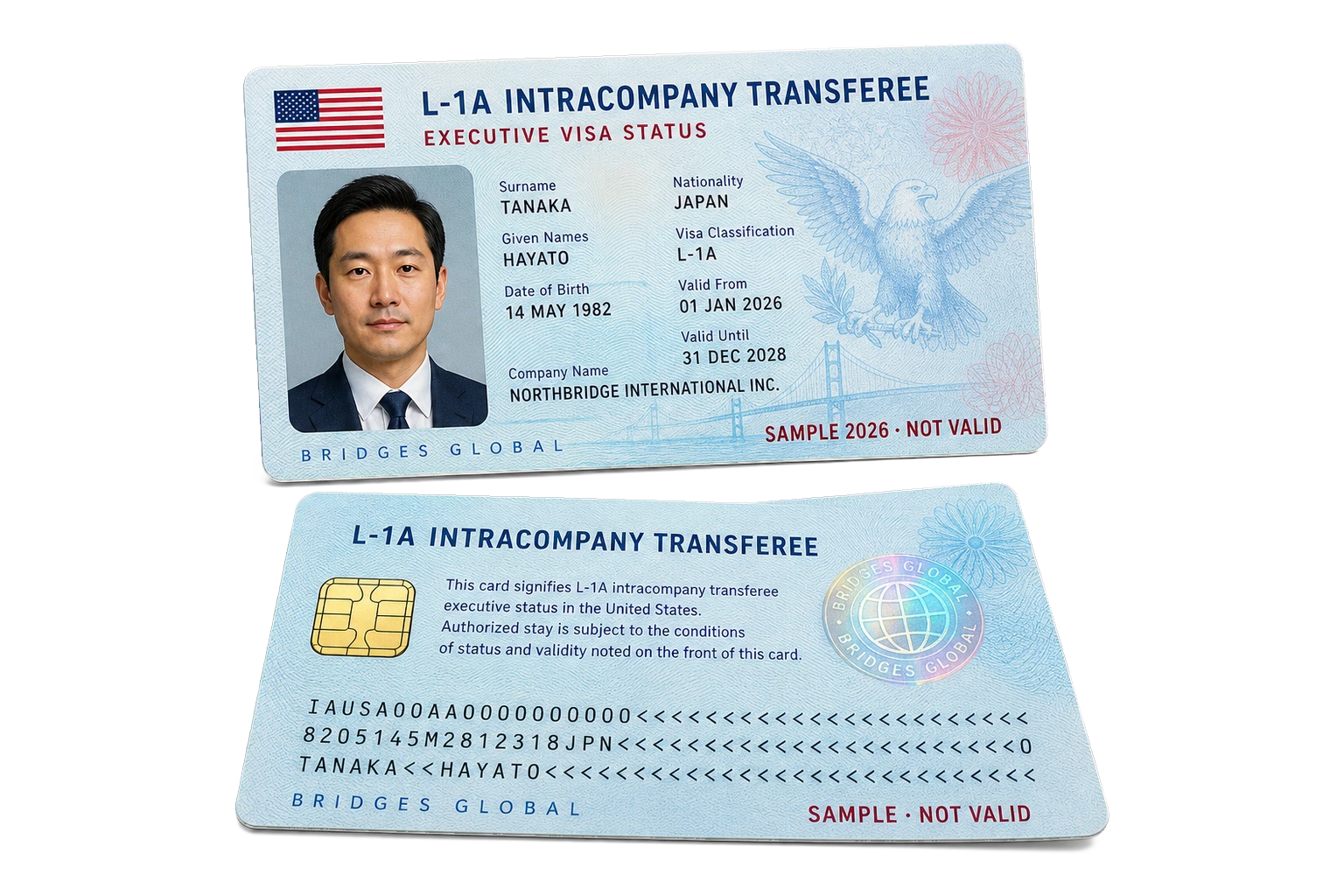
An L-1A visa in a passport and corporate documents
1 yearOf the US office operating before the green card application
3-6 monthsFrom the start of preparation to the visa
up to 7 yearsLiving and working in the US on the visa

01 / About the program

What the L‑1A visa is and how it works

Your company opens an office in the US and sends you to run it. The family comes with you. It is a US work visa for the owner or executive of a company: US law allows such a transfer within one group of companies, so you need no American employer, no large investment and no second passport.

01

You have a company

A working business in any country: trade, manufacturing, services, IT. The company has operated for at least a year, and you have been its owner or executive for at least one of the last three years.

02

You open a company in the US

A subsidiary, a branch or an affiliate under common control. We register it, open a bank account, lease an office and draw up a hiring plan. The law sets no compulsory investment amount.

03

The company sends you to run it

The US company files a petition for your transfer with US Citizenship and Immigration Services (USCIS). Once it is approved, you get the L-1A visa at a consulate, and your spouse and children under 21 get L-2 visas.

04

A green card after one year

Once the US office has operated for a year, you can apply for permanent residence in the category for multinational executives (EB-1C). It needs no labour certification from the US Department of Labor.

02 / What you get

What the L-1A visa gives you

Life and work in the US

You live in America legally and run your own company. The first visa is for one year for a new office and up to three years for an existing one, with renewals up to seven years.

A green card for the family

After a year of the office operating, you apply for permanent residence under EB-1C. Your spouse and children under 21 receive green cards with you.

Your spouse can work

A spouse on an L-2 visa may work in the United States for any employer. Children study at American schools and universities.

No compulsory investment amount

The law sets no threshold. The money goes into running your own office: rent, staff, turnover, not into a fund or a deposit.

Any citizenship

You do not need a passport of a country with a US treaty, as for the E-2 visa. The programme is open to business owners from any country.

The business stays yours

The company at home keeps working while you manage the group from the US. The American office opens access to US clients and dollar settlements.

A preliminary assessment

Check your company

Set out who is applying with you. With the calculation we tell you whether your company fits the category and show the budget for the scenario and the timeline by stage.

Who is applying for the status?

Get the calculation

about a minuteno calls and no obligationsconfidential

  • An assessment of the company against the USCIS requirements
  • The budget for the chosen office scenario
  • A plan of action: where to start
An L-1A visa and the company’s corporate documents

03 / Why people apply

Who the L-1A visa suits

The programme is for people who already have a working business and are ready to develop it in America. If the company is less than a year old or you work in it without a management role, we will find another route: E-2, O-1 or EB-5.

Company owners

You have your own firm with turnover and staff, and you want to move to the US together with the business rather than start from scratch.

Directors

You have run a company or a large division for at least a year. A stake in the business is not required; a management position is.

Companies entering the US

You need an office in America for clients, supplies or dollar settlements. The visa follows from expanding the business.

Families who want to live in America

Children go to an American school or university, the spouse can work, and the whole family lives in the US legally.

Those who cannot use E-2

Your country is not on the US treaty list. L-1A lets you do without a second passport.

Those aiming for a green card

Through L-1A and the EB-1C category an entrepreneur obtains permanent residence without an American employer and without a lottery.

04 / Travel

What the visa gives you for life and travel

L-1A is a non-immigrant visa: it allows you to live and work in the United States, but it is not a permanent status. At the same time it is the one that most often becomes a step towards a green card.

Mode 01

The United States for the term of the status

Residence and work in the American company for the whole time the status is in force. The overall limit is seven years.

Mode 02

Work only in your own company

The status is tied to the employing company. Working for an outside employer is not allowed - unlike a spouse on L-2.

Mode 03

The move to a green card

After a year of the American office working, the EB-1C category opens up. The application is filed while L-1A is still in force.

Mode 04

The rest of the world on your own passport

You travel to third countries on your passport of citizenship: that is what sets the visa regime, not the American visa.

Sources: section 101(a)(15)(L) of the US Immigration and Nationality Act and the USCIS rules on intracompany transfers. The requirements as to the corporate link and the managerial role are checked as at the date of filing.

05 / The composition of the application

Who gets the status with you

L-2 status extends to the executive’s immediate family. Open a row to see the conditions.

  • Any citizenship; a treaty country is not required
  • An executive position in the foreign company for at least a year out of the last three
  • A managerial, not an operational, role in the American office
  • The companies are related: parent, subsidiary, branch or affiliate
  • In a registered marriage
  • Has the right to work in the United States for any employer
  • Unmarried
  • Study in schools and universities in the United States
  • After 21 they move to a ground of their own
  • They are not covered by L-2 status
  • Separate grounds are found for them
  • We go through it individually

06 / Cost

What the L-1A visa costs

You pay no government contribution and invest no fixed amount. The main cost is running your US office: rent, the first staff, working capital. On top come the immigration and consular fees, document preparation and support.

A new office in the United States · the first visa for a year

There is no threshold in money

There is no threshold in money

Holding period The whole time the status is in force

  • The foreign company has worked for at least a year and continues to operate
  • The applicant has worked in it as an executive for at least a year out of the last three
  • The US office is already leased, with a hiring plan and money for the first year
  • The first visa is issued for one year
  • After a year the office is renewed if it genuinely operates: staff, turnover, reporting

The US office already operates · up to three years at once

There is no threshold in money

There is no threshold in money

Holding period The whole time the status is in force

  • The American company has worked for more than a year and has staff and turnover
  • The US company is owned by yours or is under common control
  • The visa is issued at once for up to three years, with renewals up to seven
  • The requirements as to the applicant’s managerial role are the same

Scenario

The main applicant
1
Spouse
0
Children under 21
0
Parents and other relatives
0

The law sets no minimum investment. The budget is made up of the upkeep of the American office, the USCIS and consular fees, preparing the corporate documents and support. This is a preliminary calculation, not a decision of a state authority.

07 / Comparison

L-1A against other American visas

An entrepreneur in the United States has several paths. Here are the main parameters side by side.

L-1AE-2EB-5O-1
Citizenship requirementAnyA treaty countryAnyAny
Investment thresholdNoneNone, in practice from $100,000$800,000None
Leads to a green cardYes, through EB-1CNoYesYes, through EB-1A
The maximum term of the status7 yearsNo limit, with renewalsPermanentNo limit, with renewals
Processing time3-6 months2-4 months2-4 years2-4 months

For citizens of countries without a US treaty, L-1A is usually faster than E-2: there is no need to obtain a second passport first. The data are given as at the date this page was updated.

Full program comparison →

10 / How it works

How the L-1A visa process works

STEP 1

Checking the company and your role

We look at how long the company has operated, its turnover and staff, and your position. We tell you straight away whether you qualify and what needs to be done.

STEP 2

The link between the companies

The US company must be owned by yours or be under common control. We arrange the shareholdings and documents so that this is clear at first glance.

STEP 3

The company in the US

We register the company, open a bank account and lease an office. For a new office, the premises must already be leased at the time of filing.

STEP 4

The business plan

A plan for the first year: whom you hire, who reports to whom, where the money comes from. It proves that the US needs a manager, not a doer.

STEP 5

The petition to US immigration

The US company files a petition for your transfer (form I-129). For an extra fee, processing is expedited: a response within 15 business days.

STEP 6

Visas at the consulate

After approval, you and your family get visas at a US consulate. The interview covers the company, your role and the plans for the office.

STEP 7

Renewal and the green card

After a year the new office is renewed if it genuinely operates. From then on we prepare the green card application under EB-1C.

A step-by-step plan of the process

The same seven steps as a document: what is prepared at each stage, which documents the company needs and what applications are most often refused on.

Download the step-by-step plan
A panorama of San Francisco

Your own company in the US, and your family living in America.

The USAExecutive transferBusiness
Check the company

11 / Our role

Why people arrange the L-1A visa with us

On L-1A what is checked is not the person but the construction: the link between the companies, the executive’s role and the viability of the office. A mistake in the structure costs a refusal.

01

We build the corporate link

Shareholdings, control, ownership documents. USCIS looks at that first, and it is where do-it-yourself applications most often fall apart.

02

We prove the managerial role

The reporting structure, the powers, confirmations from the foreign company. An owner who does the operational work themselves does not fit the category.

03

We prepare the plan for the office

The premises, the hiring, the funding, realistic turnover. For a new office that is the decisive part of the case.

04

We take it through to EB-1C

The visa is an intermediate step. We plan the move to a green card from the outset and make sure the office meets the requirements of the category.

15 / Materials

Useful materials on L-1A

Materials on transferring an executive: the requirements for the companies, the role and the office in the United States.

The main materialPresentation

The L-1A visa for an executive

The presentation gathers the essentials: the requirements for the companies and the position, the scenarios for a new and an existing office, the family composition, the documents and how the work is done.

Inside:

  • which companies fit the category
  • how the managerial role is confirmed
  • how a new office differs from an existing one
  • which family members receive the status
  • which documents will be needed
  • how to move to a green card under EB-1C
  • how work with BRIDGES is organised

PDF · free · current as of August 2026

The time in business, the turnover, the staff, the ownership structure and your role - what USCIS will check.

The list for both companies and for the family, marking what has to be translated and certified.

We calculate the budget: the upkeep of the office, the fees, preparing the petition and the support.

All the materials are updated regularly by our team and are used when supporting BRIDGES clients.

16 / News

What has changed on the L-1A visa

2024-04-01

The USCIS fees for employer petitions were raised, form I-129 and premium processing among them.

2026-11-01

The US State Department visa bulletin for November 2026: in the EB-1 category there is no queue for applicants from most countries. For people born in China and India the queue remains.

Worth having

Download the L-1A visa checklist

The short document we give clients before the start: the requirements for the companies and the role, the office scenarios, the cost structure and the stages - in one list, with nothing padded.

Inside the document

  • The requirements for the companies and the managerial role
  • A new office and an existing one: how they differ
  • The current conditions for 2026

We will send it after a short form - no call or obligation.

17 / Questions

Answers to common questions

A US work visa for the owner or executive of a company. Your company opens a branch in America and sends you there as its head. You and your family live in the United States, and after a year of the office operating you can apply for a green card.

If the company is less than a year old, if you are a rank-and-file employee in it, if the business exists only on paper, or if you plan to do all the work in the US yourself without staff. In these cases we find another route: E-2, O-1 or EB-5.

No. Unlike E-2, L-1A does not require citizenship of a country with a US treaty. For citizens of countries without such a treaty it is usually a more direct route: there is no need to obtain a second passport first.

The law sets no compulsory threshold. The money goes into developing your American office: rent, staff, equipment, turnover. USCIS looks not at the sum but at whether the activity is real.

The foreign company must have worked for at least a year and continue to operate after the transfer. Between it and the American company there must be a corporate link: parent, subsidiary, branch or an affiliate structure under common control.

At least a year of work in the foreign company in an executive position within the last three years, and a managerial role in the American office. An owner who does all the operational work themselves does not fit the category.

For a new office the first visa is for one year, then renewals of two years each, totalling up to seven. If the American company has already worked for more than a year, the visa is issued at once for up to three years.

Yes. After a year of the American office working, the EB-1C category for executives opens up: it runs without labour certification and is usually faster than other work categories. The application is filed while L-1A status is in force.

Yes. The spouse receives L-2 status and has the right to work in the United States for any employer. Children under 21 study in schools and universities.

The real work: the premises, the staff hired, the turnover, the reporting and the fact that you genuinely direct the office rather than doing all the work yourself. Renewing a new office is the riskiest moment, and we prepare for it from day one.

3-6 months in the ordinary course. With premium processing USCIS answers within 15 working days, but preparing the corporate pack still takes most of the time.

The status is tied to the company: if the office closes or stops working the visa is lost. That is why from the outset we build the office as a working division, not as a formality for a visa.

INITIAL ASSESSMENT

Tell us what outcome your family needs

We will design a solution for your case, choose the country and the right status, and take the whole process through to the result.

Or message us on WhatsApp or Telegram

Anna Kovalevskaya, lead lawyer at BRIDGES
Anna KovalevskayaLead lawyer, citizenship and residency, 12 years of practice