Updated
SRV-CR-CD
Corporate documents
A company’s corporate documents for the bank, the deal and the check
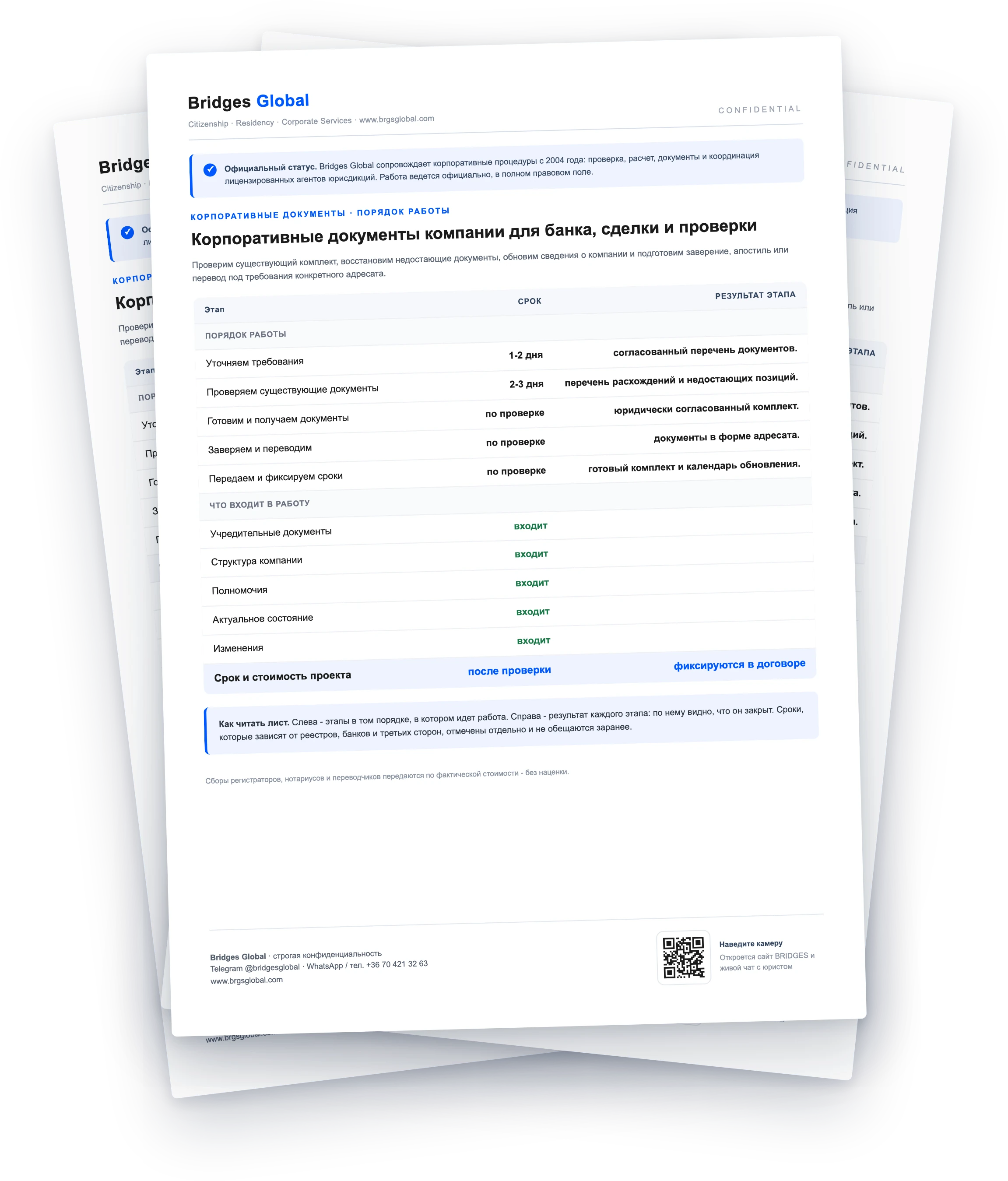
We will check the set you have, recover the documents that are missing, update the details of the company and arrange the certification, the apostille or the translation to the requirements of the particular recipient.
- We work with companies registered through other providers
- We first establish the requirements of the bank, the notary or the counterparty
- We hand over the finished set and a calendar for keeping it current
01 / Situations
A company has to evidence its structure and its authority
Documents are remembered at the moment they are already needed: a bank, a notary or the other side of a deal has asked for the set. The exact composition depends on to whom and for what purpose it is given.
The bank has asked for documents
The registration of the company, the ownership structure, the directors, the signatory’s authority and the current standing all have to be evidenced.
A deal is being prepared
The buyer, the seller, the notary or a legal adviser checks the company and the authority of those signing the contract.
The members or the director are changing
The changes have to be drawn up in resolutions and recorded in the corporate registers and, where provided for, with the registrar.
A partner is joining the company
The shares and votes, the procedure for decisions, the exit terms and the resolution of disputes all have to be fixed.
The documents have aged
Extracts and certificates may not meet the recipient’s requirements as to the date of issue, and the charter may not reflect the latest changes.
The documents are lost or incomplete
The corporate history has to be restored: certified copies and certificates obtained from the registrar or the current agent.
02 / The destination
First we establish who will be checking the documents
The recipient settles what the set contains. Before ordering extracts, an apostille and a translation we agree the list and the form of the documents — otherwise obtaining them and legalising them has to be paid for twice.
Opening or reviewing an account
The registration of the company, the owners, the directors, the signatory’s authority, the character of the business and the current standing.
The other side and its lawyers
The ownership structure, the corporate resolutions, the signatories’ authority, the restrictions and the history of changes.
A notarial act and the register
The form of the document, the date of issue, the certification, the legalisation, the translation and whether an original is needed.
An incoming member or investor
The members’ rights, the shares and votes, the way the company is run, the restrictions and evidence of authority.
03 / If the set is not assembled for the recipient
A set is rejected not over the substance of the business but over discrepancies and dates
A set that looks complete comes back when the documents contradict each other, were issued long ago or are certified in the wrong form. Every further round means weeks and paying for the legalisation again.
The details do not match
The charter, the registers, the extracts and the recipient’s form give a different structure of the company or a different set of directors.
The document has aged
The bank, the notary or the counterparty requires an extract or certificate issued within a particular period.
The authority is not evidenced
The documents do not show who may sign the contract, open the account and deal with the company’s assets.
The wrong legalisation
The apostille, the consular legalisation, the notarial certification or the translation is in a form the recipient does not accept.
The changes were not carried through
The resolution was passed but is not reflected in the corporate registers or in the registrar’s records.
The set was assembled with no list
The documents were obtained and legalised before the exact list of the bank, the notary or the other side of the deal was known.
04 / Diagnosis
What we check in the set you already have
The order of the check is the same in every jurisdiction — from the composition to the form of certification.
The composition
Which documents exist and which are missing for the task stated.
How current they are
The date of issue of the extracts and certificates against the recipient’s requirements.
The structure
Whether the members, the shares and the directors match across every document.
Authority
Who may sign and whether that is evidenced by a resolution or a power of attorney.
The history of changes
Whether every resolution is reflected in the registers and with the registrar.
The form
An original, a certified copy or an electronic extract — what the recipient will accept.
Legalisation
Whether an apostille or consular legalisation is needed or certification is enough.
Translation
Whether a sworn or notarised translation is required and into which language.
The check runs on copies: the originals are needed later and not for every item.
05 / The limits of the service
What we do not do
The line runs along the company’s actual circumstances.
We do not date resolutions back
A resolution dated to a past period and signed today is a forgery. Documents are drawn up with the current date, and the reason, where it fits, is explained in the text itself.
We do not create documents that misstate the structure
The set has to reflect the real members, directors and authorities. Anything else is not our work.
We do not conceal beneficial owners
A nominee director is possible as a management decision, but the ultimate beneficial owner is disclosed to the bank and the registrar on their requirements.
We do not substitute signatures
Documents are signed by the company’s authorised persons. Where someone has to be present or sign before a notary, we plan that in advance.
We do not certify documents ourselves
Notarial acts, apostilles and consular legalisation are carried out by the authorised persons and bodies. We answer for the composition, the form and the timing.
We do not guarantee the recipient’s decision
Accepting the set is the right of the bank, the notary or the counterparty. We answer for preparing it to the requirements they gave.
We bring the documents into line with the company’s actual structure and the requirements of the particular task.

A corporate set has to evidence one consistent picture of the company.
06 / The corporate set
What the corporate set covers
A set is not a folder with the certificate of incorporation in it but a body of documents each of which proves something: who owns the company, who may sign and what resolutions were passed.
The constitutional documents
The certificate of incorporation, the charter in its current form, the memorandum of association where the jurisdiction uses one, and the documents on the initial capital.
The structure of the company
The register of members, the register of directors, the details of beneficial owners, evidence of the shares and of any encumbrances.
Authority
The resolutions of members and directors, powers of attorney, evidence of the right to sign for the particular act.
The current standing
A register extract, a certificate of good standing, a certificate of incumbency and the other certificates the jurisdiction uses.
Changes
Appointing and changing directors, transferring shares, changing the address and the charter, increasing or reducing the capital.
Certification and translation
Notarial certification, an apostille or consular legalisation and a translation — in the form the recipient requires.
The composition depends on the jurisdiction, the structure of the company and the recipient’s requirements: not every document exists or is required everywhere.
07 / The result
What you receive when the work is finished
The set is assembled for a particular business act and handed over in the agreed form.
Documents checked
- A list of documents for the particular task
- Corporate documents updated and restored
- Fresh extracts and certificates of the company’s standing
- Resolutions of members and directors drawn up
- The discrepancies between documents cleared
Certification and translation
- Notarial certification where it is required
- An apostille or consular legalisation where they apply
- A translation in the format the recipient requires
- The form of the document confirmed before it is ordered
- The translation checked against the original before handover
Handover and control
- A schedule of the documents handed over
- The electronic set on the day it is ready
- The originals, where they were ordered
- A list of how long the certificates remain valid
- A calendar for updating the documents in future
The exact composition is confirmed after the jurisdiction and the recipient’s requirements have been checked.
08 / Timing and cost
What the timing and the cost depend on
After the preliminary check you receive the list of documents needed, a note of what can already be used, the list of items to be updated or restored, the requirements as to certification and translation, a guide to the timing and a quote by item.
The composition of the set
One power of attorney or a full review with everything re-executed are fundamentally different amounts of work.
The jurisdiction and the registrar
Registrars’ fees, the cost of extracts and the time they take to issue differ several times over between countries.
Certification and translation
An apostille is usually faster and cheaper than consular legalisation, and a sworn translation costs more than an ordinary notarised one.
Urgency and restoration
Registrars’ expedited tariffs, the delivery of originals and the restoration of missing documents are quoted separately.
Registrars’, notaries’ and translators’ fees are passed on at their actual cost — with no mark-up.
09 / How it works
How we work
We start not by ordering certificates but with to whom and for what the documents are presented.
We establish the requirements
We settle the recipient, the purpose, the deadline, the composition and the format of the set. The result: an agreed list of documents.
1–2 days
We check the documents that exist
We compare the details of the company, the dates, the authorities and the corporate history. The result: a list of discrepancies and missing items.
2–3 days
We prepare and obtain the documents
We order the extracts and certificates from the registrar, prepare the resolutions, the registers and the powers of attorney and arrange the signing. The result: a legally consistent set.
We certify and translate
We arrange the notarial certification, the apostille or consular legalisation and the translation where they are required. The result: the documents in the recipient’s form.
We hand over and record the dates
We hand over the electronic versions and the originals and note how long the certificates remain valid. The result: a finished set and a calendar for updating it.
We do not set third parties’ deadlines: the extracts and certificates are issued by the registrar, the certification is done by a notary, the apostille and consular legalisation by the authorised bodies and the translation by a sworn or notarised translator. BRIDGES GLOBAL answers for the composition, the form, the sequence and the control of deadlines.
10 / Preparation
What we will need from you
The fuller the starting material, the less has to be restored.
The documents you have
Everything there is on the company, earlier versions of the charter and old resolutions included.
The task and the recipient
What the set is being prepared for and who will check it: a bank, a notary, the registrar, a counterparty or a partner.
The recipient’s requirements
The bank’s letter or the notary’s list. An exact list saves weeks and the cost of legalising twice.
The current structure
Who owns and runs the company now, the latest changes and any arrangements not yet formalised included.
The country of use
Where the documents will be presented — the apostille, the consular legalisation and the language of translation follow from that.
The deadline and the form
By when the set is needed and whether originals are required or electronic versions are enough.
If there is no exact list from the recipient, we help draft the request and settle a base set to agree with them.
11 / Team
Who runs the work
The work is run by a BRIDGES GLOBAL lawyer, the tax part is covered by our adviser, and one coordinator holds the deadlines with the registrar, the notary and the translator.
 Martin DvorzhakDocument Processing SpecialistChecking the set, the discrepancies, restoring and preparing the documents
 Tomas LinderCompliance and AML OfficerThe ownership structure and disclosure: what the documents show a bank and the tax authorities
 Irina ShternHead of Hungary OfficeCoordinating the registrar, the notary, the apostille and the translation, the deadlines and the handover
 Karim NaserHead of Istanbul OfficeCoordinating the parties and closing the deal
13 / Questions
Answers to common questions
Usually the constitutional documents, the registers of members and directors, the resolutions of the company’s organs and fresh certificates of its standing. There is no single standard: the set depends on the jurisdiction and on whom it is presented to. So we first establish the list with the recipient and then assemble the set.
As a rule yes: certified copies and extracts are ordered from the registered agent or the jurisdiction’s register. What is available depends on the country and on whether a current agent runs the company. It has to be started early — restoration takes longer than obtaining an ordinary certificate.
Yes, that happens often. We start with a check: we look at the set you have, find the discrepancies with the actual structure and the gaps, then put the documents in order and go on keeping them current.
The exact composition comes from the bank itself — in a compliance letter or in its list of requirements for opening an account. If there is no such list, we help draft the request and settle a base set, which is then agreed with the bank before the extracts and the legalisation are ordered.
The certificates themselves often have no formal validity period, but recipients almost always require a recently issued document. The particular period is set by the bank, the notary or the counterparty, so ordering certificates in advance “to have them ready” is usually pointless.
The charter settles the internal workings of the company: the organs, the powers, the way decisions are taken. The memorandum records the founders’ agreement on creating the company. In some jurisdictions it is one document, in others two, and in some there is no memorandum at all.
It is the registrar’s certificate that the company exists and has no breaches that would make it liable to be struck off. It is asked for when the company has to be shown to be active: on opening an account, in a deal or on a counterparty’s check. The certificate does not exist in every jurisdiction, and its name and content differ.
It is the registered agent’s certificate of who, as at the date of issue, is the director, shareholder and authorised signatory of the company. Banks and notaries ask for it most often, when authority has to be evidenced. The document is used in jurisdictions where the corporate registers are kept by an agent rather than a public register.
It depends on the document and the recipient. In many jurisdictions the resolutions of a company’s organs are made in simple written form. A notary is usually needed for powers of attorney, for changes registered in the register and for transactions in shares in a number of countries. We establish the requirement before the document is prepared.
An apostille is simplified legalisation for the countries of the 1961 Hague Convention: it is affixed in the document’s country of origin and accepted in another member state. If the country of use is not a party to the convention, consular legalisation applies — it passes through several bodies and takes longer. There are also cases where a treaty between the countries means no legalisation is needed at all.
In many jurisdictions electronic extracts have full force, and part of the set can be obtained electronically. But banks, notaries and registrars often require certified originals, so we confirm the form with the recipient before ordering.
Often yes — under a power of attorney and by exchanging signed documents. But in a number of jurisdictions and for particular acts, especially transactions in shares, a signature before a notary is required. That comes out when the requirements are established, so that attendance can be planned in advance.
First establish which structure is the actual one and which is reflected in the documents and with the registrar. Then the discrepancy is cleared in order: a resolution of the company’s organ, changes in the corporate registers and, where provided for, with the registrar. Only after that does it make sense to order certificates and legalisation.
What can be speeded up is the part that depends on us: the check, the preparation of the resolutions and the coordination. The times of the registrar, the notary and the body affixing the apostille depend on the country and its workload, and some of them allow an expedited tariff. We give a realistic schedule after checking the set, not before.
INITIAL ASSESSMENT
Tell us what outcome your family needs
We will design a solution for your case, choose the country and the right status, and take the whole process through to the result.