Updated
SRV-CS-AC
Running companies
Accounting and reporting for a foreign company
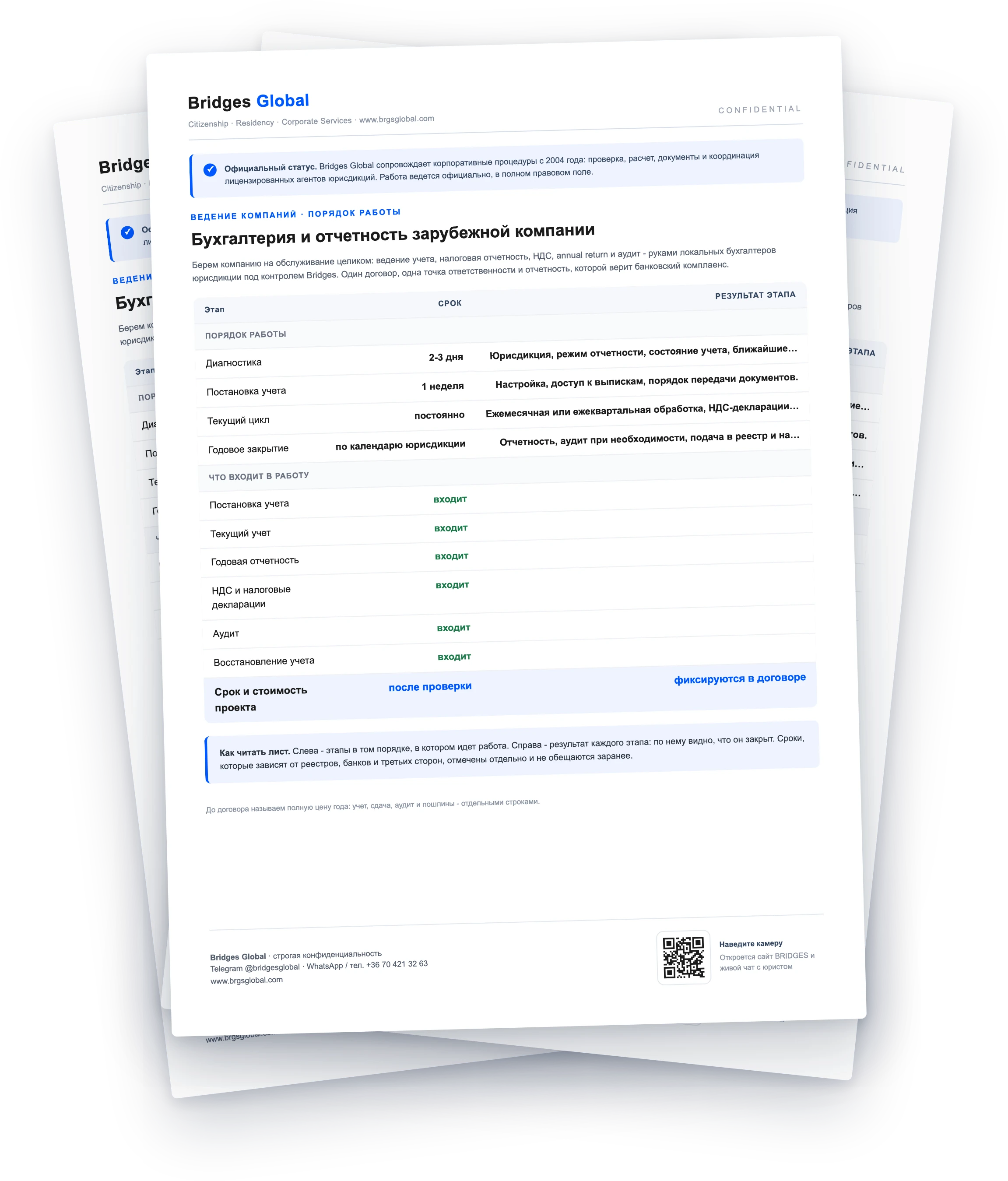
We take the company on whole: bookkeeping, tax reporting, VAT, the annual return and the audit — done by local accountants in the jurisdiction under BRIDGES’ control. One agreement, one point of responsibility and reporting that bank compliance believes.
- Local accountants in the jurisdiction — under BRIDGES’ control
- Filed on time, by the calendar rather than on a reminder from the registrar
- Reporting that bank compliance accepts
01 / The service
What this service is
Accounting for a foreign company is not only the annual report. It is correct source documents, bookkeeping to the jurisdiction’s standards, VAT where there is any, an audit where it is compulsory, and filing on time. Jurisdictions fine companies for unfiled reporting and take them out of good standing, and banks close their accounts.
Bookkeeping by the jurisdiction’s rules
Every country keeps accounts to its own standards and in its own reporting currency. We set the bookkeeping up as the company’s jurisdiction requires, not “the way it is usually done”.
Reporting as an argument for the bank
A bank’s compliance regularly asks for the financial statements. Tidy accounts filed on time are half the answer to any question about the business.
An audit without panic
Where an audit is compulsory — Cyprus, Singapore, Hong Kong and others — we prepare the company and see the audit through: it is the accountant who answers the auditor, not the owner.
Nil is a report too
A company with no operations still has to report almost everywhere. A nil return is simpler and cheaper to file, but filed it must be — the fines are the same otherwise.
02 / Why BRIDGES
International accounting with no gap between countries
Our model is not “an outsourced accountant” but an infrastructure: the work is done by a local specialist in the jurisdiction, while BRIDGES controls the timing and the quality.
Jurisdictions
Local accountants and tax advisers in the same places where we register and run companies.
Point of responsibility
You do not coordinate the accountant, the auditor and the lawyer yourself — a BRIDGES coordinator answers for the joints.
Reporting for compliance
We prepare the documents not only for the tax authority but in the format the banks ask for.
The BRIDGES standard
The local specialist does the work — BRIDGES checks the timing, the completeness and the quality against one standard.
The duties for the year ahead
The filings, the renewals and the audit thresholds sit in the calendar: you learn of a deadline in advance, not on a demand from the registrar.
For every jurisdiction
There is no need to sign a separate contract with an accountant in each country: the work and the responsibility are covered by one agreement.
03 / Situations
When this service is needed
What people come to us with most often.
A filing deadline is coming
The company is registered and the first reporting period is ending — the bookkeeping has to be set up and filed without fines.
The bank has asked for the accounts
Compliance wants financial statements and nobody kept the books. We reconstruct them and prepare the set.
Filings have piled up
Several periods missed, fines, the standing at risk — we reconstruct the bookkeeping for past years and catch up with the schedule.
A compulsory audit
The jurisdiction requires audited accounts — the bookkeeping, an auditor and support through the audit are all needed.
VAT and operations in the EU
The company has entered European turnover: VAT registration, returns, VIES — a constant cycle that cannot be missed.
The audit threshold is close
The turnover has approached the compulsory audit threshold and the accounts have to be prepared in auditable form from the outset.
04 / Honest limits
When the service is not needed
Honestly — so that you do not pay for what is not needed.
The jurisdiction requires no filing
In a number of island jurisdictions keeping internal records without filing is enough. Then we will offer only a minimal format for keeping the records.
You already have a local accountant
If your accountant is already working in the company’s country, we will not duplicate them — where needed we will check the work and help with the difficult parts.
The company is closing
Before a winding-up final accounts are needed — that is one-off work within the liquidation, not an annual agreement.
We do not keep books after the fact “as convenient”
We reconstruct periods from the source documents. There will be no entries in the accounts with nothing behind them.

A bank believes filed accounts, not promises. Our work is that the company always has them in order.
05 / Scope of work
What the service covers
The full cycle of bookkeeping — from the source documents to the report filed.
Setting up the bookkeeping
The chart of accounts, the reporting currency, the recognition rules — to the standards of the jurisdiction.
Running bookkeeping
Processing the statements and source documents, the ledger, reconciliation with counterparties.
The annual accounts
Preparing the financial statements and the annual return and filing them with the register and the tax authority.
VAT and tax returns
VAT registration, periodic returns, the jurisdiction’s corporate income tax computations.
The audit
Choosing the auditor, preparing the set, answering the audit’s requests.
Reconstructing the books
Going through past periods from the statements and documents, filing the arrears, dealing with the fines.
06 / What you get
What you have in hand
Not “an accountant’s services” but a defined result on a calendar.
Every month
- The bookkeeping processed from the statements and source documents
- Reconciliation of the accounts and counterparties
- A list of questions on unusual operations
- A check on the duties coming up
Every quarter
- VAT returns where the company is registered for VAT
- A short summary of the state of the books
- The tax calendar for the next quarter
Every year
- Financial statements to the jurisdiction’s standards
- The annual return and its filing with the register
- The corporate income tax return
- The set for the audit where one is compulsory
The exact composition depends on the jurisdiction and the company’s regime — it is fixed in the agreement as a list.
07 / Cost
What the cost depends on
The cost is worked out a year ahead after the company is reviewed. The invoice follows a clear model: base bookkeeping + the volume of operations + VAT + the payroll block + the annual return + the audit where needed.
The number of operations
Ten payments a month and a thousand are different amounts of processing. The rate is tied to the actual volume.
The jurisdiction and the standards
The requirements as to bookkeeping, language and filing format differ from country to country.
VAT and audit
VAT registration and a compulsory audit add constant cycles of work.
The state of the books at the start
Reconstructing past periods is quoted separately — by the volume of what was missed.
Before the agreement we give the full price for the year: the bookkeeping, the filing, the audit and the duties as separate lines.
08 / How it works
How we work
Set it up once — after that the cycle runs itself.
The review
The jurisdiction, the reporting regime, the state of the books, the nearest filing deadlines.
2–3 days
Setting up the bookkeeping
The set-up, access to the statements, the way documents are handed over.
1 week
The running cycle
Monthly or quarterly processing, VAT returns to the schedule.
ongoing
The year-end close
The accounts, the audit where needed, filing with the register and the tax authority.
to the jurisdiction’s calendar
The filing deadlines are set by the jurisdiction — we fix the calendar for your company at the start of the work.
09 / Preparation
What we will need from you
Above all a flow of documents with no delays.
Access to the statements
The bank statements for the period are the basis of the bookkeeping. We will set up a regular export.
The source documents
Invoices, contracts, acts on the transactions — electronically, as they appear.
Explanations of operations
The purpose of unusual payments — briefly, when the accountant asks.
Signatures on time
The annual accounts are signed by the director — we send them for signature in advance.
10 / Team
Who runs the work
An accountant in the jurisdiction under the control of a tax adviser.
 Tomas LinderCompliance and AML OfficerTax control and the reporting standards
 Martin DvorzhakDocument Processing SpecialistThe flow of documents and the filing calendar
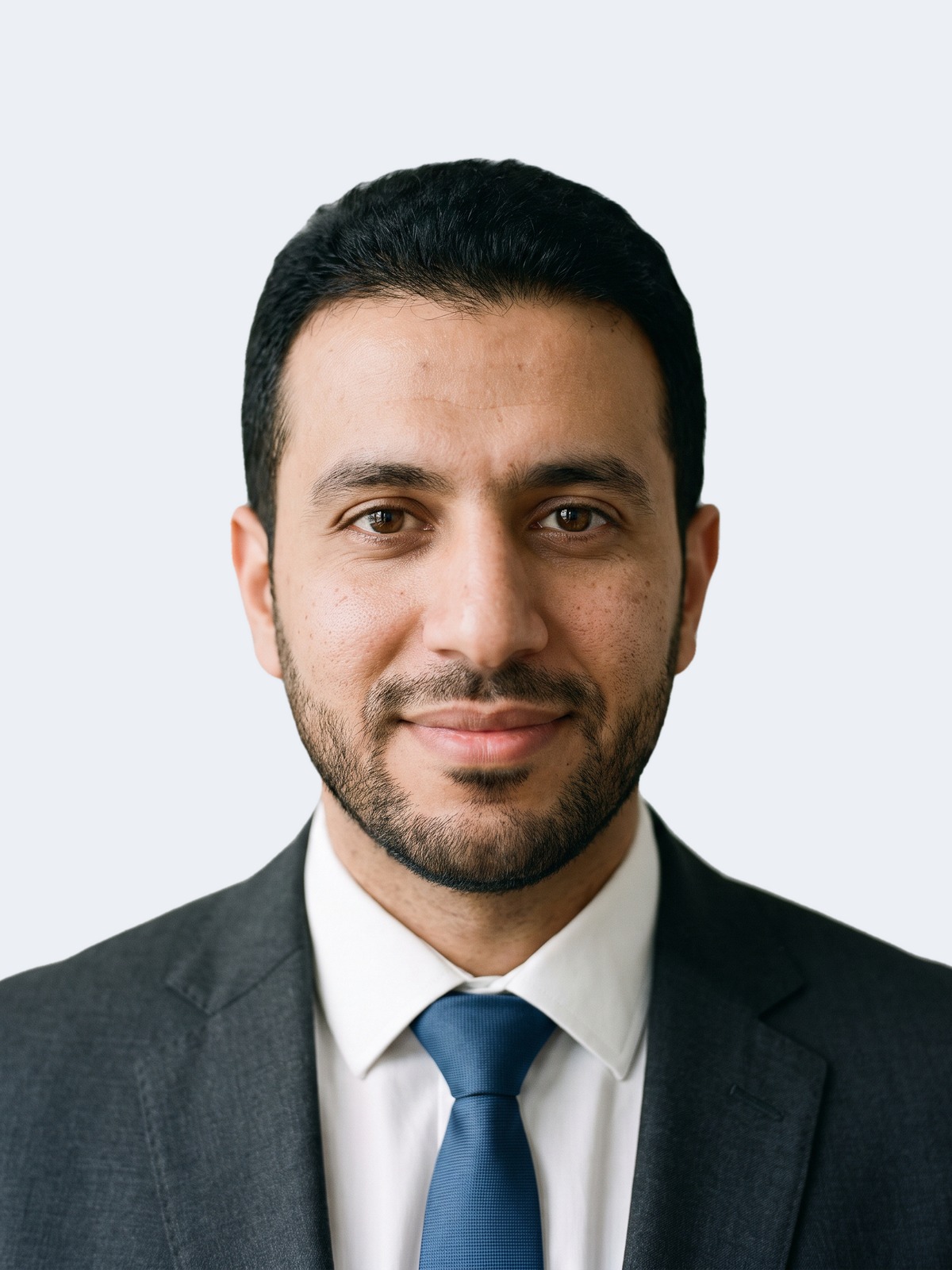 Karim NaserHead of Istanbul OfficeSignatures, registers and dealings with the agent
 Daniel KovachSenior International Law AttorneyRepatriation and archive documents
12 / Questions
Answers to common questions
In most jurisdictions yes: a nil return or a declaration of dormancy is filed. Missing a nil return is fined just as missing an ordinary report is.
We reconstruct them: we raise the bank statements and documents, assemble the bookkeeping for the missed periods, file the arrears and deal with the fines. It is standard, if laborious, work.
A compulsory audit exists in Cyprus, Singapore and Hong Kong among others — with thresholds and exemptions by the size of the company. We will say exactly for your jurisdiction at the review.
Yes. A frequent arrangement: the local specialist keeps the source records, we control the standards, prepare the annual accounts and answer for the filing.
Fines, the loss of good standing, in a number of countries personal liability for the director and in the end the company being struck off the register. A bank that sees unfiled accounts usually freezes the relationship.
Yes — where the company comes under the duty: turnover in the EU, local sales, imports. The registration, the periodic returns and the reconciliations are part of the service.
In the currency the jurisdiction’s rules set — usually the local currency or the currency of the constitutional documents. Operations in other currencies are translated under the rules of the standard.
Usually yes: reconstructing a year of bookkeeping from the statements takes from two to six weeks depending on the volume. We tell the bank the timeframe at once — that is better than silence.
Jurisdictions exchange financial information under the automatic exchange standards, and the CFC duties require the company to be declared at home. We work from transparency and help you meet the obligations rather than hide from them.
Usually five to seven years depending on the jurisdiction. We keep an electronic archive for each company — on an inspection or a change of provider everything is retrieved in minutes.
INITIAL ASSESSMENT
Tell us what outcome your family needs
We will design a solution for your case, choose the country and the right status, and take the whole process through to the result.