

Updated

DM-CIP

Citizenship by investment

Dominica citizenshipby investment

The lowest entry threshold of any Caribbean program: from $200,000. Either a contribution to the government fund or an approved property you can resell after three years. The program has been running since 1993.

  • Program running since 1993
  • We check eligibility by nationality first
  • Two routes: fund or real estate
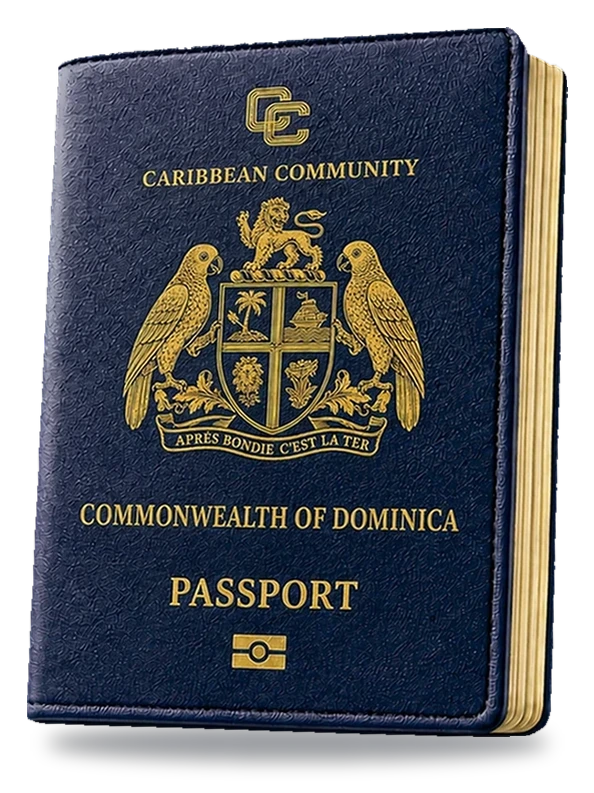
Passport of the Commonwealth of Dominica
$200,000Investment from
3-4 monthsProcessing time
SchengenVisa-free entry

01 / About the program

What this program is

Dominica has granted citizenship for an economic contribution since 1993 — one of the two oldest programs in the world. It runs under the Citizenship Act and the Citizenship by Investment Regulations 2024, and decisions are made by the Citizenship by Investment Unit. There are two routes: a non-refundable contribution to the government fund, or the purchase of a property from the approved list.

01

The lowest threshold in the Caribbean

Investment starts at $200,000 for a single applicant. Regional neighbours ask for more: Antigua from $230,000, Grenada from $235,000, St Kitts from $250,000. The rights attached to the passport are broadly comparable.

02

Fund or property — a real choice

The contribution to the Economic Diversification Fund is not returned, but it is simpler: one payment, no transaction. An approved property costs from $200,000 plus a government fee, yet it stays your asset — you can sell it after three years. That is the shortest holding period in the region.

03

A family of four at one price

The fund contribution does not change while the application covers the main applicant and up to three dependants: $250,000 for a couple and for a family of four alike. Surcharges start with the fifth person - $25,000 for each dependant under 18 and $40,000 for each dependant aged 18 or over.

04

Filing only through an authorised agent

The CBIU does not accept documents directly from applicants — the application is filed by an agent from the official list. Every applicant aged 16 or over attends a mandatory interview, usually by video call, and is screened by independent due diligence firms.

02 / What you get

What a Dominica passport gives you

Schengen without a visa

The visa waiver agreement with the European Union is in force: short trips across the Schengen area need no prior paperwork. This is the key difference from Pacific programs. The regime rests on an agreement the EU is currently reviewing — see the travel section below.

Citizenship for life, passed on to children

The status is granted for life and passes to children born after citizenship is obtained. There is no residence requirement to keep it.

No tax on worldwide income

Dominica does not tax income earned outside the country and levies no wealth, inheritance, gift or capital gains tax. Tax residency is a separate matter and does not follow from citizenship.

Three generations in one application

A spouse, children under 18, children aged 18-30 in full-time education, children over 18 with disabilities, plus parents and grandparents over 65 who are supported by the applicant. All receive status at the same time.

Dual citizenship allowed

You do not have to renounce your current passport — Dominican law expressly allows multiple citizenship, and the country does not report the grant to third parties.

A ten-year passport

The biometric passport is issued for ten years, and for five years to children under 16. Renewal is handled by the passport office or any Dominican consulate and requires no second investment.

Preliminary assessment

Find out whether the program fits you

Set out who applies with you — the cost on this page recalculates instantly, and in the full quote you get a breakdown for both routes, an honest read on your chances and a plan of action.

Who is applying for citizenship?

Get the calculation

about 1 minuteno calls, no commitmentconfidential

  • Exact cost for both routes
  • An honest read: do you qualify or not
  • A plan of action: where to start
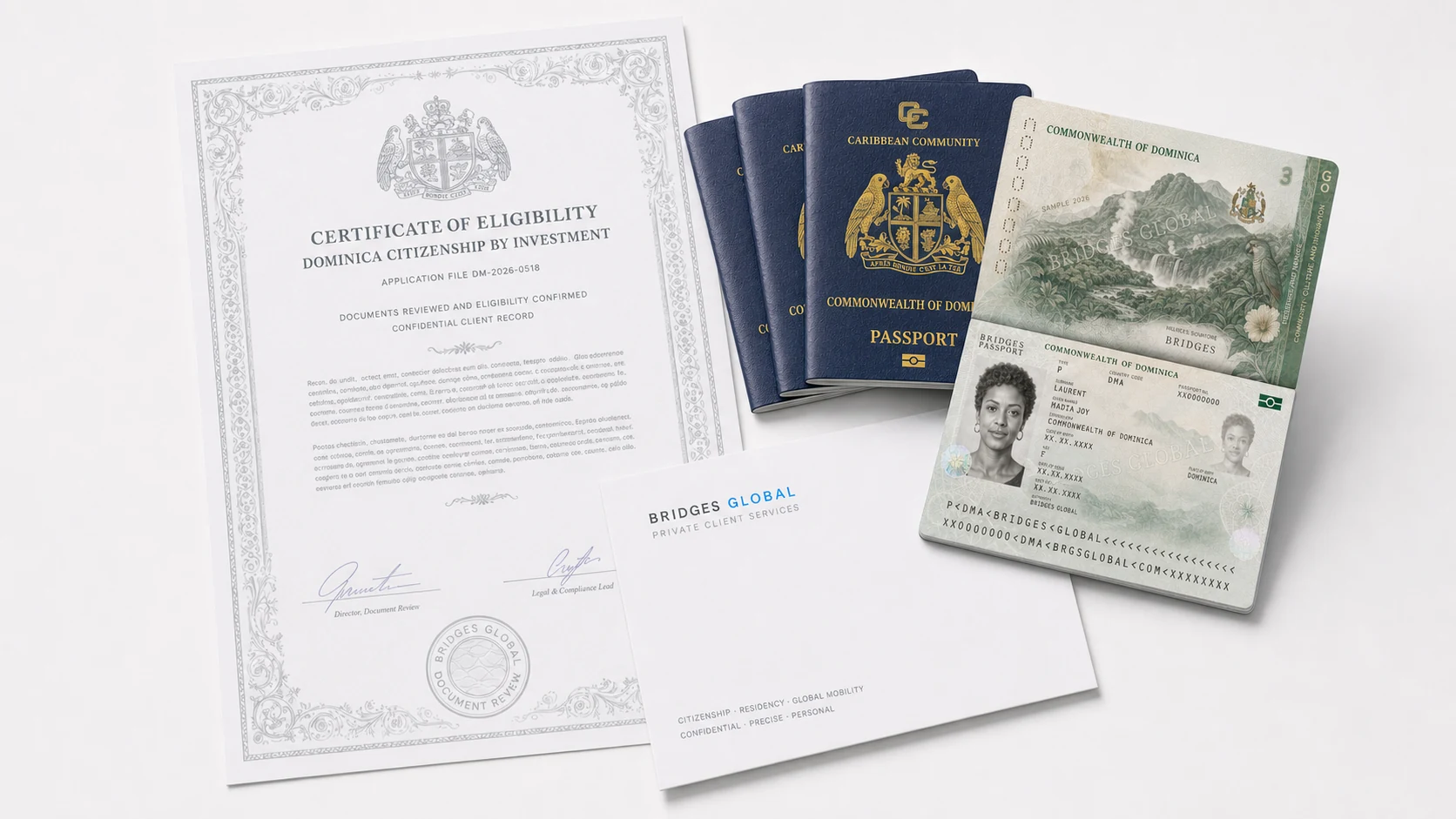
Document pack for the Dominica citizenship by investment program

03 / Why people apply

Why people get a Dominica passport

Nobody buys Dominica to move there — the island has around 70,000 residents and no direct flights from Europe. People buy it as the most economical entry into Caribbean citizenship: a second document with Schengen access, for a predictable sum, under a transparent government procedure.

When the budget is the constraint

This is the cheapest route to a Caribbean passport: $200,000 against $230,000-250,000 next door. For a family of four the gap with St Kitts runs into six figures, with a comparable set of rights.

When Schengen matters

Pacific programs do not give Schengen — Vanuatu lost its EU visa waiver in December 2024. If European travel is the priority, a Caribbean passport answers it, and Dominica is the cheapest way into that group.

When the money should stay in an asset

The real estate route does not burn the investment: an approved property stays in your name and can be sold after three years. Dominica has the shortest holding period in the region — five years in Antigua and Grenada, seven in St Kitts.

Companies and accounts abroad

A new passport is used to register companies and open corporate accounts where certain jurisdictions now meet resistance. A second passport does not remove compliance checks and does not hide your first citizenship — every citizenship is disclosed to the bank — but the choice widens.

Parents and grandparents in the same file

Few programs accept grandparents. Dominica includes dependent parents and grandparents over 65 — both the applicant’s and the spouse’s. For large families this is often the deciding argument.

A plan B for the family

Insurance for the day a single document stops working: loss, a visa refusal, a change of climate in your country of residence. The status is for life and passes to children born afterwards.

04 / Applicants

Who comes with you

Who files on their own and who can be included in the same application — everyone files together and receives status on the same day. Open a row to see the conditions for that category.

  • Aged 18 or over
  • No criminal record beyond a minor offence
  • No visa refusal from the EU, the UK or a country Dominica has visa-free travel with
  • A confirmed lawful source of funds
  • A registered marriage
  • Included in the same application as the main applicant
  • Goes through due diligence and the interview on the same terms
  • Biological or legally adopted children of the applicant or the spouse
  • No due diligence and no interview — neither fee is charged
  • The passport is issued for 5 years
  • Biological or legally adopted children of the applicant or the spouse
  • Go through due diligence and the mandatory interview
  • Counted as under-18 dependants for the contribution surcharge
  • Children aged 18-30 in attendance at a recognised institution of higher learning and fully supported
  • Unmarried daughters under 25 living with the applicant and fully supported
  • Children aged 18 or over who are physically or mentally challenged and fully supported
  • Parents and grandparents of the applicant and of the spouse
  • Included where they are substantially supported by the applicant
  • Go through due diligence and the mandatory interview

05 / Cost

What Dominica citizenship costs

Two government routes. The investment is shown large, the all-in figure with fees and paperwork sits below it. Both are recalculated for the family composition you set above.

EDF fund · non-refundable

from$200,000

Contribution · 1 person in the application

All-in with fees from $212,000

The contribution does not change while the file covers the applicant and up to three dependants. Each further person adds $25,000 if under 18 and $40,000 if aged 18 or over. Due diligence and the interview apply to everyone aged 16 or over; children under 16 pay neither fee.

Contribution to the Economic Diversification Fund
$200,000
Due diligence
$7,500
Mandatory interview
$1,000
Application processing
$1,000
Certificate of Naturalisation
$500
Translations, notarisation, apostille
$2,000
Total all-in
from $212,000
Send me this quote WhatsApp Telegram PDF

Real estate · the investment stays an asset

from$275,000

Investment · 1 person in the application

All-in with fees from $287,000

The government fee is $75,000 for a single applicant and $100,000 for an applicant with dependants. Each further person adds $25,000 under 18 and $40,000 from 18. The property stays your asset: it can be sold after 3 years, or after 5 years if the buyer is also a program applicant. The resale price is not guaranteed; taxes and running costs are not included.

Property from $200,000 plus the government fee
$275,000
Due diligence
$7,500
Mandatory interview
$1,000
Application processing
$1,000
Certificate of Naturalisation
$500
Translations, notarisation, apostille
$2,000
Total all-in
from $287,000
Send me this quote WhatsApp Telegram PDF
Main applicant
1
Spouse
0
Children under 16
0
Children aged 16-17
0
Dependants aged 18 and over
0
Parents and grandparents over 65
0

A preliminary calculation based on the official CBIU fee schedule, verified on 9 August 2026. It is not a decision of a government body: the outcome depends on nationality, source of funds and the results of due diligence. Bank charges and the passport fee are paid separately.

06 / Comparison

Dominica against the alternatives

If you are choosing between Caribbean programs, here are the key parameters side by side. Pacific Vanuatu is added as the extreme point on speed and price. The full comparison of every program sits on its own page.

DominicaSt Kitts and NevisGrenadaAntigua and BarbudaVanuatu
Investment from$200,000$250,000$235,000$230,000$130,000
Processing time3-4 monthsfrom 4 monthsfrom 8 monthsfrom 6 months30-60 days
Schengen visa-freeYesYesYesYesNo
UK visa-freeNoYesYesYesNo
Property holding period3 years7 years5 years5 yearsNo such route

Amounts are minimum investment thresholds for a single applicant, excluding fees. Timelines and conditions reflect program practice as of the date this page was updated.

Full program comparison →

09 / How it works

How the process runs

STEP 1

Eligibility check and preliminary assessment

We start with nationality: the program has banned and restricted countries, and that is a hard cut-off. Then we go through the family, the sources of funds and the documents you already hold, to see the risk of refusal before any work begins.

STEP 2

Choosing the route

We price both options for your family: the non-refundable fund contribution against buying a property with the government fee on top. If you take the second route we select a project from the official list and vet the developer.

STEP 3

Preparing the documents

We build a personal checklist and assemble the full pack: English translations, notarisation, apostilles, police clearance certificates, medical reports. Every document is filed in English.

STEP 4

Filing through an authorised agent

The application goes to the CBIU through an agent on the official list — the Unit accepts nothing directly. Multi-tier due diligence by independent firms begins.

STEP 5

The mandatory interview

Everyone aged 16 or over is interviewed, as a rule by video call. We prepare you in advance — source of funds, background, motives — and run a rehearsal. The fee is $1,000 per person.

STEP 6

Payment and the Certificate of Naturalisation

After approval in principle the investment is paid. The CBIU issues the Certificate of Naturalisation and every applicant signs the Oath of Allegiance before a notary. The passport follows.

10 / Travel

Where you can travel and where a visa is needed

Destinations fall into four entry regimes. We do not publish a total count of visa-free countries: the lists change, and a number without a verification date is misleading. We prepare the current list on the date of your enquiry.

Mode 01

Visa-free

The Schengen area and the rest of the European Union; the United Kingdom is not on this list. Beyond Europe — the Caribbean and the Commonwealth, Singapore, Hong Kong and a range of countries in Asia, Africa and Latin America.

Mode 02

Electronic authorisation

Entry after an eVisa or electronic travel authorisation is issued online, usually a few days before the trip. Part of Asia and Africa works this way.

Mode 03

Visa on arrival

The permit is issued at the airport or at the border. The receiving country sets the requirements for passport validity and supporting documents.

Mode 04

Visa required in advance

The United Kingdom, the United States, Canada and Australia require a visa before travel. The UK introduced its visa regime on 19 July 2023; before that Dominican citizens entered freely.

Sources: the United Kingdom introduced a visa requirement for Dominican citizens on 19 July 2023 (written ministerial statement HCWS979). The visa waiver with the European Union is in force as of the date this page was updated, but Regulation (EU) 2025/2441, effective 30 December 2025, allows it to be reconsidered on the ground that a citizenship by investment program exists at all; in July 2026 the European Commission asked Dominica and four other Caribbean states to phase their programs out by 1 June 2028. Entry rules are set by receiving states and can change at any time.

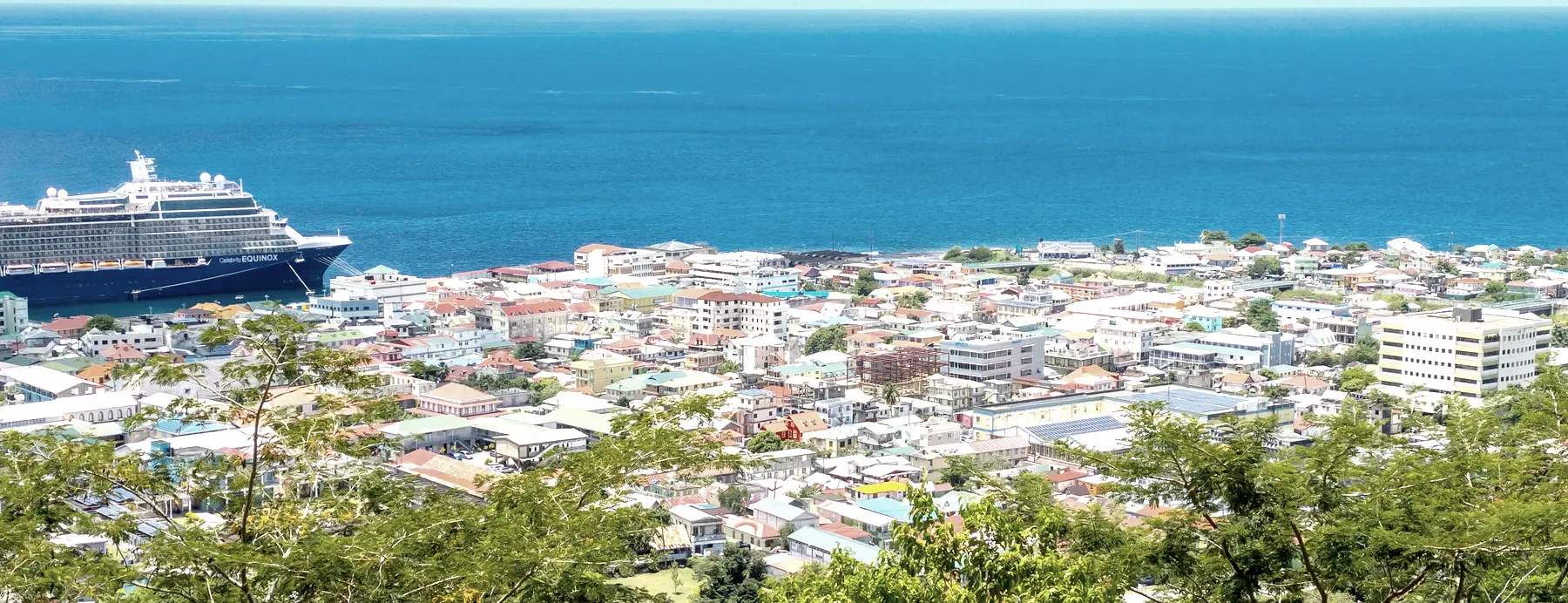
Commonwealth of Dominica, Caribbean Sea

The program has been running since 1993 — one of the two oldest in the world.

Commonwealth of DominicaCaribbeanProgram since 1993
Calculate the cost

11 / Our role

Why work with BRIDGES

We have been in this business since 2004 and have taken more than 8,000 families through it. Caribbean programs are one of our core directions, and on Dominica we run both routes: the fund and real estate.

01

We start by checking eligibility

Dominica has banned and restricted nationalities, and that is the first thing we verify. If the program is closed to your nationality we say so at the first consultation and offer alternatives that work — rather than charging you to prepare documents.

02

We price both routes instead of selling one

The fund is cheaper; real estate preserves the investment. Which suits you depends on the family, the horizon and your willingness to hold an asset abroad. We show both calculations in full — fees, purchase taxes and running costs included.

03

We prepare you for the interview

The interview is mandatory from age 16 and is held in English. We work through the questions in advance — source of funds, background, connections, motives — and run a rehearsal. An unprepared interview remains a common cause of further Unit queries.

04

Full cycle, including life after the passport

Renewals, bank accounts, company formation, adding children born after citizenship is granted. We stay with the client once the passport is issued.

15 / Materials

Useful materials

During the engagement you receive a set of professional materials prepared by our team. They cover the program, the cost, the documents, the stages of the process and what becomes possible once citizenship is granted.

Main materialPresentation

Dominica citizenship by investment

The deck covers the essentials: requirements, amounts, family members, documents and how the process runs.

Inside:

  • who can apply
  • which investment options are available
  • what it costs for your family
  • which relatives can be included
  • which documents are needed
  • how due diligence works
  • how work with BRIDGES runs

PDF · free · current as of August 2026

A short check: who passes screening, which nationalities are restricted and what due diligence looks at.

The list of documents for the applicant and every family member, with notes on translation, notarisation and apostille.

We calculate the full estimate for your family: contribution, government fees, due diligence and our work.

All materials are kept up to date by our team and are used when supporting BRIDGES clients.

16 / News

Program news

11 June 2026

The Prime Minister of Dominica announced that successful applicants will be required to visit the country in person and spend time there; the procedure and timing will be set out when the 2026/2027 national budget is presented. Until this announcement the program was fully remote.

July 2026

The European Commission wrote to Dominica and four other Caribbean states proposing that they phase out their citizenship by investment programs by 1 June 2028. Schengen visa-free access is in force as of the date this page was updated; negotiations continue.

30 December 2025

Regulation (EU) 2025/2441 came into force: the mere existence of a citizenship by investment program became a ground on which the European Union may reconsider a country’s visa-free regime.

September 2025

The five Caribbean citizenship states, Dominica among them, agreed on a single regional regulator and a common requirement of at least 30 days of physical presence within the first five years of citizenship.

Worth having

Download the Dominica citizenship checklist

The short document we give clients before they start: requirements, the full cost structure, stages and timelines — one list, no filler.

Inside the document

  • Both routes with a quote: fund and real estate
  • Who can be included in the application and on what terms
  • What changed in the program in 2026

We will send it after a short form - no call or obligation.

17 / Questions

Answers to common questions

Applications from citizens of Russia, Belarus, Yemen and Northern Iraq (including the Kurdistan cities of Erbil, Amedi, Dahuk, Kirkuk, Lalish, Raniya, Soran, Sulaymaniyah and Zakho) are not accepted. Applicants from Iran, North Korea and Sudan are refused unless they have not lived in that country for at least ten years, hold no substantial assets there and have carried on no activity with it. The list is published by the CBIU and can change — we confirm eligibility for your nationality in writing before any work starts.

Not to file: the authorised agent submits the documents, the interview is held by video call and the Oath of Allegiance is signed before a notary wherever you are. But on 11 June 2026 the government announced that successful applicants will have to visit the country in person; the procedure and timing will be set out with the 2026/2027 national budget. We confirm the requirement in writing as at your filing date.

The CBIU indicates 3-4 months from filing to approval in principle, and not less than three months. Payment, the Certificate of Naturalisation and the passport come on top — in practice the whole path takes 4-7 months. The Unit may request further information and extend the review.

The fund is cheaper and simpler: one payment, no transaction, nothing to hold or sell. Real estate costs roughly $75,000-100,000 more in government fees, but the property stays your asset and can be sold after three years. People take the fund when the passport has to be as economical as possible, and property when the investment must not be burned and they are ready to hold an asset abroad.

A spouse; children under 18; children aged 18-30 in attendance at a recognised institution of higher learning and fully supported; unmarried daughters under 25 living with the applicant; children aged 18 or over who are physically or mentally challenged and fully supported; and parents and grandparents over 65 who are substantially supported — both yours and your spouse’s. A child means a biological or legally adopted child only. Siblings are not on the list.

Up to and including four people the fund contribution stays at $250,000. From the fifth person it grows by $25,000 for each dependant under 18 and $40,000 for each dependant aged 18 or over. On the real estate route the government fee rises by the same amounts. Due diligence and the interview are counted separately for everyone aged 16 or over, and the Certificate of Naturalisation is $500 for every person in the file.

Yes, the interview is mandatory for everyone aged 16 or over, at $1,000 per person. It is usually held by video call, in English. You are asked about your background, source of funds, activities and motives for seeking citizenship. We prepare you in advance and run a rehearsal.

Yes. Dominican law recognises and allows dual citizenship, and you are not required to renounce your existing passport. It is worth checking separately how the law of your current country of citizenship treats a second one.

Schengen — yes, the visa waiver with the European Union is in force as of the date this page was updated. The UK — no: a visa regime was introduced on 19 July 2023. Note that since 30 December 2025 the EU may reconsider the waiver on the ground that the program exists at all, and in July 2026 the Commission asked Caribbean states to phase their programs out by 1 June 2028. We give you the current status on the date of your enquiry and do not build a plan around a regime that may change.

No. There is no residence requirement to retain the status, and citizenship is for life. Separately, in September 2025 the five Caribbean states agreed on a requirement of at least 30 days of presence within the first five years — how that will be applied in Dominica is for national legislation to define.

Due diligence, interview and processing fees are paid at filing and are not refunded on refusal — the investment itself is only paid after approval in principle. That is exactly why we begin with a preliminary check: it shows the risk in advance. Where we see a material risk we say so plainly and propose an alternative program.

Yes, children born after citizenship is granted acquire it by descent. In addition, the main applicant may add a minor child — biological or adopted — after the grant, with no time limit. We handle the paperwork for the child.

INITIAL ASSESSMENT

Tell us what outcome your family needs

We will design a solution for your case, choose the country and the right status, and take the whole process through to the result.

Or message us on WhatsApp or Telegram

Anna Kovalevskaya, lead lawyer at BRIDGES GLOBAL
Anna KovalevskayaLead lawyer, citizenship and residency, 12 years of practice