Updated
SRV-DS-DC
Support for deals
Closing a deal with nothing lost the money and the title
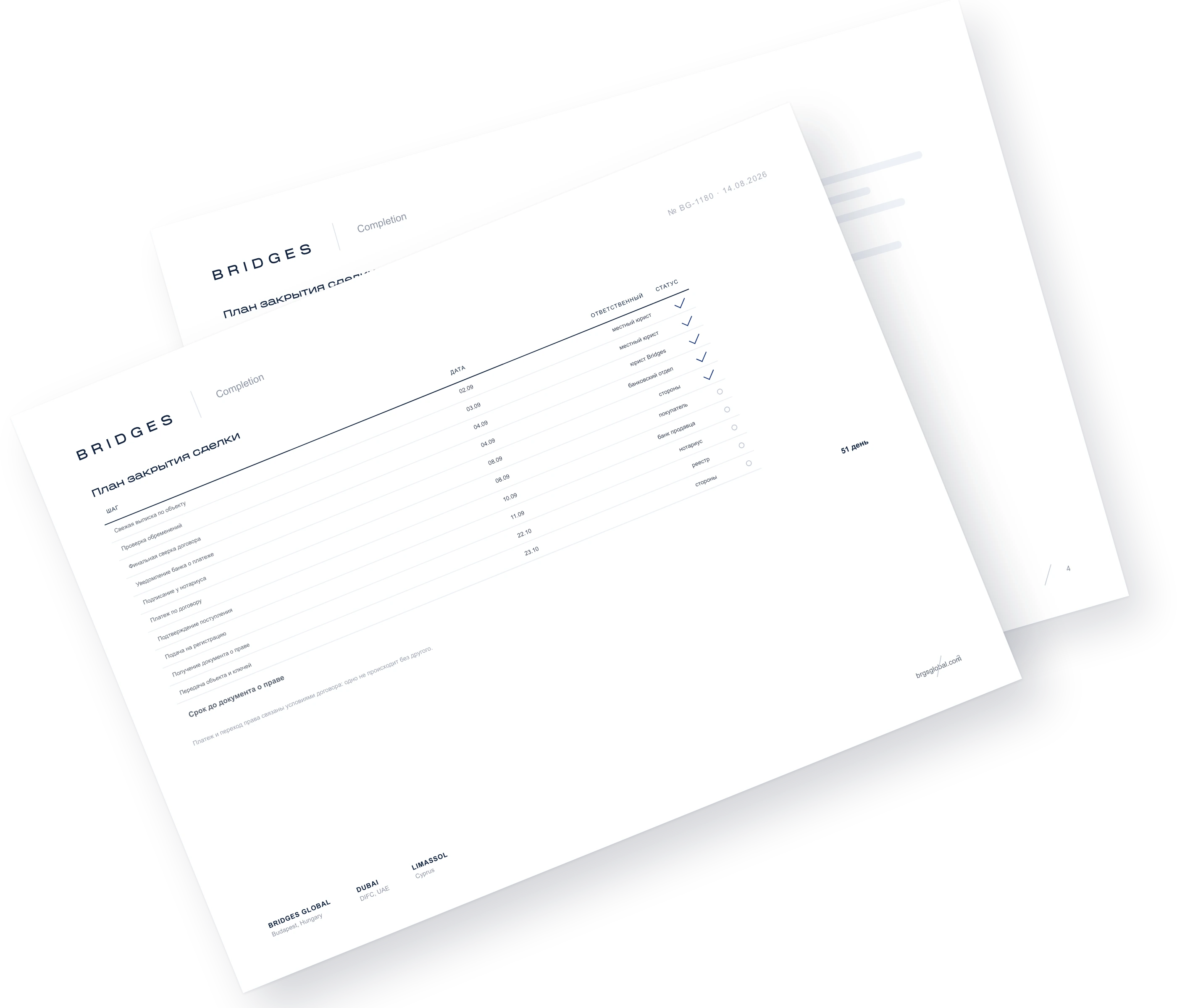
The most dangerous stage of a deal is the last. Here the money leaves your control and the title passes to you, and the order of those two events settles everything. We build the closing so that neither happens without the other.
- We set the order: the payment and the transfer of title are tied by conditions
- We prepare the banking side in advance so the payment does not hang
- We take it through to the document of title, not to the fact of payment
01 / The service
What a closing is made of
A closing is not a signature but a sequence of actions, each of which has to happen at the right moment. Breaking the order is the commonest way to lose money in a cross-border deal.
The check before signing
The final reconciliation: whether the text matches what was agreed, whether the certificates are valid, whether the property is free of encumbrances as at today.
The signing
In person, under a power of attorney or before a notary — depending on the requirements of the jurisdiction. The form governs the preparation of the documents too.
The settlement
The payment along the agreed route, with an explanation prepared for the bank in advance and tied to the moment title passes.
Transfer and registration
Entry in the register, receiving the document of title, handing over the property or the shares, re-registering the related contracts.
02 / Situations
When help at closing is needed
Situations where the risk is concentrated in the finale.
A large payment abroad
A sum where the bank is bound to ask questions, and a delayed payment wrecks the closing date.
You cannot be present
A power of attorney in the right form is needed, and someone to carry the procedure through on the spot.
Payment in instalments
The payment schedule has to be tied to the stages of the transfer of title, not to the calendar.
A property under construction
Title does not pass at once, and the buyer’s protection is built through the terms of the contract and the developer’s guarantees.
The deal is tied to a programme
An investment programme requires particular documents of ownership within particular deadlines.
The parties are in different countries
The signing and the settlement are spread out in time and space — here the order is critical.
03 / Honest limits
What we do not do
The limits we state plainly.
We do not take money into our own accounts
The settlement goes directly between the parties or through a mechanism the law provides for. We are not a holder of funds.
We do not pay on the client’s behalf
The payment is sent by the owner of the funds from their own account. Payment by a third party creates problems both with the banks and in the deal itself.
We do not split payments
Breaking a sum up to get under control thresholds is not acceptable. A large payment is made as a large one, with the justification prepared.
We do not guarantee registrars’ timelines
The time for entry in the register is set by the country’s authority. We follow the process but do not control its speed.
04 / Scope of work
What the work covers
From preparing for the closing date to the document of title in your hands.
The closing plan
What happens on the day of the deal and in what order: the signing, the payment, the handover, the registration.
The final check
Reconciling the text, fresh extracts, no encumbrances or attachments as at the closing date.
Preparing the payment
The route, the payment reference, the set for the bank — all agreed before the money is sent.
Powers of attorney
If you are not present in person: preparing, notarising and legalising the power of attorney.
Attending the signing
Taking part in the procedure at the notary or at the parties’ meeting and checking the documents against what was agreed.
Registration and handover
Entry in the register, receiving the document of title, re-registering the utility and service contracts.
After the closing we hand over the full archive of documents and a list of the obligations that have arisen for you — tax and running.
05 / Cost
What the cost depends on
It is calculated by the complexity of the procedure, not by the price of the property.
The jurisdiction
In one place a closing goes through at a notary in a single day, in another it is stretched over weeks in several stages.
The form of participation
Attending in person, acting under a power of attorney or running the whole procedure on the spot.
The structure of the settlement
A single payment is simpler than a schedule tied to the stages of construction.
The type of asset
A completed property, one under construction and shares in a company all close differently.
State duties, notarial tariffs and registrars’ fees are paid separately at their actual cost.
06 / How it works
The order of a closing
Every step is tied to the one before — that is the protection.
Preparation
The closing plan, fresh extracts, the readiness of the documents and of the banking side.
1–2 weeks
The final check
Checking the text and the state of the property or the company immediately before signing.
1–3 days
The signing
In person, under a power of attorney or before a notary — to the requirements of the jurisdiction.
1 day
The settlement
The payment along the agreed route with confirmation that it has arrived.
1–5 days
Registration and handover
Entry in the register, receiving the document of title, the actual handover.
2–8 weeks
07 / Preparation
What we will need from you
By the closing date everything must be ready in advance — not on the day itself.
The funds ready
The money in the account the payment will go from, and an evidenced origin of the funds.
Personal documents
The passport, the tax number of the country of the deal where one is required, proof of address.
Presence or a power of attorney
The form of participation is decided in advance: arranging a power of attorney takes time.
Details and confirmations
The parties’ account details, checked over a reliable channel — swapped details in correspondence remain a common form of fraud.
08 / Team
Who runs the closing
At the final stage a lawyer and the lead on the deal work at the same time.
 Irina ShternHead of Hungary OfficeThe documents, the notarial part and the registration
 Nikos PappasBanking Relations SpecialistCoordinating the closing day and the banking side
 Yan NovakWealth Structuring AdvisorTaxes on the transfer of title and the obligations that follow
 Anna KovalevskayaHead of Legal12 years of practice
10 / Questions
Answers to common questions
It depends on the jurisdiction and the structure of the deal, and that is exactly what has to be settled before the closing. The protection rests on the link: the payment is made at the same moment as title passes, or the funds are blocked until it is registered. Sending money with no such link is the main way to lose it.
In some jurisdictions a notarial closing requires the person or a representative under a notarised, apostilled power of attorney. We say so in advance, because arranging a power of attorney takes from one to three weeks.
It can, and that is the commonest reason a closing date is missed. So the bank is warned in advance, the payment reference is matched to the documents on the deal, and the set of supporting papers is prepared before it is sent, not in answer to a request.
The timing is set by the country’s registering authority: from a few days to a few months. We follow the process and hand the document over as soon as it is issued. Until then your title is evidenced by the contract and the note that it has been filed for registration.
Stop and check over an independent channel — by calling a number known earlier, not the contacts in the letter. Swapped details in correspondence before a closing remain one of the commonest ways funds are stolen in cross-border deals.
A mechanism where the money is held by an independent party and released to the seller only once the transfer of title is registered. It is needed where the payment and the transfer are spread out in time — that is the buyer’s main protection.
The split is set by the country’s law and by the contract: in one place the transfer tax is paid by the buyer, in another by the seller. We work out the exact sums before signing, so that the budget for the deal is complete.
The remedies under the contract apply: the deposit returned twice over, a penalty, specific performance. All of that works only if it is written in beforehand — which is why reviewing the contract and closing are directly linked.
It can, if every payment is tied to a stage in the transfer of title or to the readiness of the property, and not to the calendar. A schedule unconnected with the stages leaves the buyer without leverage.
A registered document of title, the full archive of the deal and a list of the obligations that have arisen: taxes, utility contracts, insurance. A receipt for payment is not what we count as the result.
INITIAL ASSESSMENT
Tell us what outcome your family needs
We will design a solution for your case, choose the country and the right status, and take the whole process through to the result.