Updated
SRV-DS-DR
Support for deals
Reviewing the deal documents before signing
A contract drawn by the other side is written in their favour — that is normal and to be expected. What is not normal is signing it without knowing what happens on a delay, a withdrawal or a dispute. We read the document before it is signed and explain the consequences in plain words.
- We read a contract from the worst case, not the best
- We explain the consequences in words, not in quotations from clauses
- We give wording for the amendments, not only a list of comments
01 / The service
What we check in a document
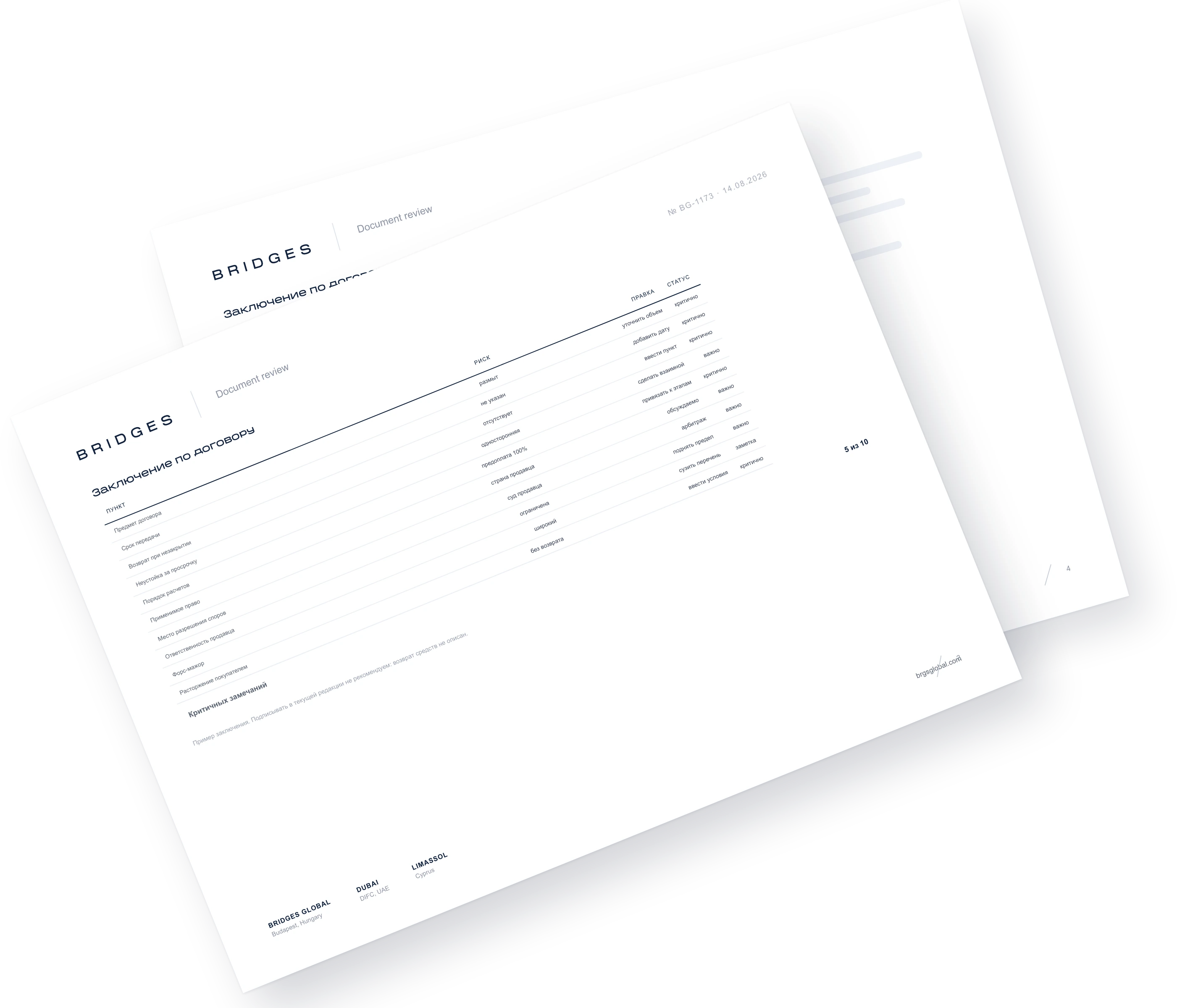
The danger usually lies not in what is written large but in what is not written at all or is buried in the section about notices. We check a document against the same joints where money is most often lost.
The subject and the extent of the obligations
What exactly you receive and what you have to do. A vague subject is the main source of future arguments about who expected what.
Money and deadlines
When, where and on what conditions payment is made, what happens on a delay, who bears the bank charges and the currency risk.
Exit and liability
How the contract is terminated, what is withheld, how the parties’ liability is limited and whether there is a penalty.
The law and the forum
Which country’s law applies and where a dispute is heard. The clause read last, and by importance one of the first.
02 / Situations
When it is worth a review
Situations where the cost of a review bears no comparison with the price of a mistake.
The other side drew the contract
Their lawyer protected their interests. Yours will appear in the text only after your amendments.
A foreign document
A different law, different terms, different consequences behind familiar-looking wording.
Buying property
Developers’ reservation agreements and preliminary contracts are almost always written one-sidedly.
Investment documents
Subscriptions, shareholders’ agreements, loans — here what matters is the rights on exit and on disagreement.
A contract with an adviser
Especially in our own industry: what the service covers, what happens on withdrawal, whether the payment is returned.
You are asked to sign urgently
Time pressure is usually a sign that this is exactly the document to read more carefully.
03 / Honest limits
The limits of the work
What a document review does not replace.
We do not check the counterparty
Going through a contract does not answer whether the other side is honest and whether they have the money. That is a separate task.
We give no guarantees on the outcome of a dispute
We show the risks and make the wording better, but a court’s decision turns on the facts and on the parties’ conduct as well.
We do not appear in court
Representation in court is done by local advocates — we help choose them and hand over the material.
We do not sign for you
The decision and the signature are always yours. What we answer for is that you take them with full understanding.
04 / Scope of work
What the review covers
The result is a breakdown, amendments and a clear conclusion on whether to sign.
A clause-by-clause breakdown
What every material term means and how it will work in a real situation.
A map of the risks
What happens on a delay, a withdrawal, an insolvency or bad faith on the other side.
Amendments with wording
Not “this is dangerous here” but text ready to be sent to the other side.
A consistency check
Whether the annexes, the specifications and the main text match each other — discrepancies turn up constantly.
A review by voice
A call where we go through the document together and answer the questions.
Support in the negotiations
We help you justify the amendments to the other side and find a compromise on the contested clauses.
05 / Cost
What the cost depends on
It is calculated by volume and complexity, not by the size of the deal.
The volume of documents
One contract, or a set with annexes, specifications and payment schedules.
The law and the language
A document under a law we know is reviewed faster; exotic jurisdictions call for a local lawyer.
The depth of the work
An opinion with comments costs less than amendments with wording and taking part in the negotiations.
Urgency
A review within a day means rebuilding the schedule and costs more than usual.
The cost of a review is almost always less than the sum it saves in a single clause about the return of a payment.
06 / How it works
How we work
Usually a few days pass from receiving the document to the review.
We receive the documents
You send the contract and the annexes and tell us the context of the deal and what worries you.
1 day
The review
We read the document and prepare an opinion with the risks and the amendments.
2–5 days
The discussion
We go through the document together by voice: what is critical, what can be given up.
1 day
The negotiations
We help defend the amendments before the other side and agree the final text.
The final check
We check the final version before signing — amendments sometimes “get lost” along the way.
07 / Preparation
What we will need from you
The context matters no less than the document itself.
The complete set
The contract with every annex and the earlier versions, if there was correspondence.
The substance of what was agreed
What you agreed in words — that is exactly how a divergence from the text comes to light.
What is critical for you
The deadlines, the sum, the ability to withdraw, confidentiality — the priorities settle where to stand firm.
The signing deadline
When an answer is expected — that governs how we work.
08 / Team
Who runs the work
A lawyer reads the contract, and a local specialist is brought in where needed.
 Martina VeberHead of Case ProcessingGoing through contracts and the wording for negotiations
 Hanna BergerTrusts and Succession AdvisorThe tax consequences of the terms of the deal
 Tomas LinderCompliance and AML OfficerThe economics of the deal and the settlement terms
 Andres FerreiraHead of Investment AdvisoryInvestment and business routes
10 / Questions
Answers to common questions
Usually yes — an urgent review takes a day. But it is fairer to say something else: a demand to sign immediately is itself worth reading as a signal. No sound deal falls apart over two days for a review.
Sometimes that is true — banks and large developers really do have rigid forms. But even there the annexes, the deadlines and the settlement procedure can usually be agreed. In the other cases the line about a standard contract is a negotiating position, not a fact.
Three things: the applicable law and the forum for disputes, the terms on which money comes back if the deal does not close, and the procedure for settling through the bank. It is these that settle what you will actually be able to do if something goes wrong.
Yes. We give the review in your language, and for documents in rare languages we bring in a local lawyer — and we say so in advance, including the cost.
It can, and sometimes it is useful: to understand your rights, find grounds for termination or prepare for a dispute. But the choice at that stage is far narrower — which is why we always ask for the document before the signature.
Usually two to five days for a set. An urgent review within a day is possible, but it means rebuilding the schedule and costs more.
Yes: a clause-by-clause breakdown, a map of the risks and wording for the amendments ready to use. Plus a call where we go through the document together — most questions are settled in the conversation itself.
What happens if the deadlines slip, how the money comes back if the deal does not close, what secures the obligations and under which law a dispute is settled. A good price means nothing if the return of funds is described nowhere.
A mechanism where the funds are held by an independent party and released to the seller when the conditions are met. It protects well, but only if the conditions are described precisely and the escrow agent is licensed in its jurisdiction.
Yes, and that is an important part of the work: amendments often bring the original version back in different words. We check the final version line by line against the one agreed before signing.
INITIAL ASSESSMENT
Tell us what outcome your family needs
We will design a solution for your case, choose the country and the right status, and take the whole process through to the result.
