Updated
SRV-DS-PC
Support for deals
Coordinating the parties to a deal one person answerable
In a cross-border deal the seller, the agent, two banks, the notary, a local lawyer and a tax adviser all work at once. Each answers for their own piece and nobody for the whole. We take that role on: we watch the deadlines, join the stages together and do not let the deal stop over one unread email.
- One person answerable instead of seven parallel email threads
- A plan of the deal with dates, dependencies and owners
- We work in your time zone and in the deal’s
01 / The service
Why deals stop
Almost always the cause is not disagreement on the substance but the organisation: someone is waiting for a document nobody ordered, the bank is silent, and the notary does not know that a condition has already been agreed. Coordination is not correspondence but holding the whole picture in one head.
Nobody answers for the whole
The agent answers for the property, the lawyer for the contract, the bank for the payment. The joints between them are where deals get stuck.
Time zones and languages
When the participants are in three countries, a simple question takes two days. We work with both sides in their own working hours.
Dependencies between the stages
The bank will not open an account without the company’s documents, and the notary will not set a date without confirmation of the funds. The order matters more than the speed.
The price of delay
A lapsed reservation, a lost property, an expired bank approval, a moved exchange rate — delays almost always cost money.
02 / Situations
When coordination is needed
Situations with more than three participants.
A purchase abroad
The seller, the agent, the notary, the bank, a local lawyer — and all of them in another country.
A deal inside a programme
Buying a property for an investment programme: the deal’s deadlines are tied hard to the filing deadlines.
Several banks in the chain
The sending and receiving banks put questions to each other, and it is you who has to answer.
A language barrier
Documents and negotiations in a language you do not command freely.
You cannot be reachable
A full schedule or the time difference makes it impossible to react to requests within the day.
The deal is already dragging
The process has stalled and it is unclear who exactly is waiting for what.
03 / Honest limits
The limits of the work
What coordination does not mean.
We do not take decisions for you
Agreeing the price, the terms and the signing are always your decisions. We see that they are taken in time and with full information.
We do not put payments through ourselves
The money goes directly between the parties. We prepare the settlement and explain the structure to the banks, but we are not an intermediary in the payment.
We do not replace the local lawyer
Where the law requires a local specialist or a notary, they do the work — we see that they are involved and that the information reaches them.
We do not guarantee third parties’ timelines
We can press a bank or a registrar for an answer, and we do, but we do not run their internal procedures.
04 / Scope of work
What the work covers
From the plan of the deal to closing, with no days lost.
The plan of the deal
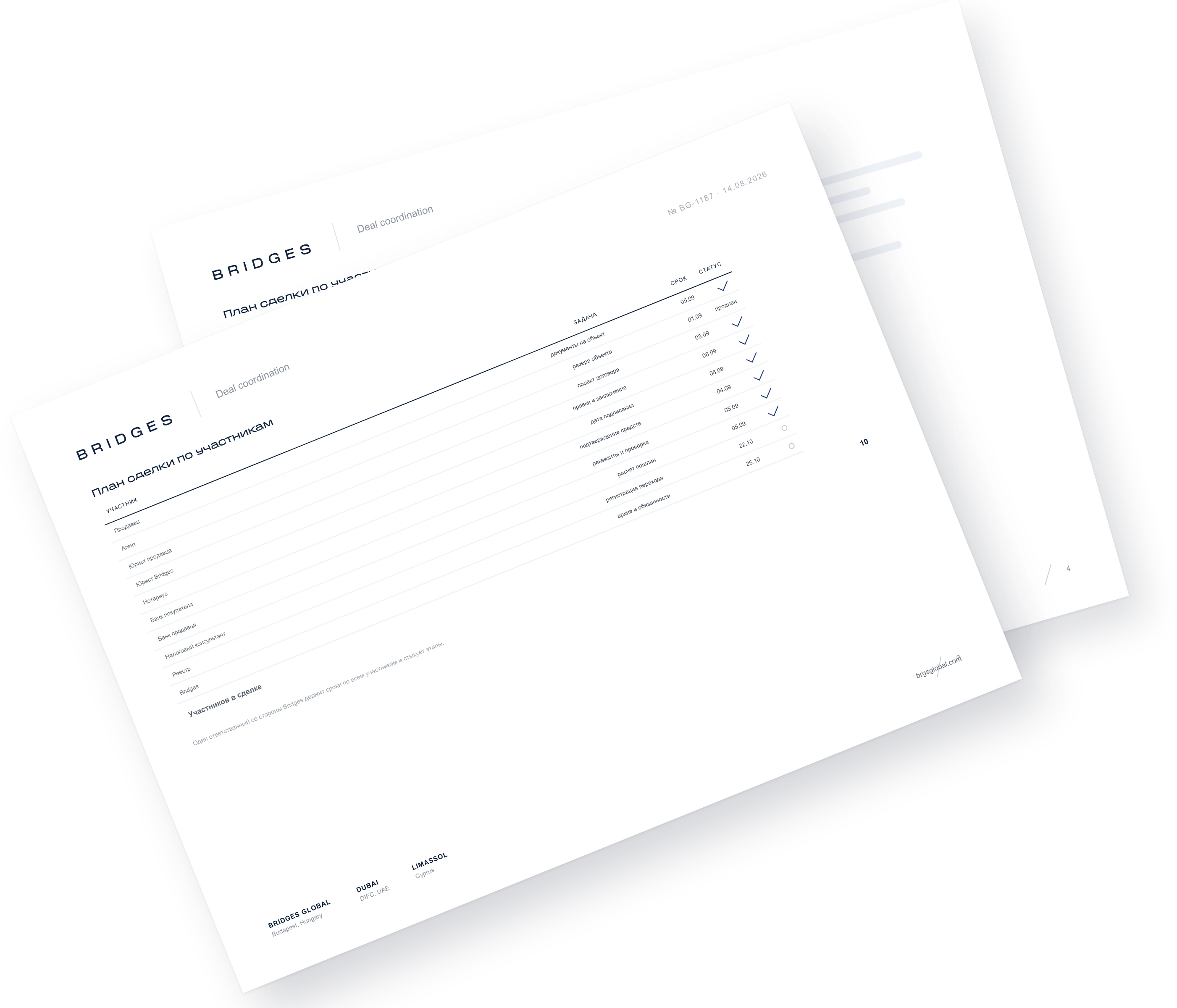
The stages, the dates, the owners and the dependencies between the steps. One document that everyone sees.
A single point of contact
Every question from the participants comes to us, and you get decisions rather than a stream of correspondence.
Control of the deadlines
We follow every deadline: reservations, approvals, the validity of certificates, the dates at the notary.
Joining the documents up
We see that every participant has the document they need, in the form they need and with the legalisation they need.
Work with the banks
We explain the structure of the deal to both banks in advance, so that the payment does not hang in a check.
A progress report
Regularly and briefly: what is done, what is next, where the risk of delay lies.
05 / Cost
What the cost depends on
It is calculated by the duration and the number of participants, not by the size of the deal.
The number of participants
Every side with its own lawyer and bank adds approvals.
The duration
A deal over a month and a deal over half a year need different amounts of running.
The number of jurisdictions
Different countries mean different requirements for documents and different working hours.
Languages
Work in several languages with sworn translations is quoted separately.
As a rule coordination works out cheaper than a lawyer’s hourly work: you pay for the result, not for the letters.
06 / How it works
How it works
We come in at any stage, a deal already dragging included.
The picture of the deal
Who is involved, what stage we are at, what is already agreed and where the block is.
1–2 days
The plan with dates
We draw it up and send it to every participant: the stages, the owners, the deadlines.
2–3 days
Running it
The daily work: requests, answers, reminders, joining up the documents and the banks.
the whole term of the deal
Closing
The signing, the settlement, the registration of the transfer of title, receiving the documents.
Handing over
The archive of documents and clear instructions on the obligations that follow.
07 / Preparation
What we will need from you
Authority and timely answers to two or three questions a week.
The participants’ contacts
The agent, the seller, the lawyers, the bank — everyone the work already runs through.
Authority to correspond
Written confirmation that we may communicate on your behalf.
The documents on the deal
The contracts, the correspondence, the payment orders — everything there already is.
Being available for decisions
The key decisions are yours, and sometimes they are quick. We agree a way of reaching you urgently.
08 / Team
Who runs the deal
A deal has one lead and a lawyer as backup.
 Sergey EvdokimovManaging PartnerRunning the deal, the deadlines and communication with the participants
 Viktoria LebedevaManaging Director, Private ClientsThe legal questions that arise along the way
 Yan NovakWealth Structuring AdvisorThe tax questions that arise at closing
 Anna KovalevskayaHead of Legal12 years of practice
10 / Questions
Answers to common questions
The agent represents the property and as a rule is paid by the seller. We work on your side and answer for the process as a whole: the documents, the bank, the taxes, the deadlines. The roles do not compete — in most deals they run in parallel.
Yes, and that happens often. We start with the picture: where we are, what is agreed, who is waiting for what. Usually the reason for the stoppage becomes clear at that very step.
Yes. We do not push the existing participants out — we join their work together. Often it is precisely the absence of that joining that makes the deal go slower than it should.
In working hours, within a few hours; on urgent questions about the deal, faster. At the closing stage we agree a separate channel, because there it is a matter of hours.
For correspondence and coordination a written confirmation of authority is enough. A power of attorney is needed only if documents have to be signed or you have to be represented before a notary — and we say so in advance.
One document on a single page: the stages, the dates, the owner of each step and the dependencies between them. Every participant sees it, so the argument about who is waiting for what simply does not arise.
At the closing stage, yes, through the agreed channel. Ordinarily we work in working hours, but with both sides in their own zone, not only in yours.
Fix the deadlines in writing and tie them to consequences: the return of the reservation, a change in price, a right to walk away. Verbal promises do not work in a cross-border deal.
The client, at the actual cost and with no mark-up from us. We choose the specialist, agree their rate before the start and pass on the invoice as it is.
Yes, most often that is the closing or the negotiations with the bank. But the later we come in, the less we can change: by then some of the terms are already fixed in signed documents.
INITIAL ASSESSMENT
Tell us what outcome your family needs
We will design a solution for your case, choose the country and the right status, and take the whole process through to the result.
