Residency · UAE
Villas in Dubai 2026: buying a villa, neighbourhoods, prices, for families and the Golden Visa

Updated: June 2026·13 min read·Expert reviewed
Terms and costs verified: June 2026
Contents
A villa in Dubai is about more than status - it is about a way of life: your own garden, a pool, a gated community with schools and parks within walking distance. In 2026 demand for houses and townhouses is outpacing supply, and prices for new villas have risen by more than 20% over the year. We break it down point by point: where to buy a villa in Dubai, how the neighbourhoods differ, how much a townhouse and a luxury villa cost in dirhams, which areas suit a family, and whether almost every property qualifies for a Golden Visa from AED 2 million.
A villa or townhouse in Dubai: what it is and who it’s for
When people talk about “buying a villa in Dubai,” they usually mean not a lone mansion somewhere in the desert but a house in a gated community - a master-planned neighbourhood with its own infrastructure. It is a fundamentally different product from an apartment in a tower: you have your own plot of land, a private garden, usually a pool or access to a shared one, parking for several cars and quiet away from the noisy tourist districts. Villas and townhouses in Dubai are bought specifically for family living - whereas an apartment in Marina or Downtown works more as an investment or as a home for one or two people.
Let’s clarify the terms, because they determine both the price and your way of life:
- Villa - a standalone house on its own plot, with a garden around the perimeter and usually a private pool. This is the upper segment of the housing market.
- Townhouse - a house in a terrace, sharing its side walls with the neighbours, yet with its own entrance, a small garden and often access to the community’s shared pool. It is the most affordable way to enter “houses in Dubai.”
- Semi-detached (twin villa) - two villas joined by a single shared wall, an intermediate option between a townhouse and a standalone villa.
For a family with children this format is almost always a considered choice: schools, playgrounds and cycle paths nearby, in a safe gated space. If you are also considering the apartment format, it makes sense to compare it with houses in our analysis of buying an apartment in Dubai.
Why families choose a house over an apartment
Dubai long ago ceased to be a city of skyscrapers alone. Alongside the towers, developers have built dozens of large-scale villa communities, and it is there that families who have come to the Emirates for the long haul are moving. The logic is simple: an apartment is good for a fast-paced life and for renting out, while a villa is for putting down roots.
What a house offers compared with an apartment:
- Space. 3-6 bedrooms, several bathrooms, a separate kitchen, a maid’s room and a garage. Floor areas that in Dubai’s apartment segment would cost noticeably more.
- Your own yard and pool. A private garden is a rare luxury in a city where most people live in towers. Children play by the house rather than on the 40th floor.
- Community infrastructure. Gated neighbourhoods are built as a whole: schools, clinics, supermarkets, parks, sports clubs and promenades. Everything within a few minutes of home.
- Safety. A guarded perimeter, access by pass and CCTV - exactly what families with children value most.
- Neighbours of a similar lifestyle. In villa neighbourhoods a community of people with a similar way of life takes shape, which matters for children’s socialisation.
Add to this the economics of ownership: in Dubai there is no annual property tax and no personal income tax, while a house in a quality community appreciates steadily and rents well. For more on the overall market, see our overview of property in the UAE.
Freehold zones: where a foreigner can buy a villa in full ownership
Before choosing a neighbourhood, you need to grasp the key rule: a foreigner in Dubai cannot buy property everywhere, only in specially designated freehold zones. Freehold means full, perpetual ownership: you own both the house and the land beneath it, and you can sell, lease and pass it on by inheritance. The property is issued a Title Deed - the ownership document registered by the Dubai Land Department (DLD).
The good news is that practically all the well-known villa communities are located precisely in freehold zones. Palm Jumeirah, Emirates Hills, Dubai Hills Estate, Arabian Ranches, Damac Hills, Tilal Al Ghaf, Jumeirah Village Circle - these are all areas where a foreigner can register full ownership.
What matters to know about costs and protecting the deal:
- DLD fee - 4% of the property value on registration, plus administrative charges. There is no annual property tax.
- Buyer protection. The market is regulated by RERA, funds for off-plan properties go into the developer’s escrow accounts, and the off-plan property itself is registered through the Oqood system.
- New build or resale. A villa can be bought both completed (with a Title Deed) and off-plan from the developer - often with a payment plan spread over the construction period.
It is always worth checking the current list of designated zones and the transaction parameters on the official portal of the Dubai Land Department (DLD). We cover the general mechanics of the purchase in detail in our guide to property in Dubai.
Dubai’s villa neighbourhoods: luxury, family and affordable communities
Choosing the neighbourhood is the key decision when buying a house. It determines not only the price but your whole way of life: whether you will live by the sea or by a golf course, amid ultra-luxury or in a quiet family suburb. Broadly, Dubai’s villa neighbourhoods fall into three large groups.
Luxury and trophy locations. These are Palm Jumeirah - the man-made palm-shaped island with villas on their own shoreline - and Emirates Hills, a gated enclave of mansions around a golf course often called “the Beverly Hills of Dubai.” Here you buy not square metres but status and exclusivity; supply is limited, so such properties are considered trophy investments.
Family communities of the mid and prime segments. Dubai Hills Estate, Arabian Ranches, Damac Hills, Tilal Al Ghaf - neighbourhoods created specifically for life with children. Schools, parks, lagoons, cycle paths and shopping centres within the community. This is the market’s sweet spot: quality of life is high while the entry point is noticeably below the luxury tier.
The affordable segment. Damac Hills 2, Dubailand, Jumeirah Village Circle (JVC), Dubai South - this is where the most affordable townhouses and compact villas are concentrated. An excellent entry into the housing market for those who want to keep to a minimal budget while still qualifying for residency.
Next we will look at the character of the key neighbourhoods and bring the indicative prices together in a table.
Palm Jumeirah and Emirates Hills: the luxury segment
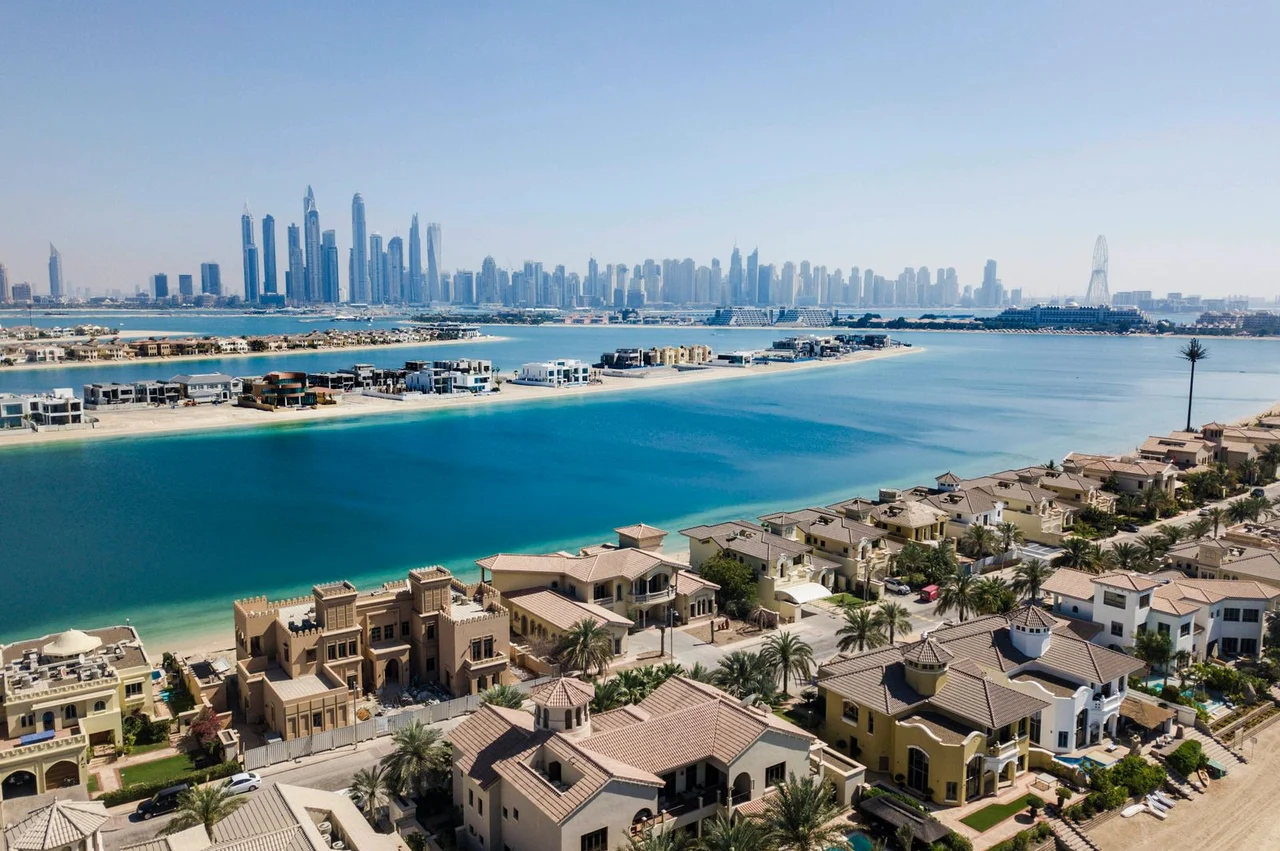
Palm Jumeirah - the calling card of Dubai and the emirate’s most recognisable address. Villas on the “trunk” and “fronds” of the palm have their own access to the sea and a private beach, with panoramic views of the bay and the skyline. It is a format for those who want to live literally on the water, surrounded by five-star hotels and restaurants. The average villa price here, by 2026 market estimates, is around AED 40 million, while unique properties with their own shoreline sell for well over AED 100 million.
Emirates Hills - a gated, intensely private neighbourhood of mansions around the Montgomerie golf course. Unlike Palm Jumeirah, there is no sea here, but there is space, greenery and the atmosphere of a country club. The plots are large and the houses are often built to bespoke designs, so the price range is very wide - roughly from AED 13 million for the more modest properties up to AED 200 million and above for the most prestigious mansions.
What both neighbourhoods share:
- This is the top of the market - in both price and prestige.
- Supply is limited and there are almost no new plots, so these properties behave like a trophy asset.
- Any villa here far exceeds the Golden Visa threshold of AED 2 million.
- High associated costs: upkeep of the garden and pool, and security.
This is the choice for those for whom a villa is not their first property purchase and who see Dubai as one of the home ports of their life.
We will find the right basis for residency in the UAE
We calculate the budget and timing for your family and list the documents you need.
Dubai Hills, Arabian Ranches, Damac Hills, Tilal Al Ghaf: for families
This is the heart of “family” Dubai and, as a rule, the most sensible choice for those buying a house to actually live in. Four neighbourhoods with different characters but one shared idea - comfortable life with children inside a thoughtfully planned community.
- Dubai Hills Estate - a modern, green neighbourhood by a golf course, with a large mall, parks and good schools. It is considered one of the most balanced in terms of quality for money. The average villa price here, by 2026 estimates, is around AED 11-12 million, while townhouses and compact villas are available for noticeably less.
- Arabian Ranches - an established, settled suburb in a Mediterranean and Arabian style, with golf, an equestrian club, schools and neat, green streets. Families value it for its calm and mature infrastructure; townhouses in Arabian Ranches III start from roughly AED 2.2 million.
- Damac Hills - a neighbourhood around a golf course with a large park, sports areas and a broad range of homes. The average villa price here is around AED 5-6 million, which makes it more affordable than the prime locations.
- Tilal Al Ghaf - one of the most fashionable new neighbourhoods by Majid Al Futtaim, built around a swimmable lagoon with beaches, parks and trails. It combines a resort feel with family living; there are both affordable townhouses and trophy waterfront mansions.
What all four share is a gated, secure perimeter, schools and nurseries within walking distance, pools, sports clubs and a community of people with a similar way of life. It is here that families from the CIS most often relocate, arranging both a home and residency at the same time. For the specifics of transactions for buyers from Russia, see our separate article on property in Dubai for Russians.
Table: villa neighbourhood - character - price from
Let’s bring together the benchmarks for the key villa neighbourhoods in a single table. Prices are given in dirhams (AED) and are indicative: the actual value depends on the size, year of construction, location within the community, view and condition of the property. For conversion: AED 2 million is about USD 545,000 (the dirham’s peg to the dollar is around 3.6725).
| Villa neighbourhood | Character | Price from (indicative) |
|---|---|---|
| Palm Jumeirah | Luxury, seafront villas, a private beach, a trophy asset | from ~AED 15-40 million, unique ones - AED 100 million+ |
| Emirates Hills | A gated enclave of mansions by a golf course, ultra-private | from ~AED 13 million to AED 200 million+ |
| Dubai Hills Estate | Family prime, a mall, parks, schools and golf | townhouses from ~AED 3 million, villas ~AED 11-12 million (average) |
| Arabian Ranches | A settled family suburb, golf and an equestrian club | townhouses from ~AED 2.2 million |
| Damac Hills | A golf community, a large park, sports | villas ~AED 5-6 million (average) |
| Tilal Al Ghaf | A resort neighbourhood with a swimmable lagoon, for families | townhouses from ~AED 3 million, waterfront mansions many times higher |
| Damac Hills 2 / Dubailand | The affordable segment, a quiet suburb | townhouses from ~AED 1.1-2.5 million |
| Jumeirah Village Circle (JVC) | Compact homes, a central location | average home price ~AED 3.1 million |
The main practical takeaway: from as little as AED 2 million you can find a townhouse or a compact villa in a quality family community - and that is exactly the threshold that unlocks eligibility for the Golden Visa.
How much it costs to buy a villa in Dubai: 2026 prices and trends
The housing market in Dubai in 2026 is one of the hottest in the world. Market data show that by the start of 2026 average home prices in Dubai had gained more than 20% year on year, with new villas and townhouses appreciating fastest of all - by roughly a quarter over the year. The reason is simple: family demand for houses is growing faster than developers can deliver new communities.
If we break the market down by budget, the 2026 picture looks like this:
- An affordable entry - from ~AED 1.1-2.5 million. Townhouses in Damac Hills 2, Dubailand and JVC. A compact house, a basic community, but already full ownership.
- The family segment - ~AED 3-10 million. Townhouses and villas in Arabian Ranches, Dubai Hills, Damac Hills and Tilal Al Ghaf. The best balance of price and quality of life.
- Prime and luxury - from ~AED 11 million and up. Large villas in Dubai Hills, homes on Palm Jumeirah, mansions in Emirates Hills. Trophy locations with a ceiling in the hundreds of millions of dirhams.
It is also important to factor in the associated costs: a one-off DLD fee of 4% on purchase plus administrative charges, and after you move in, ongoing community service charges and the upkeep of the garden, pool and security. On the other hand, there is no annual tax on the property itself in Dubai - a significant difference from Europe. We track the detailed price trends by segment in our overview of property prices in Dubai in 2026.
“The first thing I talk through with a client who wants to buy a villa in Dubai is this: decide what you are actually buying - a lifestyle for your family or an investment - because the neighbourhoods that suit those goals are different. For a family with children I almost always recommend starting with Dubai Hills, Arabian Ranches, Damac Hills or Tilal Al Ghaf: there the schools, parks and security are all contained within the community, and the entry point for a townhouse begins at roughly AED 2 million - which is exactly the amount that unlocks a ten-year Golden Visa. In other words, a single transaction settles both the question of where to live and the question of status for the whole family. Palm Jumeirah and Emirates Hills are a different conversation altogether - trophy locations for those who care not about square metres but about the address. And in any segment I insist on vetting the developer, the Title Deed and the real - not the promised - infrastructure, because these are precisely the details on which buyers most often lose money.”
A townhouse in Dubai: an affordable way into the housing market
If the budget for a standalone villa does not add up just yet, a townhouse is the most logical way to get a house in Dubai. In essence you gain most of the advantages of a villa - your own entrance, a small garden, several floors, parking, access to the community’s infrastructure - but for noticeably less money, because the house shares its side walls with the neighbours.
Why a townhouse works for both a family and an investor:
- Entry price. In the affordable neighbourhoods a townhouse starts from roughly AED 1.1-2.5 million - cheaper than many apartments in the central towers.
- Golden Visa. A townhouse from AED 2 million already grants eligibility for a 10-year residency - meaning the home and long-term status are arranged in a single purchase.
- Strong rental demand. Families are keen to rent townhouses in communities with schools, which provides a steady rental income and good occupancy.
- Capital appreciation. It is the townhouse and villa segment that shows the fastest price growth in the market.
Popular addresses for townhouses are Arabian Ranches III, Damac Hills 2, Tilal Al Ghaf and Dubailand. Many projects are sold off-plan with a payment plan spread over the construction period, which lets you enter the market gradually. For a family that wants to live in its own home while staying within a sensible budget, a townhouse is the optimal starting point.
We will calculate the budget for your family
A full estimate: contributions, fees and our work for your family.
A villa in Dubai for a family: schools, safety and a way of life
When a house is bought for a family, what comes to the fore is not the price per square metre but the quality of daily life. And here Dubai’s villa neighbourhoods offer what people move for: all the infrastructure for children is gathered inside or right next to the community.
What a family gets in a good villa neighbourhood:
- Schools within walking distance or a short drive. In Dubai Hills, Arabian Ranches and Damac Hills there are international schools following the British, American and IB curricula - no need to drive the children across the whole city.
- A safe environment. A gated perimeter, access by pass and a low crime rate - children can play in the yard and ride their bikes on their own.
- Parks, pools and sports. Playgrounds, cycle paths, tennis, football pitches, lagoons and beaches in resort communities such as Tilal Al Ghaf.
- Healthcare and daily amenities nearby. Clinics, pharmacies, supermarkets, cafes and malls within the neighbourhood or a few minutes away.
- A community of families. Neighbours with a similar lifestyle, events for residents and a friendly environment for children’s socialisation.
A separate and important point is residency for the whole family. Having bought a villa from AED 2 million, the owner obtains a Golden Visa for themselves and independently sponsors a spouse and children with no age limit, and can also sponsor parents and domestic staff. In other words, a single home solves two questions at once: where to live and on what basis the whole family can stay in the Emirates long term.
The villa and the Golden Visa: residency from AED 2 million
The main bonus of buying a house in Dubai is the link to a ten-year residency. The Golden Visa is a 10-year visa, renewable and self-sponsored: its holder is not tied to an employer and sponsors their own family. There are several routes to obtaining it, and one of the most popular is precisely through property.
The key conditions for the property in 2026:
- Threshold - from AED 2,000,000. A completed villa, an off-plan one and one bought on a mortgage from an approved bank all qualify - what matters is the property’s value.
- The former requirement for an initial payment of AED 1 million has been abolished - today it is the final property value that counts, not the amount of cash paid in.
- A 10-year visa, renewable, with the right to independently sponsor a spouse, children with no age limit, parents and domestic staff.
- Almost any full villa exceeds the threshold - which means the home and long-term status are arranged in a single deal.
It is worth being : the Golden Visa is a residence permit, not a passport. UAE citizenship is not sold for investment; it is granted only by decision of the authorities to certain categories of people. But for most families a ten-year residency with no tie to an employer and zero income tax is exactly what they need. For more on how the programme works and its thresholds, see our guide to property and residency in Dubai.
We’ll help you choose and buy a villa in Dubai
Choosing a villa in Dubai involves dozens of forks in the road: the neighbourhood, the developer, a completed property or one under construction, a cash purchase or a mortgage, how to qualify correctly for the Golden Visa and arrange residency for the whole family. A mistake in choosing the community or developer is costly, and an off-plan deal requires an understanding of escrow, Oqood and the payment-plan terms.
We handle property purchase and residency in the UAE end to end: we select a villa or townhouse for your budget and your family’s needs, vet the developer and the property, run the transaction through the DLD and arrange the Golden Visa. Discuss buying a villa in Dubai with a BRIDGES GLOBAL expert - we will match neighbourhoods to your budget and map out the path to residency.
The terms and steps of buying a villa: from selection to Title Deed
Let’s set out the process of buying a house in Dubai as a clear sequence. The transaction itself for a completed property goes quickly - a matter of days, if the paperwork is in order. The main effort goes into the selection and due-diligence stage.
How it works, step by step:
- Step 1. Define your budget and format. A townhouse, a semi-detached villa or a standalone villa; a completed property or off-plan; a neighbourhood to suit the family’s way of life.
- Step 2. Choose the neighbourhood and property. Compare communities on schools, infrastructure, views and price; verify that the zone is freehold.
- Step 3. Vet the developer and the legal title. For an off-plan property - the developer’s reputation, escrow and Oqood registration; for a completed one - a clean Title Deed with no encumbrances.
- Step 4. Sign the contract. Signing the MoU (Form F), paying the deposit (usually 10%) and agreeing the terms and timelines.
- Step 5. Complete the transfer of title. Registration with the DLD, payment of the 4% fee and administrative charges, and receipt of the Title Deed in your name.
- Step 6. Apply for the Golden Visa. With a property value from AED 2 million - arranging a 10-year residency and Emirates ID, then sponsoring the family.
A mortgage is also available to non-residents: banks finance roughly up to 50-60% of the value for foreigners, while for residents the limit is higher. This lets you buy into a more expensive house while retaining part of your capital. The basic rules and the list of designated zones are worth checking on the portal of DLD.
What to look for before buying: an expert’s view
Years of overseeing deals in Dubai show that what trips up home buyers is not rare mishaps but quite ordinary ones. Let’s go through what to check so that a villa brings joy rather than disappointment.
- The developer and the project stage. For an off-plan project, look at the developer’s reputation, its record of delivering on time, the presence of escrow and Oqood registration. For a completed property, look for a clean Title Deed with no encumbrances and no service-charge arrears.
- Real infrastructure, not renders. In new communities, schools and malls are sometimes “promised” but not yet built. Confirm what is actually operating at the time you move in.
- Associated costs. Service charges, upkeep of the garden and pool, security - budget these amounts into your cost of ownership in advance.
- Location within the community. The view, proximity to the road, the orientation of the house and the distance from noisy areas strongly affect both comfort and future resale.
- Meeting the Golden Visa threshold. If residency is part of the goal, make sure the property value comfortably exceeds AED 2 million.
And a separate word about money: banking compliance in the UAE is strict, the source of funds is checked, and not every bank opens an account for Russian nationals. All settlements are conducted strictly within the law, with no circumvention of sanctions - that is the foundation of a trouble-free deal.
We will send a document checklist for your case
Leave your details: we will put together documents and timelines for your family.
In summary: who a villa in Dubai suits
A villa or townhouse in Dubai is the choice of those who see the Emirates not as a point on the map for an investment but as a place for their family to live. Your own house with a garden and pool, a safe gated community, schools and parks nearby, zero income tax and no annual property tax - it all adds up to a very attractive way of life.
To sum up briefly:
- You can enter the housing market from roughly AED 1.1-2.5 million through a townhouse in an affordable community.
- The best balance of price and quality of life for a family is Dubai Hills, Arabian Ranches, Damac Hills and Tilal Al Ghaf.
- Luxury and trophy locations - Palm Jumeirah and Emirates Hills, from AED 13 million and many times higher.
- A villa from AED 2 million grants eligibility for the Golden Visa - the home and a ten-year residency for the whole family are arranged in one deal.
The key is to define your goal : to live, to invest, or to combine the two. That determines the neighbourhood, the format and the budget. Where exactly your family should live in Dubai is for you to decide; our job is to structure the purchase and the residency correctly for your scenario. To compare houses with the apartment format and weigh up the alternatives, see our overview of property in the UAE.
Frequently asked
Questions people ask before deciding
01How much does it cost to buy a villa in Dubai in 2026?
The range is very wide. Affordable townhouses in areas like Damac Hills 2, Dubailand and JVC start at roughly AED 1.1-2.5 million. Family villas in Dubai Hills, Arabian Ranches and Damac Hills run from about AED 3 to 10 million. Luxury on Palm Jumeirah and in Emirates Hills starts from AED 13 million and reaches AED 200 million and above. All figures are indicative and depend on the size, location and condition of the property.
02In which Dubai neighbourhoods can a foreigner buy a villa?
A foreigner buys property in freehold zones - specially set-aside designated areas. Practically all the well-known villa communities are located within them: Palm Jumeirah, Emirates Hills, Dubai Hills Estate, Arabian Ranches, Damac Hills, Tilal Al Ghaf, JVC and others. Full ownership is registered with a Title Deed, issued by the Dubai Land Department.
03How does a townhouse differ from a villa in Dubai?
A villa is a standalone house on its own plot, usually with a private pool and a garden around the perimeter. A townhouse is a house in a terrace, sharing its side walls with the neighbours, but with its own entrance, a small garden and access to the community's shared pool. A townhouse is noticeably cheaper and is considered the most affordable way to enter the housing market in Dubai.
04Which Dubai neighbourhood is best for a family with children?
For family living, people usually choose Dubai Hills Estate, Arabian Ranches, Damac Hills and Tilal Al Ghaf. Within or next to these communities are international schools, parks, pools, sports clubs, clinics and shops, and the area itself is gated and safe. It is the market's sweet spot in terms of price and quality of life.
05Does a villa in Dubai qualify for the Golden Visa?
Yes. Buying property worth from AED 2,000,000 grants eligibility for a 10-year Golden Visa residency. A completed, off-plan or mortgaged villa all qualify - what matters is the final value of the property. Almost any full villa exceeds this threshold, so the home and long-term status are often arranged in a single transaction.
06How much does a villa on Palm Jumeirah cost?
Palm Jumeirah is the luxury segment. By 2026 market estimates the average villa price here is around AED 40 million, while unique properties with their own shoreline sell for over AED 100 million. It is a trophy location with limited supply, so such homes behave like a rare asset.
07Is there an annual property tax in Dubai?
No, there is no annual property tax in Dubai. On purchase, a one-off Land Department (DLD) fee of 4% of the value is paid, plus administrative charges. After moving in, the owner pays regular service charges for the upkeep of the community, garden, pool and security.
08Can a foreigner buy a villa in Dubai on a mortgage?
Yes. UAE banks finance property purchases by foreigners; for non-residents the limit is roughly up to 50-60% of the property value, and for residents it is higher. A villa bought on a mortgage from an approved bank still qualifies for the Golden Visa if it is worth from AED 2 million - it is the value of the property that counts.
09What are freehold and the Title Deed when buying a villa?
Freehold is full, perpetual ownership: a foreigner owns both the house and the land beneath it and can sell, lease and bequeath it. The Title Deed is the official ownership document issued by the Dubai Land Department (DLD) after the transaction is registered. A foreigner can buy a villa in full ownership only in freehold zones.
10Can a villa in Dubai secure residency for the whole family?
Yes. The owner of a villa from AED 2 million obtains a Golden Visa for themselves and independently sponsors a spouse and children with no age limit, and can also sponsor parents and domestic staff. The visa is valid for 10 years, is renewable and is not tied to an employer - one home settles both housing and status for the family.
11Does buying a villa grant UAE citizenship?
No. UAE citizenship is not sold for investment - a passport is granted only by decision of the authorities to certain categories of people. Buying a villa grants eligibility for Golden Visa residency (a 10-year residence permit), but not citizenship. For most families it is precisely long-term residency, free of any tie to an employer, that meets their needs.
12How much have villa prices in Dubai risen?
The housing market in Dubai is one of the most dynamic in the world. According to market data, by the start of 2026 average home prices had gained more than 20% year on year, with new villas and townhouses appreciating fastest of all - by roughly a quarter over the year. The reason: family demand for houses is growing faster than developers can deliver new communities.
Transparency
How this material was prepared
- Author
- Hanna Berger, trusts and Succession Advisor, BRIDGES
- Terms and costs last verified
- June 2026
- Sources
- official government authorities of the relevant country and state publications
- Methodology
- government minimum requirements are stated separately from due diligence charges, state fees, legal and banking costs
Sources and methodology
Figures, terms and timelines are checked against official sources as of June 2026. Link availability verified in August 2026. Third-party blogs and agent websites are not used as a source of programme terms.
- [1]Federal Authority for Identity, Citizenship, Customs and Port Security (ICP)Visas, residence statuses, Emirates IDicp.gov.ae/en
- [2]Official portal of the UAE GovernmentGolden visa and residence visasu.ae/en/information-and-services/visa-and-emirates-id/residence-visas/golden-visa
Methodology: tables and charts state government minimum investment requirements; due diligence charges, state fees, legal, banking and other costs are calculated separately and are not included in the minimum thresholds.
About the author
Related materials
What to read next
 ArticleUAE citizenship by investment in 2026: is there a program and what really works?
 ComparisonDubai or Abu Dhabi in 2026: where to live, work and buy property
 AnalysisWhat is due diligence and why the Caribbean is rejecting applications
Personal programme selection is conducted by Anna Kovalevskaya, Head of Legal, BRIDGES.
Buying property in UAE: what to check
Title, encumbrances, outstanding debts and what to look for in the contract.