Residency · UAE
UAE property 2026: how a foreigner can buy in Dubai, prices, taxes, residency

Updated: June 2026·13 min read·Expert reviewed
Terms and costs verified: June 2026
Contents
Dubai long ago became one of the world's most open housing markets for foreigners: a citizen of almost any country can buy property in the UAE, with no local sponsor and even no visa. In this overview hub we break down Dubai's property market in substance - which freehold zones are available to a foreigner, how much the 4% DLD fee costs, why there's no annual property tax here, what prices per square meter are in 2026, how the buyer's money is protected through escrow and RERA, and at what sum a purchase gives residency or Golden Visa. Separately - what's important for a Russian citizen to account for.
Dubai's property market: why foreigners come here
Dubai's property market is a rare case where the city deliberately built legal infrastructure for the international buyer. You don't need to be a resident, don't need a local partner, don't need to open a bank account in advance - a foreigner buys an apartment or villa in their own name with full ownership. That's exactly why UAE property has become one of the main capital preservation tools for entrepreneurs and private investors from dozens of countries.
Three factors hold up demand. First - the tax regime: no annual property tax, no capital gains tax upon sale, no individual income tax on rent. Second - the tie to residency: buying above a certain sum opens residency, and from 2 million AED - the ten-year Golden Visa. Third - protecting the buyer's money through escrow accounts and the state regulator RERA, especially important when buying under-construction housing from a developer.
It's important to fix the frame right away: UAE property gives the right of residence, but not citizenship - a UAE passport isn't sold for investment. This overview is an introductory topic hub; there are separate breakdowns further on each major question:buying property in Dubai step by step, how to buy an apartment in Dubai, Dubai property prices in 2026and UAE property for Russian citizens.
Can a foreigner buy property in the UAE
The short answer - yes, and it's one of the world's most liberal models. A foreigner with no UAE citizenship and no local sponsor buys property in Dubai in so-called designated zones (freehold zones). In these zones, a non-resident gets full ownership: it's perpetual, inheritable, can be sold, rented out, gifted. The document confirming ownership is the Title Deed - an extract from the Dubai Land Department's (DLD) registry.
What's important to know about the foreign buyer's status:
- A visa and residency aren't required for the purchase itself.A property can be acquired as a tourist, and even remotely through a Power of Attorney.
- A local bank account isn't mandatory.Settlement goes through the developer's bank or a certified payment; a UAE account is convenient, but not a deal condition.
- The purchase doesn't equal an automatic visa.Residency is arranged separately and when the threshold sum is reached (more on this below).
- Ownership is registered by name.The property is registered to a specific individual or a company, and this is recorded in the Title Deed.
The restrictions concern not the buyer's identity, but geography: outside freehold zones, a foreigner can acquire a property as long-term lease (leasehold, up to 99 years) or a usufruct right, but full ownership - only in designated zones. So the first practical step is choosing exactly a freehold neighborhood.
Dubai's freehold zones: where a foreigner is allowed full ownership
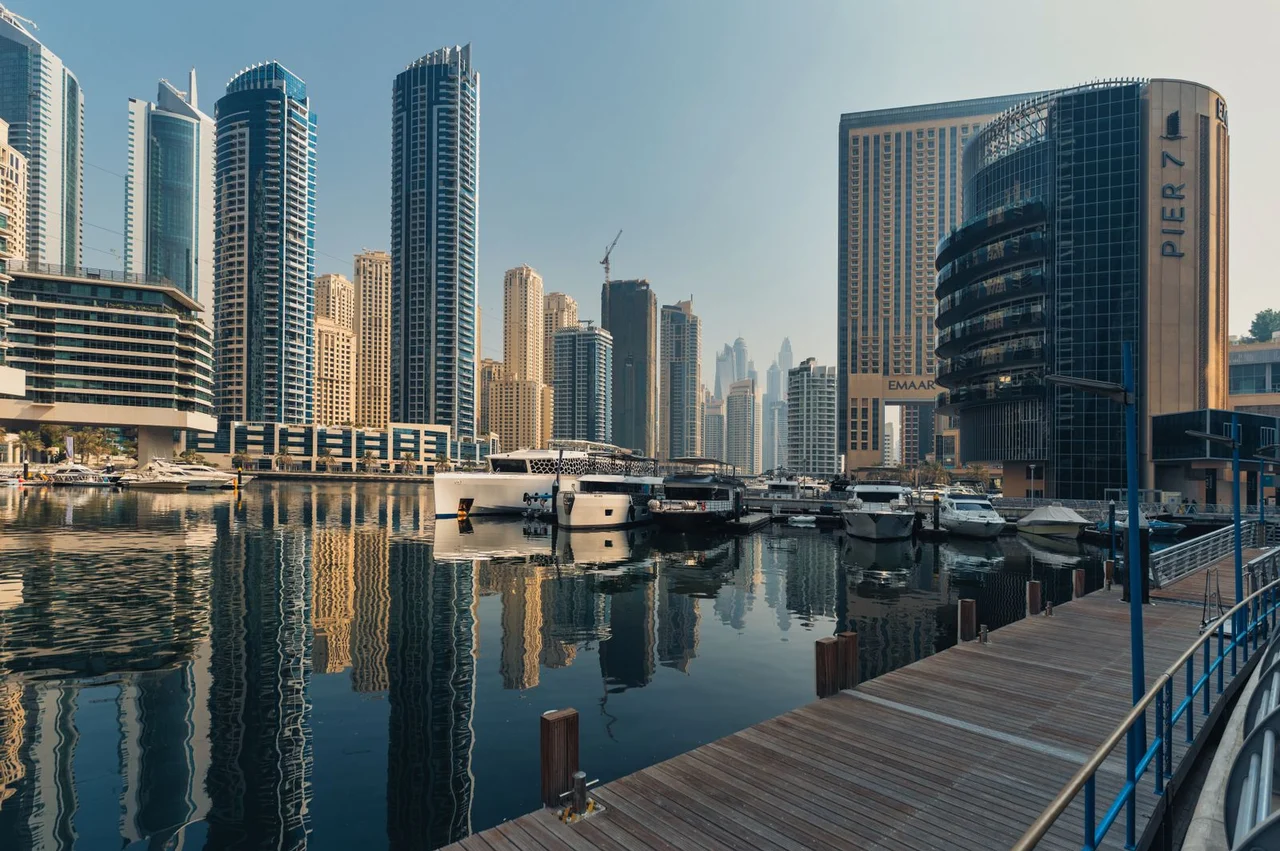
Designated (freehold) zones are neighborhoods the Dubai government has officially opened for full foreign ownership. Today there are more than sixty such neighborhoods, and it's exactly in them that international buyers' demand is concentrated. When people say "buying property in Dubai as a foreigner", they almost always mean exactly these zones.
The most well-known and liquid freehold neighborhoods:
- Dubai Marina- a waterfront with skyscrapers, a yacht marina, one of the city's most rented neighborhoods.
- Downtown Dubai- the center by Burj Khalifa and Dubai Mall, the premium segment.
- Palm Jumeirah- an artificial island, villas and apartments by the water, the upper price tier.
- Business Bay- a business district by the canal, a mix of housing and offices.
- Jumeirah Village Circle (JVC)- a more affordable family neighborhood, popular with investors for rental.
- Dubai Hills Estate- a green neighborhood with villas, townhouses, and infrastructure for families.
Choosing a zone isn't just about price, but about strategy: some neighborhoods give high rental returns, others - stable value growth and comfort for your own residence. We keep a detailed breakdown of neighborhoods and the choice logic in the article onbuying property in Dubai. At the start it's enough to remember the rule: full ownership for a foreigner - only in a freehold zone, and this is the first thing checked before the deal.
UAE property: prices per square meter in 2026
UAE property prices strongly depend on the neighborhood, the property's completion stage, and the housing type. To orient yourself, it's useful to keep 2026's average figures in mind - they give a picture of the budget's scale. Below are approximate ranges for Dubai's key freehold zones.
| Neighborhood / segment | Price per m² (2026 benchmark) | A typical apartment budget |
|---|---|---|
| Dubai's average market | about 18,000 AED/m² | from ~750,000 AED for compact housing |
| JVC, affordable neighborhoods | 13,000-16,000 AED/m² | studios and 1-bedrooms from ~600,000-900,000 AED |
| Dubai Marina | 22,000-29,000 AED/m² | a 1-bedroom around 1.8 million AED |
| Downtown Dubai | 24,000-29,000 AED/m² | a 1-bedroom from ~2.3 million AED |
| Palm Jumeirah, premium | above 30,000 AED/m² | villas and view apartments - individual |
The figures are approximate and change with the market, so they're always checked against current data before a deal. A useful public source - the Land Department's housing price index at the portal ofDubai Land Department (dubailand.gov.ae). A detailed breakdown by neighborhood and dynamics - in the overview ofDubai property prices in 2026. An important detail for the budget: buying from 2 million AED puts you in the Golden Visa threshold, and from 750k AED - in the 2-year residency threshold, so the property's price affects not just the deal, but visa opportunities too.
We will find the right basis for residency in the UAE
We calculate the budget and timing for your family and list the documents you need.
The 4% DLD fee and accompanying purchase expenses
The main mandatory payment when buying property in Dubai is the Land Department fee (the DLD transfer fee) at 4% of the property's value. This fee is paid upon registering the ownership transfer and is formally split between the parties, but in practice is almost always borne by the buyer. Beyond it there's a set of accompanying expenses, and a sound benchmark is to budget approximately 7-8% above the property's price for all fees and commissions.
What the deal's expenses consist of:
- The DLD fee - 4%of the property's value (the main payment).
- DLD administrative fees- fixed sums for issuing the Title Deed (around a few thousand AED).
- An agency commission- generally about 2% when buying on the secondary market.
- NOC (No Objection Certificate)from the developer upon resale - from a few hundred to a few thousand AED.
- Mortgage registration- if the property is bought on credit, a separate fee for registering the lien is added.
When buying under-construction housing directly from a developer, the agency commission is often absent, and the DLD fee is still paid - but the developer often includes special conditions. It's more convenient to break down the exact estimate for a specific property with an example, and we do this in the guide onhow to buy an apartment in Dubai.
Purchase conditions and stages: a "stage - term - expense" table
To avoid surprises, it's useful to see the whole deal in advance as a sequence of stages with real timeframes and expenses. Below is a typical roadmap for a foreigner buying UAE property. Specific timeframes depend on the property (ready or under construction) and whether a mortgage is needed.
| The purchase stage | Timeframe (benchmark) | Expense |
|---|---|---|
| Choosing the freehold property and checking the developer | from a few days to a couple of weeks | with no direct payments |
| Booking, signing the agreement (SPA / Form F) | 1-3 days | a deposit of about 10% of the value |
| A developer's NOC (for secondary) | 3-7 business days | from a few hundred to a few thousand AED |
| Registering the ownership transfer at DLD | 1 day (when the parties are ready) | the 4% DLD fee + administrative fees |
| Oqood registration (for a new build) | at the time of purchase | included in the DLD fees |
| Getting the Title Deed (ready housing) | on the deal day | as part of the administrative fees |
| Applying for residency / Golden Visa | from 1-2 weeks | government fees (benchmark about 10k AED) + a medical exam and Emirates ID |
For under-construction housing, a payment schedule by construction stage through escrow is added to this scheme, and the Title Deed is issued after the property's completion (Oqood confirms rights before that). It's better to form the final personal estimate and deal calendar for the specific property.
Buying UAE property as a Russian citizen: what to account for
For Russian citizens, Dubai remains one of the most accessible destinations: visa-free entry for 90 days within 180 with a regular foreign passport, direct flights, no local sponsor requirement for the purchase. A Russian citizen can buy UAE property under the same freehold conditions as any other foreigner - the deal itself has no special citizenship restrictions.
The key nuance lies not in the purchase, but in the money:
- Enhanced bank compliance.UAE banks apply strict KYC/AML procedures and a source-of-funds check. For Russian citizens this means a more thorough check, and not every bank is ready to open an account or process a payment.
- Confirming the origin of funds.Documents explaining where the money came from (asset sale, income, dividends, etc.) will be needed - this is a standard worth preparing for in advance.
- The settlement route.Settling through the developer's bank or a certified payment requires correct arrangement; mistakes at this stage are a common cause of delays.
It's fundamentally important: everything strictly within the law, with no sanctions bypass and no gray schemes. The task is to conduct the deal cleanly and transparently, with a correctly prepared source-of-funds package, so the bank and regulator have no questions. A detailed breakdown of exactly this scenario - in the article onproperty in Dubai for Russian citizens.
Common buyer mistakes: what to look at before the deal
Over time working with Dubai's market, we see foreign buyers let down not by exotic risks, but the same basic oversights. Let's break them down so you don't lose money and time.
- Buying outside a freehold zone.Sometimes an attractive property turns out to be in a neighborhood where only leasehold ownership is available to a foreigner. The zone's status needs checking before putting down a deposit.
- Underestimating the full estimate.People count only the property's price and forget about the 4% DLD fee, administrative fees, the commission, and the NOC - in total about 7-8% above. The budget needs planning with the expenses right away.
- Ignoring checking the developer.Escrow and Oqood protection works only with a licensed developer and with correct deal registration. An unnamed "advantageous" new build with no registration is a red flag.
- Confusing the purchase and the visa.The deal doesn't automatically "switch on" residency: the visa is arranged separately, and it's important to observe the value threshold in advance if the goal is residency.
- Weak source-of-funds preparation.Especially for Russian citizens: money-origin documents are prepared before the deal, not at the moment the bank has already asked a question.
Dubai forgives a lot, but doesn't forgive haste and an unchecked developer. The more thorough the preparation at the start, the calmer both the deal and the visa arrangement go.
We will calculate the budget for your family
A full estimate: contributions, fees and our work for your family.
Conclusion: who Dubai property suits and why
UAE property is a combination of three rarely coinciding things: full foreign ownership in freehold zones, a mild tax regime with no annual property tax and no capital gains tax, and a legal path to residency through residency from 750k AED or Golden Visa from 2 million AED. For an entrepreneur wanting to diversify capital and get a "backup base" for family, this is one of the most rational options today.
caveats matter too. Property gives residency, but not citizenship - a UAE passport isn't issued for investment. For Russian citizens, bank compliance and source-of-funds confirmation become the key stage, and this is solved only within the legal field, with no sanctions bypass. And the market itself requires discipline: checking freehold status, the developer's license, Oqood registration, and calculating the deal's full estimate.
The optimal strategy for most is to first determine the goal (residence, income, or residency), select a property for the needed visa threshold, and conduct the deal cleanly, with a money package prepared in advance. From there you can dig into details in our breakdowns:buying property in Dubai, how to buy an apartment in Dubaiand current 2026 prices.
UAE property taxes: what's absent here
The tax regime is one of the main reasons wealthy people choose UAE property. A fundamental difference from Europe: there's no annual property tax here. You pay the DLD fee once upon purchase - and thereafter own the property with no regular fiscal burden.
What's important to know about property-related taxes:
- There's no annual property taxfor the individual owner.
- There's no capital gains taxwhen an individual sells housing - the profit from value growth remains fully with you.
- There's no personal income tax, including no tax on an individual's income from renting out an apartment.
- VAT 5%generally doesn't apply to residential property sale and rent (housing is mostly exempt or taxed at a zero rate); commercial property is taxed with VAT at the standard rate.
- The municipal feeon housing is generally built into the tenant's utility payments and isn't a tax on the owner in the classic sense.
Separately about business: since 2023, 9% corporate tax on profit above 375,000 AED has been in effect in the UAE, and Pillar Two rules for large international groups since 2025. But this concerns companies, not a private housing owner. If property is registered to a company or it's about an investment portfolio, the tax construction is worth calculating in advance - this is a consultation topic.
"When people come to me with a request to buy property in Dubai, I always start not with the property, but the goal and the money. The goal determines the threshold: just need an asset - we look at one budget, need residency - we hold the bar from 750 thousand dirhams, need a ten-year Golden Visa - from two million. And the money determines the scenario: the UAE has strict bank compliance, and especially for Russian citizens it's important to gather a clean source-of-funds package in advance - this is solved only within the law, with no gray workarounds whatsoever. Then the technique: only a freehold zone, only a licensed developer, we always check escrow and Oqood registration, calculate the full estimate accounting for the 4% DLD fee and accompanying expenses. If these three things - goal, money, and verification - are built correctly, the deal goes calmly, and residency gets arranged as a logical consequence."
Buyer protection: escrow accounts, RERA, and Oqood
Dubai's new-build market is built so the buyer's money doesn't go directly and uncontrolled to the developer. RERA (the Real Estate Regulatory Authority) - a regulator within the Land Department - watches over this. The key protection tool is the escrow account.
How this works in practice:
- An escrow account for each project.Under-construction housing buyers' money goes not to the developer, but to a special guarded account opened only for the specific project.
- Payments by construction stage.The developer gets access to funds in parts, as RERA-confirmed construction stages are reached - not all at once.
- Spending control.Developers must file construction progress and spending reports certified by accredited engineers; violations threaten fines and license revocation.
- Oqood registration.When buying an under-construction property, the deal is registered on the Oqood platform, and the buyer gets an Oqood certificate confirming their rights before the final Title Deed is issued.
- Protection if the project fails.Upon a serious delay, cancellation, or the developer's bankruptcy, escrow rules allow returning funds in the RERA-established order.
This system is exactly what distinguishes Dubai's primary market from countries where money is given to the developer with no guarantees. But protection works only when buying from a licensed developer and with correct deal registration, so checking the developer's status and Oqood registration is a mandatory point.
Residency for property: from 750k AED and Golden Visa from 2 million
Buying property in the UAE isn't just an asset, but also a legal path to residency. The visa's size directly depends on the property's value, and there are two main steps here.
- From 750,000 AED - 2-year residency.Buying housing for this sum gives the right to a renewable two-year resident visa with Emirates ID arranged. This is the basic and most budget-accessible path.
- From 2,000,000 AED - Golden Visa for 10 years.This is the flagship status: a ten-year renewable visa, self-sponsored (with no sponsoring employer). The property can be ready, under construction, or acquired on a mortgage with an approved bank - the threshold is counted by the property's value.
What Golden Visa gives the holder - and this is its main advantage:
- The abilityto sponsor family themselves- a spouse and children with no age restriction.
- Sponsoringparents and household staff.
- Long-term residence with no tie to an employer and no requirement to constantly be in the country, as with a regular visa.
There are also intermediate options: a 5-year retirement visa for persons 55+ with property from 1 million AED (or with sufficient savings/income). At the same time, the purchase itself doesn't "switch on" the visa - residency is arranged through a separate procedure with a medical exam and Emirates ID. We break down visa routes and the document package in more detail in the hub's dedicated articles.
We will send a document checklist for your case
Leave your details: we will put together documents and timelines for your family.
Purchase options: a new build, secondary, a mortgage, to a company
A foreign buyer in Dubai has several working scenarios - and the choice between them determines the budget, risks, and visa opportunities. Let's break down the main options to have something to build from.
- A new build from a developer (off-plan).Often cheaper at the start, installments over the construction period are popular, money is protected by escrow and Oqood. The downside - waiting for completion and the delay risk, which RERA control partially removes.
- Ready housing on the secondary market.You move in or rent out right away, see a real property, but it's usually more expensive and an agency commission of about 2% and a developer's NOC are added.
- Buying on a mortgage.For a non-resident, LTV (the credit share) is usually up to 50-60%, for a resident - higher. A mortgaged property also counts toward the Golden Visa threshold by value.
- Registering to a company.Sometimes a property is registered to a local or offshore structure (for example, for holding several assets) - but this changes the tax and visa logic, and is decided individually.
There's no universal "best" option: ready housing more often fits a family for their own residence, a new build in a promising neighborhood fits an investor for growth and returns. The main thing is to calculate the full estimate and keep the target visa threshold in mind. Our specialists will help break down your specific situation and select a scenario.
Frequently asked
Questions people ask before deciding
01Can a foreigner buy UAE property with no visa and local sponsor?
Yes. In Dubai's designated (freehold) zones, a foreigner buys property in their own name with full ownership, with no visa, local sponsor, and even no UAE bank account. The deal can be conducted in person during a visit or remotely through a power of attorney. The ownership document is the Title Deed from the Land Department's registry.
02What is the 4% DLD fee and what other expenses come with the purchase?
The DLD fee is the Land Department's payment of 4% of the property's value upon registering the ownership transfer; in practice it's borne by the buyer. Beyond it, DLD administrative fees, an agency commission of about 2% on secondary, a developer's NOC, and mortgage registration for credit are budgeted. A sound benchmark - about 7-8% above the property's price for all fees.
03Is there an annual property tax in the UAE?
No. There's no annual property tax for the individual owner in the UAE. There's also no capital gains tax upon selling housing and no tax on an individual's rental income. You pay the DLD fee once upon purchase and thereafter own the property with no regular fiscal burden. VAT generally doesn't apply to residential property.
04At what sum does buying property give residency in the UAE?
From 750,000 AED, buying housing gives the right to renewable 2-year residency with Emirates ID. From 2,000,000 AED, Golden Visa for 10 years (self-sponsored) opens, under which the holder sponsors family themselves with no age limit for children, as well as parents. There's a 5-year retirement visa for persons 55+ with property from 1 million AED.
05Does UAE property give citizenship or a passport?
No. Property gives the right of residence (residency or Golden Visa), but not citizenship. A UAE passport isn't sold for investment - citizenship is granted only by decree of the authorities for exceptional categories of persons or through very long naturalization. There's no citizenship-by-investment program in the UAE, and this is important to understand.
06What are Dubai property prices in 2026?
On average across Dubai's market - about 18,000 AED per square meter. In affordable neighborhoods like JVC - approximately 13,000-16,000 AED/m², in Dubai Marina and Downtown - approximately 22,000-29,000 AED/m², at Palm Jumeirah and in premium - above 30,000 AED/m². The figures are approximate and change with the market, checked against current data before a deal.
07What are freehold zones and why check them?
Freehold (designated) zones are neighborhoods officially opened for full foreign ownership; there are more than sixty in Dubai. Only in them does a non-resident get perpetual inheritable ownership. Outside these zones only long-term lease (leasehold) or a usufruct right is available. So the zone's status is checked before putting down a deposit.
08How is the buyer's money protected when buying a new build?
Through escrow accounts under RERA control. Under-construction housing buyers' money goes not directly to the developer, but to a guarded account for the specific project, and the developer gets it in parts as construction stages are confirmed. The deal is registered on the Oqood platform with a certificate issued. If the project fails, funds are returned per RERA rules.
09Can property be bought in Dubai on a mortgage as a foreigner?
Yes. For a non-resident, the credit share (LTV) is usually up to 50-60%, for a UAE resident - higher. A mortgaged property also counts toward the Golden Visa threshold by the property's value - the former requirement to contribute 1 million AED of own funds no longer exists, the total property value from 2 million AED is counted.
10Can a Russian citizen buy UAE property?
Yes, under the same freehold conditions as any foreigner - there are no citizenship restrictions on the deal itself. The key nuance - enhanced bank compliance: banks strictly check the source of funds, and not every one is ready to process a payment for a Russian citizen. Everything is conducted strictly within the law, with no sanctions bypass, with a money-origin package prepared in advance.
11How long does a Dubai property purchase deal take?
The registration of the ownership transfer at DLD itself, when the parties are ready, goes through in one day, but the whole cycle takes from a couple of weeks: choosing and checking the property, booking with a deposit of about 10%, a developer's NOC for secondary, registration, and getting the Title Deed. For under-construction housing, the Title Deed is issued after completion, and Oqood confirms rights before that.
12What's better for a foreigner - a new build or ready housing?
It depends on the goal. A new build from a developer is often cheaper at the start, installments exist, money is protected by escrow and Oqood, but you need to wait for completion. Ready housing on secondary can be used or rented out right away, you see a real property, but it's more expensive and a commission of about 2% and an NOC are added. Ready housing more often fits a family for residence, a new build fits an investor for growth.
Transparency
How this material was prepared
- Author
- Dmitry Nagy, international Tax Consultant, BRIDGES
- Terms and costs last verified
- June 2026
- Sources
- official government authorities of the relevant country and state publications
- Methodology
- government minimum requirements are stated separately from due diligence charges, state fees, legal and banking costs
Sources and methodology
Figures, terms and timelines are checked against official sources as of June 2026. Link availability verified in August 2026. Third-party blogs and agent websites are not used as a source of programme terms.
- [1]Federal Authority for Identity, Citizenship, Customs and Port Security (ICP)Visas, residence statuses, Emirates IDicp.gov.ae/en
- [2]Official portal of the UAE GovernmentGolden visa and residence visasu.ae/en/information-and-services/visa-and-emirates-id/residence-visas/golden-visa
Methodology: tables and charts state government minimum investment requirements; due diligence charges, state fees, legal, banking and other costs are calculated separately and are not included in the minimum thresholds.
About the author
Related materials
What to read next
 ArticleUAE citizenship by investment in 2026: is there a program and what really works?
 ComparisonDubai or Abu Dhabi in 2026: where to live, work and buy property
 AnalysisWhat is due diligence and why the Caribbean is rejecting applications
Personal programme selection is conducted by Anna Kovalevskaya, Head of Legal, BRIDGES.
Tax residency in UAE: how it is determined
When tax residency arises, how double taxation is avoided and what the tax authority checks.
