News · Nauru
Nauru issues 221 passports: the programme now receives 25 applications a month

Updated: November 2026·9 min read·Expert reviewed
Terms and costs verified: November 2026
Contents
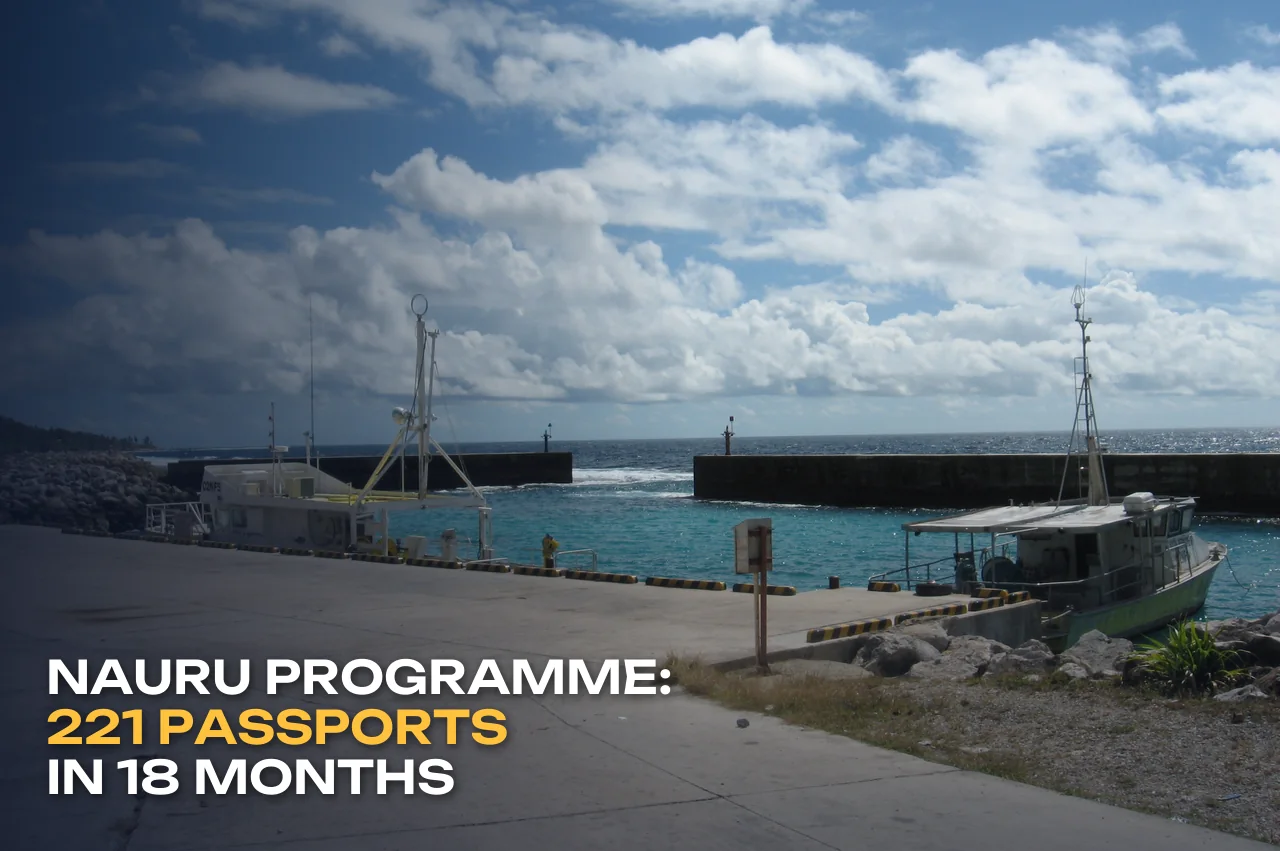
Nauru's citizenship programme has issued 221 passports. The programme office gave the figures in a media release on 19 November 2026: by 13 November it had approved 98 applications, received 205 since February 2025, and now takes in about 25 applications a month, twice the average of its first eighteen months. New citizens come from 42 countries, and 90.6% of decided files were approved. The reduced $90,000 contribution applies to applications filed before 31 December 2026, after which it returns to $115,000. For anyone choosing an affordable second passport, these are the last five weeks at the current price.
Key points
- 221 passports were issued on 98 approved applications: more than two people per file on average.
- Demand is rising: about 25 applications a month now, against roughly 11 a month over the first 18 months.
- 90.6% of decided files were approved. The average path from filing to documents is 155 days, and about 121 days for recent files.
- Families are getting larger: 2.9 people per application on average in 2026, up from 2.3 in 2025.
- The $90,000 contribution holds for applications filed before 31 December 2026. From 2027 it is $115,000.
What the programme office reported
For the first time, Nauru's programme office has released detailed statistics on eighteen months of operation. The figures cover every stage: how many applications were filed, how many were approved, how many passports new citizens already hold, and how long it takes to get from filing to documents. There is no public annual report with these data on the programme website, ecrcp.gov.nr: the office shared them in a media release, and we report them as programme office data.
| Indicator | Programme office data |
|---|---|
| Passports issued by 13 November 2026 | 221 |
| Applications approved | 98 |
| Applications filed since February 2025 | 205 |
| Applications per month now | about 25 |
| Countries of origin of new citizens | 42 |
| Approval rate among decided files | 90.6% |
| Average time from filing to documents | 155 days, fastest 96 |
| Files lodged in May-July 2026 | 120.8 days on average |
| Average family size in 2026 | 2.9 people |
The headline number is 221 passports. They were issued on 98 approved applications, so an average file brings citizenship to more than two people. That follows directly from how the programme works: a single file can include a spouse, children, parents, and the brothers and sisters of the applicant or spouse. We covered the family rules and the rate for each category on the Nauru citizenship programme page.
The second key number is the 90.6% approval rate. It counts only the files that have already been decided. The 98 approved applications are 48% of everything filed: the rest are still in progress, and many were lodged in recent months. Put simply, about one file in ten is refused, and most applicants with carefully prepared documents receive a passport.
Demand has doubled
Over its first 18 months the programme received 205 applications, an average of about 11 a month. It now receives about 25 a month. The growth came in 2026, and the head of the programme office, Edward Clark, links it to changes the office made along the way: a lower contribution and a broader definition of the family.
The mix of applicants is changing too. In the first year Chinese nationals filed the most applications, followed by stateless applicants. In 2026 their share fell, while applications from the Gulf states rose noticeably. In all, Nauru's new citizens come from 42 countries, so the programme is no longer a niche story about a single market.
For comparison, Sao Tome and Principe received 548 applications and approved 350 in its first year, see our news on Sao Tome's first report. Nauru is smaller in volume but growing faster, and it discloses timelines for each stage. How the two programmes compare on price and terms is set out in our Sao Tome vs Nauru comparison. How openly different countries publish such data is shown in our citizenship programme transparency index.
Timelines: 155 days on average, recent files faster
According to the office, the average path from filing to finished documents is 155 days, or about five months. The fastest file took 96 days. The programme website quotes three to four months to a decision, and the gap is easy to explain: the 155 days include not only the review but also paying the contribution, taking the oath and producing the passport.
What matters more is that timelines are shrinking. Files lodged in May-July 2026 completed the path in 120.8 days on average, and their approvals came on average 68.9 days after formal acceptance. So the realistic benchmark today is about four months to a passport with a complete file.
The timeline depends above all on the file. Due diligence covers every adult family member, and any gaps in income or source-of-funds documents add time. In our own practice we have a case where the passport came on day 85 because the file was prepared in advance. What goes into the document package and in what order things happen is described in our Nauru citizenship guide.
What this means for you. Recent files complete the path in about four months. If you file a complete package in December, a passport by spring 2027 is realistic, and the contribution is locked at the 2026 price.
Families are getting larger
In 2026 the average application includes 2.9 people, up from 2.3 in 2025. More than 60% of applications include at least one dependant, more than 35 families filed for five people or more, and the largest family in a single file has nine members, including brothers and sisters.
The head of the office links this growth directly to the revised family inclusion rules. A file can include a spouse, children, the parents of the applicant and spouse, and also brothers and sisters, a category most citizenship programmes do not offer. Children under 16 need no additional contribution, a dependant aged 16 or over adds $2,000, and a brother or sister adds $15,000. How one file solves the question for adult children at university is shown in our case of a family with student children.
For a large family this is the main argument. One main applicant contribution plus modest additions for relatives brings passports for everyone at once, in a single file and on a single timeline. According to the office, the average contribution per application in 2026 was $91,682 before fees, so families mostly pay only a little more than the base price.
The $90,000 contribution until 31 December
Since 3 February 2026 the main applicant contribution has been cut by $25,000, to $90,000 instead of $115,000. The discount first ran until 30 June, and the office then extended it to applications filed before 31 December 2026. The official programme website confirms this: the discount applies to all current and new applications filed before that date.
Crucially, the deadline is tied to the filing date, not the payment date. The main contribution is paid after approval, so an application filed in December keeps the $90,000 price even if the decision comes in 2027. From 1 January, unless extended again, the contribution returns to $115,000. The full calculation with all fees is in our article on the cost of Nauru citizenship, and how one family made it before the previous increase is told in our case on filing before the price rise.
At this level Nauru is one of the most affordable citizenship by investment programmes in the world. It is a non-refundable contribution to the national treasury fund: no property purchase, no relocation, no personal visits. You do not need to live in Nauru, you do not have to give up your first passport, and citizenship itself creates no tax obligations, see our article on dual citizenship and our article on taxes. The passport is issued for 10 years to every family member, children included.
Nauru is now Naoero
Since the summer the country has had a new official name. On 26 June 2026 Nauru notified the United Nations that it is now called the Republic of Naoero. The programme and its office changed names too: the Naoero Economic and Climate Resilience Citizenship Program and the Naoero Program Office. The official website address is unchanged: ecrcp.gov.nr.
For applicants the new name changes nothing: the terms, the contribution and the filing procedure stay the same, and passports are already issued under the new name. Bank and consular forms may use either version, and both refer to the same state. The history, economy and institutions of the country are covered on our Nauru country page, and the passport itself is explained in our article on the Nauru passport.
How we got here
- 11.2024The programme is presented at the UN climate conference in Baku
- 02.2025The programme office starts accepting applications through accredited agents
- 08.2025The first investors receive Nauru citizenship
- 03.02.2026The main applicant contribution is cut by $25,000: $90,000 instead of $115,000
- 06.2026The discount is extended to applications filed before 31 December 2026
- 26.06.2026The country notifies the UN of the name Republic of Naoero
- 13.11.2026221 passports issued on 98 approved applications
- 31.12.2026Last day to file at the $90,000 contribution
The programme was launched at the UN climate conference in Baku in November 2024. Contributions fund the island's climate resilience, and the country builds its position on that: the programme is a source of financing, not a passport sale in the old sense. Strict checks on every adult applicant and filing only through accredited agents are part of this model.
One limitation is worth knowing in advance. Since 9 December 2025 the United Kingdom has required visas from Nauru citizens, a decision the programme office has disputed. That is why clients choose Nauru not for travel to Europe but as a second document with a low entry price for family security, banking and business mobility in Asia and Oceania. Current entry rules by country are collected in the Nauru passport index. If Europe is the priority, compare other options in our Nauru vs Vanuatu comparison and in the citizenship catalogue.
Who Nauru suits right now
- Large families. Parents, adult children, brothers and sisters in one file and on one timeline.
- People who need a backup passport without relocating. There is no need to live in or even visit the country.
- Budget-conscious applicants. $90,000 for the main applicant until the end of the year, with modest additions for family members.
- Entrepreneurs active in Asia, the Middle East and Oceania. A second citizenship for accounts, companies and business travel.
The office's statistics answer the main question about any new programme: does it work in practice. 221 passports, 42 countries and a 90.6% approval rate show that the process runs smoothly and timelines are getting shorter. The programme's key terms are explained in our Nauru programme glossary.
Darya MelnikSenior Investment Programs Advisor, BRIDGES
File before 31 December at the $90,000 contribution
We will calculate the total for your family, check your documents and file through an accredited agent before the price rises.
What to do now
Decide by mid-December
To file before 31 December, start collecting documents now: certificates, translations and apostilles take time.
Define your family
Decide whom to include: spouse, children, parents, brothers and sisters. The family affects the total and the document package.
Prepare a complete file
Recent files complete the path in about four months when the file is complete from day one.
Lock in the price
An application filed before 31 December keeps the $90,000 contribution even if the decision comes in 2027. Terms are on the programme page.
BRIDGES supports clients through the Nauru programme from the first calculation and document collection to passports for the whole family. You can review your situation and file before the price rises at an online consultation.
Share this article
Still have questions? We'll answer for your case
Tell us what you want to solve, and an expert on the topic will contact you.



Frequently asked
Questions people ask before deciding
01How many passports has the Nauru programme issued?
According to the programme office, 221 passports had been issued on 98 approved applications by 13 November 2026. 205 applications have been filed since February 2025.
02What share of applications is approved?
90.6% of the files that have already been decided. About one file in ten is refused.
03How long does it take to get a passport?
155 days on average from filing to documents, with the fastest file at 96 days. Files lodged in May-July 2026 took 120.8 days on average.
04Until when does the $90,000 contribution apply?
For applications filed before 31 December 2026. The payment date does not matter, as the main contribution is paid after approval. After that it returns to $115,000.
05What does the name Naoero mean?
It is the country's new official name: on 26 June 2026 Nauru notified the UN that it is now the Republic of Naoero. The programme terms have not changed.
About the author
Related materials
What to read next
 NewsSão Tomé and Príncipe: 548 applications in the first year, Russia in second place
 ComparisonNauru or Vanuatu citizenship: which should an investor choose
 ArticleArea and size of Nauru: how small is this country
News+10 stories on 24 November
Related news
 Saint Kitts and Nevis · 24 NovNevis Premier asks for five years to close citizenship programmes: a statement, not an EU decision
 Caribbean · 24 NovCitizenship programme transparency index 2026: 8 of 13 below 30%, Saint Lucia leads
 Germany · 24 NovGerman citizenship stays at 5 years: SPD rejects CDU plan to bring back 8
Personal programme selection is conducted by Anna Kovalevskaya, Head of Legal, BRIDGES.
File before 31 December and keep the $90,000 contribution
We will calculate the total for your family, check the documents and file before the price rises.