News · Germany
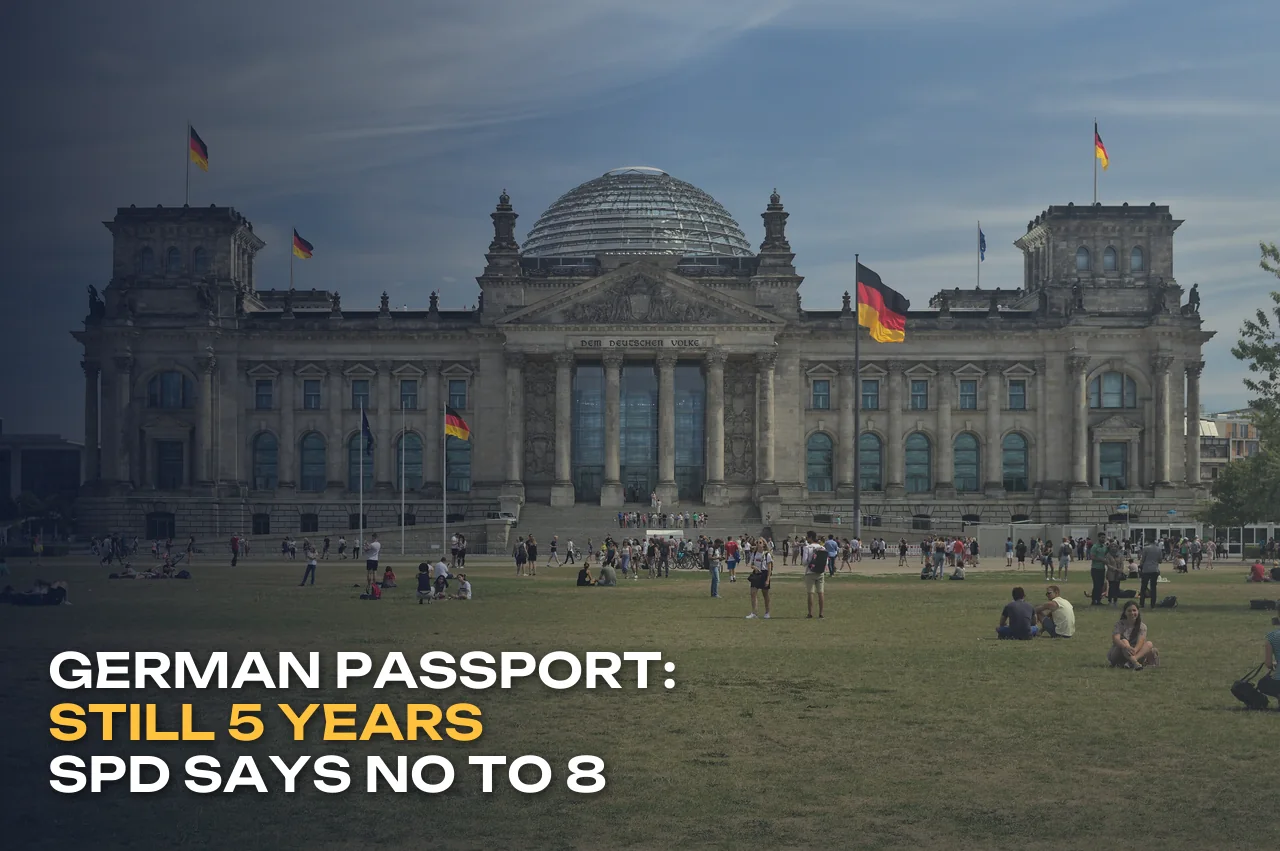
German citizenship stays at 5 years: SPD rejects CDU plan to bring back 8
Updated: November 2026·10 min read·Expert reviewed
Terms and costs verified: November 2026
Contents
Germany's citizenship law is not going to change. That was the answer of the Social Democrats, the CDU/CSU's partner in the governing coalition, on 19 and 20 November 2026 to the conservatives' proposal to bring back an eight-year residence requirement for naturalisation. Hakan Demir, the SPD group's deputy spokesperson on domestic policy, called reports of a joint reform package made up and said there are no talks on the issue and none are planned. His colleague Sebastian Fiedler told Deutsche Welle the same: there will be no changes. The current rules therefore stand: five years of residence, B1 German and dual citizenship.
Key points
- The SPD rejected the CDU plan for eight years before citizenship: there are no talks and the law stays as it is.
- Without SPD votes the CDU/CSU has no majority in the Bundestag, so the conservative proposal cannot become law for now.
- Today German citizenship is available after 5 years of lawful residence, with B1 German and without giving up your current passport.
- The 3-year fast track has been abolished since 30 October 2025. Nobody is proposing to bring it back.
- In 2025 Germany naturalised 332,500 people, a record since statistics began.
What the SPD said
Hakan Demir, deputy spokesperson of the SPD group in the Bundestag for domestic and migration policy, responded first. On 19 November he told the Tagesspiegel that the reports of a joint reform package were completely invented and that there are no negotiations on the subject. In his words, Germany has a good citizenship law and it will stay that way: anyone who lives and works in the country, speaks German and accepts democracy and the Basic Law should gain equal rights after five years.
Demir also recalled the condition on which the SPD accepted the last tightening. The Social Democrats agreed to abolish the three-year fast track only on the basis that the rest of the citizenship law would remain untouched. This is written into the coalition agreement, and Demir said the party would lose all credibility if it agreed to more.
On 20 November Demir's office repeated the position to Deutsche Welle. No new negotiations on naturalisation are under way or planned, so the question of concessions by the SPD does not arise. The compromise was already reached in the coalition talks: the fast track is gone and every other provision of the law stays. Sebastian Fiedler, the SPD group's spokesperson on home affairs, put it briefly to Deutsche Welle: there will be no changes to the citizenship law.
According to Demir, the conservatives are not united either. He names CDU MP Alexander Throm as the driver of the changes, while Interior Minister Alexander Dobrindt of the CSU, in his account, has no interest in the initiative. That detail matters: citizenship bills are drafted by the interior ministry.
What this means for you. For people living in Germany nothing has changed. Five years, B1 German and dual citizenship remain in force. If you already meet the conditions, apply under the current rules.
What the conservatives proposed
On 18 November the newspaper Bild, citing unnamed sources, reported a CDU plan to tighten naturalisation rules. We covered it in detail in our news on the proposal to bring back 8 years. In short: raise the residence period from five years back to eight, allow dual citizenship only in exceptional cases, require B2 German instead of B1, and make receipt of social benefits a ground for refusal with no exceptions. Eight years was also proposed as the condition for citizenship of children born in Germany.
| Requirement | In force now | CDU proposal (Bild, 18 Nov) | SPD position |
|---|---|---|---|
| Residence period | 5 years | 8 years | keep 5 years |
| Fast track | abolished from 30 Oct 2025 | not planned | abolition was the concession, no more |
| Dual citizenship | allowed | exceptional cases only | keep it |
| German language | B1 | B2 | no change |
| Social benefits | exceptions in the law | no exceptions | no change |
| Children born in Germany | parent lived 5 years | parent lived 8 years | no change |
According to Bild, in return the conservatives were ready to back the SPD's demand to strengthen the rights of foreigners who work or train in Germany, and the coalition could have discussed the package this week. The SPD's answer closes that route: there will be no trade, because there are no talks at all. The CDU proposal remains one party's position, not a government plan.
The rules in force today
The main conditions for naturalisation are set out in Germany's Nationality Act (StAG). The standard route, used by 72 percent of all new citizens in 2025, requires at least five years of lawful habitual residence in the country. The period is counted in years lived in Germany with a suitable residence permit, not from the date of the application.
- Residence. At least 5 years of lawful residence in Germany.
- Language. German at B1 level, shown by a certificate or by education in Germany.
- Test. The "Life in Germany" test on the country's legal and social order.
- Income. Applicants support themselves and their family. The law allows exceptions, for example for long-term full-time workers.
- Record and loyalty. No convictions for serious offences and a commitment to the democratic order.
- Dual citizenship. There is no need to give up your current passport, as long as the law of your home country allows it.
A separate rule applies to children. A child of foreign parents born in Germany becomes a citizen at birth if one parent has lived lawfully in the country for five years and holds a permanent right of residence. A spouse and minor children can be naturalised together with the applicant: 19 percent of new citizens gained their passport this way in 2025.
Applications go to the citizenship authority where you live. Queues are long in the big cities, so it pays to prepare documents early: language certificate, test result, proof of income and residence, marriage and birth certificates with translations.
The fast track is gone
Three years instead of five became possible on 27 June 2024, when the previous coalition's reform took effect. It required special integration achievements: C1 German, a good job, civic engagement. In October 2025 the Bundestag, under the new coalition, removed the provision, and since 30 October 2025 there has been no fast track. The German government confirms that a minimum period of five years now applies to everyone.
The rule did not last long. In 2024, 19,100 people gained citizenship through the fast track, 7 percent of all naturalisations. In 2025 there were only 1,500, less than one percent. The law gave no transition period to those who had not yet received a decision.
The current dispute does not touch the fast track. The conservatives are not proposing to bring it back, and the SPD sees its abolition as a concession already made. A realistic benchmark for planning over the coming years is therefore five years.
Record demand for the passport
The dispute comes against a record number of new citizens. According to the Federal Statistical Office, 332,500 people acquired German citizenship in 2025, 14 percent more than a year earlier. Germany had never recorded more than 300,000 naturalisations in a year since statistics began in 2000. 467,400 applications were filed, and of 371,100 completed cases 90 percent ended in citizenship and only about 3 percent in refusal.
The largest groups were citizens of Syria, then Turkey and Russia. New citizens from Turkey and Russia rose by 51 percent, to 34,100 and 19,700. The statisticians link this growth directly to the acceptance of dual citizenship: many used to have to give up their passport, and now they can keep it. How your home country treats dual citizenship is worth checking before you apply; for Russian law we covered it in our guide to dual citizenship.
The average time lived in Germany at naturalisation was 12.4 years. Many people do not apply straight after five years but once their language and documents are in order. That is one more reason not to wait: the residence period is already met, while the rules may become a subject of dispute again in the next parliament.
Could the CDU proposal come back
Changing the citizenship law needs a majority in the Bundestag. The CDU/CSU does not have one without the SPD: the governing bloc refuses to work with the AfD, and the other groups do not support a tightening. As long as the Social Democrats hold their position, no eight-year bill will appear. Even if that changed, a bill would have to be drafted, introduced and passed, which takes months, and new rules would most likely apply only to new applications.
It is too early to take the issue off the agenda entirely. The conservatives voted for eight years at the CDU congress in February 2026 and will come back to it, especially ahead of elections. Germany's next federal election is due by 2029 at the latest. Anyone starting out now should plan on the current five years while keeping a longer period in mind as a scenario.
How we got here
- 27.06.2024The reform takes effect: 5 years instead of 8, a 3-year fast track, dual citizenship for everyone
- 04.2025CDU/CSU and SPD agree in the coalition deal to scrap only the fast track
- 30.10.2025The law abolishing the fast track takes effect, the 5-year period stays
- 02.2026The CDU congress in Stuttgart votes for a return to 8 years
- 03.06.2026Federal statistics: 332,500 naturalisations in 2025, a new record
- 18.11.2026Bild reports a CDU plan: 8 years, B2 German, limits on dual citizenship
- 19-20.11.2026SPD: no negotiations, the citizenship law will not change
Against this background Germany remains one of the most open EU countries for naturalisation. Since 19 May 2026 Portugal has required 10 years of residence from citizens of most non-EU countries, see our analysis of the new Portuguese law and our guide to naturalisation in Portugal. Greece requires 7 years of genuine residence, as explained in our guide to Greek citizenship. Hungary's general period is 8 years, with the conditions in our guide to naturalisation in Hungary. Ireland is also debating a citizenship reform, as we reported in our news on Ireland.
What it means for people living in Germany
- Lived there 5 years or more. You can apply under the current rules. Waiting for the outcome of political disputes gains nothing.
- Lived there 3-4 years. The benchmark is 5 years. Use the time before applying for the B1 certificate and the "Life in Germany" test.
- Want to keep your current passport. This is allowed today. Check whether the law of your home country permits dual citizenship.
- Families with children born in Germany. The five-year rule for a parent applies, and the child becomes a citizen at birth.
For those still choosing a country, the entry rules are unchanged. You can work in Germany on an EU Blue Card, through the Opportunity Card, whose results we covered in a separate news story, or as a freelancer, see our guide to freelancing in Germany. What a German passport gives you for travel is shown in the passport index.
Irena SokolovskaHead of European Practice, BRIDGES
Living in Germany? We will prepare your citizenship application under the current rules
We will check your residence period and documents, prepare the file for the whole family and advise on keeping your current passport.
What to do now
Count your years
Add up your years of lawful residence in Germany. If you have five, prepare your application.
Get the language and test done
The B1 certificate and the "Life in Germany" test are needed before you apply. Take them early.
Gather family documents
Proof of income and residence, marriage and birth certificates with translations go in with the application.
Keep a back-up plan
If you need a second passport sooner, compare programmes in the citizenship catalogue and options in the residence catalogue.
Naturalisation takes years, and the rules can change along the way. That is why many of our clients pursue two tracks at once: a passport where they live and a second citizenship through an investment programme, which takes months. How these differ from golden visas is covered in our comparison of programmes, and EU residence permits without a stay requirement are collected in our review of EU residence options. The state of European programmes is shown in our review of golden visas in autumn 2026.
BRIDGES supports clients with citizenship and residence in EU countries and beyond. You can discuss your situation at an online consultation.
Share this article
Still have questions? We'll answer for your case
Tell us what you want to solve, and an expert on the topic will contact you.

Frequently asked
Questions people ask before deciding
01Has Germany brought back 8 years before citizenship?
No. The CDU proposed 8 years, but its coalition partner the SPD said on 19-20 November 2026 that there are no talks and the law will not change. The 5-year period applies.
02Can I get German citizenship in 3 years?
No. The 3-year fast track was abolished by a law that took effect on 30 October 2025. The minimum period is now 5 years for everyone.
03Does Germany allow dual citizenship?
Yes. Since 27 June 2024 there is no need to give up your current passport. The SPD supports keeping this rule.
04What level of German is needed for citizenship?
B1 under the current law. The CDU proposed raising it to B2, but the coalition has not backed the proposal.
05Should I apply now?
If you have lived in Germany for 5 years and meet the other conditions, yes. Applying under the current rules is safer than waiting for political disputes to end.
About the author
Related materials
What to read next
 AnalysisPortuguese citizenship after the 29 October regulation: who should apply now
News+10 stories on 24 November
Related news
 Germany · 19 NovGermany may restore 8 years to citizenship: governing bloc tables the proposal
 Germany · 25 OctGermany's opportunity card: 7,983 visas in the first half of 2026 and first data on moves into work
 Saint Kitts and Nevis · 24 NovNevis Premier asks for five years to close citizenship programmes: a statement, not an EU decision
Personal programme selection is conducted by Anna Kovalevskaya, Head of Legal, BRIDGES.
Meet the 5 years? We will prepare a German citizenship application for the whole family
We will check your residence period and documents and advise on keeping your current passport.