News · Italy
Italy debates a citizenship bill: B1 certificate for all applicants and new grounds for revocation

Updated: October 2026·16 min read·Expert reviewed
Terms and costs verified: October 2026
Contents
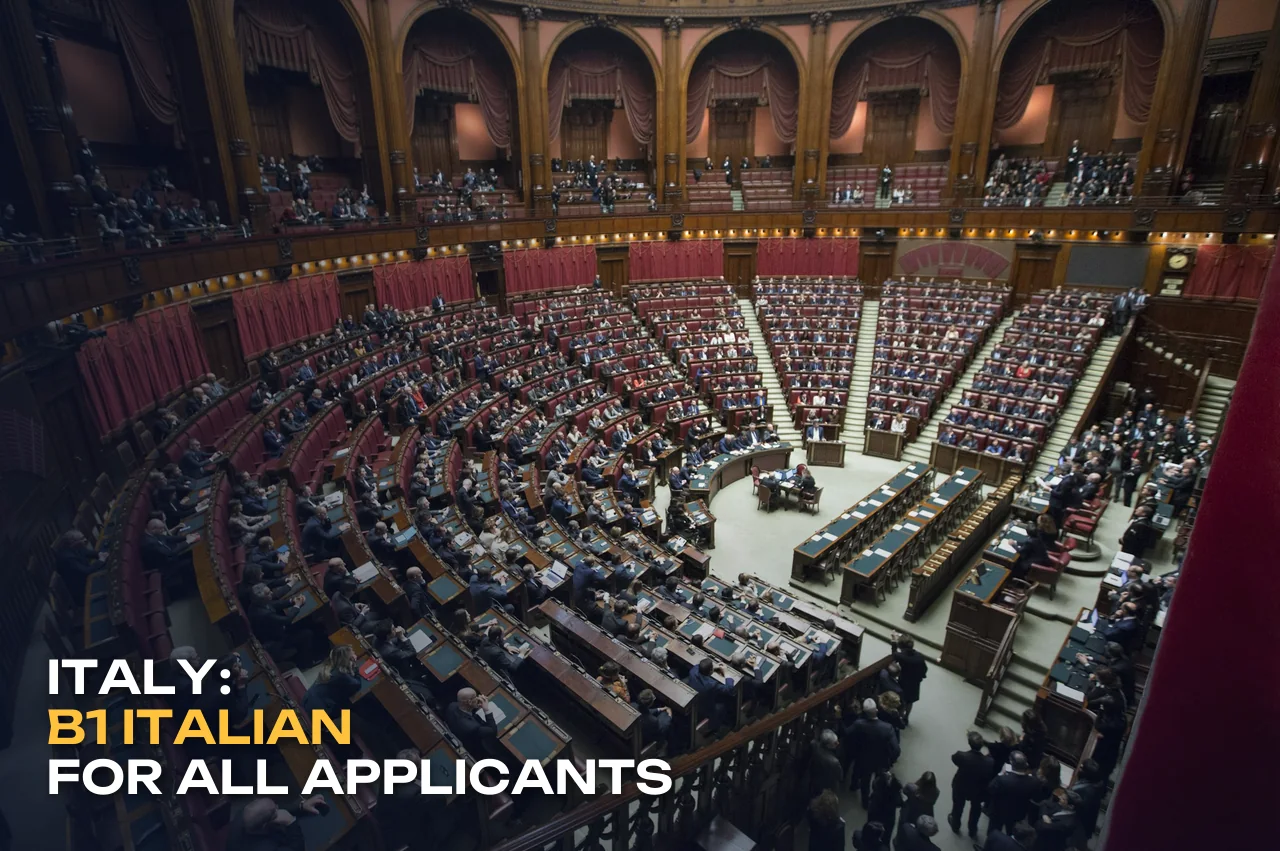
On 19 October 2026 the Italian Chamber of Deputies opened the plenary debate on bill AC 2124-A, which amends citizenship law 91/1992. The first signatory is MP Igor Iezzi and the rapporteur is Simona Bordonali. The text requires a B1 Italian language certificate from everyone who applies for citizenship by marriage or by residence, introduces mandatory grounds for refusal, an oath taken only in Italian, and a longer list of offences for which citizenship can be revoked. This is a bill, not a law: the Chamber has not voted yet, and the Senate must then pass it. I explain what the text actually says, who it affects and what to do if you are preparing documents now.
In brief
- Bill AC 2124 was tabled on 31 October 2024. The Constitutional Affairs Committee examined it from 8 July to 14 October 2026 and approved a text for the floor.
- The general debate in the Chamber of Deputies took place on 19 October 2026. As of publication there has been no vote on the text in the Chamber, and the Senate has not yet examined the bill.
- The B1 level itself is not new: it has been required since 2018. What is new is that the exemptions for EU long-term residence permit holders and for those who signed the integration agreement are removed.
- For naturalisation by residence the bill introduces a closed list of refusal grounds: convictions and pending cases for serious offences, and security threats.
- The oath will be taken only in Italian. The list of offences leading to revocation is extended, and citizenship can be reacquired no earlier than 10 years later.
- The text does not change recognition of citizenship by descent. Descendants of Italians are governed by the 2025 reform.
What the committee text says: seven changes to Law 91/1992
I have read both texts published on the Chamber of Deputies website: the original 2024 bill and the text approved by the Constitutional Affairs Committee on 14 October 2026. It is a single article with seven blocks of amendments to Law 91/1992. The committee rewrote the bill substantially. For example, the original version also extended the B1 certificate requirement to young people born in Italy; the committee text drops that part. The list of offences for revocation is different too: the original version included murder and sexual offences, while the committee text covers mafia-type offences, cyber attacks on public and critical systems, female genital mutilation, human trafficking, and death or serious harm caused while smuggling migrants.
Below I compare the current wording of the law with what the committee proposes. I checked the current text against Italy's official legislation database. If you want to start with the grounds for acquiring citizenship themselves, read our overview of Italian citizenship first and then come back to the table.
| Provision of Law 91/1992 | Now | What the committee text proposes |
|---|---|---|
| Language, Article 9.1 | B1 required for marriage and residence, but no certificate is asked of those who signed the integration agreement or hold an EU long-term residence permit | every applicant by marriage or by residence attaches a B1 certificate or an Italian school diploma |
| Refusal of naturalisation by residence, Article 9 | discretionary decision, no statutory list of mandatory refusal grounds | refusal for convictions or open criminal cases for serious offences and for security reasons |
| Born in Italy, Article 4(2) | declaration at 18, no list of bars | barred for certain convictions, suspended while a case is open |
| Decision deadline, Article 9-ter | 24 months, up to 36, for marriage and residence | the same 24-36 months also for those born in Italy |
| Oath, Article 10 | within six months of notification of the decree | oath in Italian only; exemption for severe disability |
| Revocation, Article 10-bis | for terrorism and subversion | adds mafia-type offences, attacks on critical IT systems, human trafficking and others |
| Reacquisition, Article 13 | not provided after revocation | no earlier than 10 years after social danger status ends |
Coverage in the Italian press revolves around the word "stretta", a tightening. Reading the text, for an ordinary law-abiding applicant there is really one main change: the language certificate. The other provisions concern people with criminal cases and those who acquired citizenship rather than being born with it.
What this means for you. If you have no criminal record, the bill changes one thing for you: get your B1 certificate early, even if today you are not formally required to file it.

B1 Italian: what actually changes
The requirement to know Italian at no lower than B1 on the Common European Framework scale entered Article 9.1 of Law 91/1992 in 2018. It applies to two grounds: marriage to an Italian citizen (Article 5) and naturalisation by residence (Article 9). The level is proved with a qualification from an Italian state or officially recognised school, or with a certificate from an accredited examination body. The document is filed together with the application.
The same article currently contains an exemption. Two groups do not have to file the certificate: those who signed the integration agreement on arrival, and holders of an EU long-term residence permit. The bill deletes those words. If it is adopted, every applicant by marriage or by residence will have to file a certificate or diploma, with no exceptions.
This matters for anyone heading towards citizenship through permanent residence in Italy. It is precisely EU long-term permit holders who today often apply without a separate B1 certificate. Under the new text that option disappears. B1 exams are taken at accredited centres on their own schedule, and results do not arrive immediately. I would allow several months for this.
A foreign diploma does not prove the language, even if it was issued in Italian. The law refers to a document from an Italian state or recognised school. For the rest of the file, though, foreign documents are needed: birth certificate, criminal record certificate, marriage certificate. They are legalised with an apostille and translated into Italian with certification; we describe how this works on the page about sworn translation of documents.
What this means for you. Take the B1 exam before you apply, without waiting for the law. If the amendments are not adopted, the certificate is still useful: it settles the language question under any ground.
Refusal and revocation: the new grounds
Naturalisation by residence in Italy is currently discretionary. The Ministry of the Interior assesses the applicant as a whole: income, criminal record, integration, security. The law contains no closed list of bars for Article 9; such a list exists only for marriage (Article 6). The bill transfers that list to naturalisation. Refusal becomes mandatory if the applicant has a conviction or an open criminal case in one of the following groups.
- offences against the State: against Italy's international and internal security and against citizens' political rights;
- intentional offences for which the law provides a maximum sentence of three years or more;
- a foreign court sentence of more than one year's imprisonment for a non-political offence, if the judgment has been recognised in Italy;
- proven threats to the security of the Republic.
If a case is open, the application is suspended until the case is dismissed or there is a final acquittal. Rehabilitation lifts the bar. At the same time the text expressly keeps the authorities' power to weigh any information on the applicant's actual integration, so a clean record does not by itself guarantee approval.
For people born in Italy who lived there legally and without interruption until adulthood, a separate Article 4-bis is introduced. Citizenship by declaration at 18 will be barred for those convicted of offences against the State or of offences on the revocation list, and for those sentenced to more than three years for an offence aggravated by racial or religious hatred or for drug offences. A suspended sentence with no further offences, and rehabilitation, lift the bar. This ground is covered in detail in our article on Italian citizenship by birth.
Revocation in Italy applies only to people who acquired citizenship: by birth in Italy and a declaration at 18, by marriage or by naturalisation. A person who is a citizen by birth to an Italian parent cannot lose it under this article. Revocation is possible after a final conviction, by decree of the President of the Republic on a proposal from the Interior Minister, within 10 years of the conviction becoming final, and only if the person has or can obtain another citizenship. The bill leaves these conditions untouched; it extends the list of offences and adds the right to reacquire citizenship no earlier than 10 years after a court has lifted the person's status as socially dangerous.
What this means for you. If you have even an old conviction in any country, get a fresh certificate and show it to a lawyer before applying. We help you obtain and legalise criminal record certificates from every country where you have lived.
The oath in Italian and processing deadlines
A positive decision does not yet make you a citizen. The decree takes effect only if, within six months of notification, the person swears allegiance to the Republic and promises to observe the Constitution and the laws. At present the law does not specify the language of the oath. The bill states it expressly: the oath is taken in Italian. At the same time it writes into the law an exemption that the Italian Constitutional Court required back in 2017 in judgment no. 258: a person with a severe, certified disability who cannot take the oath is exempt from it. The disability is certified by a public health facility or a doctor of the national health service. How the citizenship ceremony itself works is explained in our glossary.
Processing deadlines are currently set by Article 9-ter: 24 months from the application date, extendable to a maximum of 36 months. This covers marriage and naturalisation. The bill extends the same deadline to applications from people born in Italy. For marriage and residence applicants the deadline does not change. We looked at real timelines and costs for each ground in our articles on Italian citizenship timelines and the cost of Italian citizenship.
What this means for you. The oath in Italian is one more reason to work on the language early. You show the B1 certificate when you apply, but you will also have to speak Italian at the ceremony two or three years later.
Status: a bill, not a law
To be clear: as of 25 October 2026 none of this is in force. The Chamber of Deputies bill page shows the following progress. The bill was tabled on 31 October 2024 and assigned to the Constitutional Affairs Committee on 12 March 2025. The committee began work on 8 July 2026 and finished on 14 October, approving the text that day and asking to report it orally. The Justice and EU Affairs committees gave favourable opinions on 14 October, the Budget committee on 21 October. On 19 October, at sitting no. 728, the general debate took place with a government representative and MPs from both the governing parties and the opposition. On 20 October the Chamber's budget service published dossier no. 132 on the financial effects: it raised no cost issues, as the provisions only concern citizenship rules.
According to the Italian press, on 8 July 2026 the Chamber approved an urgent procedure for this bill, while the opposition calls the text unconstitutional and has tabled preliminary objections. As of publication, the bill page shows no vote on the article or on the text as a whole. After the Chamber of Deputies, the Senate must pass the law in the same wording. If the Senate amends it, the text goes back to the Chamber.
The committee text contains no transitional provisions. It does not say how the new rules will apply to applications filed before the law enters into force. Once the law is adopted and published in the Official Gazette, I would expect guidance from the Ministry of the Interior. Until then Law 91/1992 applies in its current wording. Italy is not the only country revisiting naturalisation rules: Ireland, for example, is debating an eight-year residence bill.
What this means for you. If you are ready to apply now, apply under the current rules. But build your file so that it would also pass under the new ones: with a B1 certificate and fresh certificates.
Want Italian citizenship? We will help you get it
We will send a document checklist for your case.
Descendants of Italians: the 2025 reform and the new bill
Bill AC 2124 does not deal with recognition of citizenship by descent. Descendants are covered by different rules, and those changed earlier. On 28 March 2025 the government adopted decree-law no. 36, and on 23 May 2025 parliament converted it into law no. 74. Article 3-bis was added to Law 91/1992: a person born abroad who holds another citizenship is deemed never to have acquired Italian citizenship, except in three cases. First, the recognition application or court claim was filed by 23:59 Rome time on 27 March 2025. Second, a parent or grandparent holds, or held at death, only Italian citizenship. Third, after acquiring citizenship a parent lived in Italy for at least two consecutive years before the child's birth.
On 12 March 2026 the Italian Constitutional Court found the challenge brought by the Turin court against this provision partly unfounded and partly inadmissible; the judgment was published as no. 63 of 2026. On 23 July 2026, by order no. 147, the same court referred a question to the EU Court of Justice in cases from Mantua and Campobasso: whether such a restriction is compatible with EU law on Union citizenship. The EU Court has not yet answered. We wrote more about practice and common pitfalls for descendants in our articles on Italian citizenship by descent and on mistakes in EU citizenship by descent claims.
The link with the new bill is indirect. If a descendant falls under none of the Article 3-bis exceptions, the ordinary path of a foreigner remains: a residence permit, years of residence and naturalisation. That is exactly where the B1 certificate without exemptions and the new list of refusal grounds will apply. Italy allows dual citizenship, so there is no need to give up your current passport; details are in our overview of Italian dual citizenship.
What this means for you. If your descent recognition case was filed before 27 March 2025, bill AC 2124 does not affect it. If not, check the Article 3-bis exceptions before planning a move and naturalisation.
What this means for three groups of applicants
Naturalisation by residence. A non-EU national needs 10 years of legal residence in Italy to naturalise, plus income and a clean record. The bill does not change the years. Two things change: the B1 certificate becomes mandatory for EU long-term permit holders too, and a conviction or open case for a serious offence becomes a direct ground for refusal. This path is described step by step in our article on naturalisation in Italy, and the paperwork in the article on documents for Italian citizenship.
Spouses of Italian citizens. At present you can apply after two years of legal residence in Italy following the marriage, or after three years of marriage if the couple lives abroad; with children the periods are halved. Marriage is already covered by the Article 6 list of bars, so spouses face almost no new refusal grounds. The main change is the B1 certificate for everyone, including long-term permit holders. Details are in our article on Italian citizenship by marriage.
Investors with an Italian investor visa. The Italian investor visa gives a residence permit but does not shorten the 10 years needed for naturalisation. The bill does not touch the programme. What matters for an investor who may want an Italian passport years from now is different: an EU long-term permit will no longer exempt you from the B1 certificate, and the years of residence must be real and documented. If citizenship is a goal rather than a nice extra, plan the language from year one. We covered the programme itself in our article on the investor visa, and taxes on relocation in our overview of Italian taxes.
Families. Each adult applies for citizenship separately, and each adult applicant needs a B1 certificate. Minor children living with a parent who acquires citizenship acquire it by law, provided that by then they have lived in Italy legally for at least two consecutive years, or since birth if they are under two. How to plan a move with a spouse and children is covered in our guide to residence for families.
To compare the Italian requirements with another EU country, see our article on naturalisation in Portugal. Italy for now is changing not the number of years but the depth of the checks: language, criminal record, oath.
What this means for you. The further you are from applying, the less the bill changes your plans: you have time to prepare. The closer you are, the more important it is to build the file to the future rules already.
What to do now
Take the B1 exam
A certificate from an accredited centre or an Italian school diploma. Even if you hold an EU long-term permit and it is not mandatory for you today.
Check convictions and cases
Obtain criminal record certificates from Italy and every country where you have lived. Under the new text an open case for a serious offence will suspend the application.
Legalise and translate documents
Birth and marriage certificates and police certificates, with an apostille and a certified Italian translation. Certificates have limited validity, so do not obtain them too early.
Count your years of residence
10 years for naturalisation, 2-3 years for marriage. Gaps and changes of status affect the count. How we calculate timelines and budgets is set out in our guide to costs and timelines.
Follow the vote
After the Chamber of Deputies, the Senate must pass the text. We will write when the law is adopted and when it enters into force.
If you are not sure which ground to apply on or whether your timing works, book an online consultation: we will look at your documents and tell you what to do in your situation. All the countries we work with are on the BRIDGES home page, and all our material on Italy is collected in the Italy section. What an Italian passport gives you once you have citizenship is described separately.
How this article was prepared
The article is based on primary sources: the AC 2124 bill page on the Italian Chamber of Deputies website (progress, committees, sitting no. 728 of 19 October 2026), the text of bill no. 2124 of 31 October 2024 and committee text no. 2124-A of 14 October 2026 with the opinions of the Justice and EU Affairs committees, the Chamber budget service dossier no. 132 of 20 October 2026, the current wording of Law 91/1992 and of Article 407 of the Code of Criminal Procedure in Italy's official legislation database, the Ministry of the Interior page on citizenship, and press releases of the Italian Constitutional Court of 12 March 2026 and 23 July 2026 (judgment no. 63/2026, order no. 147/2026). Information on the urgent procedure and the opposition's position comes from Italian press reports. The bill may change during the vote and in the Senate. This article does not replace advice on your own case.
Share this article
Frequently asked
Questions people ask before deciding
01Has the B1 law for Italian citizenship been adopted?
No. On 19 October 2026 the Chamber of Deputies held the general debate on bill AC 2124-A. As of publication there has been no vote in the Chamber, and the Senate must then pass the text.
02Is B1 for Italian citizenship a new requirement?
No, B1 has been required since 2018 for marriage and residence. The bill removes the exemption for EU long-term permit holders and those who signed the integration agreement: everyone will file a certificate or diploma.
03Does the bill affect descendants of Italians?
It does not change recognition of citizenship by descent. Descendants are governed by Article 3-bis, introduced by decree-law no. 36/2025 and law no. 74/2025.
04What could lead to revocation of Italian citizenship under the bill?
Besides terrorism and subversion: mafia-type offences, attacks on critical IT systems, human trafficking, female genital mutilation and deaths caused while smuggling migrants. It applies only to acquired citizenship, not citizenship by birth to an Italian parent.
05What should I do if I am applying in the coming months?
Apply under the current rules, but attach a B1 certificate and fresh criminal record certificates with an apostille and translation. The text contains no transitional provisions.
About the author
Related materials
What to read next
 ArticleItalian Citizenship 2026: How to Obtain, Pathways, EU Passport
 ArticleItalian citizenship through naturalization in 2026: 10 years, language, conditions
 ArticleItalian Citizenship Through Marriage in 2026: Timelines, Language, Conditions
News+6 stories on 25 October
Related news
 Saint Kitts and Nevis · 25 OctSaint Kitts and Nevis: citizenship for children and grandchildren of citizens born abroad after 1983
 Portugal · 23 OctPortugal: 690,000 citizenship applications await a decision as the queue grows 38% in a year
 Saint Kitts and Nevis · 21 OctSt Kitts residency requirement: what is announced, what is in force and how to plan a trip to the island
Questions about the new Italian law? Ask a lawyer
Our lawyer will answer your questions and tell you where to start.
