News · Greece
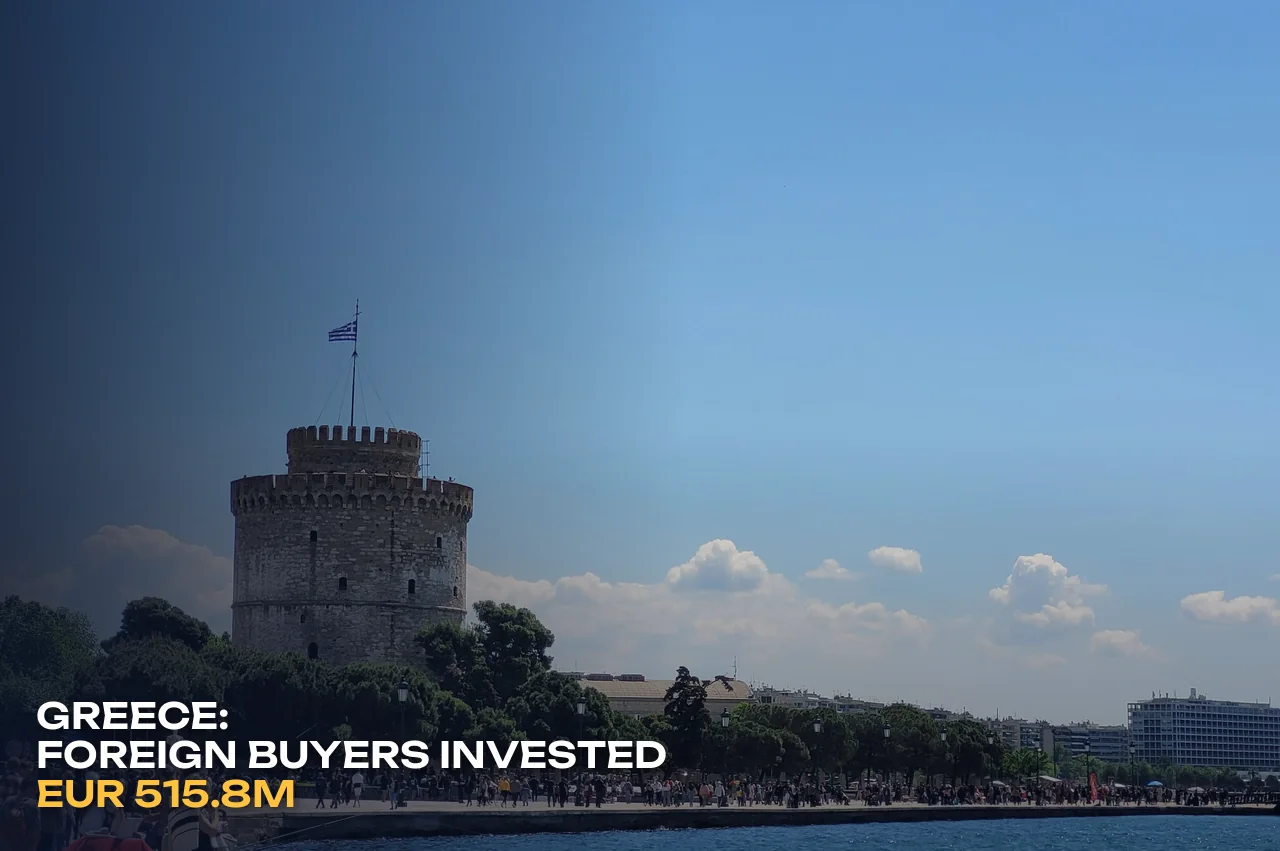
Greece: foreigners invested EUR 515.8 million in property in the second quarter, 11.3% less

Updated: October 2026·14 min read·Expert reviewed
Terms and costs verified: October 2026
Contents
The Bank of Greece has updated its statistics on foreign direct investment in real estate. In the second quarter of 2026 non-residents put EUR 515.8 million into Greek property. That is 11.3% less than in the second quarter of 2025, when EUR 581.5 million came in. Flat prices keep rising, though more slowly: the Bank of Greece index shows plus 5.5% over the year. I set both series against the data on golden visa applications and explain what they mean for people buying a home for residence and for those counting on rental income.
In brief
- In the second quarter of 2026 net foreign inflows into Greek real estate amounted to EUR 515.8 million, 11.3% less than a year earlier.
- In the first half of 2026 EUR 1,027.4 million came in, 9.5% more than in the first half of 2025 but 10% less than in the record year 2024.
- The Bank of Greece apartment price index rose 5.5% year on year in the second quarter of 2026. A year earlier growth was 8.1%. The market is still getting more expensive, but at a calmer pace.
- New golden visa applications in the first eight months of 2026 were 35.8% lower than a year earlier, according to the Ministry of Migration.
- Golden visa thresholds have not changed as of 26 October 2026: EUR 800,000, 400,000 and 250,000 depending on the area and the type of property.
- A rise in the purchase tax on homes for non-EU buyers from 3% to 15% from 1 July 2027 has been announced. The law has not been passed yet.
EUR 515.8 million: what exactly the Bank of Greece counted
The Bank of Greece keeps a separate series in its balance of payments statistics: net foreign direct investment in Greek real estate. It covers money from non-residents used to buy flats, houses, plots and commercial premises, minus sales in which foreigners take money back out. The series is published quarterly in millions of euros, and it is the only official indicator that shows foreign demand in money rather than in the number of deals.
The figure for the second quarter of 2026 is EUR 515.8 million. The first quarter brought EUR 511.6 million, so quarter on quarter the inflow barely moved, plus 0.8%. Against last year the picture is mixed. The second quarter was 11.3% weaker than the same quarter of 2025 and 17% weaker than the second quarter of 2024. At the same time, the first quarter of 2026 beat the first quarter of 2025 by 43%. That is why the half year as a whole looks better than last year.
| Quarter | 2024 | 2025 | 2026 | 2026 vs 2025 |
|---|---|---|---|---|
| Q1 | 520.0 | 356.8 | 511.6 | +43.4% |
| Q2 | 622.1 | 581.5 | 515.8 | -11.3% |
| Q3 | 783.7 | 527.4 | no data | |
| Q4 | 824.5 | 590.0 | no data | |
| First half | 1,142.1 | 938.3 | 1,027.4 | +9.5% |
| Full year | 2,750.3 | 2,055.6 |
Here is where the swings come from. The first quarter of 2025 was the weakest since 2021, at only EUR 356.8 million. It followed two record quarters, the third and fourth of 2024, with EUR 783.7 million and EUR 824.5 million. In my assessment, some buyers brought their deals forward to autumn 2024, when the new golden visa thresholds took effect, and several months of demand were used up in advance. Against such a low base, growth in early 2026 looks dramatic, but the amount itself, EUR 511.6 million, is ordinary for the past three years.
If you add up the last four quarters, from the third quarter of 2025 to the second quarter of 2026, you get EUR 2,144.8 million. The four quarters a year earlier brought EUR 2,546.5 million. That is minus 15.8%. This is a more accurate picture than a single quarter: foreign demand has contracted since the 2024 peak but holds at around EUR 2 billion a year. For comparison, in 2017 the whole year brought EUR 414.7 million, and the total for 2019-2025 was about EUR 12.4 billion.
What this means for you. The second quarter drop is not a market collapse but a return to a normal pace after the 2024 rush. Foreign buyers are staying in Greece; their money simply arrives more evenly.
One caveat. The Bank of Greece series covers all non-residents: EU citizens who do not need residence, companies, funds and private buyers from third countries. These statistics cannot separate the golden visa from other demand. So below I look at them together with Ministry of Migration data.

Prices are rising more slowly: the Bank of Greece index for the second quarter
The second official series is the apartment price index. The Bank of Greece builds it from valuations that banks make when granting mortgages and publishes it by region and by the age of the property. Data for the second quarter of 2026 are still provisional and may be revised, but the direction is already clear.
| Where | Index, 2007 = 100 | Q2 2026 vs Q2 2025 | Q2 2025 vs Q2 2024 |
|---|---|---|---|
| All of Greece | 114.2 | +5.5% | +8.1% |
| Athens | 118.3 | +5.0% | +6.3% |
| Thessaloniki | 111.9 | +4.7% | +10.0% |
| Other large cities | 108.2 | +5.4% | +10.3% |
| Rest of the country, including islands | 112.8 | +7.1% | +9.1% |
| New flats (up to 5 years old) | 120.0 | +6.2% | +7.4% |
| Older flats (over 5 years old) | 110.6 | +5.0% | +8.5% |
Across the country flats became 5.5% more expensive over the year. A year earlier, in the second quarter, growth was 8.1%, and in the first quarter of 2026 it was 6.6%. This is the third quarter of slowdown in a row. It is strongest in Thessaloniki and other large cities, where the pace halved from 10% to 5%. The rest of the country, which includes islands and resort areas, is slowing least: plus 7.1% over the year.
Even with the slowdown, prices are high. The index stands at 114.2 with 2007 as the base, so flats are on average 14% more expensive than at the pre-crisis peak and almost twice as expensive as at the low point in 2017. New flats are rising faster than older ones: plus 6.2% against plus 5%. We have collected prices by area in the review of Greek property prices in 2026, with separate pages for Athens and Thessaloniki.
For comparison with the rest of Europe: Eurostat does not publish a house price index for Greece, but it does show rents, which rose 7.5% over the year. Figures for all EU countries are in our news item on EU house prices in the second quarter of 2026.
What this means for you. These data give no reason to expect Greece to get cheaper. Growth has slowed, but prices are not falling in any region. If you are buying for residence, the programme threshold is fixed in euros, while a square metre has become about 5% more expensive over the year.
Want Greek residence through a home purchase? We will help you get it
We break the costs down item by item: mandatory payments, fees and services, with nothing hidden.
Who is buying: investors' countries in 2025
The Bank of Greece gives a breakdown by country only for a full year, and the latest is for 2025. The country in these statistics is the investor's country of residence, not their citizenship. Of EUR 2,056 million, about EUR 785 million came from euro area countries, EUR 50 million from other EU countries and EUR 1,217 million, almost 60%, from countries outside the EU.
| Investor's country | 2024, EUR million | 2025, EUR million |
|---|---|---|
| Turkey | 293 | 214 |
| Switzerland | 238 | 211 |
| Cyprus | 319 | 210 |
| Germany | 162 | 142 |
| Hong Kong | 338 | 115 |
| France | 77 | 101 |
| Bulgaria | 95 | 101 |
| Israel | 129 | 88 |
| United States | 131 | 88 |
| China (excluding Hong Kong) | 33 | 50 |
| All countries | 2,750 | 2,056 |
The most visible change is Hong Kong: EUR 338 million in 2024 and EUR 115 million in 2025. Investment from Turkey, Cyprus, Israel and the United States also fell. Investment from France, Bulgaria and mainland China grew. Turkey and Switzerland moved to the top with amounts just over EUR 210 million. Buyers from the EU as a whole held up better than buyers from third countries, who were more affected by the new golden visa thresholds.
What this means for you. The Greek market does not depend on one country. When one group of buyers leaves, others partly take its place. For you this means liquidity in popular areas is preserved: a flat in Athens or on the islands can be resold without inflows from any one particular country.
Golden visa: fewer applications, stricter rules
The Greek Ministry of Migration and Asylum publishes monthly statistics on investor permits. According to the August report, main investors filed 3,426 new applications in the first eight months of 2026, compared with 5,333 in the same months of 2025. That is a drop of 35.8%. The number of valid permits, however, rose to 34,759 from 23,882 a year earlier: the ministry continues to issue residence permits on applications from previous years. Details are in our news item on the fall in Greek golden visa applications.
The main reason for the decline is the thresholds raised in autumn 2024. A purchase of EUR 800,000 is required in Attica, Thessaloniki, Mykonos, Santorini and on islands with more than 3,100 residents. In other areas the threshold is EUR 400,000. In both cases it must be one property of at least 120 square metres. The EUR 250,000 threshold remains only for converting non-residential buildings into homes and restoring listed buildings. The zone map is described in the article on Greek golden visa zones, and the term investment threshold is explained in the glossary.
Uncertainty has been added. On 15 October 2026 Migration Minister Thanos Plevris said residence permits would be revoked for discounts outside the contract and for short-term letting through management companies. There is no regulation on this yet, but the tone has changed: we explain what it means for properties already bought in the news item on golden visa revocations and in the article on the sublet-through-a-company scheme.
The third factor is tax. In September 2026 the government announced that from 1 July 2027 the property transfer tax on homes bought by individuals from outside the EU would rise from 3% to 15%, or from 3.09% to 15.45% with the municipal levy. On a EUR 400,000 flat that is EUR 61,800 instead of EUR 12,360. The bill has not yet been tabled in parliament. Calculations for different budgets are in the news item on the 15% tax for non-EU buyers.
What this means for you. The fall in applications and the fall in foreign money in the second quarter are two sides of the same process. Residence buyers have become more cautious and arrive with larger budgets. The programme itself is open, and the thresholds as of 26 October 2026 are unchanged.
What this means for a residence buyer
First, negotiating has become a little easier. When foreign demand weakens and prices rise more slowly, sellers at the top end are more willing to make concessions, especially on properties that have been listed for a long time. But any discount must be reflected in the contract. Any discount returned separately from the contract is, after the minister's statement, a direct risk of losing your residence permit.
Second, time works against a postponed purchase. Until 1 July 2027 the 3% rate applies, unless the government changes the announced parameters. After that date a buyer from outside the EU will pay about another 12% of the price in tax. A residence purchase from choosing the property to signing at the notary usually closes within a few months, but with property checks, document translation and opening a bank account it is better to leave a margin. What the timeline consists of is described in the guide on how costs and timelines are calculated.
Third, the threshold is fixed but the price per square metre is not. With growth of 5-7% a year, EUR 400,000 in the regions will buy you a few square metres less in a year's time. The law requires 120 square metres in a single property, so in expensive areas the choice narrows. If your family is large, check who is included in the residence permit and how that affects the choice of flat: the rules for spouses, children and parents are in the guide on residence for families.
Fourth, count more than the price. Besides the transfer tax, there are notary, lawyer and land registry fees, the annual ENFIA property tax and the costs of the residence permit itself. The cost structure is described in the articles on the cost of the golden visa and property taxes in Greece. Documents from another country will need an apostille and a sworn translation.
What this means for you. If you have already chosen an area and a budget, the Bank of Greece figures give no reason to delay: prices are not falling, and the tax for non-EU buyers may rise from July 2027. If you are torn between countries, compare Greece with the Portuguese golden visa and Cyprus permanent residence.
What this means for a rental investor
For someone buying for income, the ratio of price to rent matters more. Here the data favour the investor: according to Eurostat, rents in Greece rose 7.5% over the year, while flat prices on the Bank of Greece index rose 5.5%. When rents grow faster than prices, the yield on each euro invested improves slightly. A year ago it was the other way round: prices were rising by 8%, and the yield on new purchases was shrinking.
But residence and rental do not always go together. Under the 2024 law, a property bought for the golden visa cannot be let short term; only long-term letting is allowed. A breach can lead to a fine and revocation of the permit, and in October the minister explicitly called subletting through management companies a workaround. So if your goal is income from tourists on the islands, a residence purchase is not the right fit: you need a separate property not tied to the programme.
For long-term letting, look at areas with steady tenant demand: central and southern Athens, Thessaloniki, university cities. The index shows that prices in Thessaloniki rose only 4.7% over the year, less than the national figure, while rental demand there is high. The islands are rising faster than the mainland, plus 7.1% over the year, but there are fewer long-term tenants and stronger seasonality. How we calculate yield is described in the article on rental yield in Greece, and there is a separate review of property on the Greek islands.
Rental income in Greece is taxed, and the rate depends on the amount and on where you are tax resident. If you plan to live in Greece for more than 183 days a year, take into account the rules on tax residency. Managing the flat, finding tenants and reporting can be handed over: that is how our property management service in Greece works.
What this means for you. For rental, the second quarter figures are rather good: buying costs 5.5% more, while rents are rising by 7.5%. But calculate yield from real contracts in a specific area, not from national averages.
Looking for a flat to let in Greece? We will find options
We take into account your budget, city and purpose: living, renting out or residence.
Maria StavruReal Estate Analyst, BRIDGES
What to do now
Define the purpose of the purchase
Residence, long-term rental or both. This determines the area, the threshold and whether you can let the property. Programme terms are on the page on the Greek golden visa, and general information is on the Greece country page.
Calculate the budget with taxes
Property price plus transfer tax, notary, lawyer, ENFIA and residence costs for the whole family. If you are not from the EU, calculate a separate scenario for after 1 July 2027.
Check the property before the deposit
Title, debts, building permits, area in the land registry. Details are in the article on property due diligence in Greece and on the property check service page.
Fix the price in the contract
No refunds, bonuses or guaranteed returns outside the contract. According to the minister, this is exactly what residence permits will be revoked for.
Ask a lawyer
If the deal is complex or you are buying with a mortgage, discuss it in an online consultation. There is an article on mortgages for foreigners in Greece.
The general purchase process is described in the article on buying property in Greece, and the programme changes over the year in the review of golden visa changes in 2026. All our articles on residence and citizenship programmes are collected on the BRIDGES home page.
How this article was prepared
Figures on foreign inflows come from the Bank of Greece series "Net Foreign Direct Investment in Greece: Real Estate" (a quarterly series in EUR million, data up to and including the second quarter of 2026) and its annual breakdown by country for 2002-2025. Prices come from the Bank of Greece tables "New index of apartment prices by age" and "New index of apartment prices by geographical area" (data for 2025-2026 are provisional). Rents follow the Eurostat consumer price index, as in our news item of 1 October 2026. Golden visa application numbers come from the monthly report of the Greek Ministry of Migration and Asylum for August 2026. The 15% tax is based on the announcement by the government and the Ministry of National Economy and Finance in September 2026; the law has not been passed. The Migration Minister's statement of 15 October 2026 has not been formalised in a regulation. Year-on-year changes, half-year and four-quarter totals are my own calculations from the published series. This article does not replace advice on your own transaction.
Share this article
Frequently asked
Questions people ask before deciding
01How much did foreigners invest in Greek property in the second quarter of 2026?
According to the Bank of Greece, EUR 515.8 million in net foreign direct investment in real estate. That is 11.3% less than in the second quarter of 2025.
02Does this mean prices in Greece are falling?
No. The Bank of Greece apartment price index rose 5.5% year on year in the second quarter of 2026. Growth slowed from 8.1% a year earlier, but prices are not falling in any region.
03Have the Greek golden visa terms changed?
Not as of 26 October 2026. The thresholds are EUR 800,000 in Attica, Thessaloniki and the large islands, EUR 400,000 in other areas and EUR 250,000 for converting non-residential buildings into homes and for restoration.
04Can a flat bought for the golden visa be let?
Yes, but only on a long-term lease. Short-term letting of a golden visa property is prohibited, and a breach can lead to a fine and revocation of the permit.
05Is it worth buying before July 2027?
If you are a national of a country outside the EU, a rise in the home purchase tax from 3% to 15% from 1 July 2027 has been announced. The law has not been passed yet, but under the announced parameters a deal completed before that date is taxed at the old rate.
About the author
Related materials
What to read next
 ArticleGreece property prices 2026: by city and island, trends and forecast
 ArticleProperty in Greece 2026: How a Foreigner Can Buy, Prices, Taxes, Residency
 ArticleRental yield in Greece in 2026: what property returns by city, taxes and the Airbnb ban
News+6 stories on 26 October
Related news
 Greece · 17 OctGreek golden visa applications down 36%: ministry figures for eight months
 Greece · 16 OctGreece will revoke golden visas for discounts and short-term letting: what the minister said
 Greece · 11 OctGreece will raise the tax on buying a home to 15% for non-EU buyers
Personal programme selection is conducted by Anna Kovalevskaya, Head of Legal, BRIDGES.
Want to buy a home in Greece for residence? We will help
We set out each step from the first documents to the final status, with timings.
