Residency · Greece
Property in Thessaloniki 2026: districts, prices, yield for an investor

Updated: June 2026·12 min read·Expert reviewed
Terms and costs verified: June 2026
Contents
Thessaloniki is Greece's second city and perhaps the most undervalued property market in the country. The square meter here is cheaper than in Athens, yet demand is stable: 88,000 students at Aristotle University alone, a growing flow of tourists, a waterfront and a port. In January 2026 the average apartment price held at about 2,325 euros per square meter - a rise of almost 7.4% over the year. We break it down by district: where to buy a seaside apartment, how much a meter costs in the center and in Kalamaria, what yield rental gives, what Russians need to know, and how buying in Thessaloniki relates to Greece's Golden Visa.
Why Thessaloniki is a smart alternative to Athens
When people talk about property in Greece, they instinctively think of Athens, the islands, Santorini. Thessaloniki stays in the shadow - and wrongly so. It's the country's second-largest city, the cultural and student capital of the north, a major port and logistics hub for all of Southeastern Europe. For an investor this means one simple thing: housing demand here isn't seasonal and doesn't depend on a single tourist peak, but holds up year-round.
The main reason to look at Thessaloniki is the entry price. The square meter here is consistently cheaper than in Athens, while the market is growing even faster than the capital's. In January 2026 the average sale price for housing was roughly 2,325 euros per square meter, up about 7.4% over the year. In some districts growth in 2025 reached 9-10%. So you enter cheaper, and catch up with the market on equal footing with everyone else.
The second argument is the structure of demand. The city has over 88,000 students at Aristotle University alone, the largest in the Balkans, plus other universities. This is a constant, renewable stream of tenants who need studios and small apartments near the campus. Add tourism, business trips, and the relocation of IT specialists - and you get a market where renting out housing is easier than in many European capitals.
If you're just starting to figure out the Greek market, it makes sense to first read the general breakdown,how to buy real estate in Greece, and then compare the two main cities in the article onproperty in Athens. Thessaloniki in this pairing is the choice of those seeking a balance of price and yield, not a prestigious showcase.
Thessaloniki: property and prices - the overall market picture 2026
Let's start with the numbers the whole conversation builds on. Thessaloniki's market in 2026 is a growing market with a pronounced spread of prices across districts. The averaged price hides the reality: the difference between a cheap outlying district and the waterfront can be threefold.
Key price benchmarks at the start of 2026:
- Citywide average- about 2,325 euros per square meter for housing for sale.
- Premium waterfront(the White Tower area, Lefkos Pyrgos) - roughly 3,600-4,200 euros per meter, the market's ceiling.
- Historic center and central Kalamaria- around 2,800-3,100 euros per meter, individual renovated properties are pricier.
- Affordable outskirts(Evosmos and beyond) - about 1,650-1,950 euros per meter, and in outlying zones like Epanomi below 1,500.
The trend is clearly upward: prices have risen for several years in a row, with a citywide gain of about 9-10% in 2025, and the market continued moving up in early 2026. Infrastructure gives an additional push - in February 2026 the metro extension toward Kalamaria opened, revaluing the eastern districts (Kalamaria, Aretsou, Nea Krini, Mikra), which got a direct link to the center.
An important caveat about figures: price per meter is a benchmark, not a verdict. The real cost of a specific apartment depends on the floor, condition, presence of an elevator and parking, year built, and the view from the windows. Fresh benchmarks for the whole country are conveniently checked in the overviewof real estate prices in Greece in 2026.
Districts of Thessaloniki: a “district - character - price per m2” table
Thessaloniki is a city of contrasts even within itself. The prestigious waterfront and student Toumba are a few minutes apart, but they're two different worlds in price and investment logic. To avoid drowning in names, let's bring the main districts together into one table with approximate prices at the start of 2026.
| District | Character | Price, euros per m2 (benchmark) |
|---|---|---|
| Nikis waterfront / Lefkos Pyrgos | The city's showcase, bay views, premium | 3 600-4 200 |
| Historic center (Aristotelous, Ladadika) | Tourism, rental, prestige | 2 800-3 100 |
| Kalamaria (center) | Sea, prestigious residential, families | 2 500-3 500 |
| Pylaia (Konstantinopolitika) | Modern, young professionals, business | 2 600-3 000 |
| Panorama | Hillside villas, views, wealthy families | 2 400-3 200 |
| Toumba | Students, affordable rental, middle class | 1 700-2 100 |
| Ano Poli (Upper Town) | Old character, views, high yield | 1 800-2 400 |
| Evosmos and the western outskirts | Budget, locals, volume | 1 650-1 950 |
The logic is simple: the closer to the sea and the center, the higher the price and prestige, but the lower the percentage yield. The farther and simpler the district, the cheaper the entry and the higher the rental yield, but the slower the value growth. For the Golden Visa with an 800-thousand-euro threshold, it's specifically the expensive waterfront and central districts that realistically qualify, more on this separately below.
A seaside apartment in Thessaloniki: the waterfront, Kalamaria, the east
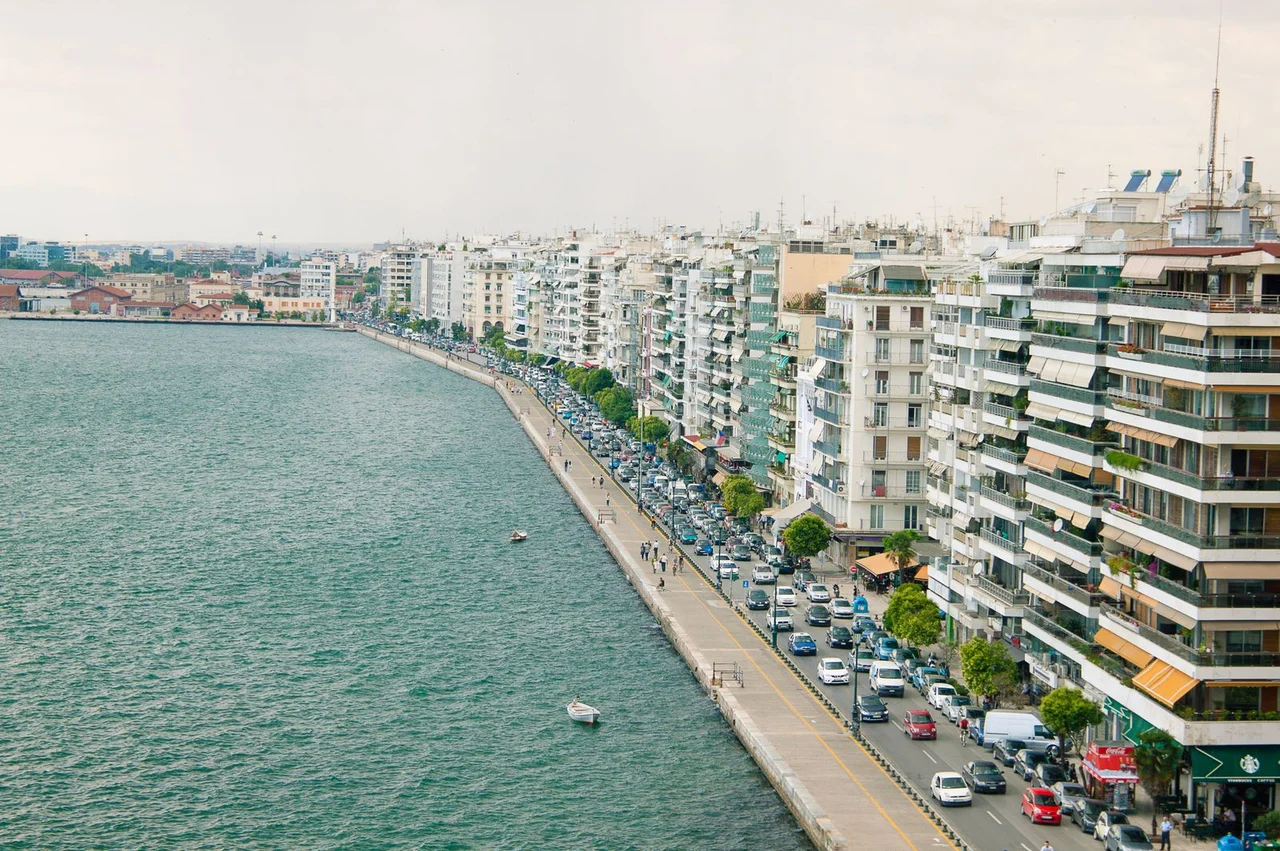
The search “seaside apartment in Thessaloniki” is one of the most common, and understandably so. The city stretches along the Thermaic Gulf, with a full waterfront (Nea Paralia) - one of the most beautiful in Greece, with parks, bike paths and a view of Olympus in clear weather. Water-view housing here is both a point of pride and the most liquid asset.
Where exactly to look for seaside housing:
- Nikis waterfront and the White Tower area- the heart of the seafront showcase. Old, dense building stock, apartments with a direct bay view, the city's highest prices. People come here for status and capital preservation.
- Kalamaria- a prestigious seaside district east of the center. Combines proximity to the sea, developed infrastructure, schools, and a calm family atmosphere. There are more modern buildings here than in the historic center.
- Eastern districts- Aretsou, Nea Krini, Mikra. After the metro extension opened in 2026 they became more interesting: the center is now quick to reach, and prices are still below Kalamaria's.
a nuance: “sea view” varies. A direct frontal bay view is expensive and rare; a “side” view or a view over rooftops from upper floors is offered far more often. That's not bad, but it strongly affects the price. When viewing, always check the view in person or via video in daylight - a developer's photos know how to embellish. A sea-view apartment in Kalamaria of 80-90 meters in good condition cost roughly 250-450 thousand euros at the start of 2026, depending on the row and floor.
We will find the right basis for residency in Greece
We calculate the budget and timing for your family and list the documents you need.
Rental yield: students, tourists, and real percentages
The main reason to buy in Thessaloniki rather than Athens is yield. With a lower entry price, rental rates hold up confidently, and the return on invested capital here is often higher than the capital's. By various estimates at the start of 2026, gross yield (before taxes and expenses) ranges roughly from 4.5% to 6.8% a year, and in some inexpensive and student districts it goes even higher.
Where such rental demand comes from:
- Students.Over 88,000 students at Aristotle University alone - a constant, annually renewed army of tenants. They need studios and small apartments near the campus and the metro. The most predictable and stable segment.
- Long-term rental for locals and relocated professionals.Young professionals, families, specialists relocated for work. A calm flow with no seasonal dips.
- Tourists and short-term rental.The center and waterfront rent well short-term, but caution is important here - more on legislative restrictions below.
Where yield is higher: paradoxically, not in the most expensive districts. The best percentage return comes from inexpensive and student districts - Ano Poli, Toumba, areas around the campus, where a low entry price combines with steady demand. The premium waterfront gives a lower rental percentage, but appreciates better in value and is more reliable for capital preservation. A detailed breakdown of yield calculations for the country is in the article onrental yield on real estate in Greece. Before buying always calculate the net yield: subtract the rental income tax, the annual ENFIA tax, management costs and vacancy periods from the gross rate.
Thessaloniki and the Golden Visa: the premium zone and an 800,000-euro threshold
This is where an important fork begins, which many discover too late. If your goal isn't just to buy an apartment, but to get a residence permit through this purchase (Greece's Golden Visa), then since 2024 Thessaloniki falls into the premium zone with the highest investment threshold.
How the Golden Visa thresholds work in 2026:
- 800,000 euros- the premium zone: all of Attica (Athens), Greater Thessaloniki, Mykonos, Santorini, and major islands with a population over 3,100.
- 400,000 euros- the standard threshold for most of the rest of the country's regions.
- 250,000 euros- only for two special cases: converting a commercial building to residential or restoring an architectural landmark.
Additional strict rules since 2024: the property must bea single, with an areaat least 120 square meters; you can't reach the threshold by combining several small apartments. So for the Golden Visa in Thessaloniki you need one large apartment or house valued from 800,000 euros - the premium waterfront, the best properties in the center, villas in Panorama.
What this means in practice. If your budget is 250-400 thousand euros and you specifically want Thessaloniki - such a purchase won't work directly for the Golden Visa here (except rare conversions and restorations). In this case the logic is: either take the property for income and yield and arrange the residence permit through another region or another option, or view a Thessaloniki purchase specifically as an investment, not a visa tool. The country's threshold map is broken down in the article onGreece's Golden Visa zones- it's worth reading before choosing a city.
Purchase conditions: AFM, notary, taxes and the step-by-step order
Now for the deal's mechanics. Foreigners, including Russian citizens, buy property in Greece freely - the only restriction is on strategically significant border and island zones, which require special permission (this normally doesn't apply to Thessaloniki). The procedure is well-established and clear, but requires preparation.
| Step | What's happening | Costs and timelines (benchmark) |
|---|---|---|
| AFM tax number | Obtaining a Greek tax number for the buyer | Through a representative, a few days |
| Bank account | Opening an account at a Greek bank for settlements | Depends on compliance review |
| Property verification (due diligence) | The lawyer verifies ownership, encumbrances, ENFIA debts | 1-3% of the price - lawyer's fee |
| A preliminary contract and deposit | Fixing the terms, reserving the property | Usually a 10% deposit |
| Transfer tax | State tax when buying resale housing | 3.09% of the value |
| Notary and registration | Signing the deed, registering ownership | ~1-2% notary plus duties |
Key points that can't be missed. First - the AFM tax number is mandatory for any buyer, without it there's no deal. Second - settlements must be transparent, through a bank, with a confirmed source of funds; this is especially important for Russian citizens (more below). Third - budget on top of the property price about 7-10% for taxes, notary, lawyer and registration. It's best to check current requirements and forms on the official government services portalgov.gr. A full breakdown of the country's procedure is in the guidehow to buy real estate in Greece.
Why the Thessaloniki market is growing: metro, port, technology
Price growth in Thessaloniki isn't a speculative bubble, but the result of real changes in the city. Understanding the drivers matters: they show whether the growth is sustainable and where to look over a horizon of several years.
What's pushing the market up:
- The metro.After years of construction, the metro started running in the city, and in February 2026 the extension toward Kalamaria opened. Districts along the new stations are being revalued - transport accessibility directly converts into the price per square meter.
- A shortage of renovated housing.The center's housing stock is mostly old, demand for quality renovated apartments exceeds supply. This supports prices and gives a premium to properties after a well-done renovation.
- A technology and logistics hub.Thessaloniki is developing as an IT and logistics hub for Southeastern Europe, attracting companies and skilled professionals - and that's new solvent demand for rental and purchase.
- Tourism and the airport.A growing tourist flow and a convenient international airport make the city attractive both for short-term rental and as a second home.
It's worth separately keeping the comparison with Athens in mind. For a long time the main growth was concentrated in the capital, but in 2025-2026 regional centers, and Thessaloniki first and foremost, are growing faster. This is a typical catch-up market effect: an undervalued asset moves toward a fair price. For an investor, the “cheaper but growing fast” window isn't forever - and that's an argument not to shelve the decision.
We will calculate the budget for your family
A full estimate: contributions, fees and our work for your family.
Property in Thessaloniki for Russians: what's important to know
Let's separately break down the situation for Russian citizens, because there are plenty of myths here. The main point right away: buying property in Thessaloniki as a Russian citizen is by itself accessible and legal. Greece doesn't prohibit Russians from owning housing, and ownership is protected the same as for any foreigner.
What Russians specifically should pay attention to:
- Source of funds.Bank compliance has tightened since 2022. The money must have a transparent, documented origin - and go through strictly legally, with no sanctions circumvention. This is a key point: a well-prepared source-of-funds dossier resolves most issues at the entry stage.
- Settlements and the bank.Payment goes through a bank account, not cash. Opening a Greek account and moving funds requires a package of documents gathered in advance.
- A visa for entry.For short trips to view properties and close the deal you need a Schengen visa - it's issued, though stricter and less often multi-entry since 2022. For long-term residence you need a national D visa or a residence permit.
- The Golden Visa is available.The residence-by-investment program is open to Russians - strictly legally, with enhanced verification of the source of funds. This is a legal way to tie a premium property purchase to the right of residence.
Practical takeaway: for a Russian, buying in Thessaloniki is a matter of correctly preparing documents, not prohibitions. The most common cause of a deal falling through isn't “politics”, but an unprepared money dossier that the bank refuses to accept. So work on the source of funds starts in advance, not at the moment the property has already been found.
Short-term rental and Airbnb: where caution is mandatory
Many investors see the center of Thessaloniki and immediately think about Airbnb - there are tourists, there's demand, rates are higher than long-term. The logic is understandable, but two important caveats are needed here.
The first is legislative and concerns the Golden Visa. If the property was bought under the residence-by-investment program, short-term (daily, Airbnb) rental of that property is prohibited. A violation risks not a fine, but revocation of the residence permit itself plus a large monetary penalty. So a Golden Visa property is either rented long-term, not rented at all, or used for living.
The second is regulatory, affecting the market as a whole. In recent years Greece has been tightening short-term rental rules: registering the property number, restrictions in certain central zones, tax reporting. The rules change, and what was allowed yesterday may require a license tomorrow or be banned outright in a specific district.
What this means for an investor in Thessaloniki:
- If the property is NOT for the Golden Visa and you want Airbnb - check current restrictions for the specific district in advance and register the activity officially.
- For stable predictable income, long-term rental to students and locals is more reliable: fewer vacancies, fewer regulatory risks, simpler bookkeeping.
- If the purchase is for a residence permit - forget about short-term rental of this specific property, it's a direct path to losing status.
In other words, short-term rental yield in Thessaloniki is real, but it's incompatible with the Golden Visa and requires constant monitoring of changing rules. For most investors, long-term rental is calmer and more advantageous over the long run.
Common mistakes made by buyers in Thessaloniki
Over years of practice we've seen that investors in Thessaloniki are tripped up not by rare force majeure events, but by the same recurring miscalculations. Let's break them down so you don't step on the same rakes.
- Buying for the Golden Visa without checking the threshold.A person takes a good apartment for 350 thousand, counting on a residence permit, and finds out Thessaloniki is a premium zone with an 800-thousand threshold. Check the zone and threshold BEFORE putting down the deposit.
- Betting only on price per meter.A district's average price says nothing about a specific apartment: a floor with no elevator, old wiring, no parking or a bad view can devalue a “cheap” purchase. Look at the property, not the statistics.
- Ignoring net yield.A 6% gross rate turns into 3-4% net after the rental tax, ENFIA, management and vacancy periods. Count the money after all expenses.
- Weak preparation of the source of funds (especially among Russians).The deal falls through at bank compliance. The dossier is prepared in advance.
- Buying without an independent lawyer.Verifying ownership, encumbrances and debts on the property isn't an item to skimp on. A lawyer on the buyer's side pays for itself with one problem avoided.
What unites all these mistakes is one thing: haste and reliance on a pretty picture instead of a calculation. Thessaloniki is a great market, but it rewards those who calculate and verify, not those who buy on emotion by the sea.
An expert's view: how to choose a property in Thessaloniki
Let's sum up with a practical view. Thessaloniki is a market where the right strategy matters more than a pretty view from the window. Before looking at specific apartments, answer one question: why are you buying - for a residence permit, for income, or for capital preservation. Everything else depends on this.
For the Golden Visa the route is strict: one property from 800,000 euros and 120+ meters, the premium waterfront or center, and forget about short-term rental. For income rental the logic is reversed: an inexpensive studio near the university or metro will give a better percentage than an expensive waterfront apartment. And for capital preservation and personal use, liquid districts are chosen - the waterfront, Kalamaria, the center - where the property can always be resold. There's no universal “best district”, only the best district for your specific task and budget.
We will send a document checklist for your case
Leave your details: we will put together documents and timelines for your family.
Bottom line: who buying in Thessaloniki suits
Thessaloniki is the choice of an investor who knows how to calculate and doesn't chase a big name. The meter is cheaper here than in Athens, rental yield is higher, student demand is constant, and the market is growing, fueled by the metro, the port, and the city's technological development. For those seeking a balance of entry price and return, it's one of the most sensible markets in Greece in 2026.
But there's an important fork. If your main goal is a residence permit, remember: Thessaloniki falls into the Golden Visa premium zone with an 800-thousand-euro threshold and a requirement for a single property of 120+ meters. In this case the choice narrows to expensive waterfront and central districts, and it's worth comparing with other cities and zones. But if the goal is income or capital preservation, Thessaloniki opens up a much wider and more accessible choice.
The optimal strategy for most is to first settle on the goal, then check the thresholds and zones, and only then look at specific properties. It's useful to read a pair of articles:how to buy real estate in Greece, a comparison withproperty in Athens, the mapthe Golden Visa zonesand the calculationrental yields. Current government procedures should always be checked on the official portalgov.gr.
Frequently asked
Questions people ask before deciding
01How much does it cost to buy an apartment in Thessaloniki in 2026?
The average housing price at the start of 2026 is about 2,325 euros per square meter, up about 7.4% over the year. The spread is large: 3,600-4,200 euros per meter on the premium waterfront, 2,800-3,100 in the center and Kalamaria, and 1,650-1,950 euros per meter in accessible outskirts like Evosmos.
02Which district of Thessaloniki is best for buying a seaside apartment?
Seaside housing is sought on Nikis waterfront and around the White Tower (the most expensive, direct bay view), in prestigious Kalamaria (sea plus infrastructure and schools), and in the eastern districts of Aretsou and Nea Krini, which are cheaper and became more convenient after the metro opened in 2026. A direct frontal sea view costs noticeably more than a side one.
03What's the rental yield in Thessaloniki?
Gross yield (before taxes and expenses) at the start of 2026 is roughly 4.5% to 6.8% a year, sometimes higher in inexpensive and student districts. The best percentage comes from studios near the university, not expensive seaside apartments. Net yield is lower: subtract the rental tax, annual ENFIA, management and vacancy periods.
04Why is property in Thessaloniki cheaper than in Athens?
Thessaloniki is the country's second city and stayed in the capital's shadow for a long time, so the price per square meter here is historically lower than Athens's. At the same time the market is growing even faster: this is a catch-up market effect, when an undervalued city moves toward a fair price. In 2025-2026 regional centers are outpacing Athens in growth rates.
05Can you get the Golden Visa by buying an apartment in Thessaloniki?
You can, but Thessaloniki falls into the premium zone with the highest threshold - 800,000 euros, and the property must be a single one of at least 120 square meters. A purchase of 250-400 thousand for the Golden Visa in Thessaloniki won't work directly, except in rare cases of converting commercial property to residential or restoring a landmark.
06Can Russians buy property in Thessaloniki?
Yes, Russian citizens buy property in Greece freely and legally, ownership is protected. The key requirement is a transparent, documented source of funds and settlements through a bank, strictly legally with no sanctions circumvention. The Golden Visa is available to Russians with enhanced verification of the money's origin.
07What taxes and costs are there when buying an apartment in Thessaloniki?
When buying resale housing - a 3.09% transfer tax on the value. On top of the property price budget about 7-10% for the notary (about 1-2%), the lawyer's fee (1-3%), registration and duties. After purchase the annual ENFIA property tax is paid. The buyer definitely needs a Greek AFM tax number.
08Do you actually need to live in Thessaloniki if you arrange a residence permit through purchase?
No. Greece's Golden Visa barely requires physical presence: it's enough to maintain the investment. This is convenient for those who want an EU residence permit without relocating. But future citizenship will require actual residence, language and an exam - that's a different, long path.
09What's more advantageous in Thessaloniki - long-term rental or Airbnb?
For stable income, long-term rental to students and locals is more reliable: fewer vacancies and regulatory risks. Short-term (Airbnb) gives a higher rate, but requires registration and is subject to tightening rules. Important: if the property was bought for the Golden Visa, short-term rental is prohibited and risks residence permit revocation and a fine.
10Which district of Thessaloniki has the most growth potential?
The historic center, central Kalamaria, Pylaia (Konstantinopolitika) and Toumba have grown the most in recent years. There's additional potential in the eastern districts along the new metro extension - Kalamaria, Aretsou, Nea Krini, Mikra - which got a direct transport link to the center in February 2026.
11How many students are in Thessaloniki, and why does this matter to an investor?
Aristotle University alone has over 88,000 students - the largest university in the Balkans, plus other institutions. For an investor this means constant, annually renewed demand for renting studios and small apartments near the campus - the most predictable market segment with no seasonal dips.
12What most often derails a purchase deal in Thessaloniki?
For Russians - an unprepared source of funds that the bank refuses to accept during compliance. For all buyers - buying for the Golden Visa without checking the zone threshold (Thessaloniki requires 800 thousand), betting on the district's average price instead of inspecting the specific property, and skipping an independent lawyer. All of this is fixed by preparation before the deposit.
Transparency
How this material was prepared
- Author
- Maria Stavru, real Estate Analyst, BRIDGES
- Terms and costs last verified
- June 2026
- Sources
- official government authorities of the relevant country and state publications
- Methodology
- government minimum requirements are stated separately from due diligence charges, state fees, legal and banking costs
Sources and methodology
Figures, terms and timelines are checked against official sources as of June 2026. Link availability verified in August 2026. Third-party blogs and agent websites are not used as a source of programme terms.
- [1]Ministry of Migration and Asylum of GreeceResidence permits, including the investor permitmigration.gov.gr/en
- [2]Enterprise GreeceConditions of the investor programmewww.enterprisegreece.gov.gr/en
Methodology: tables and charts state government minimum investment requirements; due diligence charges, state fees, legal, banking and other costs are calculated separately and are not included in the minimum thresholds.
About the author
Related materials
What to read next
 ArticleGreek citizenship by descent in 2026: by roots, parents, grandparents
 ComparisonGolden Visa of Greece or Caribbean citizenship 2026: EU residence permit versus second passport
 AnalysisWhat is due diligence and why the Caribbean is rejecting applications
Personal programme selection is conducted by Anna Kovalevskaya, Head of Legal, BRIDGES.
Buying property in Greece: what to check
Title, encumbrances, outstanding debts and what to look for in the contract.
