Comparisons · Argentina
Giving Birth in Argentina, Brazil, Chile or Mexico: Which Is Better

Updated: October 2026·16 min read·Expert reviewed
Terms and costs verified: October 2026
Contents
Argentina, Brazil, Chile and Mexico are the four Latin American countries that families from Russia, Ukraine, Belarus and Kazakhstan choose for childbirth. In three of them a tourist's child acquires citizenship at birth. In Chile, since 2026, it does not. The rules for parents differ too: in Brazil citizenship can be obtained after one year, in Mexico after two, and in Argentina the parents' route depends on the Supreme Court. Below: a comparison by the child's citizenship, parents' rights, entry, healthcare, passport and price. Terms, cost and procedure for the programme are on the Argentine citizenship by investment page.
Where to give birth: the short version
In brief: for the child's citizenship, Argentina, Brazil and Mexico work. For fast citizenship for the parents, Brazil and Mexico. Since April 2026 Chile has not granted citizenship to tourists' children.
constitutions and citizenship laws of the four countries; Chilean Civil Registry circulars No. 014 and No. 016 of 2026; Argentine Decree 366/2025
The matrix shows that in 2026 the choice depends on the family's goal. If the goal is the child's passport, Argentina remains convenient: visa-free entry, the Spanish language, the strong medicine of Buenos Aires and a passport with one of the best results in the region. If the goal is passports for the whole family after the birth, Brazil and Mexico are currently more predictable: their laws on parents are not being challenged in court.
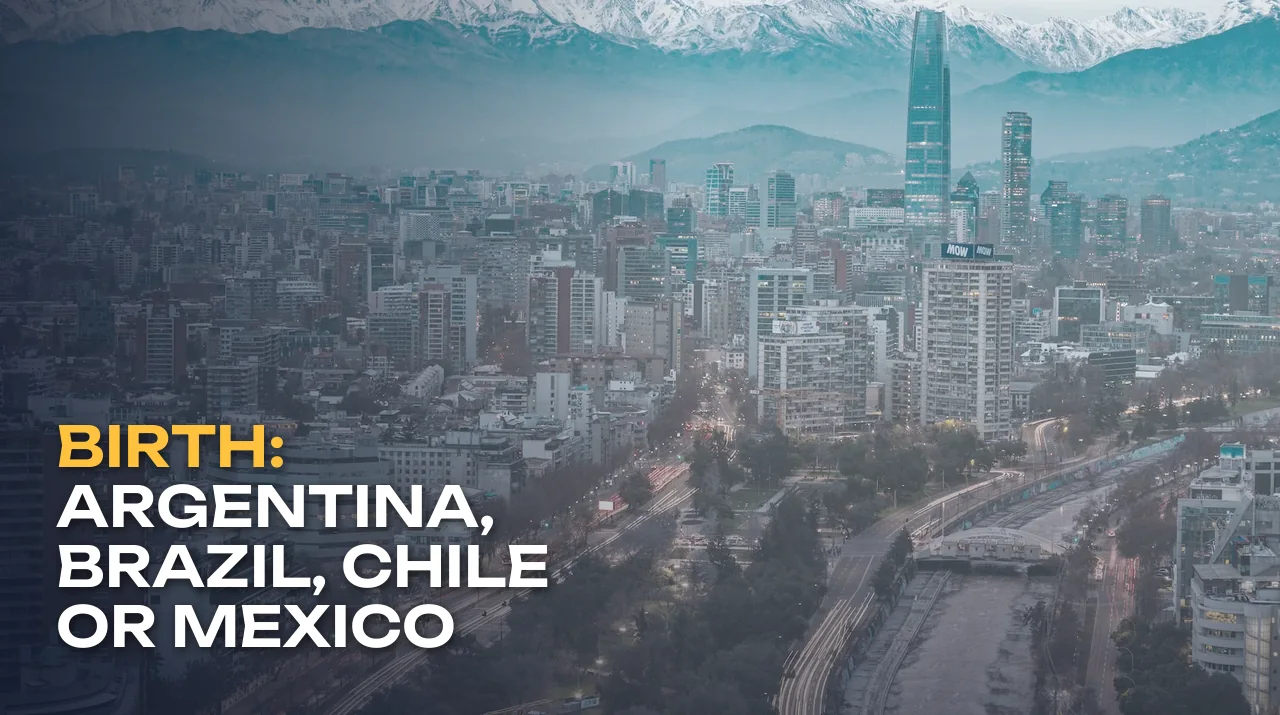
Chile has dropped off the list for families arriving as tourists. Tourists' children are registered as children of "foreigners in transit" and can opt for Chilean citizenship only after turning 18. Each country is examined in detail below.
Argentina: unconditional citizenship for the child
In brief: the child is an Argentine citizen from birth whatever the parents' status. The parents receive residence, and their citizenship depends on the Supreme Court's ruling on Decree 366/2025.
Article 1 of Citizenship Law No. 346 grants citizenship to everyone born on the country's territory, except children of foreign diplomats. Citizens of Russia, Ukraine and Belarus enter visa-free for 90 days. Decree 366/2025 removed naturalisation for parents without a residence period, but in June 2026 the courts found the decree unconstitutional as regards citizenship, and the dispute moved to the Supreme Court.
Since 11 August 2026 national hospitals have been billing foreigners without permanent residence, so families give birth in private clinics. The strength of citizenship by birth is the main argument for Argentina: a citizen by birth cannot be stripped of citizenship, and in Spain obtains citizenship after 2 years of residence. More in the articles giving birth in Argentina and citizenship and how much childbirth costs in Argentina.
Brazil: citizenship for the parents after a year
In brief: a child born in Brazil is a citizen from birth. The parents receive residence on the basis of reunification with the child and can apply for citizenship after 1 year.
Article 12 of the Brazilian Constitution grants citizenship to everyone born in the country, except children of foreigners in the service of their own state. Migration Law 13.445/2017 shortens the naturalisation period to 1 year of indefinite residence for anyone with a Brazilian child. The applicant must be able to communicate in Portuguese, proven by a certificate, and file the application with the Federal Police while in Brazil.
Citizens of Russia and Ukraine enter Brazil visa-free for 90 days. The SUS public health system treats everyone in the country, but foreign families usually give birth in private clinics in Sao Paulo, Rio de Janeiro or Florianopolis. The main barrier is the Portuguese language. More in the article Argentine or Brazilian passport.
Chile: tourists' children are no longer citizens
In brief: Article 10 of the Chilean Constitution excludes children of "foreigners in transit" from right of soil. Since April 2026 the Civil Registry has been registering tourists' children this way: they do not acquire citizenship automatically.
On 13 April 2026 the Chilean Civil Registry issued Circular No. 014: children of tourists and of foreigners without valid residence are to be registered as children of "foreigners in transit". On 4 May 2026 Circular No. 016 restored citizenship to children of undocumented migrants who live in the country. For tourists the rule remained: the Registry stated explicitly that the aim is to stop trips by families with no connection to Chile who come only for the child's passport.
The child of a "foreigner in transit" can opt for Chilean citizenship within a year of turning 18. For parents, naturalisation in Chile requires 5 years of living in the country. So for a family coming to give birth as tourists, Chile does not work in 2026. If the family lives in Chile with residence, the child acquires citizenship at birth. The Chilean passport is strong, though: Chile is in the US Visa Waiver Program.
Mexico: permanent residence for parents straight away, citizenship after 2 years
In brief: a child born in Mexico is a citizen from birth. The parents receive permanent residence as relatives of a citizen and citizenship after 2 years of living in the country, but must declare that they renounce their previous citizenship.
Article 30 of the Mexican Constitution grants citizenship to everyone born on its territory. The Migration Law allows the parents of a Mexican to obtain permanent residence without a temporary stage. The Nationality Law shortens the naturalisation period to 2 years for those with Mexican children by birth. The applicant takes an exam in Spanish and in Mexican history and culture.
Mexico has two peculiarities. The first is that on naturalisation a foreigner signs a renunciation of their previous citizenship. Russia and most other countries do not recognise such a renunciation, so in practice the previous passport is kept, but for citizens of Kazakhstan this creates an additional risk. The second is entry: citizens of Russia and Ukraine need an electronic authorisation to enter by air or a visa, while citizens of Belarus and Kazakhstan need a consular visa or a valid US, Schengen, UK or Japanese visa. The decision on entry is made by the border officer, so documents on the purpose of the trip, accommodation and a return ticket should be kept to hand.
Sofia MendesInvestment Programs Expert, BRIDGES
Choosing a country to give birth in? We will help you decide
We will compare the price, the timelines and what each option gives your family.
The parents' route: a comparison
In brief: parents obtain citizenship fastest in Brazil, then in Mexico. In Argentina everything depends on the Supreme Court, and in Chile 5 years are needed.
The comparison shows that in all four countries the parents' citizenship requires living in the country. Even in Brazil the year is counted after indefinite residence is granted, and obtaining it takes several more months. For a family not prepared to relocate, childbirth gives citizenship only to the child, while passports for the parents come through citizenship by investment programmes. More in the article citizenship by investment in Latin America.
| Country | Parents' residence | Time to citizenship | Exam and language |
|---|---|---|---|
| Argentina | Temporary for up to 3 years as relatives | No period under the previous law or 2 years under the decree, Supreme Court to decide | Spanish for the court |
| Brazil | Through reunification with the child | 1 year of indefinite residence | Portuguese, certificate |
| Chile | Temporary residence as relatives | 5 years of residence | Spanish and a history exam |
| Mexico | Permanent residence straight away | 2 years of residence | Spanish and an exam in history and culture |
For Argentina the conservative scenario is that the parents receive residence and naturalise after 2 years of living there without leaving. If the Supreme Court upholds the chamber's ruling, the parents' route will be shorter. More in the article changes to the childbirth rules in Argentina. For the investment route, the total for your family is shown in the Argentine citizenship estimate.
The child's passport: what it gives
In brief: all four passports open the Schengen area without a visa. The Chilean passport gives visa-free entry to the United States with ESTA, and the Argentine passport a fast route to Spanish citizenship.
According to the BRIDGES index, the Argentine passport opens 168 destinations without a consular visa, including Schengen, the United Kingdom and Japan. The Brazilian and Mexican passports are close in strength. The Chilean passport is the only one of the four that allows travel to the United States with an ESTA electronic authorisation, without a visa.
For a child who may live in Europe in the future, another advantage matters more. Citizens by birth of all four countries obtain Spanish citizenship after 2 years of residence there, while naturalised citizens need 10 years. More in the article an Argentine passport and living in Europe.
Healthcare and the price of childbirth
In brief: in all four countries foreign families give birth in private clinics in large cities. Childbirth prices are comparable, while the cost of living and the rules of state hospitals differ.
In Argentina a natural birth in a private clinic in Buenos Aires costs roughly $3,000-6,000, and since August 2026 state hospitals have been charging non-residents. In Brazil the public system is free for everyone in the country, but foreigners choose private clinics. In Mexico and Chile private medicine in the capitals is strong, and childbirth prices are close to Argentina's.
The overall trip budget depends on accommodation and length of stay. Buenos Aires and Mexico City are cheaper than Sao Paulo and Santiago for rent and living costs. In Mexico bear in mind that many families give birth in Cancun, where medicine is weaker than in the capital and prices are geared to tourists.
The child's documents in each country
In brief: the procedure is similar in all the countries: a clinic certificate, civil registry entry, birth certificate, identity card and passport. Timelines and requirements for parents differ.
In Argentina the birth is registered within 40 days, often right at the clinic, and then the DNI identity card and passport are issued by RENAPER. In Brazil the child is registered at a civil registry notary office, then receives a CPF tax number and a passport from the Federal Police. In Mexico the birth is registered at the state civil registry, then the child receives a CURP personal number and a passport from the Ministry of Foreign Affairs. Everywhere the parents need passports and a marriage certificate with an apostille and translation.
If Argentina's Supreme Court upholds the chamber's ruling, the parents' route will be shorter.
citizenship laws of the four countries
The birth certificate is then apostilled and registered at the consulate of the parents' country. Russian citizens obtain a Russian birth certificate at the consulate and register the child's citizenship. All the documents take 3 to 8 weeks, so the return flight is booked with a margin.
Language and life after the birth
In brief: if the family stays on for the parents' citizenship, the language, the city and the cost of living matter. Spanish is easier to learn than Portuguese, and the Russian-speaking community is largest in Buenos Aires.
Buenos Aires attracts families from Russia and Ukraine with its European architecture, mild climate and large community of compatriots that has formed since 2022. Mexico City and Playa del Carmen also have many Russian-speaking families, but the climate is hot and safety depends heavily on the neighbourhood. Sao Paulo is a huge business city where even everyday life is difficult without Portuguese.
For parents' naturalisation, Brazil requires a Portuguese certificate, and Mexico an exam in Spanish and in the country's history. In Argentina judges check conversational Spanish at an interview. More on life in the article living in Argentina.
The child's citizenship in the parents' country
In brief: a child of Russian or Ukrainian citizens acquires the parents' citizenship by birth and holds two passports. For citizens of Kazakhstan dual citizenship is prohibited.
Argentina, Brazil and Mexico do not require the child to give up a second citizenship: citizenship by birth is kept alongside any other. Belarus requires notification of a second citizenship within three months. Kazakhstan does not recognise dual citizenship, so the family decides in advance which citizenship the child will keep on reaching adulthood. More in the articles for Belarusian citizens and for Ukrainian citizens.
Entry while pregnant
In brief: Russian citizens enter Argentina, Brazil and Chile visa-free, and Mexico with an electronic authorisation or a visa. In all the countries the border officer may ask about the purpose of the trip.
Since 2024 Argentina has been checking pregnant foreign women more closely at the border, and Decree 366/2025 established a declaration of the purpose of entry and of insurance. In Mexico entry is sometimes refused to passengers with little travel history abroad and an unclear purpose, even with an electronic authorisation. In all the countries the family should have an accommodation booking, a return ticket, insurance, the clinic's estimate and proof of funds, and should state the purpose of the trip openly.
Citizens of Kazakhstan enter Argentina visa-free for 30 days, while Mexico requires a visa for them. This should be taken into account when planning the timeline. More in the articles for citizens of Kazakhstan and for Russian citizens.
Length of the trip and the visa-free period
In brief: a trip to give birth lasts 3-4 months. In Argentina, Brazil and Chile the visa-free period for Russian citizens is 90 days, and in Mexico the electronic authorisation gives up to 180 days.
Families arrive 6-10 weeks before the birth and leave 4-8 weeks after it, once the child's documents are ready. In Argentina and Brazil this often does not fit within 90 days, so the stay is extended at the migration service before the visa-free period expires. In Mexico the length of stay is set by the border officer and may be less than 180 days, so state your real return date.
Overstaying in any of the countries leads to a fine and complicates the parents' residence application. Citizens of Kazakhstan entering Argentina for 30 days need to plan the extension from the first day of the trip. Airlines usually require a doctor's certificate after 28 weeks of pregnancy, so it is better to fly early.
Who each option suits
In brief: Argentina for the child's citizenship and the Spanish language. Brazil for a family prepared to relocate and learn Portuguese. Mexico for fast permanent residence for the parents. Chile only for families already living in the country. How we handle an application from due diligence to passport is described on the support for Argentina's programme page.
- A passport for the child, parents return home. Argentina or Mexico.
- Citizenship for the whole family within 1-2 years, with relocation. Brazil or Mexico.
- The Spanish language and a European way of life. Argentina.
- The family already lives in Chile with residence. Chile.
- A passport for the parents without relocating. Argentina's investment programme.
Where families go wrong when choosing
In brief: they choose Chile based on old articles, overlook the renunciation of citizenship in Mexico and the language in Brazil, and count on free hospitals in Argentina.
- They go to Chile to give birth as tourists. Since 2026 the child does not acquire citizenship automatically.
- They do not know about renouncing citizenship in Mexico. This matters for citizens of Kazakhstan.
- They underestimate Portuguese. Without it you cannot naturalise in Brazil.
- They count on a free hospital in Argentina. Since August 2026 non-residents pay.
- They buy a "guarantee of citizenship for the parents". No country offers one without living there.
How much does giving birth abroad cost? We will calculate it
We will break the costs down by item: mandatory payments, fees and services, with no hidden amounts.
Sofia MendesInvestment Programs Expert, BRIDGES
Share this article
Frequently asked
Questions people ask before deciding
01Where is it best to give birth in Latin America in 2026?
For the child's citizenship, Argentina, Brazil or Mexico. For fast citizenship for the parents, Brazil or Mexico. Chile does not grant citizenship to tourists' children.
02Will a child born in Chile get Chilean citizenship?
Not if the parents are tourists. Since April 2026 the Civil Registry has been registering such children as children of "foreigners in transit", and they can opt for citizenship after turning 18.
03After how many years will parents get Brazilian citizenship?
After 1 year of indefinite residence, with knowledge of Portuguese and the application filed in Brazil.
04After how many years will parents get Mexican citizenship?
After 2 years of living in the country with permanent residence, following exams in Spanish and in Mexican history and culture.
05Do you have to renounce your citizenship in Mexico?
On naturalisation a foreigner signs a renunciation of their previous citizenship. Many countries do not recognise it, but for citizens of Kazakhstan it is a risk.
06Do Russian citizens need a visa for Mexico?
They need an electronic authorisation for entry by air, a consular visa or a valid US, Schengen, UK or Japanese visa.
07Whose passport is stronger?
All four open Schengen. The Chilean passport gives entry to the United States with an ESTA. The Argentine passport opens 168 destinations without a consular visa.
08Is childbirth free in state hospitals?
In Brazil, yes, for everyone in the country. In Argentina non-residents have paid since August 2026. In all the countries foreign families usually give birth in private clinics.
09Can parents get citizenship without relocating?
Not through childbirth, in any of the countries. Without relocating, a passport comes through Argentina's citizenship by investment programme.
10How long do the child's documents take?
From 3 to 8 weeks in all four countries: birth registration, identity card, passport and registration at the consulate of the parents' country.
11How long does a trip to give birth last?
Usually 3-4 months: arriving 6-10 weeks before the birth and leaving 4-8 weeks after, once the child's documents are ready.
12Can the visa-free period be extended?
In Argentina and Brazil, yes, through the migration service before the period expires. Overstaying leads to a fine and complicates the parents' residence.
13Where are there more Russian-speaking families?
Most of all in Buenos Aires, where the community has grown since 2022. There are also many families in Mexico City and on the Mexican coast.
14What does an Argentine passport give the child?
Visa-free entry to 168 destinations, the right to live in the MERCOSUR countries and Spanish citizenship after 2 years of living there.
Transparency
How this material was prepared
- Author
- Sofia Mendes, investment Programs Expert, BRIDGES
- Terms and costs last verified
- October 2026
- Sources
- official government authorities of the relevant country and state publications
- Methodology
- government minimum requirements are stated separately from due diligence charges, state fees, legal and banking costs
Sources and methodology
Figures, terms and timelines are checked against official sources as of October 2026. Link availability verified in August 2026. Third-party blogs and agent websites are not used as a source of programme terms.
- [1]EUR-LexOfficial texts of European Union legislationeur-lex.europa.eu/homepage.html
- [2]European Commission - Migration and Home AffairsEntry and residence rules in the EUhome-affairs.ec.europa.eu/index_en
Methodology: tables and charts state government minimum investment requirements; due diligence charges, state fees, legal, banking and other costs are calculated separately and are not included in the minimum thresholds.
About the author
Related materials
What to read next
 ComparisonCaribbean Passport: 5 Citizenship Programs Through Investment in 2026
 ArticleLatin America with a Vanuatu passport: Peru, Ecuador and the Caribbean visa-free
 ComparisonPassport of Portugal or Spain in 2026: which is stronger, terms and dual citizenship
News+1 story on 3 November
Related news
 Argentina · 11 OctArgentina citizenship by investment ban bills: risks for investors
 Greece · 3 NovGreece: the 15% home purchase tax will depend on tax residency, not on your passport
 European Union · 1 NovEuropean Union: updated social security rules for living and working in two countries enter into force
Personal programme selection is conducted by Anna Kovalevskaya, Head of Legal, BRIDGES.
Planning to give birth in Latin America? We will send you a step-by-step plan
We will set out the steps from the first documents to the final status, with the timeline for each.
