Citizenship · Argentina
Giving birth in Argentina: what changed in 2025-2026

Updated: October 2026·14 min read·Expert reviewed
Terms and costs verified: October 2026
Contents
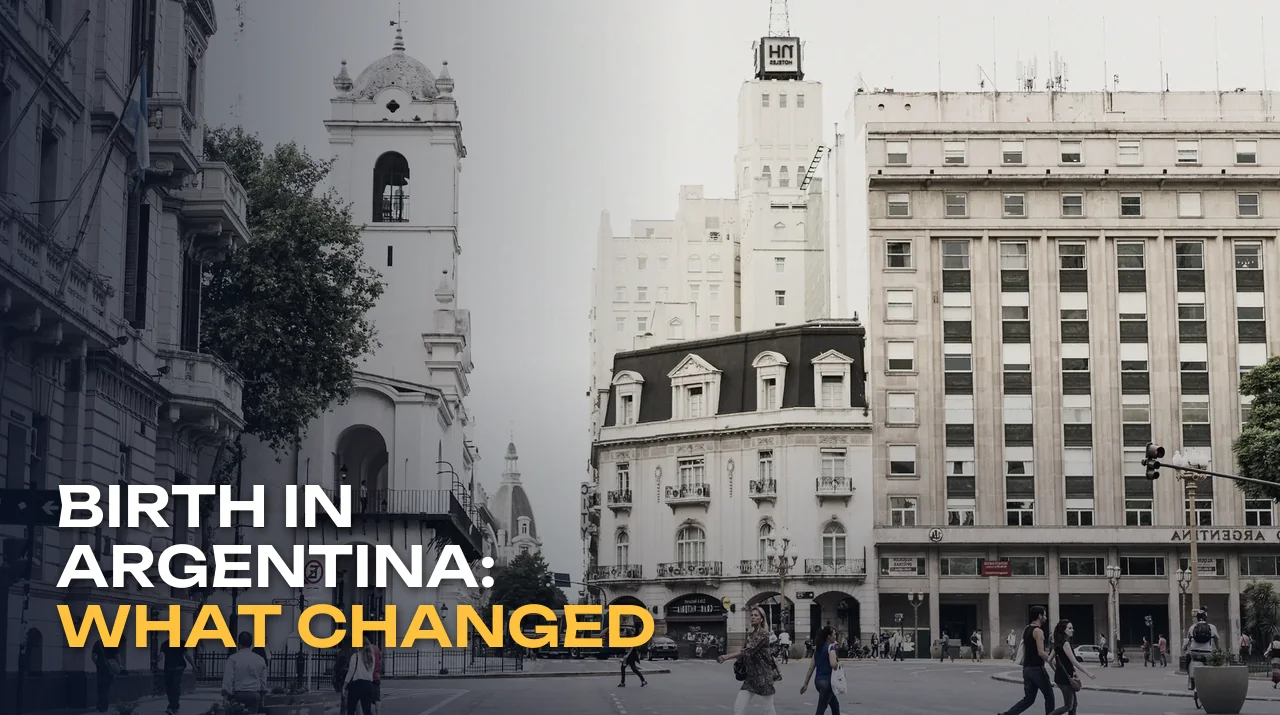
Argentina has not abolished birthright citizenship: a child born in the country is still a citizen from birth. But over 2025-2026, four things changed for families who come to give birth: the parents' route to citizenship, fees in public hospitals, entry conditions and the requirements for a residence permit. The courts have already called some of these changes into question. Below we set out what has changed, what remains the same and how to plan a birth before the Supreme Court rules. The terms, cost and procedure of the programme are on the page Argentine citizenship by investment.
What has changed: in brief
In brief: the child's citizenship has not changed. What has changed are the rules for parents, hospital fees and checks at entry. The main dispute, over the naturalisation of parents, will be settled by the Supreme Court.
Decree 366/2025, Ministry of Health Resolution 1066/2026, Chamber rulings of 18 and 30 June 2026
The comparison shows that every change concerns the parents, not the child. Searches such as "Argentina has abolished birthright citizenship" are therefore based on a mistake: Decree 366/2025 removed the simplified route for parents but did not touch the right of the soil. For a family whose priority is the child's citizenship, Argentina remains one of the most straightforward countries. For a family that counted on citizenship for the parents within 1-2 years, the rules have become contested.
Decree 366/2025: what it changed
In brief: the decree of 29 May 2025 amended the citizenship law and the migration law. For families, the key points are the end of naturalisation for parents without a residence period, hospital fees and new entry conditions.
Decree 366/2025 is a decree of necessity and urgency that the government adopted instead of a law. It changed several provisions at once. On citizenship, naturalisation now requires 2 years of lawful residence without leaving the country, decisions are made by the migration service, and the simplified route for parents and spouses of citizens has been removed. On migration, the decree introduced a declaration of the purpose of entry and of health insurance, the right of hospitals to charge non-residents, and a requirement to prove means of support for permanent residence.
The government justified the changes by the rise of "birth tourism" and the pressure on hospitals and courts. The decree also created the legal basis for citizenship by investment, on which the programme was built in October 2026. More in the article Decree 366/2025 and the courts.
Why Argentina tightened the rules
In brief: after 2022, thousands of pregnant foreign women came to Argentina, above all from Russia. The government linked this to pressure on hospitals and courts and to intermediaries selling "citizenship through birth".
Argentina became popular for childbirth thanks to a combination of visa-free entry, the right of the soil, free hospitals and fast naturalisation for parents. In 2022-2023 the number of pregnant Russian women flying into Buenos Aires grew so much that the subject made the news and the reports of the migration service. Intermediaries sold "birth plus passports for the whole family" packages, and some of them, as a 2024 investigation found, used forged residence documents.
Javier Milei's government responded with a package of measures: it restricted free healthcare for non-residents and tightened naturalisation and entry. These measures were adopted by a single decree rather than a law, and that became the main argument of the courts that in 2026 ruled the decree unconstitutional as regards citizenship.
Parents: from naturalisation without a residence period to a court dispute
In brief: until May 2025, the parents of an Argentine child applied for citizenship without any residence period. The decree abolished this, but in June 2026 the courts ruled the decree unconstitutional as regards citizenship.
For years the family route was this: the child is born in Argentina, the parents apply for naturalisation under Decree 3213/84 as parents of a citizen by birth, and a federal judge considers the application within 1-2 years. Decree 366/2025 closed this route: parents now naturalise on general terms.
On 18 June 2026, the Third Division of the National Court of Appeals in Civil and Commercial Matters ruled the decree unconstitutional as regards citizenship: the citizenship law cannot be amended by decree. On 30 June 2026, the National Electoral Chamber, in the case "Yang, Liping", declared the decree null and returned citizenship decisions to federal judges. The government appealed, on 24 September 2026 the Chamber admitted the appeal, and the dispute moved to the Supreme Court.
As of October 2026, first-instance courts follow the Chamber's ruling and apply the previous law. But until the Supreme Court has spoken, that ruling may be overturned, and families would be wise to plan on the conservative scenario.
Hospitals: fees for foreigners without permanent residence
In brief: from 11 August 2026, national hospitals bill foreigners without permanent residence. Emergency deliveries are accepted unconditionally, but the patient pays the costs after stabilisation.
Decree 366/2025 allowed hospitals to charge non-residents, and Ministry of Health Resolution No. 1066/2026 set out the procedure. A foreigner without permanent residence presents insurance or pays for planned care in advance, against an estimate. Labour that has already started, bleeding and emergency care for a newborn are treated as emergencies and are never refused. Permanent residents use public healthcare on equal terms with citizens, with a DNI identity card.
Several provinces, including Salta, Jujuy, Mendoza and Santa Cruz, were charging non-residents even before the resolution. That is why in 2026 families plan births in private clinics and set their budget against a written estimate. More in the article how much it costs to give birth in Argentina.
Entry: declaration, insurance and checks
In brief: visa-free entry for citizens of Russia, Ukraine and Belarus remains. Decree 366/2025 added a declaration of the purpose of entry and of insurance, and since 2024 border officers have checked women in late pregnancy more closely.
Since 2024, Argentina's migration service has checked pregnant foreign women at the border more closely, and there have been cases of entry being refused where answers about the purpose of the trip were inconsistent. In the same year the authorities investigated schemes that sold "citizenship through birth" with forged documents. Decree 366/2025 enshrined a declaration of the purpose of entry and of health insurance. As of October 2026 the procedure for the declaration has not been approved, but consulates advise having insurance on entry.
In practice, entry by a pregnant woman is lawful if the purpose of the trip is stated openly. The family should carry an accommodation booking, a return ticket, insurance, a letter or estimate from the clinic and proof of funds. More in the article giving birth in Argentina and citizenship.
Darya MelnikSenior Investment Programs Advisor, BRIDGES
What has changed for giving birth in Argentina? Ask a lawyer
Describe your situation in a couple of words and we will tell you where to start.
Parents' residence permit: new requirements
In brief: the parents of an Argentine child still receive a residence permit, but since May 2025 it is a temporary permit for up to three years on family reunification grounds rather than permanent residence straight away. For permanent residence, proof of means of support is required.
Residence as the parents of a citizen remains the family's main status after the birth. It gives the right to live and work in Argentina, open a bank account, obtain a CUIT tax number and, once permanent status is granted, use public healthcare. The new requirement is proof of means of support: income, savings or work in the country.
Visa-free status does not guarantee entry: state the purpose of the trip openly and carry insurance, an accommodation booking and a return ticket.
Argentine migration service, 2026
If the Supreme Court upholds the decree, permanent residence, together with two years of residence without leaving the country, will become a mandatory condition for the parents' naturalisation. That is why the residence permit is worth obtaining straight after the birth, even if the family is not yet sure about relocating. More in the articles Argentine residence permit and Argentine permanent residence.
Universities and schools
In brief: the decree allowed public universities to charge foreigners without permanent residence. Schooling and vaccinations for an Argentine child remain free.
Argentina's public universities long admitted foreigners free of charge, which attracted students from across Latin America. Decree 366/2025 allowed universities to introduce fees for foreigners without permanent residence, and each university decides for itself. For a family giving birth in Argentina this is a question for the distant future: an Argentine child studies at public schools and universities as a citizen.
Parents who want to study in Argentina themselves should take the new rules into account: with permanent residence they study on equal terms with citizens, without it under the rules of the particular university.
Who is affected by the changes
In brief: the rules are the same for all foreigners. What differs are the entry conditions and how the parents' country treats the child's second citizenship.
Citizens of Russia, Ukraine and Belarus enter Argentina visa-free for 90 days, citizens of Kazakhstan for 30 days with the option of an extension. For the child of Russian or Ukrainian citizens, the parents' citizenship arises by birth. Belarus requires notification of a second citizenship within three months. Kazakhstan does not recognise dual citizenship, so a family from Kazakhstan needs to decide in advance which citizenship the child will keep. More in the articles for citizens of Russia, Ukraine, Belarus and Kazakhstan.
What stays the same
In brief: the child's citizenship by birth, the child's passport, visa-free entry for citizens of Russia, Ukraine and Belarus, and the strength of Argentine citizenship by birth.
- Right of the soil. Article 1 of Law No. 346: everyone born in Argentina is a citizen.
- The child's documents. Birth registration, the DNI identity card and the passport are issued as before.
- Strength of citizenship. A citizen by birth cannot be stripped of citizenship, and in Spain they obtain citizenship after 2 years of residence.
- Visa-free entry. 90 days for citizens of Russia, Ukraine and Belarus.
- Dual citizenship. The child keeps the citizenship of the parents' country if its law allows this.
It is these rules that keep Argentina popular for childbirth after 2025. The child receives one of the strongest passports in Latin America, the right to live in the MERCOSUR countries and a fast route to Spanish citizenship. More in the article the Argentine passport.
What the Supreme Court will decide
In brief: the court will decide whether the government could amend the citizenship law by decree. The parents' route and the legal basis of the investment programme depend on this.
| Supreme Court ruling | What happens to parents | What the family should do now |
|---|---|---|
| Upholds the Chamber's ruling | Naturalisation under the previous law, through a federal judge | Apply for residence and gather documents for the court |
| Overturns the Chamber's ruling | General terms of the decree: 2 years without leaving and permanent residence | Live in the country and build up the residence period |
| Issues a partial ruling | Some provisions of the decree remain | Follow official clarifications and act on the conservative plan |
No one can say when the Supreme Court will rule: the court sets the order of its cases itself. Until there is a ruling, the lower courts follow the Chamber, and the migration service continues to prepare the investment programme on the basis of the decree. For a family, this means the conservative plan works whatever the outcome: the child obtains citizenship, the parents obtain residence and live in the country, and if the court upholds the Chamber's ruling, the parents' route becomes shorter.

Citizenship by investment as an alternative
In brief: from October 2026, a family can obtain citizenship without residence in return for a contribution: $350,000 for the main applicant, $100,000 for a spouse and $25,000 for a child under 18.
The programme was announced on 2 October 2026, and applications are expected to open in the fourth quarter. A family of two parents and two children contributes $500,000. The migration service makes a decision within 30 working days after the Agency's checks. The programme rests on the same Decree 366/2025, so the Supreme Court ruling matters for it too. More in the article how much Argentine citizenship costs.
For a family where it is the parents who need citizenship and who do not want to live in Argentina, the programme is clearer than the birth route. For a family whose priority is the child's citizenship, birth remains an accessible route without large investment. For the investment route, the total for your family is shown in the Argentine citizenship estimate.
How to plan a birth now
In brief: count on the child's citizenship, budget for a private clinic, obtain the parents' residence permit straight away and plan the parents' citizenship on the conservative scenario. How we handle an application from checks to passport is described on the page support with the Argentina programme.
- Goal. The child's citizenship is guaranteed by law. The parents' citizenship depends on the court.
- Clinic. Private, with a written estimate and neonatal care.
- Entry. Purpose stated openly, insurance, accommodation, return ticket, funds.
- Documents. Marriage certificate with an apostille and translation, prepared in advance.
- Residence permit. Apply as soon as you receive the birth certificate.
- Court ruling. Follow the Supreme Court ruling and act on its outcome.
Planning to give birth in Argentina? We will send you a step-by-step plan
We will set out the steps from the first documents to the final status, with the timing of each.
Darya MelnikSenior Investment Programs Advisor, BRIDGES
Share this article
Frequently asked
Questions people ask before deciding
01Has Argentina abolished birthright citizenship?
No. A child born in Argentina is a citizen from birth under Article 1 of Law No. 346. Decree 366/2025 changed only the parents' route.
02What has changed for parents?
Decree 366/2025 removed naturalisation for parents without a residence period. In June 2026 the courts ruled the decree unconstitutional as regards citizenship, and the dispute is now before the Supreme Court.
03Is giving birth in a public hospital now fee-paying?
For foreigners without permanent residence, yes, from 11 August 2026 under Resolution 1066/2026. Emergency deliveries are always accepted, but further treatment is paid for.
04Can a pregnant woman enter Argentina?
Yes, visa-free entry for citizens of Russia, Ukraine and Belarus remains. State the purpose of the trip openly and carry insurance, an accommodation booking, a return ticket and proof of funds.
05When will the Supreme Court rule?
There is no deadline: the court sets the order of its cases itself. The appeal reached the court on 24 September 2026.
06Do parents get a residence permit after the birth?
Yes, on family reunification grounds. Since May 2025 this is a temporary permit for up to three years; for permanent residence, proof of means of support is required.
07What happens if the Supreme Court upholds the decree?
Parents will naturalise on general terms: 2 years of lawful residence without leaving the country and permanent residence.
08What happens if the court sides with the Chamber?
Citizenship decisions will stay with federal judges, and parents will be able to apply under the previous law.
09Is there an alternative for parents?
Yes, citizenship by investment: $350,000 for the main applicant, $100,000 for a spouse and $25,000 for a child under 18, with no residence requirement.
10Can you study at an Argentine university for free?
Citizens and permanent residents can. Universities may charge foreigners without permanent residence, and each university decides for itself.
11Do the changes affect citizens of Kazakhstan?
Yes, the rules are the same for all foreigners. Citizens of Kazakhstan enter visa-free for 30 days, and Kazakhstan does not recognise dual citizenship for the child.
12Why did Argentina tighten the rules?
After 2022 the number of foreign women arriving to give birth rose, and intermediaries sold "passports for the whole family" packages. The government linked this to pressure on hospitals and courts.
13Why do articles from 2023 say something different?
They describe the rules before Decree 366/2025: naturalisation for parents with no residence period and free hospitals for everyone.
Transparency
How this material was prepared
- Author
- Darya Melnik, senior Investment Programs Advisor, BRIDGES
- Terms and costs last verified
- October 2026
- Sources
- official government authorities of the relevant country and state publications
- Methodology
- government minimum requirements are stated separately from due diligence charges, state fees, legal and banking costs
Sources and methodology
Figures, terms and timelines are checked against official sources as of October 2026. Link availability verified in August 2026. Third-party blogs and agent websites are not used as a source of programme terms.
- [1]EUR-LexOfficial texts of European Union legislationeur-lex.europa.eu/homepage.html
- [2]European Commission - Migration and Home AffairsEntry and residence rules in the EUhome-affairs.ec.europa.eu/index_en
Methodology: tables and charts state government minimum investment requirements; due diligence charges, state fees, legal, banking and other costs are calculated separately and are not included in the minimum thresholds.
About the author
Related materials
What to read next
 ComparisonCaribbean Passport: 5 Citizenship Programs Through Investment in 2026
 ArticleLatin America with a Vanuatu passport: Peru, Ecuador and the Caribbean visa-free
 ComparisonPassport of Portugal or Spain in 2026: which is stronger, terms and dual citizenship
News+1 story on 3 November
Related news
 Argentina · 11 OctArgentina citizenship by investment ban bills: risks for investors
 Greece · 3 NovGreece: the 15% home purchase tax will depend on tax residency, not on your passport
 European Union · 1 NovEuropean Union: updated social security rules for living and working in two countries enter into force
Personal programme selection is conducted by Anna Kovalevskaya, Head of Legal, BRIDGES.
Want Argentine citizenship for your family? We will help you get it
We take your situation into account and note what you already have and what you still need.
