News · Spain
Spain: housing up 80% in ten years while wages rose 28%

Updated: October 2026·15 min read·Expert reviewed
Terms and costs verified: October 2026
Contents
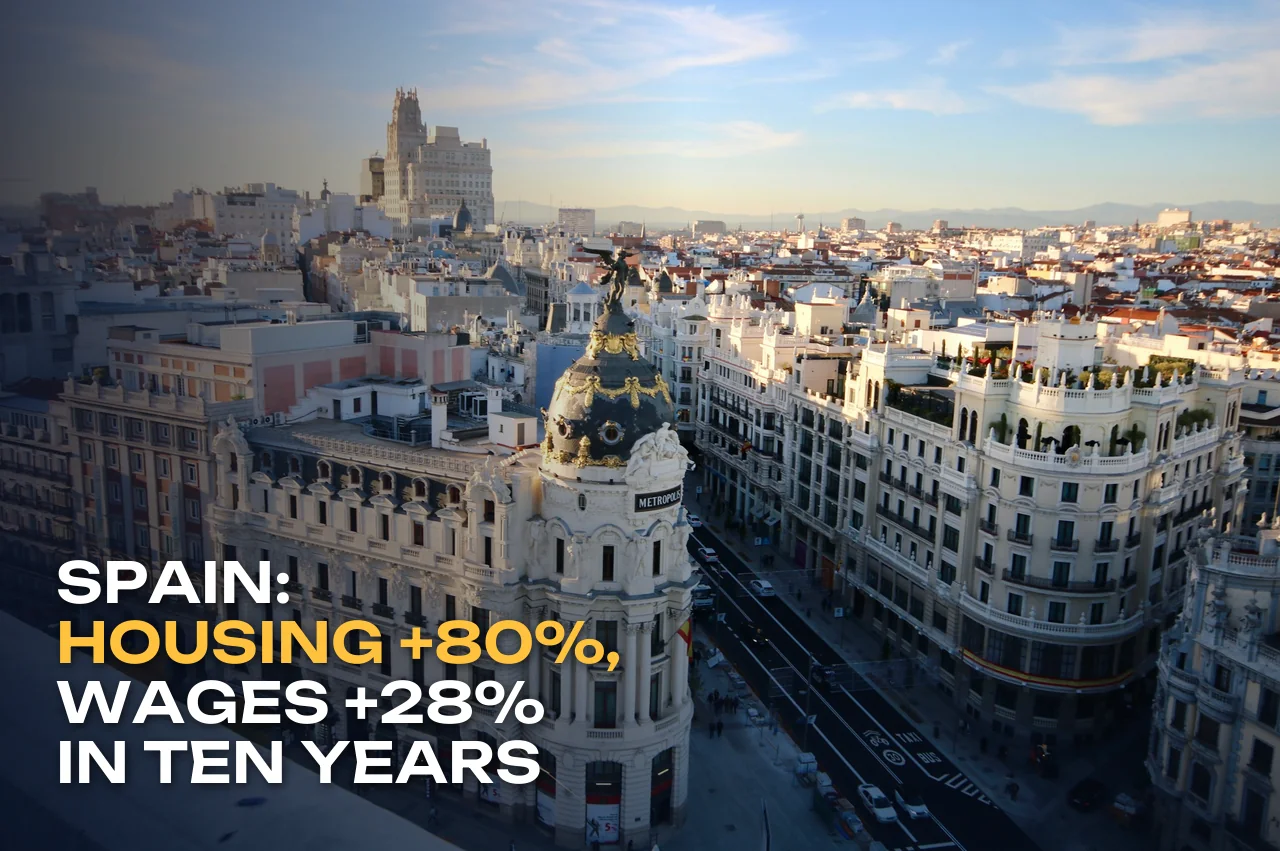
On 26 October 2026 the European press reported figures now being debated in Spain ahead of the snap election: between 2015 and 2025 housing became 84.6% more expensive, while wages rose by 27.85%. I checked these numbers against the tables of Spain's National Statistics Institute (INE), Eurostat and the Bank of Spain and recalculated them myself. The order of magnitude holds: house prices rose by roughly 80-84% depending on the method, wages by roughly 25-28%. I explain where the difference comes from, what it means for anyone renting or buying a home in Spain, and what residence options remain now that the golden visa is closed.
In brief
- On INE's house price index the 2025 average is 79.9% above the 2015 average. Q4 2025 is 84.3% above Q4 2015.
- According to INE, the average gross annual salary rose from EUR 23,106 in 2015 to EUR 29,540 in 2024, an increase of 27.85%. This survey has no 2025 data yet.
- Adjusted for inflation, wages grew by about 3.5% over 2015-2024, while housing became about 42% more expensive over 2015-2025. This is my calculation based on INE data.
- Growth continues: in Q2 2026 housing was 12.2% more expensive than a year earlier.
- The snap general election is set for 29 November 2026 by Royal Decree 806/2026, published in the Official State Gazette on 6 October.
- Spain has had no golden visa for buying a home since 3 April 2025. Other grounds for residence remain, and for investment residence it is worth looking at Portugal and Greece.
What the official figures show
The main source on prices is INE's house price index. It is built from transactions recorded by notaries and tracks the price of homes of constant quality. Until the end of 2025 the base year was 2015: the 2015 average equals 100. In 2025 the average index value was 179.9, and in Q4 2025 it was 186.75. New homes rose faster than resale homes: an index of 206.5 against 175.8.
INE has two main sources on pay. The annual wage structure survey shows the average gross annual salary per worker: EUR 23,106.30 in 2015 and EUR 29,540.26 in 2024, the latest year published. The quarterly labour cost survey gives the wage cost per worker per month: an average of EUR 1,902 in 2015 and EUR 2,377 in 2025, up 24.9%. Both series say the same thing: pay is growing about three times more slowly than housing.
| INE indicator | 2015 | 2025 | Change |
|---|---|---|---|
| House prices, annual average (index) | 100 | 179.9 | +79.9% |
| House prices, Q4 (index) | 101.3 | 186.75 | +84.3% vs Q4 2015 |
| New homes, annual average (index) | 100 | 206.5 | +106.4% |
| Resale homes, annual average (index) | 100 | 175.8 | +75.8% |
| Average gross annual salary | EUR 23,106 | EUR 29,540 (2024 data) | +27.85% over 2015-2024 |
| Wage cost per worker per month (quarterly survey) | EUR 1,902 | EUR 2,377 | +24.9% |
| Consumer prices, annual average | - | - | +26.8% |
Eurostat gives a similar picture using its own method. Spain's house price index stood at 180.6 in 2025 with 2015 at 100, i.e. up 80.6%. The EU average over the same period was 61.9%. In Portugal housing rose even more, 2.6 times. We collected the latest European data in our article on EU house prices in Q2 2026.
What this means for you. The gap between prices and pay in Spain is not a journalist's estimate; it is visible in official statistics. The only debate is whether it is 80% or 85%, depending on which periods you compare.
Where 84.6% and 27.85% come from and why the method matters
The 27.85% figure exactly matches the growth of INE's average gross annual salary over 2015-2024: EUR 29,540.26 against EUR 23,106.30. So pay is measured up to 2024, while house prices run to 2025. Comparing different periods slightly overstates the gap: pay also grew in 2025, but this survey is published with a delay of about eighteen months.
We did not find the 84.6% figure in that form in INE's tables. The closest is the growth of the index from Q4 2015 to Q4 2025: 84.3% by my calculation. Comparing annual averages gives 79.9%. The difference of a few points depends on which quarters you take and does not change the conclusion. In this article I rely on calculations from the official series and quote 84.6% and 27.85% as press figures.
There is a third adjustment: inflation. Consumer prices in Spain rose by 23.5% over 2015-2024 and by 26.8% over 2015-2025. So real pay gained about 3.5% in nine years, while the real price of housing gained about 42% in ten. This is my calculation: the house price index and pay divided by the consumer price index.
A simple example. A flat that cost EUR 200,000 at the national average in 2015 would cost about EUR 360,000 in 2025 according to the index. In 2015 it took 8.7 average gross annual salaries to buy it; at 2025 prices and 2024 pay it takes 12.2. This is an illustration based on averages, not the price of a specific flat: in Madrid and the Balearic Islands the gap is wider, in the Basque Country narrower.
What this means for you. If you are budgeting a purchase from articles written ten years ago, multiply the price by at least 1.8. If you are working out what you can pay from a local salary, assume income growth three times lower.
Where housing rose the most
INE calculates the index for each autonomous community. The strongest ten-year growth was in Madrid, where prices almost doubled, and in the Balearic Islands. Catalonia is slightly above the national average. The Canary Islands and the Valencian Community, popular with foreign buyers, are below average over ten years, but even there growth was 67-75%. At the end of 2025 prices were rising in every region without exception: from 10.9% a year in Catalonia to 15.3% in Castile and Leon.
| Region | Price growth 2015-2025 (annual average) | Annual growth, Q4 2025 |
|---|---|---|
| Madrid | +99.5% | +14.2% |
| Balearic Islands | +95.1% | +13.4% |
| Catalonia | +87.7% | +10.9% |
| Spain overall | +79.9% | +12.9% |
| Andalusia | +79.2% | +12.4% |
| Canary Islands | +74.5% | +11.0% |
| Valencian Community | +67.4% | +13.5% |
| Basque Country | +65.9% | +12.3% |
Growth did not stop in 2026. In Q2 2026 INE's index rose by 12.2% on the same quarter of 2025 and by 3.4% on the previous quarter. New homes rose 7.4% over the year, resale homes 12.9%. From 2026 INE calculates the index from a new base year, 2025, so 2026 figures cannot be placed directly in the same series as the 2015-based index, but annual rates are comparable.
The Bank of Spain explains why this is happening. In its Annual Report 2025, presented on 18 June 2026, it estimated the accumulated housing shortfall for 2021-2025 at about 750,000 units: the difference between the number of new households and the number of homes completed. The bank notes that access problems hit young people, migrants and residents of large cities and tourist areas hardest.
What this means for you. A shortfall of 750,000 homes in five years is not closed in a year or two. I would not expect prices in Spain to fall any time soon, even if new measures appear after the election.
Thinking of moving to Spain? We will help you choose a route
We compare price, timing and what each option gives your family.
The 29 November election: housing at the centre of the campaign
The election date is confirmed by an official document. Royal Decree 806/2026 of 5 October 2026 dissolving the Congress of Deputies and the Senate and calling elections was published in Official State Gazette no. 248 on 6 October and took effect on the day of publication. The vote takes place on Sunday, 29 November 2026. The campaign lasts 15 days, from 13 to 27 November. The new parliament convenes on 23 December 2026.
European and Spanish media report that housing has become one of the main campaign issues. The reason is plain: on 2 October 2026 Congress rejected the government's first rental package, and on 6 October the government adopted two new royal decree-laws, 28/2026 and 29/2026. We described how they work in our article on the Spanish rent cap. The decrees must be validated within 30 days of adoption by the standing committee of Congress, which acts in place of the dissolved parliament. At the time of writing we had not found an official decision on their validation.
There is a second issue that buyers from outside the EU should know about. In May 2025 the governing party's parliamentary group tabled a bill in Congress for an additional tax on home buyers not resident in the EU, of up to 100% of the price. According to press reports, the bill remained at an early stage. Under the rules of Congress, dissolution ends the consideration of unfinished business, so if the idea returns after the election it will have to be tabled again.
What this means for you. Until the new parliament convenes there will be no major housing laws: only decrees already adopted by the government apply. Decisions affecting buyers and tenants will not come before 2027.
What it means for tenants
For someone moving to Spain and renting, the INE figures mean one thing: rent is expensive and will keep rising, and few flats are available. Since 8 October 2026 Decree-law 29/2026 applies. At the annual review, rent above the state reference index is frozen; rent below it may rise by no more than 2%. A temporary lease now runs from 31 days to 12 months and only with a proven reason, such as work or study.
In practice, for a foreigner this means a lease on a permanent home is best signed from the start as an ordinary lease, not a temporary one. An ordinary lease gives a five-year minimum term, a cap on increases and a right to extension. If you are applying for a residence permit, a lease is often needed as proof of address, and its type matters. A Spanish-language contract, with a translation into your language, is best checked before signing. If your own documents must be submitted in Spanish, they are prepared through sworn translation.
If the decrees are not validated, the previous rules return: the freeze and the 2% cap stop applying, and temporary leases become flexible again. So it makes sense for a tenant to extend the lease while the decree applies and keep all proof of payment: an extension under the decree requires rent to have been paid on time for eight months in a row.
What this means for you. If you rent in Spain, extend your lease now and pay strictly on time. If you are just moving, allow more time for flat-hunting than you expect: competition for housing in Madrid, Barcelona, Valencia and Malaga is intense.
What it means for buyers
For a buyer, rising prices mean entering the market costs more and rental yields are lower than ten years ago: prices have risen faster than rents can rise under the new limits. If you are buying a home for yourself, this is less of a problem than for an investor. If you are buying to let, calculate yield on the rents the decree allows, not on market listings.
The second side is transaction costs. In Spain the price is topped up by transfer tax on a resale home or VAT and stamp duty on a new one, plus notary, registry and lawyer fees. Rates differ by region. How to calculate the full cost of a purchase is set out in our guide on property purchase costs. Before the deal it is worth ordering checks on the property and the seller: debts, encumbrances, building permits and the tourist licence if one is claimed.
The third side is status. Buying a home in Spain no longer gives residence. If your goal is to live in Spain, first choose a basis for residence, then buy a home. We explain the link between buying property and residence in different countries in our guide on property and residence permits.
What this means for you. If you are buying in Spain to live there, rising prices are no reason to give up, but they are a reason to check you are not overpaying for the area. If you are buying for rental income, under current rules I would calculate yield very cautiously.
Canary Islands: a draft rule on 10 years of residence
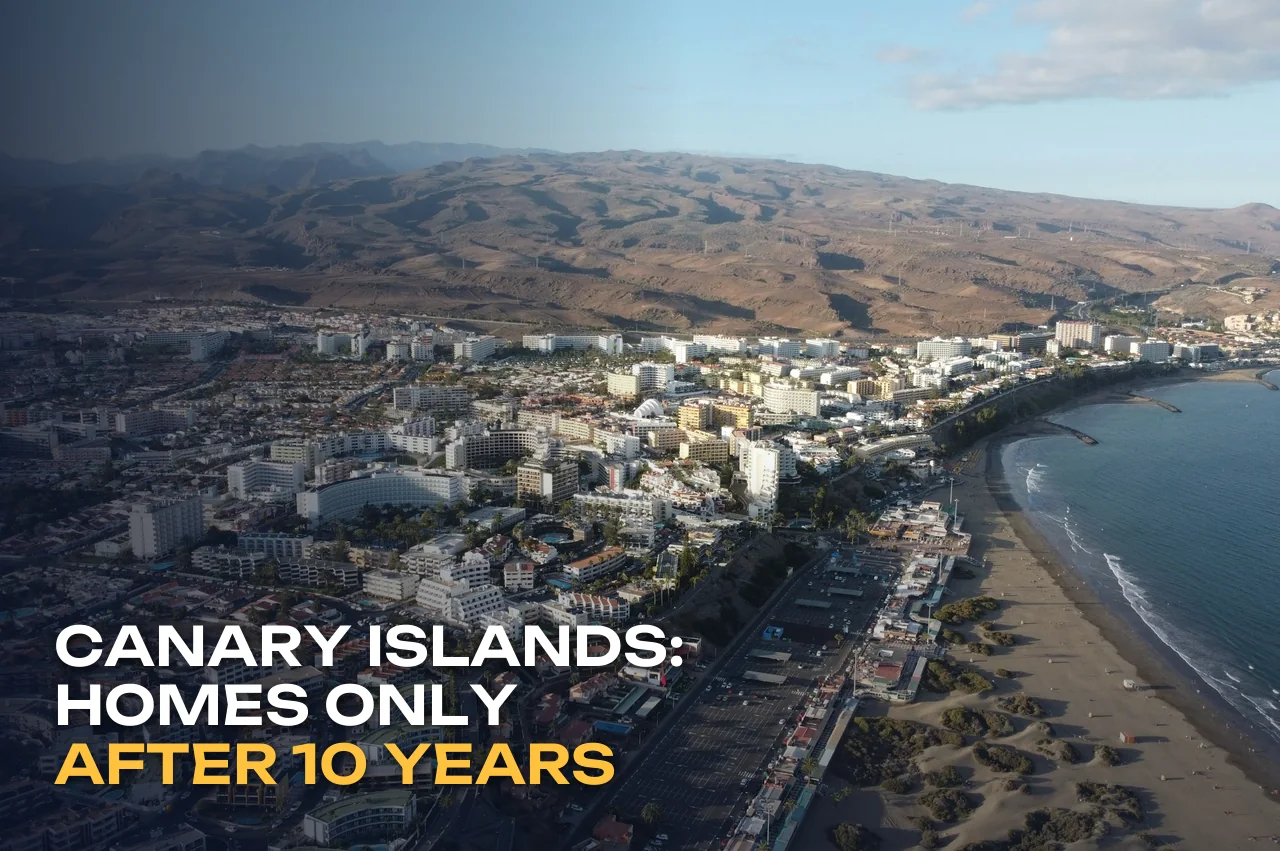
The Canary Islands are a separate story. On 15 October 2026 the Canarian government sent the Spanish government a draft royal decree-law: only people registered on the municipal register of residents for 10 consecutive years, or 15 years with breaks, would be able to buy a home on the islands. The rule does not distinguish by nationality and applies to foreigners and residents of mainland Spain alike.
For now it is a draft: the Spanish government must adopt it, and a purchase restriction must pass a test of compatibility with EU law on the free movement of capital. With parliament dissolved and no new government yet, the chances of a quick decision are slim. We wrote in detail about the draft, its chances and what buyers should do in our article on the Canary Islands 10-year residence rule. On INE's index the Canaries rose 74.5% over ten years, slightly below the national average, and at the end of 2025 growth was 11.0% a year.
What this means for you. If you are looking at a home in the Canaries, deals under current rules are possible. But I would only proceed to signing after checking that the deal will complete before any changes, and with a lawyer on the ground.
Residence in Spain without a golden visa
Spain's golden visa is gone. Organic Law 1/2025 of 2 January 2025 removed the investor visa articles from Law 14/2013, and since 3 April 2025 no new applications are accepted. All investment routes are closed, including buying a home from EUR 500,000. What happened to permits already issued and which grounds remain is covered in our article on the end of the Spanish golden visa and in the glossary entry on the Spanish golden visa.
Living in Spain is still possible. If you have passive income and do not plan to work in Spain, the non-lucrative residence permit fits. If you work remotely for a company or clients outside Spain, the digital nomad visa fits. Both require proof of income and an address, and here rising rents become a practical problem: a lease or your own home has to be found before applying or right after arrival. If you are moving with a spouse and children, the income requirement rises for each family member, as explained in our guide on residence for families.
What this means for you. If you chose Spain because of the golden visa, that route is closed. If you want to live in Spain specifically, choose a basis linked to income or work, and rent or buy your home separately from the residence process.
Portugal and Greece: what to compare
If you need residence by investment, two clear alternatives remain in southern Europe. In Greece the golden visa is still granted for buying property: EUR 800,000 in Attica, Thessaloniki, Mykonos, Santorini and large islands, EUR 400,000 in other regions and EUR 250,000 for converting a commercial building to residential use or restoring a listed building. Note that the Greek government has announced a rise in the transfer tax on homes for non-EU buyers from 3% to 15% from 1 July 2027, as we reported in our article on the 15% tax in Greece.
In Portugal the golden visa is no longer granted for buying a home, but investing EUR 500,000 in an investment fund and other routes remain. For those living on passive income there is the D7 visa. According to Eurostat, housing in Portugal has risen even more than in Spain since 2015, while rental rules there are being relaxed, as described in our article on renting in Europe in autumn 2026.
We compared the countries in our articles Greece or Spain and residence in Portugal or Spain. An overview of the conditions in Spain is on our page about Spain. The full cost of any option, with taxes, fees and family costs, is best calculated in advance, as described in our guide on how costs and timelines are calculated.
What this means for you. If you specifically want Spain to live in, you do not need alternatives: choose a basis linked to income. If residence by investment and freedom of movement in Schengen matter, compare Greece and Portugal by full cost, not by the threshold amount.
Want residence in Spain or nearby? We will do the maths
We break the costs down item by item: mandatory payments, fees and services, with nothing hidden.
Igor VencReal Estate Managing Director, BRIDGES
What to do now
Define your goal
Living in Spain, getting residence by investment or investing in rental property are three different decisions with different countries and budgets.
Choose a basis for residence
For Spain, income or work. For investment residence, Greece or Portugal. Buying a home in Spain does not give residence.
Recalculate your budget
Use 2025-2026 prices and growth of about 12% a year, not figures from old reviews. Add taxes and transaction costs.
Check your lease
For a permanent home, an ordinary lease, not a temporary one. Keep proof of payment.
Follow the election
After 29 November and the formation of a government, housing rules may change. We will write when decisions appear.
If you would like to discuss your situation before deciding, book an online consultation and a lawyer will tell you where to start. An overview of all BRIDGES programmes is on our home page.
How this article was prepared
House price figures: the house price index of Spain's National Statistics Institute (INE), base 2015, national and regional series, the Q4 2025 press release of 6 March 2026 and the Q2 2026 press release of 7 September 2026. Pay: INE's annual wage structure survey (average gross annual salary, 2015-2024) and INE's quarterly labour cost survey (2015-2025). Inflation: INE's consumer price index. EU comparison: Eurostat's house price index, 2015 = 100. Housing shortfall: the Bank of Spain's Annual Report 2025, presented on 18 June 2026. Election: Royal Decree 806/2026 of 5 October 2026, Official State Gazette no. 248 of 6 October 2026. End of the golden visa: Organic Law 1/2025 of 2 January 2025. The 84.6% and 27.85% figures and reports that housing has become a campaign issue come from the press; all recalculations in the text are mine. The status of the rental decrees and of the bill on a tax for non-EU buyers is as of 26 October 2026. This article does not replace advice on your own situation.
Share this article
Frequently asked
Questions people ask before deciding
01Is it true that housing in Spain rose 84.6% in ten years?
The order of magnitude is right. On INE's index the 2025 average is 79.9% above 2015, and Q4 2025 is 84.3% above Q4 2015. The exact 84.6% figure comes from the press.
02How much have wages in Spain risen?
INE's average gross annual salary rose from EUR 23,106 in 2015 to EUR 29,540 in 2024, by 27.85%. Adjusted for inflation the increase is about 3.5%.
03When is the election in Spain?
On 29 November 2026. It was called by Royal Decree 806/2026 of 5 October 2026, published in the Official State Gazette on 6 October. The new parliament convenes on 23 December.
04Can I get Spanish residence by buying a home?
No. The golden visa has been closed since 3 April 2025. For living in Spain the non-lucrative permit and the digital nomad visa remain; Greece, for example, still gives residence for buying a home.
05What should a tenant in Spain do now?
While Decree-law 29/2026 applies, extend the lease, pay on time and sign an ordinary lease, not a temporary one, for a permanent home.
About the author
Related materials
What to read next
 ArticleSpain’s Golden Visa has been abolished: what changed on 3 April 2025 and what the alternatives are
 ComparisonGreece or Spain in 2026: golden visa, residence permit, taxes, real estate - what to choose
 Comparison7 reasons to choose Portugal instead of Spain for a residence permit
News+6 stories on 26 October
Related news
 Spain · 24 OctThe Canary Islands propose selling homes only to those who have lived there 10 years: what it means for buyers
 Spain · 11 OctSpain rent cap 2026: freeze above Serpavi, 2% limit and lease extensions
 Greece · 26 OctGreece: foreigners invested EUR 515.8 million in property in the second quarter, 11.3% less
Personal programme selection is conducted by Anna Kovalevskaya, Head of Legal, BRIDGES.
Want to live in Spain? We will help you choose a route
We compare price, timing and what each option gives your family.
