News · Spain
Spain: Extremadura will again pay remote workers up to EUR 10,000 to move, but conditions are stricter
Updated: October 2026·14 min read·Expert reviewed
Terms and costs verified: October 2026
Contents
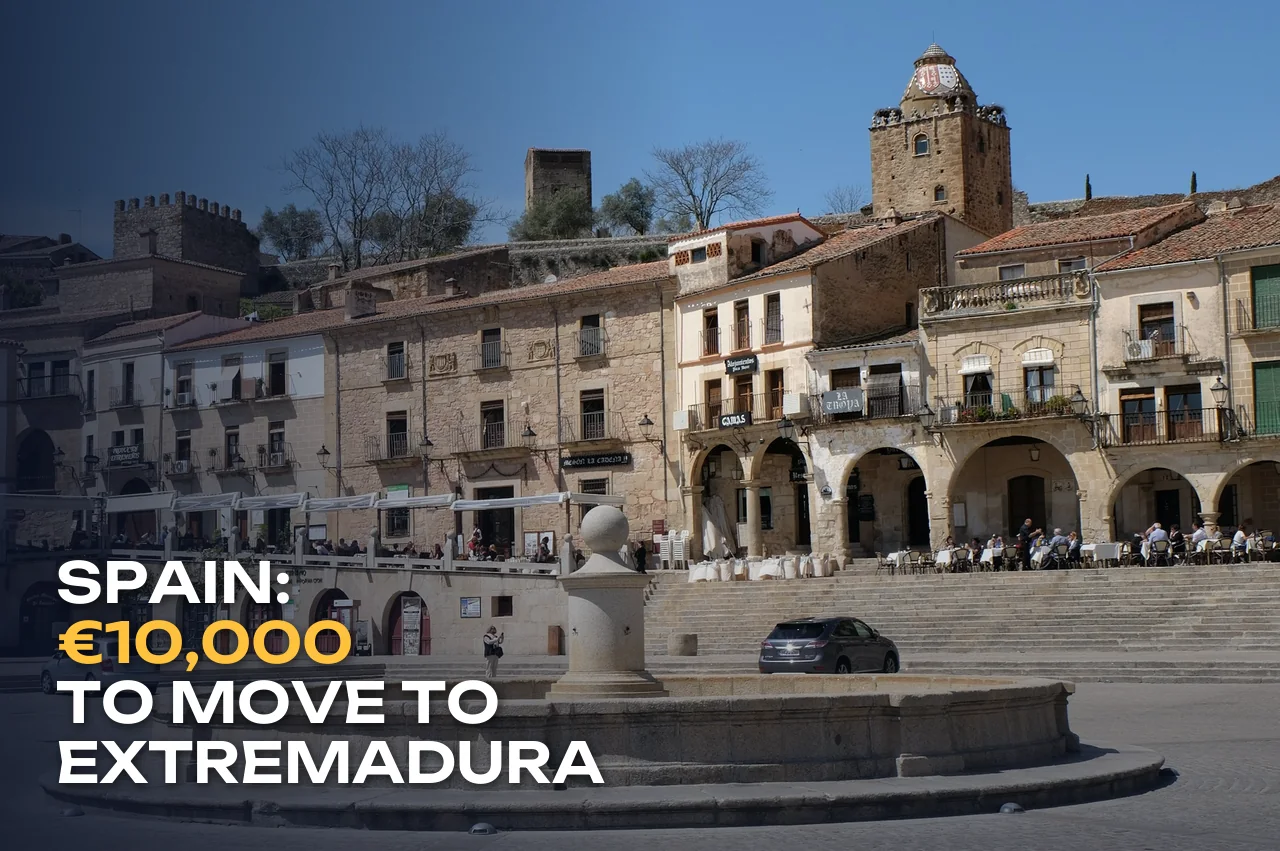
The government of the Spanish region of Extremadura is preparing a new round of payments for remote workers who move to live there. On 29 October 2026 the Extremadura Public Employment Service announced a draft decree: up to EUR 10,000 for the first two years in the region and up to EUR 5,000 for the third, with a total budget of EUR 4.5 million. The amounts are unchanged, but the conditions are stricter: applicants must now have lived outside the region for 18 months instead of 6 and move their tax address to Extremadura. For non-EU nationals the key to the scheme is the Spain digital nomad visa.
In brief
- On 29 October 2026 the Extremadura Public Employment Service (SEXPE) announced a draft decree on support for digital nomads for 2026-2027 with a budget of EUR 4.5 million. It is still a draft and has not yet been published in the regional official gazette.
- Programme I: EUR 10,000 for people under 30, women and those who register in a town with fewer than 5,000 residents, EUR 8,000 for everyone else. The condition is to live and be registered in the region for 24 months.
- Programme II: EUR 5,000 or 4,000 for those who stay another 12 months. Over three years the total can reach EUR 15,000.
- New: 18 months living outside Extremadura before registering instead of 6, a tax address in the region with income tax paid there, and the application filed after registration.
- Applications will be accepted for one year after the decree is published. People who registered in the region from 8 October 2025 get an extra three-month window.
What happened
Extremadura is a region in western Spain on the border with Portugal, with the cities of Merida, Badajoz and Caceres and hundreds of small towns. It is sparsely populated, and since 2024 the regional government has been paying remote workers to move there and stay. The first round ran from 9 October 2024 to 8 October 2025 under Decree 119/2024. According to the employment service, more than 400 digital nomads registered in the region's municipalities during that time.
Applications have been closed since October 2025, and the official service page is marked "out of time". On 29 October 2026 the employment service announced that a draft of a new decree is ready. It restates the rules of the scheme and immediately opens a first round under two programmes. The draft has been posted on the regional transparency portal for comment. The round will open once the final text is published in the Official Gazette of Extremadura.
For a remote worker, three points matter most in this news. The money is coming back, in the same amounts. The requirement about where you lived before has become three times stricter. And for those who already moved after the first round closed, the draft offers a chance to apply retroactively.
| Condition | Current 2024 decree | Draft 2026 decree |
|---|---|---|
| Programme I: settling and registering for 24 months | EUR 10,000 or 8,000 | EUR 10,000 or 8,000 |
| Programme II: 12 more months after the first 24 | EUR 5,000 or 4,000 | EUR 5,000 or 4,000 |
| Who gets the higher amount | under 30, women, registration in a town under 5,000 residents | the same three groups |
| Time lived outside Extremadura before moving | 6 months before applying | 18 months before registering in the region |
| Order of steps | apply first, then register | register first, then apply within 3 months |
| Tax address | no separate condition | tax address in Extremadura and income tax paid there |
| Application window | 9 October 2024 - 8 October 2025, closed | 1 year from the day after the decree is published |
| Budget | EUR 2 million for the first round, later increased | EUR 4.5 million for 2026-2027 |
What this means for you. If you are moving to Extremadura in the coming months, the date of registration matters. Under the draft you apply within three months after it, and you must have lived outside the region for 18 months before it. Do not register until you are sure you meet both time limits.
How much is paid and to whom
The amounts in the draft are the same as in the current decree. Under Programme I the payment is EUR 10,000 if the applicant is under 30, is a woman, or registers in a municipality with fewer than 5,000 residents. The conditions do not add up: a woman under 30 in a small town still gets EUR 10,000. Everyone else is entitled to EUR 8,000.
Programme II rewards those who stay. After the 24 months of Programme I you can live in the region another 12 months and receive EUR 5,000 in the same three groups or EUR 4,000 otherwise. In total, over three years, that is EUR 15,000 for the higher groups and EUR 12,000 for the rest. The payment partly covers the cost of moving and settling in the region.
Under the current decree the money is paid in a single instalment after the grant decision and proof of registration. The aid cannot be combined with other payments for the same purpose from any Spanish public authority. For the self-employed it counts as small-scale state aid under EU rules, and such payments must be declared in the application. Whether the new decree repeats these rules will be clear once the final text is published.
What this means for you. The easiest way to get the higher amount is through location: a town with fewer than 5,000 residents gives EUR 10,000 to any applicant. But registration there must be kept for the whole period, and moving is only allowed to another town of the same size.
Sofia MendesInvestment Programs Expert, BRIDGES
Moving to Spain and working remotely? We will check whether you qualify
We will assess the digital nomad visa, time limits and Extremadura support conditions for your family.
What has changed in the conditions
The first and main change is the time spent outside the region. Under the 2024 decree, six months outside Extremadura before applying was enough. Under the draft you must have lived outside the region for 18 months before registering in an Extremadura municipality. This filters out people who simply re-register from a neighbouring town for the payment, and targets genuinely new residents, including those from abroad.
The second change is the order of steps. Previously a person applied while living outside the region and registered after the decision. Under the draft you first register in an Extremadura municipality and then apply for Programme I within three months. This is easier for someone who has already moved, but riskier for someone in a hurry: missing the three months may cost you the right to the payment.
The third change concerns taxes. The draft requires registering a tax address in Extremadura, or moving it there, and paying income tax in the region. Part of Spanish income tax goes to the budget of the region where the taxpayer lives, so the region wants new residents to leave part of their tax with it. For a foreigner this means the question of tax residence has to be thought through before the move, not after. How the 183-day rule works is explained in our glossary.
The fourth change is extra time windows. Those who registered in Extremadura between 8 October 2025 and the publication of the new round get three months to apply for Programme I. Those who already completed 24 months under Programme I before the new round starts get three months to apply for Programme II. This closes the gap between the first and second rounds.
Who can receive the support
The decree defines a digital nomad as a person who works as an employee or self-employed, remotely and only through computers, the internet and other information systems. The work must be such that it can be done from Extremadura. An employee needs a letter from the employer allowing remote work from the region, or a remote work agreement. A self-employed person needs a description of the activity: how it is organised, what means it uses and what results are expected.
A foreigner needs a Spanish foreigner identity number (NIE). Documents in another language are filed with a sworn translation into Spanish. To prove that the person lived outside Spain, the service accepts a certificate of consular deregistration or an official document from the country where they lived. If such documents are issued abroad, they usually need an apostille.
General restrictions for recipients of public aid in the region also apply: the person must have no debts to the Spanish tax agency, the Extremadura tax authority or Social Security, and no other barriers listed in the regional subsidies law. The service checks all this itself unless the applicant objects, in which case certificates must be provided.
How this relates to the digital nomad visa
EU citizens can move to Extremadura and register there without a visa. For everyone else, the current decree names the document required for payment: a visa for international remote work under the entrepreneurs support law, to which this visa type was added in December 2022. This is the digital nomad visa. Without it a third-country national cannot legally live in Spain and work remotely, and therefore cannot receive the support.
The digital nomad visa is designed for people who work for companies outside Spain or serve foreign clients. A self-employed person may take Spanish clients, but no more than 20% of their total work. You need to prove qualifications or experience, that the employer company has operated for at least a year, and income above the set threshold. The visa is issued for up to a year, and a residence permit obtained in Spain for up to three years with renewal. More on the requirements is on our Spain digital nomad visa page and in our article on the digital nomad visa in Spain.
The time frames of the visa and the scheme fit well together. Programme I requires 24 months, Programme II another 12, three years in total. A residence permit for remote work is issued for up to exactly three years. So a person can get the visa, move to Extremadura, register, receive the first payment, renew the status and receive the second. But applying for support does not replace a visa, and a visa does not guarantee support: they are two separate decisions by two separate authorities.
An important detail for those planning a visa: the 18 months outside Extremadura. If you already live in Spain but in another region, this period counts only if you did not live in Extremadura. If you are moving from abroad, the requirement is easier to meet. But remember that your current residence abroad must be proven with a document.
What this means for you. If you are not an EU citizen, the order is: digital nomad visa first, then registration in Extremadura, then the application for support. Getting the order wrong can cost you the payment.
Taxes: what to watch
The new condition about a tax address in Extremadura ties the payment to Spanish tax residence. Anyone who lives in the country more than 183 days a year usually becomes a Spanish tax resident and pays tax on worldwide income. For remote workers there is a special regime for incoming professionals, known as the Beckham law, which for several years replaces the normal scale with a flat rate.
How the draft requirement fits with the special regime is not clear from the employment service announcement. The final text of the decree will answer that. For now we recommend working out taxes in advance: a EUR 10,000 payment should not be the reason to choose an inconvenient tax setup for several years. A comparison of taxes for nomads in different countries is in our article on taxes under a digital nomad visa, and typical mistakes are covered in our comparison of tax residency for digital nomads.
Housing and life in the region
Extremadura is attractive not only because of the payment. Housing here is noticeably cheaper than in Madrid, Barcelona and on the coast, where prices are rising faster than wages. We covered this in our news on housing prices and wages in Spain. Large cities also have rent restrictions, described in our news on the rent cap, and how a foreigner can rent a flat is explained in our article on renting in Spain.
The other side is the small towns with fewer than 5,000 residents, where the payment is higher. There may be few rentals, no international schools and no stable internet on every street. Before moving, check connectivity, transport to the nearest city and airport, and the availability of housing for the whole programme period.
How to get the payment: the steps
Check the 18 months
Make sure that by the registration date you have lived outside Extremadura for 18 months, and prepare a document proving it.
Secure the right to live in Spain
Non-EU nationals need a digital nomad visa and an NIE. EU citizens need registration as an EU citizen.
Find housing and register
Choose a municipality. A town with fewer than 5,000 residents gives the higher amount to any applicant.
Move your tax address
Under the draft you need a tax address in Extremadura and income tax paid in the region.
Apply within 3 months
Once the decree is published, apply for Programme I. Attach the employer letter or a description of your activity.
Keep the conditions for 24 months
Live in the region, work remotely and keep your registration. You can then apply for Programme II.
Applications are filed electronically through the Extremadura government portal. The decision is made by the head of the employment service within three months. If there is no answer, under the current decree the application is deemed rejected, and the decision can be appealed to a higher authority.
What happens if the conditions are not met
The current decree takes breaches seriously. The recipient must live and be registered in the region continuously for 24 months, work remotely throughout and not interrupt work for more than 60 days in total. If the conditions are breached, the payment must be returned in full with interest. Partial repayment is possible only if the person completed more than half of the period and reported the breach in advance, or more than 70% of the period without reporting.
There is a separate rule for those who received the higher amount for a town with fewer than 5,000 residents: registration there must be kept for the whole period. You may move only to another town of the same size and must report it within 15 days. If the new decree keeps these rules, take them into account when choosing housing. If you are considering Spain more broadly, see our Spain country page.
If remote work does not fit
The Extremadura scheme and the digital nomad visa are designed for people who work. If your income is passive, such as a pension, rent or dividends, the Spain non-lucrative residence permit fits better. Regional payments do not apply to it, since the support requires remote work. Our article on residence in Portugal and Spain helps compare Spain with its neighbour, and all remote work visas in Europe are gathered in our digital nomad visas section.
For travel it also matters that Spain is in the Schengen area: with a residence permit you can travel across the zone without separate visas. On changes at internal borders, see our news on the end of checks on the Italy-Spain border. Step-by-step visa instructions are in our Spain digital nomad visa guide.
What to do now
Until the decree is published, you cannot apply. But you can prepare now. Check how many months you have lived outside Extremadura. Gather documents that prove it. If you are a non-EU national, start the digital nomad visa: collecting documents, a criminal record certificate, translations and apostilles usually takes several months. You can discuss your situation at an online consultation.
We are following the publication of the decree and will update this news when the final text appears in the regional official gazette. It will contain exact application dates, the list of documents and repayment rules.
Want to live in Spain and work remotely? We will arrange the visa
We will prepare the visa documents and check the time limits and regional support conditions.
Sofia MendesInvestment Programs Expert, BRIDGES
How this article was prepared
Sources: announcement by the Extremadura Public Employment Service (SEXPE) of 29 October 2026 on the draft decree setting the rules of support for attracting and settling digital nomads and the first round under Programmes I and II, on sexpeemplea.juntaex.es; Decree 119/2024 of 17 September 2024, published in the Official Gazette of Extremadura (DOE) No. 196 of 8 October 2024; the service page "Support for attracting and settling digital nomads" on the Extremadura government portal juntaex.es; Spanish Law 14/2013 on support for entrepreneurs as amended by Law 28/2022 in the Official State Gazette (BOE). As of 31 October 2026 the new decree is a draft: amounts and conditions are taken from the employment service announcement, and the final text may differ. Payment, repayment and document rules are given according to the current 2024 decree.
Share this article
Frequently asked
Questions people ask before deciding
01How much does Extremadura pay remote workers?
Under the draft decree, EUR 10,000 for 24 months in the region for people under 30, women and those registered in a town with fewer than 5,000 residents, and EUR 8,000 for others. For the next 12 months, another EUR 5,000 or 4,000.
02Can I apply now?
No. As of 31 October 2026 the decree is a draft. Applications will open for one year after the final text is published in the Official Gazette of Extremadura.
03What has changed since 2024?
Before registering you must have lived outside the region for 18 months instead of 6, move your tax address to Extremadura and pay income tax there. The application is filed within three months after registration.
04Does a foreigner need a digital nomad visa?
Non-EU nationals do. The current decree requires a visa for international remote work, that is the Spain digital nomad visa, and an NIE number for payment.
05What if I moved to Extremadura after October 2025?
The draft provides an extra three-month window for those who registered in the region between 8 October 2025 and the publication of the new round.
About the author
Related materials
What to read next
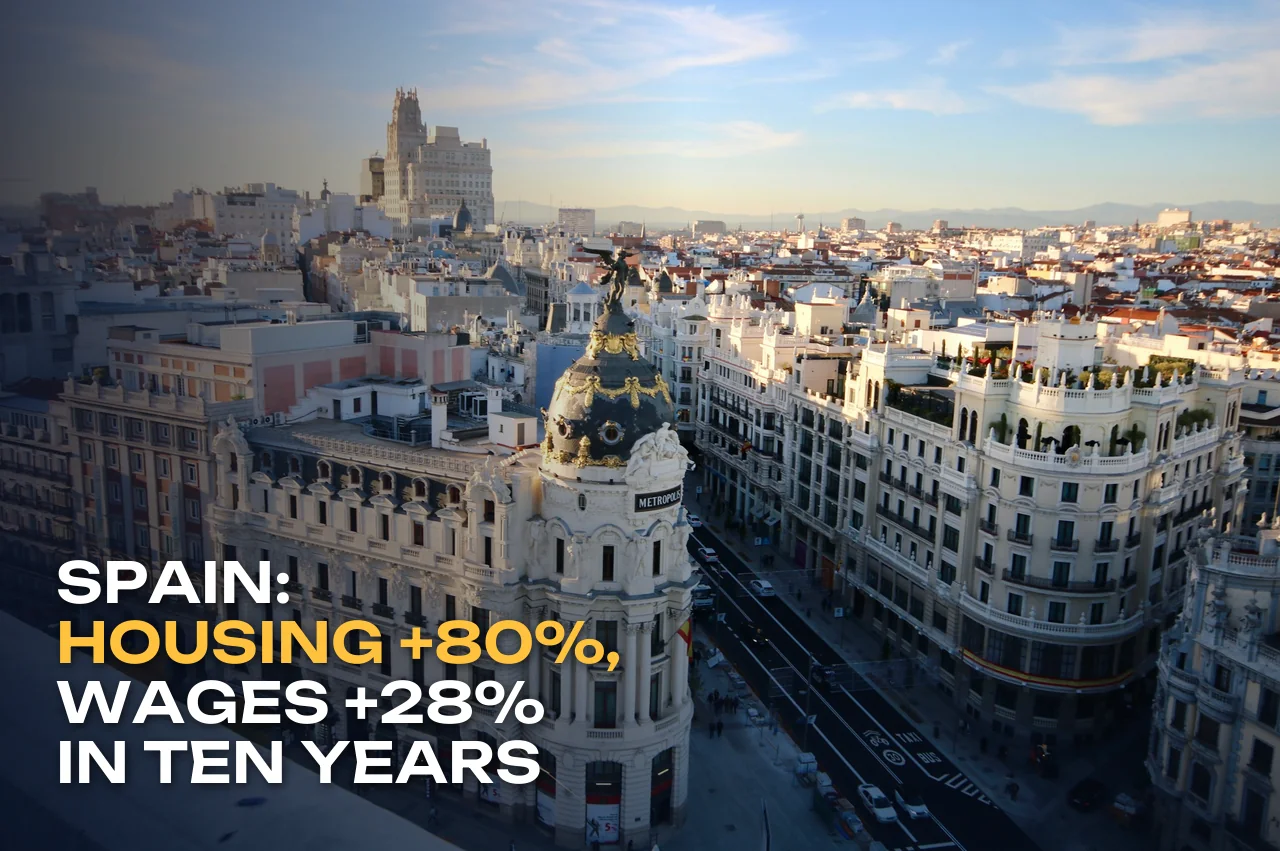 NewsSpain: housing up 80% in ten years while wages rose 28%
 ComparisonGreece or Spain in 2026: golden visa, residence permit, taxes, real estate - what to choose
 ArticleSpain’s Golden Visa has been abolished: what changed on 3 April 2025 and what the alternatives are
News+3 stories on 1 November
Related news
 Spain · 1 NovSpain: foreigners bought 13% fewer homes as the market falls for an eighth month
 Spain · 28 OctIbiza prepares a record EUR 4.2 million fine for tourist letting without a licence
Personal programme selection is conducted by Anna Kovalevskaya, Head of Legal, BRIDGES.
Moving to Spain and working remotely? We will check whether you qualify
We will assess the digital nomad visa, time limits and Extremadura support conditions for your family.
