Comparisons · Europe
Digital nomad visa and tax residence: the 183-day rule in Spain, Portugal, Croatia and Greece

Updated: October 2026·16 min read·Expert reviewed
Terms and costs verified: October 2026

Contents
A digital nomad visa gives you the right to live in a country and work remotely, but it does not answer the main question: where you pay tax. That is decided by other rules - how many days you spend in the country and where your home, family and money are. Spain, Portugal, Croatia and Greece count this differently, and each has its own tax regime for newcomers with separate conditions and application deadlines. Here is when the visa turns you into a tax resident, what each regime offers and what to prepare before the move so you do not end up resident in two countries at once.
In brief
- A nomad visa is an immigration status. Tax residence arises under the country's tax law, usually after 183 days of presence or when you move the centre of your life.
- Spain: you are resident if you spend more than 183 days there in a calendar year. An employed remote worker with the visa can choose a special regime: 24% on income up to EUR 600,000 for the year of the move and the next five years.
- Portugal: more than 183 days in any 12 months, or a home kept for habitual residence. The NHR regime is closed to new applicants; its replacement, IFICI, covers only a defined list of activities.
- Croatia: by law, a nomad's income from an employer not registered in Croatia is not treated as income. The status lasts up to 18 months, and a new application is possible six months after the previous one ends.
- Greece: a 50% income exemption for seven years, but for employees only when working for a Greek company or a permanent establishment in Greece.
A visa and tax residence are separate decisions
The most common mistake remote workers make is assuming the visa determines their taxes. The visa is issued by the immigration authority and answers the question of whether you may live in the country. Tax residence is determined by tax law, which looks at facts: how many days you spent in the country, whether you have a home for habitual living, where your family lives and where your main income comes from. So the same visa can make you resident in the very first year in one situation and not at all in another.
A resident usually pays tax on worldwide income in the country of residence. A non-resident pays only on local income. For a remote worker paid a salary or fees from abroad the difference is huge: as a resident they must declare that income in the new country, as a non-resident they do not. How tax residence works in general and why the 183-day rule is not the only test is covered separately. Here we compare four countries where people most often take out a digital nomad visa in southern Europe.
What this means for you. If you plan to live in a country on a nomad visa for more than half a year, assume you will become tax resident there. It then makes sense to choose the country for its tax regime, not only for its climate and the length of the visa.
How the four countries determine tax residence
All four countries have a 183-day threshold, but they count it differently. Spain looks at the calendar year. Portugal and Greece look at any 12-month period, so a move in September can make you resident as early as the following spring. Croatia uses the concept of habitual residence: a stay of at least 183 days in one or two calendar years. Besides days, each country has criteria under which you can become resident sooner: a centre of economic interests, a home for habitual living, family.
| Country | Day threshold | Other criteria | Resident from |
|---|---|---|---|
| Spain | more than 183 days in a calendar year | centre of economic interests in Spain; presumption if spouse and minor children live in Spain | the whole calendar year |
| Portugal | more than 183 days in any 12-month period | a home kept in circumstances suggesting habitual residence | the first day of presence |
| Croatia | at least 183 days in one or two calendar years | domicile in Croatia | under the habitual residence rules |
| Greece | more than 183 days in any 12-month period | permanent or main home, habitual abode, centre of vital interests | the first day of presence |
There are important counting details. In Portugal any day, full or partial, counts as a day of presence if you spent the night in the country. In Spain sporadic absences are included in the period unless you prove tax residence elsewhere with a tax residence certificate. In Greece and Portugal residence starts from the first day of presence, so tax may apply to income from the date of entry, not from the date you reach 183 days. The terms 183-day rule and centre of vital interests are explained in our glossary.
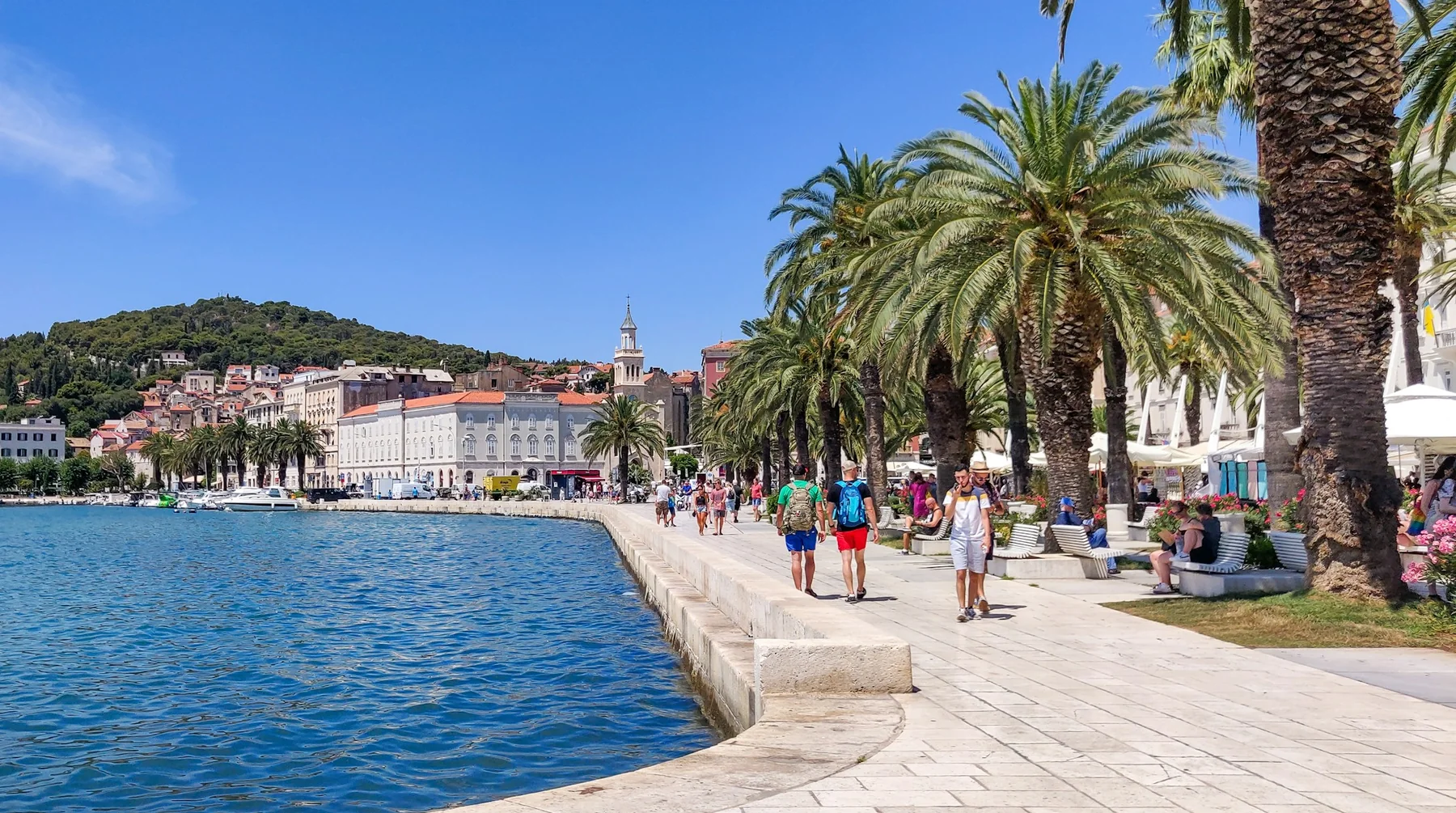
Spain: the remote work visa and the inbound regime
The Spanish personal income tax law treats as resident anyone who spends more than 183 days in the country in a calendar year, or whose main centre of business or economic interests is in Spain. There is also a presumption: if your spouse and minor children habitually live in Spain, you are presumed resident unless you prove otherwise. For a remote worker this means something simple: if you move on the visa in January and live in the country all year, you will be resident for that year.
The remote worker status itself was introduced by Law 28/2022 on startups. It is the right to live in Spain and work for companies outside the country using only IT and telecommunications. An employee may work only for foreign companies. A self-employed professional may take Spanish clients if their share does not exceed 20% of total professional activity. The visa is issued for up to one year, after which you can obtain a residence authorisation for up to three years, renewable for two years at a time. More on the visa itself is on our Spain digital nomad visa programme page and in our Spain guide.
The same law changed the tax side. The special regime for inbound workers, often called the Beckham Law, now expressly covers employees holding the international remote work visa. The person remains resident, but tax is calculated under non-resident rules: employment income is taxed at 24% up to EUR 600,000 and 47% above that amount. The regime applies for the year of the move and the next five years. The condition is that you were not tax resident in Spain during the five years before the move. The election must be made within six months of the start date of activity shown in your social security registration.
The regime has features worth understanding before deciding. All employment income during the regime is deemed earned in Spain, so the 24% rate also applies to a salary from a foreign employer. Passive income from abroad, meanwhile, is taxed under non-resident rules, and wealth tax is paid only on assets in Spain. A spouse and children under 25 can join the regime with the main applicant if the conditions are met. For self-employed remote workers the regime conditions differ and must be checked separately.
What this means for you. In Spain the benefit of the inbound regime depends on whether you make the election within the six-month window. Missing it means the ordinary progressive scale on worldwide income.
Sofia MendesInvestment Programs Expert, BRIDGES
Moving on a nomad visa? We will calculate your tax before you apply
We will compare Spain, Portugal, Croatia and Greece for your income and family.
Portugal: the D8 visa, NHR closed, IFICI for a narrow group
The Portuguese personal income tax code treats as resident anyone who spends more than 183 days in the country, consecutive or not, in any 12-month period starting or ending in the tax year. The second test is housing: if you have a home in Portugal in conditions suggesting an intention to keep and occupy it as your habitual residence, you can become resident with fewer days. Residence begins on the first day of presence. A day of presence is any day that includes an overnight stay in the country.
The D8 visa is designed for people who work remotely for a foreign employer or clients. Consulates require proof of average monthly income over the last three months of at least four Portuguese minimum monthly wages. From 1 January 2026 the minimum wage is EUR 920, so the threshold is EUR 3,680 a month. Details on documents and steps are in our article on the D8 visa and on the D8 programme page.
The tax regime is more complicated than a few years ago. The NHR regime was closed to new applicants by the 2024 budget law. It was replaced by the incentive for scientific research and innovation, IFICI: a 20% rate on employment and business income for 10 consecutive years. But it is not available to all new residents, only to those working in specific fields: university teaching and research, highly qualified professions in companies with investment incentives or in exporting companies, certified startups, and research and development. The conditions are that you were not resident in Portugal in any of the previous five years and have not used NHR before. The application is filed by 15 January of the year after the year you became resident.
For a typical remote worker employed by a foreign company with no link to Portuguese support schemes, IFICI usually does not apply. Income is then taxed on the general progressive scale. So in Portugal the question is not "will there be a relief" but "does my job fit the list". It should be checked before the move, not after the first tax return.
What this means for you. A D8 visa almost always leads to Portuguese tax residence if you live in the country. IFICI relief is possible, but only for specific professions and employers, and the application must be filed by 15 January.
Croatia: nomad income is not taxed, but the status is limited
Croatia has chosen the most direct approach. Since 2021 the income tax law lists among receipts not treated as income the earnings of a person with digital nomad status from work or activity for an employer not registered in Croatia. Such earnings do not need to be reported or taxed in Croatia. This applies specifically to income from remote work for a foreign company: if you start working for a Croatian firm, the relief does not apply.
The length of the status was changed by amendments to the Foreigners Act that took effect in March 2025. Temporary stay for a digital nomad is now approved for up to 18 months, and within that limit it can be extended once. After the status ends, a new nomad application is possible only after six months. The same six-month gap applies if, after nomad status, you want temporary stay on another ground. The 2026 amendments to the Foreigners Act did not change these rules. More on the requirements is on the Croatia digital nomad visa programme page and in our Croatia guide.
Tax residence in Croatia arises with domicile or habitual residence in the country. The General Tax Act defines habitual residence as a continuous or time-connected stay of at least 183 days in one or two calendar years. Over an 18-month status this threshold will almost certainly be passed. That does not cancel the exemption for nomad earnings, but a resident's other income is taxed on a worldwide basis: rent, dividends, interest, sales of assets. If you have such income, it must be taken into account.
What this means for you. Croatia suits a remote worker with a single source of income - a salary or fees from abroad. But the status is temporary: after 18 months you need a six-month break or another ground to live in the country.
Greece: the 50% relief and its conditions for remote workers
The Greek income tax code treats as resident anyone whose permanent or main home, habitual abode or centre of vital interests, meaning personal and economic ties, is in Greece. In addition, anyone who spends more than 183 days in the country in any 12-month period becomes resident from the first day of presence. The exception for stays of up to 365 days for tourist, medical and similar private purposes does not cover remote work.
The best-known Greek regime for newcomers is Article 5C of the code. It exempts 50% of income from work in Greece from income tax and the solidarity contribution for seven tax years. There are several conditions: you were not resident in Greece for five of the six years before the move, you move from an EU or EEA country or a country with which Greece has an administrative cooperation agreement on tax, and you declare that you will stay at least two years. For employees there is a key condition: the work must be performed under an employment relationship with a Greek company or a permanent establishment of a foreign company in Greece.
For a remote worker on a nomad visa this is the main pitfall. The visa is designed for work for foreign employers and clients, while the employee relief requires a Greek employer or establishment. An employee of a foreign company with no presence in Greece usually does not fall under this part of the regime. For people who move to carry on individual business activity in Greece, the law provides a similar 50% exemption for seven years, which is an option for freelancers, but its compatibility with a particular visa must be checked. The application is filed by the end of the year work starts if it starts by 2 July, otherwise in the following year. More on the visa is in our article on the Greek nomad visa and on the programme page.
What this means for you. In Greece the 50% relief is real for someone who joins a Greek company or sets up their own business in the country. An employee of a foreign firm should plan on the ordinary scale.
Comparison: what a remote worker gets in each country
Below is a summary of the tax regimes that can be combined with remote worker status. It is a general guide: each rule has exceptions, and the choice depends on how your work is structured - as an employee or as self-employed.
| Spain | Portugal | Croatia | Greece | |
|---|---|---|---|---|
| Remote worker status | visa up to 1 year, then residence up to 3 years | D8 visa, then residence permit | temporary stay up to 18 months | digital nomad visa, then residence permit |
| Special tax regime | inbound regime: 24% up to EUR 600,000 | IFICI: 20% for 10 years, listed activities only | income from a foreign employer is not treated as income | 50% exemption for 7 years if conditions are met |
| Regime period | year of the move and the next 5 | 10 consecutive years | the whole nomad stay | 7 tax years |
| Who does not qualify | anyone resident in Spain in the previous 5 years | former NHR users, residents in the previous 5 years | anyone working for a Croatian employer | employees of a foreign company with no presence in Greece |
| Application deadline | 6 months from starting work | by 15 January of the following year | no separate application | by the end of the year work starts or the next |
Put briefly, Croatia is more favourable for an employed remote worker with one income, but only for the length of the status. Spain gives a predictable rate for six years if you file the election in time. Portugal and Greece are interesting for those whose work meets the regime conditions; everyone else should calculate on the ordinary scales. How the countries compare in general, without reference to the nomad visa, is covered in our pieces Portugal or Spain and Greece or Spain; an overview of the programmes is in our guide to nomad visas.
The risk of dual residence and tax treaties
Moving on a nomad visa does not mean your previous country will stop treating you as its resident. If you still have a flat, family or business there, you may be resident in two countries at once. Each will then claim tax on worldwide income, and the question is settled by the double tax treaty between them, if there is one.
Most such treaties follow the OECD model, where the conflict is resolved by a sequence of tests. First, where the person has a permanent home. If there is a home in both countries, where the centre of vital interests is. If that cannot be determined, where they habitually live. Then nationality. If that does not help either, the tax authorities settle the matter by mutual agreement. So a remote worker who keeps a flat back home and rents in Lisbon or Valencia should understand in advance which country wins under these tests.
The practical tool is a tax residence certificate from the new country. It confirms the status for the employer, the bank and the tax authority of the previous country. Without it, a tax credit and treaty relief are often impossible. What to do about tax obligations in the country you leave is covered in our article on digital nomad taxes; where residence pays off most is in our overview of the best countries for tax residence.
What this means for you. If you keep a home and family in your previous country, dual residence is likely. It is better to resolve it in advance by arranging the facts in favour of the new country than to argue it after the fact.
What to prepare before the move
Choose the date of the residence change
Decide from which year you want to be resident in the new country and check it against the day-count rules: calendar year in Spain, any 12 months in Portugal and Greece.
Check your eligibility for a regime
Whether your work fits the inbound regime in Spain, IFICI in Portugal or Article 5C in Greece. In Croatia, whether you have Croatian employers or other income.
Gather documents on your work
Employment contract or client contracts, an employer letter permitting remote work, proof of income for recent months.
Note the application deadlines
Six months from starting work in Spain, by 15 January in Portugal, by the end of the year work starts in Greece. A missed deadline often means losing the relief.
Keep a calendar of days
Keep tickets, the lease and entry stamps. They are your evidence for both the new country and the previous one.
Obtain a residence certificate
After the first year, request a certificate in the new country and give it to your employer and bank.
If your situation includes income in several countries, a company or family staying back home, the tax side should be structured with a lawyer before applying for the visa. We do this as part of our tax coordination service; all programmes for remote workers are in the digital nomad visas section, and you can go through your situation in an online consultation.
Want to change residence without double tax? We will draw up a plan
We will choose the country and check your eligibility for relief and the deadlines.
Sofia MendesInvestment Programs Expert, BRIDGES
How this article was prepared
Sources are official texts of laws and public authorities as of October 2026. Spain: Personal Income Tax Law 35/2006 (Articles 9 and 93), its regulation (Article 116), Law 14/2013 as amended by Law 28/2022 (Articles 74 bis to 74 quinquies), the official gazette BOE and the tax agency Agencia Tributaria. Portugal: the Personal Income Tax Code (Article 16) and the Tax Benefits Statute (Article 58-A), Ordinance 352/2024 on the Portal das Financas, the 2026 minimum wage decision as published by DGERT, and Portuguese consular requirements for the remote work visa. Croatia: the Foreigners Act as amended by NN 40/2025 and NN 55/2026, the Income Tax Act as amended by NN 138/2020 and the General Tax Act in the official gazette Narodne novine, and information from the Croatian Ministry of the Interior. Greece: Income Tax Code 4172/2013 (Articles 4 and 5C) and guidance from the tax authority AADE. Dual residence tie-breakers follow the OECD Model Tax Convention. This article does not replace individual tax advice.
Share this article
Frequently asked
Questions people ask before deciding
01Does a digital nomad visa make me tax resident?
Not by itself. Residence arises under the country's tax law: usually after more than 183 days of presence, or if your permanent home and centre of interests are in the country.
02Can a remote worker in Spain pay 24%?
Yes, an employee with the remote work visa can choose the inbound regime: 24% on employment income up to EUR 600,000 and 47% above that. The conditions are no Spanish residence in the five years before the move and an election within six months.
03Does NHR in Portugal apply to D8 holders?
No, NHR is closed to new applicants. Its replacement, IFICI, gives 20% for 10 years, but only for a defined list of activities; most remote workers pay on the general scale.
04Does a nomad pay tax in Croatia?
Not on income from work for an employer not registered in Croatia: the law does not treat it as income. Other income of a tax resident is taxed.
05Can I get Croatian nomad status again?
Yes, but not earlier than six months after the previous status ends. The status itself is granted for up to 18 months with one extension within that limit.
06Does the Greek 50% relief suit a nomad?
For employees, only when working for a Greek company or a permanent establishment of a foreign company in Greece. There is a similar relief for individual business activity in Greece.
About the author
Related materials
What to read next
 ArticleThe 183-Day Rule: How Tax Residency Works and Why It's Not Everything
 ArticleDigital nomad taxes: how to pay correctly and avoid double taxation
 ArticlePortugal's D8 digital nomad visa 2026: for remote workers and freelancers
News+6 stories on 31 October
Related news
 Europe · 16 OctRenting in Europe in autumn 2026: Portugal lifts limits on landlords, Spain freezes rents
 Barbados · 31 OctBarbados: House of Assembly passes investor residence bill with a path to citizenship
 Poland · 31 OctPoland: the government is preparing stricter citizenship rules - B2 Polish, a test and a longer residence period
Personal programme selection is conducted by Anna Kovalevskaya, Head of Legal, BRIDGES.
Moving on a nomad visa? We will calculate your tax before you apply
We will compare Spain, Portugal, Croatia and Greece for your income and family.
