News · Russia
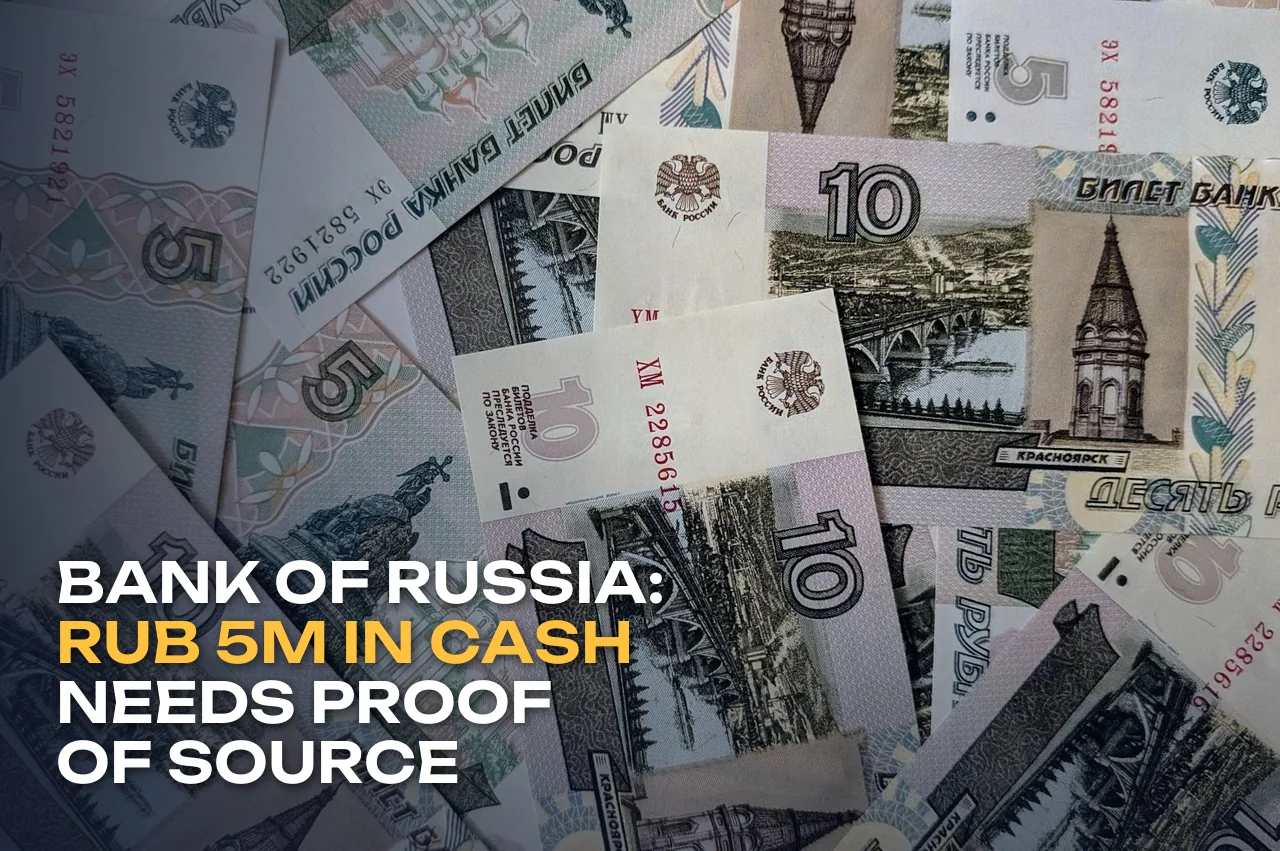
Bank of Russia: cash deposits from RUB 5 million will need proof of source
Updated: October 2026·11 min read·Expert reviewed
Terms and costs verified: October 2026
Contents
On 26 October 2026 the Bank of Russia published methodological recommendations No. 5-MR: before a transaction, banks should establish where a client's cash came from if an individual deposits it into an account, transfers it without an account or exchanges it for foreign currency in amounts of RUB 5 million or more at once or within a month. The document cancels three earlier letters on the same subject and, for the first time, gives an open list of papers a bank may request. I explain who is affected, which documents to prepare and why it matters if you pay for a residence permit, a passport or property abroad.
In brief
- Bank of Russia methodological recommendations No. 5-MR dated 26 October 2026 were published on the regulator's website the same day.
- For individuals the threshold is RUB 5 million in a single transaction or in total over a calendar month. For companies and sole traders there is no threshold: the focus is on transactions untypical for their business.
- Covered are cash rouble deposits, transfers without an account funded by cash, purchases of bullion, precious metal coins and diamonds for cash, and exchange of cash roubles for cash foreign currency.
- Banks are advised to obtain documents on the source of funds before the transaction, in an amount comparable to the sum. No documents or doubts about them, and the transaction may be treated as suspicious and refused.
- Recommendations No. 1-MR of 20 May 2026, No. 9-MR of 27 April 2024 and No. 11-MR of 9 September 2025 have been cancelled.
What exactly the Bank of Russia recommends
The regulator explains the document by a rise in suspicious cash transactions: large deposits into accounts, transfers without an account funded by cash, precious metal purchases and exchanging cash roubles for currency. In the Bank of Russia's assessment, some of these transactions serve to move cash from the shadow economy into legal circulation. Hence four recommendations to banks.
- Establish the client's financial position and source of funds before the transaction, not after it, in an amount comparable to the sum.
- Obtain documentary evidence of this information. A verbal explanation is not enough.
- Check the transaction against the purposes the client stated at identification or when updating their profile.
- Monitor amounts, including those paid in through ATMs and other self-service devices.
The document also says banks must examine papers on substance rather than formally, and that the full set of documents must leave no doubt that the money is legitimate. Point 8 extends the recommendations to the same transactions in cash foreign currency. This matters: depositing a large sum of dollars or euros in cash is now as hard as depositing roubles.
Methodological recommendations are not law. But for banks they are a supervisory benchmark: during inspections the Bank of Russia checks how a bank followed them. In practice, therefore, banks apply them almost as binding rules, as we noted in our news story on how banks are blocking the USDT-for-cash scheme.
| Document | Date | What it covered |
|---|---|---|
| No. 9-MR | 27 April 2024 | closer attention to certain client transactions |
| No. 11-MR | 9 September 2025 | closer attention to cash transactions |
| No. 1-MR | 20 May 2026 | source of funds for cash transactions |
| No. 5-MR | 26 October 2026 | replaces the three above: RUB 5 million threshold, document lists, refusal where in doubt |
What this means for you. If you plan to deposit a large sum in cash, assume the transaction will not go through without papers on the origin of the money. Prepare the documents in advance, not at the counter.
Which documents a bank may request
The annex to the recommendations contains an indicative list of documents for individuals. The list is open: a bank may ask for other papers too, including on money received from third parties. Below are the main items, grouped by source of funds.
| Where the money came from | What the bank may ask for under the annex to the recommendations |
|---|---|
| Salary and other taxed income | a certificate of income and tax withheld (form KND 1175018) |
| Self-declared income | a 3-NDFL personal income tax return (form KND 1151020) |
| Self-employed work | a certificate of registration as a professional income tax payer and an income statement |
| Loan or repayment of a debt | the loan agreement and proof the money changed hands |
| Inheritance | the certificate of inheritance |
| Gift | documents confirming a gift of cash |
| Sale of a flat, car or other property | the sale contract, the transfer deed, an extract from the property register or the vehicle registration certificate |
| Rental income | the lease agreement and proof of rent received |
The key rule in the recommendations is that documents must cover the amount of the transaction. An income certificate for RUB 2 million will not explain a deposit of 6 million. If the money came from several sources, such as the sale of a flat plus savings from salary, each must be shown. For cash that has been kept at home for a long time, the bank will ask you to link it to specific income from previous years: a statement showing a withdrawal, a sale contract, a tax return.
Companies and sole traders have their own list: tax reporting, documents on foreign trade, cash book extracts, receipt and payment orders, documents on the sale and lease of property. A company cannot deposit takings above its usual turnover without explanation, even below RUB 5 million. More on what source of funds means and how it is evidenced is in our glossary and in the guide to proving the origin of money.
A practical tip on the form of documents. The income and tax certificate and tax return records can be downloaded from the taxpayer's personal account or the state services portal; they carry the tax service's electronic signature, and banks usually accept them without paper originals. Sale contracts and inheritance certificates are best shown in the original or as a notarised copy. If the cash came from a relative, the bank will want to see where that relative got it: a statement, a sale contract or their income. The shorter the path from the document to the sum on the counter, the faster the check.
What this means for you. Build a folder in advance: income certificates for 3-5 years, tax returns, property sale contracts, inheritance and gift documents. It will be useful not only for a Russian bank but also for a foreign bank when opening an account and when applying for residence.
When a bank may not apply the recommendations
The recommendations name two cases where a bank may skip the document request. The first is where the client's business is itself cash-based, for example retail. Even then the exception does not apply if the cash amount noticeably exceeds usual turnover, rises sharply or does not match the scale of the business.
The second case is where the bank already holds documents on the client's financial position and sources of funds in an amount comparable to the transactions. For example, you previously evidenced the sale of a flat and are now depositing part of that sum. But if the number or volume of cash transactions has grown significantly compared with earlier periods, the bank will ask for papers again.
What this means for you. If you plan several large deposits, it makes sense to submit a full document pack to the bank once and ask for it to be recorded in your file. This reduces the risk of delays on later transactions.
What happens if there are no documents
If a client does not provide documents, provides only some, or staff doubt their authenticity, banks are advised to consider three steps: treat the transaction as suspicious under internal control rules, refuse it under point 11 of article 7 of Federal Law No. 115-FZ on combating money laundering, and raise the client's risk rating. Structuring is mentioned separately: if a client splits a large amount into parts below the threshold, the bank will see it as an attempt to avoid checks.
A refusal under Law No. 115-FZ is more than an inconvenience. Banks report refusals to the Russian financial intelligence service, and such a record can complicate banking elsewhere too. That is why splitting deposits under the RUB 5 million threshold is risky: the rule is written precisely against it. If a bank has already refused, do not repeat the transaction elsewhere; sort out the documents first. We help with bank compliance and with preparing a bank file.
Need to prove where your money came from? We will build the document pack
We will tell you which papers cover your amount and check them before the bank does.
Why this matters for paying for programmes abroad
Many clients pay for a residence permit, a second passport or property abroad from Russian accounts. The money was often saved in cash: the sale of a business or a flat, years of savings. To make a transfer later, the cash is first deposited into an account. That is exactly the step now checked most strictly: from RUB 5 million the bank will ask for documents before crediting the money.
There is a second side too. Foreign banks and government agencies also check the origin of funds, often more strictly than Russian ones. For example, the Greek golden visa accepts payment only by bank transfer, and Turkish citizenship through property requires payment through a Turkish bank with confirmation. Passport programmes such as Vanuatu require proof of source of funds at the due diligence stage. If a Russian bank has accepted your documents, the same pack almost always works abroad after translation and apostille.
With cryptocurrency things are more complicated: from 2027 Russia is restricting p2p exchange, and some platforms are leaving the market. We covered this in news stories on the ban on p2p crypto transactions and a crypto exchange leaving Russia. How banks treat money from cryptocurrency is covered by our crypto capital legalisation service.
What this means for you. If you plan to pay for a programme from Russia, start with documents on the origin of the money. Without them it is not only the cash deposit that stalls, but also acceptance of the funds by a bank or government body in the programme country.
The link with tax enquiries about foreign accounts
The Bank of Russia recommendations come amid more frequent tax office enquiries about foreign accounts. The tax service receives data through automatic CRS exchange and compares it with account notifications. We wrote about the enquiries being sent about foreign accounts and how to answer them. Source of funds documents help with these replies too: the tax office also asks where the money in the account came from.
The rules on notifying the tax office about foreign accounts are covered in the article on foreign account notifications. If you have become tax resident in another country, the rules change; it helps to know how this works with tax residency and cryptocurrency. Opening an account in the EU without a residence permit is hard for Russians but possible; the options are in our piece on an EU bank account without residence.
What this means for you. One document pack covers three tasks: the cash deposit, the reply to the tax office and checks abroad. Build it once and keep it up to date.
What to do if you are planning a large deposit
Work out the amount
If you deposit RUB 5 million or more in cash at once or within a month, documents will certainly be needed. Do not split the amount below the threshold.
Collect documents for each source
Income certificates, tax returns, sale contracts, inheritance and gift documents. Together they must cover the deposit amount.
Submit the pack in advance
Ask the bank to accept the documents before the transaction and record them in your file. Keep copies and an inventory.
If the bank refuses
Do not repeat the transaction at another bank. Find out which documents were missing and prepare the pack again.
Think about the next step
If the money is going to a programme abroad, translate and apostille the key documents straight away. It saves weeks.
If you need help, see our source of funds service or book an online consultation. How this works for permanent residence in Cyprus is shown in the article on source of funds for Cyprus permanent residence. We run sanctions list checks and enhanced due diligence before documents are filed. The terms AML and KYC are explained in the glossary, and all our services are on the BRIDGES home page.
Paying for residence or a passport from Russia? We will check your documents
We will tell you which papers the bank and the programme country will accept.
Nikos PappasBanking Relations Specialist, BRIDGES
How this article was prepared
Sources: Bank of Russia methodological recommendations No. 5-MR of 26 October 2026 on determining the financial position and sources of funds of credit institutions' clients to strengthen control over cash transactions, and their annexes; the Bank of Russia statement of 26 October 2026; the list of legal acts on the Bank of Russia website; Federal Law No. 115-FZ of 7 August 2001. The recommendations are not a regulatory act; the exact set of documents is decided by the bank. This article does not replace advice on your transaction.
Share this article
Frequently asked
Questions people ask before deciding
01From what amount will a bank ask about the origin of cash?
Under Bank of Russia recommendations No. 5-MR of 26 October 2026, from RUB 5 million in one transaction or in total over a calendar month. There is no threshold for companies and sole traders.
02Which documents are suitable?
An income certificate (KND 1175018), a 3-NDFL tax return, self-employment documents, a loan agreement, a certificate of inheritance, gift documents, a property sale contract with a register extract, a lease agreement. The list is open.
03Does this apply to foreign currency?
Yes. Point 8 of the recommendations extends them to the same transactions in cash foreign currency.
04What happens without documents?
The bank may treat the transaction as suspicious, refuse it under point 11 of article 7 of Law No. 115-FZ and raise the client's risk rating.
05Can I deposit in parts below RUB 5 million?
The threshold also counts the monthly total, and the recommendations explicitly name structuring as a sign of avoiding checks. It is safer to prepare documents.
About the author
Related materials
What to read next
 ArticleTax office request about a foreign account: how to reply and which documents to attach
 ArticleOrigin of funds for permanent residence in Cyprus: how to prove the purity of money in 2026
 NewsBanks block the "USDT in the CIS, cash in Russia" scheme: what it means for paying for residence with crypto
News+10 stories on 27 October
Related news
 Russia · 26 OctRussia: tax service sends requests about foreign accounts after the 2025 data exchange
 Russia · 23 Oct68% of home purchases abroad are for residence: what a 9-month 2026 market study showed
 Russia · 23 OctDecree No. 750: Russian strategic companies need state consent to disclose information abroad and sell foreign assets
Personal programme selection is conducted by Anna Kovalevskaya, Head of Legal, BRIDGES.
Need to prove where your money came from? We will build the document pack
We will tell you which papers cover your amount and check them before the bank does.
