Updated
SRV-BA-CM
Bank accounts · Compliance
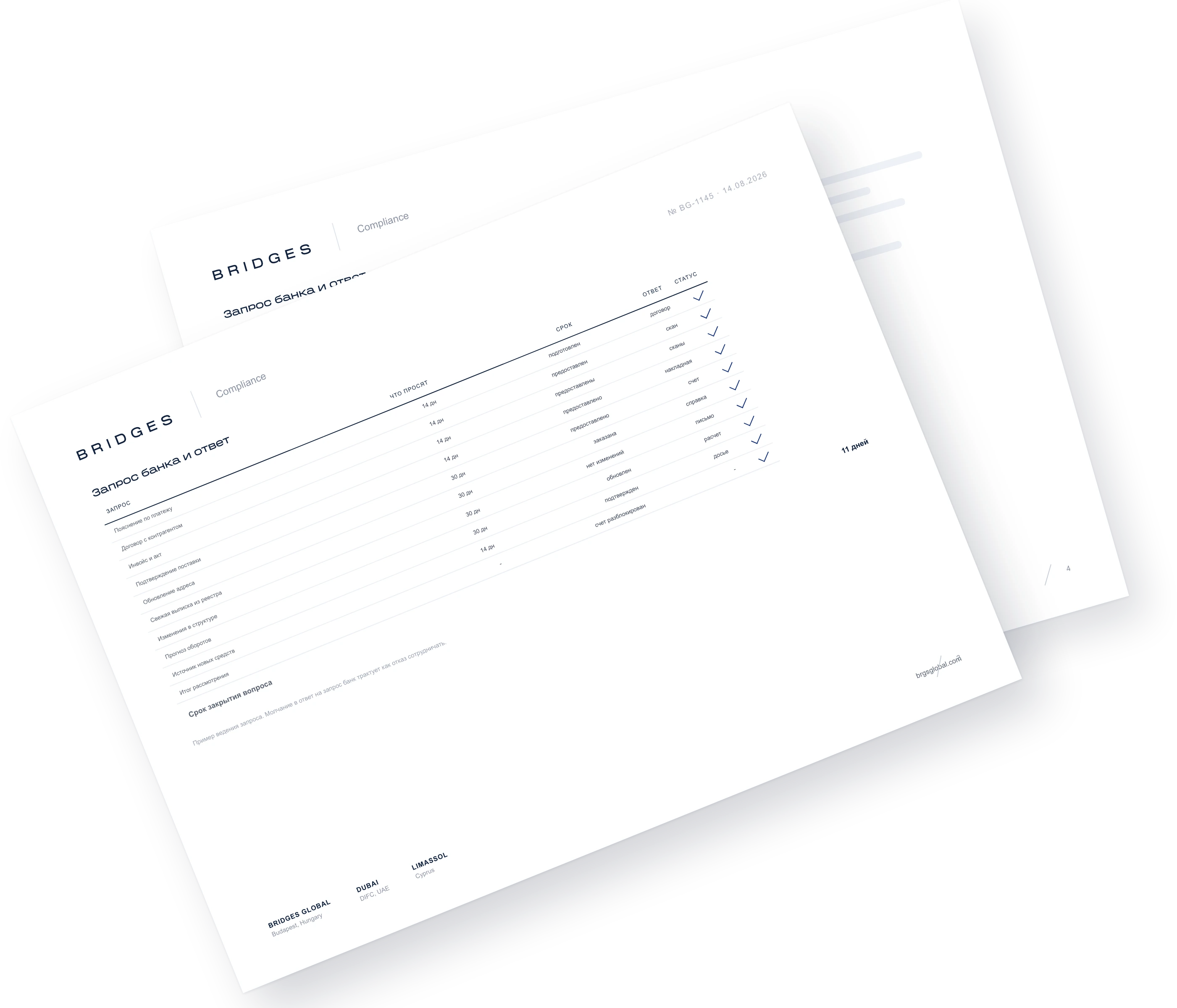
A bank’s requests and blocks we answer for you
The bank has asked for documents, held a payment or warned that it will close the account. You have a deadline to answer and one chance to answer well. We go through the cause, prepare the documents and run the correspondence with compliance — in its language and its logic.
- We answer on time and to the substance of the request rather than fobbing it off
- We go through the real cause, not the formal wording of the letter
- We do not promise to “sort it out” round the rules — we work with documents
01 / The service
Why the bank asks questions
Compliance is the bank’s duty to its regulator, not fault-finding with you. It has to understand who you are, where the money comes from and whether the operation matches your profile. When the picture stops adding up the bank sends a request — and whether you keep the account depends on the quality of the answer.
The periodic review
The bank refreshes a client’s data regularly: the documents have aged, the status has changed, time has passed. It is a routine procedure, but ignoring the request leads to the account being restricted.
An operation outside the profile
An incoming payment that does not fit the stated business, a new counterparty from another country, a sharp rise in turnover — all of these trigger a request.
An outside signal
Changes in the sanctions lists, press coverage, a request from a correspondent bank. The cause may not lie with you at all but in the chain of the payment.
A change in the bank’s policy
The bank reconsiders its attitude to an industry, a jurisdiction or a type of client. Then the question is not about your documents — and the strategy for the answer is different.
02 / Situations
When help is needed
Situations where it is a matter of days.
A request for documents on an operation
The bank wants a particular payment evidenced: the contract, the invoice, a justification of the reference. The deadline is usually short.
A payment held
The transfer has hung in a check. The money has neither gone nor come back, and the counterparty is waiting — a quick and precise answer is needed.
A KYC review
The bank has asked for the whole file to be refreshed: updated documents, evidence of status, a description of the current business.
A warning that the account will be closed
The bank has given notice that it intends to end the relationship. Sometimes the decision can be challenged, sometimes a fallback account has to be arranged urgently.
A request about the origin of funds
Compliance asks for the source of the capital behind a balance or an incoming payment — the commonest and the most serious request.
A refusal to open an account
The application was declined. We go through the reason and decide: challenge it, improve the file or change bank.
03 / Honest limits
What we do not do
We set out the limits at once — they protect you too.
We do not “have a word” with the bank
Compliance is not settled through acquaintances. Anyone promising to make the question go away with a phone call is either selling air or offering something both parties answer for.
We do not manufacture documents
Confirmations dated after the fact, contracts written to fit the situation, forged statements — that is a criminal offence and is spotted instantly on a check.
We do not help conceal an operation
Splitting payments, changing a reference to get round controls, routing funds through third parties — we do not take such work on.
We do not promise a result
The decision stays with the bank. We answer for the quality and the timeliness of the reply, not for the outcome — and we say so before the work starts.
If there is nothing to answer with in substance, we will say so honestly and turn to moving the relationship to a bank that works with your profile.
04 / Scope of work
What we do
From going through the request to a closed question or a move to another bank.
Going through the request
We read the bank’s letter and settle the real cause: the wording in the letter and the actual trigger often differ.
Assessing the risk
What is at stake: a one-off explanation, a restriction on operations or the closure of the account. The strategy and the urgency follow from that.
Gathering the documents
We prepare what actually closes the question: contracts, statements, evidence of the source of funds, explanations about the counterparties.
The answer to the bank
We write the reply in compliance’s language: point by point against the request, with references to the annexes, with no surplus words and no contradictions.
Running the correspondence
We answer the follow-up questions until the matter is closed. The client does not have to conduct that dialogue.
The fallback
If the bank moves to close, we prepare the transition in parallel: we choose an institution to fit the profile and move the settlements without stopping the business.
Every answer goes in your name and with your approval. We have no access to the account and give no instructions on it.
05 / Cost
What the cost depends on
It is calculated by the type of request and the volume of preparation, with urgency counted separately.
The type of request
An explanation of one operation is short work. A full KYC review or a dispute about closing an account is a project.
The state of the documents
If the evidence is to hand, the work is assembly. If documents and a history have to be reconstructed, it takes longer.
Urgency
An answer within a day means rebuilding the queue of work — that shows in the estimate.
The number of banks
Simultaneous requests from several institutions are quoted separately, but part of the preparation is reused.
The first review of the request is done before the agreement: you know straight away how serious the situation is and what it will take.
06 / How it works
How we work
Speed matters here as much as precision.
The urgent review
You send the bank’s letter. We read it, settle the cause and the deadline and assess the risk.
within the day
The plan for the answer
We tell you exactly what has to be gathered and what has to be written. We agree the strategy with you.
1–2 days
Gathering the documents
You provide what you have; we prepare what is missing and the translations where needed.
2–7 days
The answer and the correspondence
We send the answer on time and deal with the follow-ups until the matter is closed.
until the bank decides
The outcome and prevention
We go through what led to the request and set the work up so that the situation does not recur.
The time to decide is set by the bank. Our area of responsibility is to meet its deadlines and to answer in substance.
07 / Preparation
What we will need from you
The sooner you send the starting material, the more time is left for the preparation.
The bank’s letter in full
The complete text of the request with every annex and the deadline stated — the wording matters word for word.
The documents on the operation in question
The contract, the invoice, the correspondence with the counterparty, evidence that the goods or services were delivered.
The history with the bank
Whether there have been requests before, what was answered, how long you have banked there — that affects the strategy.
The current details
Changes in ownership, residency and business — everything that has happened since the account was opened.
The documents are sent over secure channels; confidentiality is an obligation under the agreement.
08 / Team
Who runs the work
The answer to the bank is written by a lawyer: the outcome turns on the wording.
 Viktoria LebedevaManaging Director, Private ClientsGoing through the request, the strategy and the correspondence with compliance
 Hanna BergerTrusts and Succession AdvisorThe tax and financial side of the explanations
 Karim NaserHead of Istanbul OfficeGathering and restoring the documents to the deadline
 Tomas LinderCompliance and AML OfficerChecks and legalisation
10 / Questions
Answers to common questions
Usually yes: we do the urgent review on the day you come to us and the plan for the answer the next day. What is critical is to send the bank’s letter at once rather than a day before the deadline. If the time genuinely does not allow the documents to be gathered, we prepare a reasoned request for an extension — banks most often agree to it.
No. The bank reads silence in one way only: first a restriction on operations, then the closure of the account and a note in the system that will make opening accounts at other banks harder. An answer always has to be given, even an incomplete one.
No, funds do not disappear: they will either go back to the sender or be credited after the check. The task is to give the bank quickly what closes the question, so that the payment does not hang for weeks and the counterparty does not walk away from the deal.
Sometimes yes — where the decision rests on a misunderstanding that documents clear up. But if the bank has reconsidered its policy on your industry or jurisdiction, arguing is pointless: the right strategy is an organised move to an institution that works with such a profile. We will say honestly which case we are in.
You can, and sometimes that is enough. The difficulty is that compliance reads the answer as a legal document: a surplus sentence, an imprecise formulation or a contradiction with what was filed before strengthens the suspicion. As a rule there is no second attempt.
No, and nobody can: the decision is the bank’s. What we answer for is that the reply is timely, complete and consistent — and that is what actually affects the outcome.
It is the periodic refresh of the file — a routine procedure, not a suspicion. The trigger may be the time since the last check, a change in turnover, a new counterparty or a new country of payment.
Usually seven to thirty days. The deadline is best not missed: the bank reads silence as a refusal to cooperate, and the next step is a restriction on operations.
Yes, if an operation falls under suspicion or the client does not answer a request. So in getting it unblocked what matters is the speed and quality of the first answer, not months of correspondence.
Anything that cannot be evidenced by a document, and anything that contradicts what was filed before. Compliance checks the answer against the history of the relationship, and a discrepancy does more harm than an inconvenient fact.
No. The bank must return the balance, but it may require evidence of the origin of the funds before the transfer and may send them only to an account of the same owner. That is exactly why a fallback account is opened in advance.
INITIAL ASSESSMENT
Tell us what outcome your family needs
We will design a solution for your case, choose the country and the right status, and take the whole process through to the result.
