Updated
SRV-CR-PS
Company registration
Supporting a company afterregistration good standing
Companies die far more often from a missed renewal and unfiled accounts than from an inspection. A fine, the status of a struck-off company, removal from the register — and putting it right costs more than several calm years of support.
- We keep the calendar of duties and remind you in advance
- We answer for the deadline rather than “passing the information on”
- We take on companies registered by someone other than us
01 / The service
What happens to a company every year
After registration a company acquires a set of recurring duties. They are simple, but there are many of them, they fall on different dates and they differ in every jurisdiction. Missing one starts a chain that ends in losing the account.
Renewal and fees
The annual government fee and the payment for the registered agent and address. A delay means a fine, and then the status of a company not in good standing.
Reporting
Financial statements, tax returns and, where required, an audit. What is needed depends on the jurisdiction and the turnover.
Economic substance
In a number of jurisdictions it is confirmed every year that the company really carries on business on the ground.
Keeping the details current
Changes among the owners, the directors and the addresses have to appear in the registers within the periods set, not when someone remembers.
02 / Situations
When support is needed
Almost always — the only question is how much of it.
The company has just been registered
The first year is the riskiest: the duties appear before the habit of watching them does.
There is more than one company
Different jurisdictions, different dates, different agents — without one calendar something is bound to be missed.
The standing has already suffered
The company is not in good standing or has been struck off — it has to be restored and the fines paid.
The structure is changing
A new director, the sale of a shareholding, a change of address, an increase of capital — every change is drawn up and registered.
The bank is running a review
A periodic refresh of the file: the bank asks for current documents and evidence of standing.
The previous agent does not answer
A frequent situation with cheap registrars — we move the company to a proper agent.
03 / Honest limits
The limits of the work
What the support does not cover.
We do not keep your books
The primary accounting is done by you or your accountant. We coordinate the preparation of the reporting and watch the filing deadlines.
We do not sign audit opinions
The audit is done by licensed auditors in the jurisdiction — we organise the work and hand the documents over.
We do not create an appearance of presence
A formal address where real activity is required solves nothing and makes the position worse on inspection.
We do not keep changes from the registers
If the information is subject to disclosure, it is disclosed. Otherwise the company loses its good standing.
04 / Scope of work
What the support covers
An annual cycle with fixed duties and clear responsibility.
The calendar of duties
Every deadline for the company for the year ahead: the fees, the reports, the confirmations, the renewals. We remind you in advance, not on the last day.
Renewal and fees
Paying the government fees and the agent’s and registered address’s charges, and checking that the payment has arrived.
Reporting
Coordinating the preparation and filing of the financial and tax reporting and, where needed, the audit.
Changes
A change of directors, members, address, name or capital: the resolutions, the registration, notifying the bank.
Dealing with the bank
Answering the bank’s periodic requests, refreshing the file, current corporate certificates.
The corporate book
We keep the registers and resolutions current — so that the set is ready before anyone asks for it.
Companies registered by other agents are taken on after a review of their current state.
05 / Cost
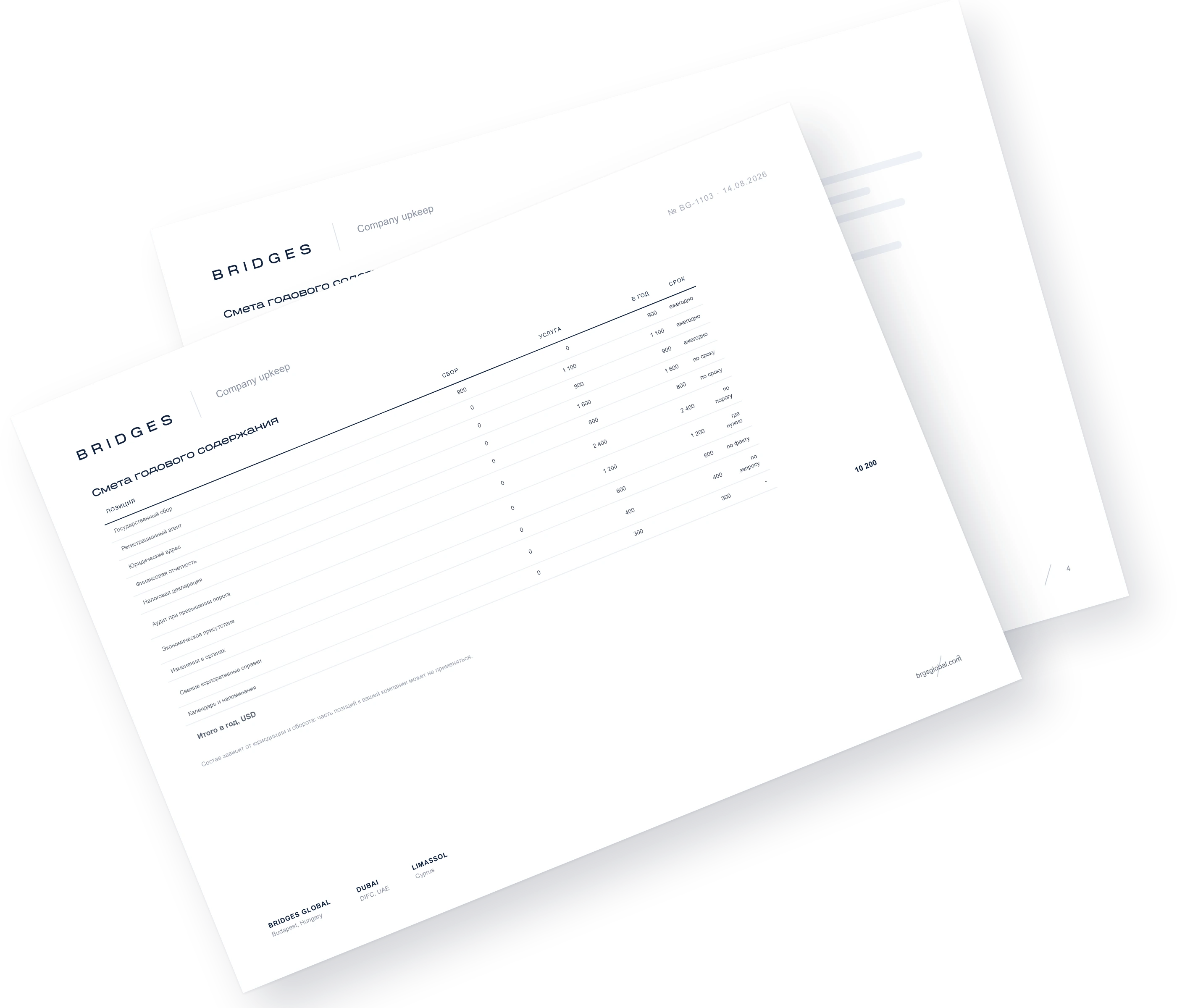
What the cost depends on
The annual work is quoted by the jurisdiction and the volume of duties.
The jurisdiction
The government fees and the agents’ tariffs differ several times over. We show them separately from our own fee.
Reporting and audit
A company with no operations and a company with turnover and a compulsory audit take different amounts of work.
The requirements as to presence
Where an office and staff are needed, running the company costs substantially more.
The number of companies
A group costs less per company to run than each one separately.
The annual budget is fixed in advance: there should be no sudden renewal invoices in our work.
06 / How it works
How it works
Support is a process, not a set of one-off instructions.
The review
We look at the current state: the standing in the register, the arrears, the reporting filed, the set of documents.
3–5 days
The calendar for the year
We draw up the list of duties with the dates and the people answerable.
2–3 days
Clearing the tail
If there are arrears we pay the fees and restore the standing.
from 2 weeks
The annual cycle
We run the company to the calendar: the reminders, the payments, the reporting, the changes.
The annual review
Once a year we look at whether the jurisdiction and the structure still match your present tasks.
07 / Preparation
What we will need from you
Not much, but on time.
Access to the documents
The constitutional documents, the correspondence with the previous agent, the details of the standing in the register.
The financial data
The turnover and the primary documents for the reporting — within the times agreed in the calendar.
Information about changes
A change of owners, directors or address, or plans to sell the company, has to be told to us at once.
Signatures
Some documents are signed by a director or member in person — we plan for that in advance.
08 / Team
Who runs the support
A particular person answers for the company, not a shared inbox.
 Daniel KovachSenior International Law AttorneyThe calendar, the renewals, dealings with the agents
 Eva LauriHead of OperationsCorporate changes and documents
 Dmitry NagyInternational Tax ConsultantReporting, taxes and the requirements as to presence
 Sergey EvdokimovManaging PartnerStrategy, capital, complex matters
10 / Questions
Answers to common questions
First a fine, then the status of a company not in good standing, then removal from the register. At the fine stage everything is settled quickly; at the removal stage it takes a restoration procedure that runs for months and costs substantially more. The bank usually freezes the account in the meantime.
In most jurisdictions yes — a nil return is filed. Having no operations does not remove the duty to report, and that is exactly where the owners of dormant companies most often come unstuck.
Yes, it is a standard procedure. We start with a review of its state, clear the arrears with the previous agent and arrange the transfer. It usually takes two to four weeks.
In most jurisdictions restoration is possible within a set period: every fee and fine is paid and an application filed. The sooner it starts, the cheaper it is. Once the period expires, restoration becomes impossible and the company’s assets are left in a difficult position.
A periodic refresh of the file is usually done every one to three years, and more often when the structure or the character of the operations changes. A company in good standing with current documents goes through it calmly — and that is the point of the support.
Provides the registered address, receives official correspondence, keeps the registers and files the compulsory forms. It is a requirement of law in almost every jurisdiction: without an agent a company cannot exist.
Yes, it is a standard procedure: the accounts with the previous agent are settled, the transfer is arranged and the register is notified. It usually takes two to four weeks.
A duty to evidence that the company is genuinely managed in its country of registration: an office, staff, expenditure, decisions taken locally. It applies to particular types of activity and in particular jurisdictions, and failing it brings fines.
It depends on the jurisdiction and the figures: turnover, assets, headcount. In many countries small companies are exempt, but the exemption does not remove the duty to file the accounts themselves.
Draw up the resolution of the organ, update the registers, file the change with the state register where that is required, and be sure to notify the bank. The last is what is most often forgotten, and it is exactly what leads to payments being blocked.
INITIAL ASSESSMENT
Tell us what outcome your family needs
We will design a solution for your case, choose the country and the right status, and take the whole process through to the result.
