Updated
SRV-CR-LQ
Winding up companies
Winding up a foreign company
We close a company with a check on the reporting, the taxes, the obligations, the assets and the bank accounts before it is formally struck off the register.
We support a voluntary winding-up, the reconstruction of corporate reporting before closure and the coordination of the procedure in the country of registration.
- The company’s standing is checked before the procedure starts
- Reporting, settlements and registration steps in one process
- Documentary confirmation that it has been struck off the register
01 / Situations
When a foreign company has to be closed
A winding-up is needed when the activity is already over and the legal structure keeps generating costs, reporting and risks.
The project is finished
The company has done what it was created for and is no longer used.
The activity has stopped
There are no operations, but the costs of running it and the reporting duties remain.
The structure is changing
Part of the group is being closed, assets are being transferred, the owners are ending a joint project.
The company has been fined
Reporting or a renewal was missed, and the company has to be put in order before it is closed.
The bank account has been closed
The company can no longer work properly, but the legal and reporting duties remain.
The assets have to be distributed
Money, property, shareholdings, claims or other assets are left on the balance sheet.
02 / Why BRIDGES
A winding-up requires the corporate, tax and banking obligations to be closed
The register looks at whether the procedure was followed, the tax authority at the final settlements, the bank and the creditors at what happens to the money and the obligations. The agreement of one does not stand for the other two, so the procedure is prepared on all three fronts at once.
Following the procedure
The register checks the members’ resolution, the publications, the waiting periods for creditors’ claims and the completeness of the documents filed. In a number of jurisdictions the procedure must be run by a licensed liquidator. A missed step sends the matter back to the beginning rather than on to the next stage.
The final settlements
The tax authority looks at the periods filed, the sums charged and how the assets were distributed before closure. Distributing property and money to members can create tax both for the company and for the owner — in the owner’s country of residency included. The calculation is made before the distribution.
What happens to the money and the obligations
The bank closes the account after the settlements and requires evidence of the grounds for the balance. Creditors may bring claims within the period the law allows. Until those questions are closed, either the striking off will not happen or it will leave the obligations with the owners.
03 / If nothing is done
What happens if a foreign company is not formally closed
While the company remains in the register it may keep duties as to reporting, tax, upkeep and the keeping of documents. Being struck off compulsorily also does not always end the obligations of the owners and directors — that depends on the jurisdiction.
Obligations keep arising
Duties, the agent’s fees and the duties to report and keep documents apply for as long as the company is on the register.
The fines mount up
The registers and tax authorities of most jurisdictions charge fines for missed filings — and the sums grow over time.
The assets stay inside the structure
Money, property and shareholdings remain with an unfinished company. In a number of jurisdictions the assets of a company struck off compulsorily pass to the state.
A trace in future checks
Questions about an abandoned company can arise in later banking and corporate checks on the owner and the director.
04 / A comparison of the routes
Winding up, selling, reorganising or being struck off
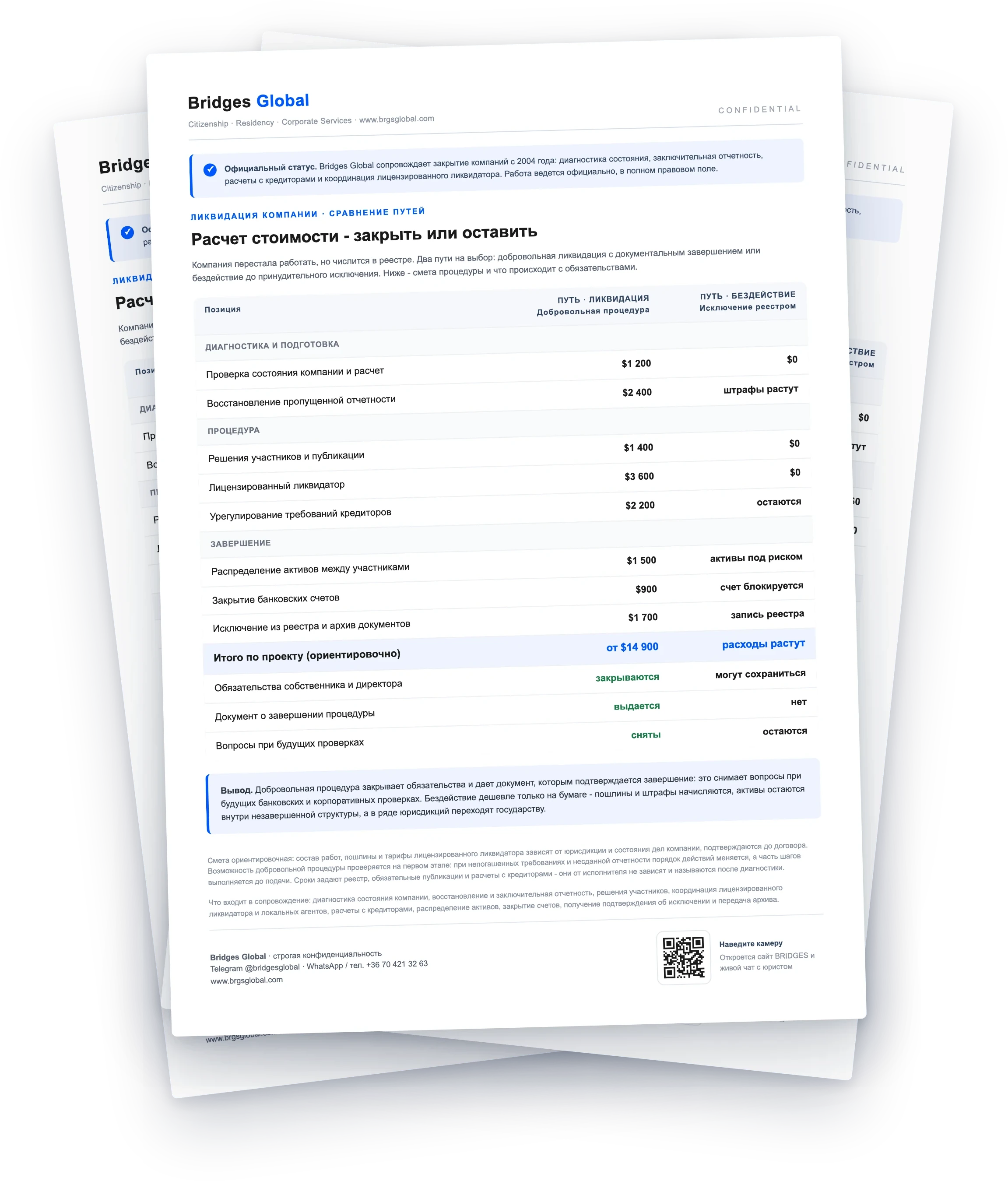
The table shows the direction of the consequences rather than a ready answer. What applies to your company depends on the jurisdiction, the state of the reporting, the debts and the assets — that is settled by a check before the procedure starts.
| A voluntary winding-up | Being struck off | Selling the company | Leaving it as it is | |
|---|---|---|---|---|
| The legal person | Ends under the procedure | Struck off by decision of the register | Continues with the new owner | Stays on the register |
| Obligations | Closed in the course of the procedure | May remain with the owners and the director | Pass with the company under the contract | Keep arising |
| Assets | Distributed before it ends | In a number of jurisdictions they pass to the state | Pass to the buyer with the company | Stay inside an unfinished structure |
| Reporting | Final accounts are filed | The outstanding filings as a rule remain | Run by the new owner | Arrears and fines accumulate |
| The document at the end | Confirmation of the striking off | The register’s entry of the striking off | The contract and the change of owner in the register | None |
| The director’s liability | Ends when the procedure is completed | May remain | Settled by the terms of the deal | Remains while the company is on the register |
| When it applies | There are no debts or they have been settled | A company with no assets, debts or disputes | There is a buyer and the structure is clean and saleable | It is not a solution at all |
| What follows | An archive and closed obligations | Possible questions in future checks | The owner’s exit from the structure | Growing costs and risks |
The table scrolls sideways
Whether a voluntary winding-up is possible, what happens to the assets and what follows for the director are settled by the law of the particular jurisdiction. That is not promised in advance.
05 / The check
The preliminary check on a company before a winding-up
The order of the steps is settled not by a wish to close the company but by what the check shows. The eight points below settle which route is available at all.
The jurisdiction and its procedure
Which ways of ending the company the law of the country of registration provides for, whether a licensed liquidator and publications are required.
The standing in the register
An active company, a suspended one or one already struck off compulsorily: whether restoration comes first follows from that.
Reporting and taxes
Unfiled periods, fines charged and the final returns. Without closing that, the register will not let the company go.
Debts and claims
Debts to counterparties, members’ loans, disputes. A voluntary procedure may not be available while claims are outstanding.
The assets and who owns them
Money, property, shareholdings and claims: what is distributed, where tax arises and what cannot be left in the company.
The bank accounts
The balances, the standing instructions and the order of closing. The account is closed after the settlements, not at the start of the procedure.
Contracts and licences
The obligations in force, the leases, the subscriptions and the permissions: what is terminated, what is notified, what is transferred.
The owners and the resolutions
The way the decision is taken under the charter, whether every member is available and whether their signatures can be obtained.
The check is run before the procedure starts. A hidden creditor or unfiled reporting stops a winding-up halfway — and that costs more than the check.
06 / The scope of work
Winding a company up turnkey
Closing a company runs along five circuits at once: a circuit missed stops the procedure halfway.
Corporate
The members’ resolutions, the liquidator, the corporate documents and the registration steps.
Tax & Accounting
Reconstructing the missing reporting, the final returns and the tax computations.
Banking
Closing the bank accounts once the necessary settlements are complete.
Assets & Liabilities
Distributing the assets, settling with creditors and closing the obligations.
Registry
Formally striking the company off the register and obtaining the confirming documents.
07 / Checking the decision
We settle the applicable way of ending the activity
A winding-up is not the only way out, and we do not propose it automatically.
The company can be sold
We compare a winding-up with handing over a ready structure, where a sale is permissible and makes economic sense.
Changing the structure is enough
If the task is about the owners, the management or the jurisdiction, a corporate reorganisation may fit.
There are unresolved debts or disputes
First we settle how they are to be dealt with. A voluntary winding-up may not be available until those questions are resolved.
The company has been struck off compulsorily
We check the standing and settle whether the company has to be restored before the procedure can be finished properly.
08 / The circuit of a winding-up
The obligations that have to be closed before a winding-up
A winding-up is not one application but a closed circuit of six compulsory parts.
Reporting and taxes
Prepare the missed and the final reporting and carry out the applicable tax steps.
Creditors and obligations
Settle the debts, the claims, the contracts and the order of payment.
The assets and the remaining funds
Distribute the money, the property, the shareholdings and the other assets, allowing for the tax consequences.
The bank accounts
Make the settlements and close the accounts at the right moment in the procedure.
Corporate resolutions
Draw up the members’ resolutions, the appointment of the liquidator and the other documents required.
Striking off
File the documents, go through the compulsory publications and obtain the official confirmation of closure.
By law some of the steps are carried out by the local liquidator, accountant or auditor in the jurisdiction, and the decisions are taken by the state bodies. BRIDGES coordinates the whole circuit and answers to you under the agreement.
09 / The result
The documents after a winding-up is finished
What the documents are depends on the jurisdiction and the state of the company. Before the procedure starts we settle the expected set of results.
Confirmation of closure
- Confirmation that the company has been struck off the register
- The official extract or certificate — under the jurisdiction’s rules
- Confirmations of the registration steps taken
Reporting and settlements
- The final accounts closed
- The documents on the settlements and the distribution of the remainder
- Confirmations of the tax steps taken
- The documents on closing the accounts, where that is part of the procedure
The archive and what follows
- The complete electronic archive of the winding-up
- A list of the duties that may remain with the owner
Winding a company up does not automatically end the owner’s personal tax and reporting duties — we give a separate list of what remains in your particular case.
Book a meeting at the office→10 / Geography
Winding up companies in international jurisdictions
The order of the procedure, the compulsory publications and the requirements as to the liquidator differ from country to country. We work where the procedure is open to us directly or through a licensed local specialist.
- The UAE
- Cyprus
- The United Kingdom
- Hong Kong
- Singapore
- Estonia
- Hungary
- Malta
- BVI
- Cayman
- Other jurisdictions
If your jurisdiction is not on the list, we will check the procedure and confirm whether we can run the closure of a company in that country.
11 / Timing and cost
The cost and the timing of winding a company up
There is no universal price and no universal timeframe: they are settled by the jurisdiction and by the company’s actual state of affairs.
The jurisdiction
The order of the procedure, the compulsory publications, the duties and the local specialists required differ from country to country.
The state of the company
Missed reporting, fines and lost standing are put right first — without that the procedure does not start.
The assets on the balance sheet
Property, shareholdings and portfolios call for the transfer to be arranged and the tax consequences worked out.
Creditors and disputes
Claims lengthen the procedure and add legal work to resolve them.
After the review you receive: a conclusion on the applicable procedure, a list of the preliminary steps, the scope of the work of BRIDGES and the local specialists, a guide to the timing, a quote by stage and a list of the documents needed to start.
A preliminary assessment of the procedure
Where is the company registered?
The current standing
Are there assets or money in the accounts?
Are there debts or claims?
We give the cost after checking the company’s standing: there is no automatic calculation from four answers.
12 / How it works
The stages of winding a company up
We run a winding-up from the first check to the documented conclusion — every stage ends with a result that can be verified.
The review
We check the company’s standing, the reporting, the debts, the assets, the accounts and the documents. The result: a preliminary plan and a quote for the work.
The preparation
We close the missed reporting, prepare the members’ resolutions and take the compulsory preliminary steps. The result: the company is ready for the applicable procedure to start.
The formal procedure
We appoint the parties required, file the documents and go through the stages the jurisdiction provides for. The result: the procedure is registered and running in the order set.
Settlements and closing the obligations
We coordinate the settlements with creditors, the distribution of the assets and the remainder, the final accounts and the bank accounts. The result: the financial and corporate circuit is complete.
The striking off and the archive
We obtain the confirmation of the striking off and hand over the final set of documents. The result: the closure of the company evidenced in documents.
The length is set by the jurisdiction, the compulsory publications and the company’s state of affairs. We give a guide for your case after the review and fix it in the plan — we promise no universal timeframes.
13 / Preparation
The documents needed to start the procedure
A full picture is a condition: a hidden creditor or unfiled reporting stops the procedure halfway.
The company’s documents
The constitutional and registration documents, the contracts in force, the owners’ resolutions.
Reporting and records
The last reporting filed and the accounting data available.
The accounts and the assets
A list of the bank accounts and of the assets: money, property, shareholdings, claims.
Debts and claims
Information about the debts, the disputes and the obligations to counterparties.
The specialists’ contacts
The contact of the present accountant or agent, if they are involved in the company’s affairs.
If some documents are missing, we first settle what can be restored and what the procedure cannot start without.
14 / Team
The project team
The lead expert is a BRIDGES tax adviser. The check on the standing and the documents are run by lawyers, and the work in the jurisdiction is done by a licensed local liquidator or agent whose steps BRIDGES coordinates.
 Tomas LinderCompliance and AML OfficerTaxes, the final accounts and the settlements on closure
 Robert HaasCorporate LawyerThe check on the company’s standing, the debts and the documents
 Nikos PappasBanking Relations SpecialistCoordinating the local liquidator, the banks and the agents
 Irena SokolovskaHead of European PracticeThe offices and the partner network
16 / Questions
Questions about winding up foreign companies
Formally the register will strike it off sooner or later, but that is no solution: until then the fines mount up, the assets stay inside the structure, and in a number of jurisdictions the owners’ and directors’ duties remain even after a compulsory striking off. Questions about an abandoned company then surface in bank checks.
A voluntary winding-up in most jurisdictions requires the creditors to be paid. If the assets do not suffice, an insolvency procedure applies, with different rules and different consequences for the directors. At the review we settle which route is open to your company and say so directly.
First the settlements with creditors and the taxes, then the distribution of the remainder to the members with the transfer of title arranged. The tax consequences of the distribution are worked out before, not after. Assets left with a struck-off company pass to the state in a number of jurisdictions.
At the right moment in the procedure: too early and there is nothing to pay creditors and duties with; too late and the balance is stuck in a closing bank. Usually the account is closed after the settlements and the distribution of the remainder, before the final filing.
Yes. Jurisdictions do not close companies with unfiled reporting and unpaid duties — putting the affairs in order is always the first stage of the procedure.
Yes, and often it has to be: the stranded assets have to be dealt with and the tax duties closed. In a number of jurisdictions the company can be restored to the register so that its affairs can be finished properly. We will check the standing and say whether that makes sense in your case.
From a few months in jurisdictions with a simple procedure to a year or more where a compulsory period of notice to creditors and publications are provided for. The exact guide depends on the jurisdiction and the state of affairs — we give it after the review rather than promising it in advance.
On the jurisdiction, the company’s state at the start, the composition of the assets and the presence of creditors or disputes. The government duties and the work of the compulsory local specialists — the liquidator, the accountant, the auditor — go as separate lines. You receive the quote by stage after the review, before the agreement is signed.
The final set: confirmation of the striking off — an extract or certificate under the jurisdiction’s rules — the final accounts closed, the documents on the settlements and the distribution and the complete electronic archive of the procedure. That is enough for future questions from banks and for checks.
After a proper voluntary winding-up the grounds are narrow: hidden creditors or untrue statements in the procedure. That is exactly why the settlements and the disclosures are done carefully. Particular personal duties of the owner — keeping documents and declaring past periods, for instance — may remain, and we record them in the final list.
INITIAL ASSESSMENT
Tell us what outcome your family needs
We will design a solution for your case, choose the country and the right status, and take the whole process through to the result.
