Updated
SRV-LS-TX
Legal structures
Tax coordination for a structure reporting without fines
A structure creates obligations: to notify the authorities of the participation, to report on a controlled company, to declare the income, to answer the data from the automatic exchange. We build that part so that it can actually be complied with and does not turn into a source of fines.
- We work out the tax burden before the structure is created, not after
- We make the reporting workable — we do not help avoid it
- We keep a calendar of obligations so that no deadline slips
01 / The service
What obligations a structure creates
A foreign structure is lawful in itself, but it is visible: the automatic exchange of information works, and the rules on notifications and on controlled foreign companies apply. The question is not whether it will be known but whether everything will be in order by then.
The notification of participation
Participation in a foreign organisation or in a structure without a legal personality has to be notified to the tax authority within a set period. Missing it means a fine, and one for every entity.
The CFC rules
If you control a foreign company or structure, its profit is in certain conditions brought into your tax base. Both the calculation and the supporting documents matter here.
The automatic exchange
Information about the structure’s accounts goes to the country where the beneficial owners are tax resident. The data arrive whether you have reported or not — and the discrepancy is the main risk.
Reporting in the country of the structure
The administrator, the trustee or the foundation council keep their own records and undergo their own checks. Those have to match what you file at home.
02 / Situations
When coordination is needed
Situations where a mistake costs more than the service.
A new structure is being created
The tax model has to be worked out before it is established: sometimes the result changes the choice of jurisdiction or of the instrument itself.
The structure exists, the reporting does not
The company or the foundation is working and the notifications have not been filed. We go through the situation and put it in order with the least possible consequences.
A request has come from the tax authority
Information about an account or a participation has arrived through the exchange, and an explanation and supporting documents are needed.
A change of tax residency
A move changes the whole picture: in one place obligations end, in another new ones arise, and there is a transitional period.
Distributions from the structure
Payments to beneficiaries are a tax event. The procedure and the paperwork affect the final burden.
A sale or a winding-up
Closing a structure and taking the assets out call for their own calculation and correct paperwork.
03 / Honest limits
What we do not do
The position is firm and does not change.
We do not help conceal income
We do not build arrangements whose only purpose is to keep income or a participation out of sight. That is criminal liability, and the exchange of information makes such arrangements pointless.
We do not arrange a fictitious loss of control
A formal transfer of control to a nominee to escape the CFC rules is a construct that falls apart at the first check.
We give no guarantees on disputes
We forecast the tax authority’s position but do not control it. What we answer for is the quality of the calculation and the documents, not the outcome of a dispute.
We do not replace the auditor
The audit and the signing of accounts in the country of the structure are done by licensed specialists — we coordinate that work rather than stand in for it.
We work only with capital that is declared or is to be declared — that is a condition of entry, not a preference.
04 / Scope of work
What the work covers
From working out the model to a calendar of obligations and prepared documents.
The tax model of the structure
What obligations arise for you and for the structure, in which countries and in what sums. Worked out before the structure is created.
Notifications and reports
We prepare the notifications of participation, the reporting on controlled companies, the annexes and the supporting documents.
Matching the two sides
The administrator’s reporting on the structure and your return have to agree. A discrepancy is the main trigger for questions.
The calendar of obligations
Every deadline for the year ahead in every country: what to file, when and who is answerable. We remind you in advance.
Answers to requests
We prepare the explanations and documents when the tax authority asks about exchange data or about the reporting.
Recalculating on changes
A change of residency, a change in the assets, new rules — the model is recalculated rather than left on last year’s paper.
Coordination is continuing work, not a one-off service: the obligations arise every year.
05 / Cost
What the cost depends on
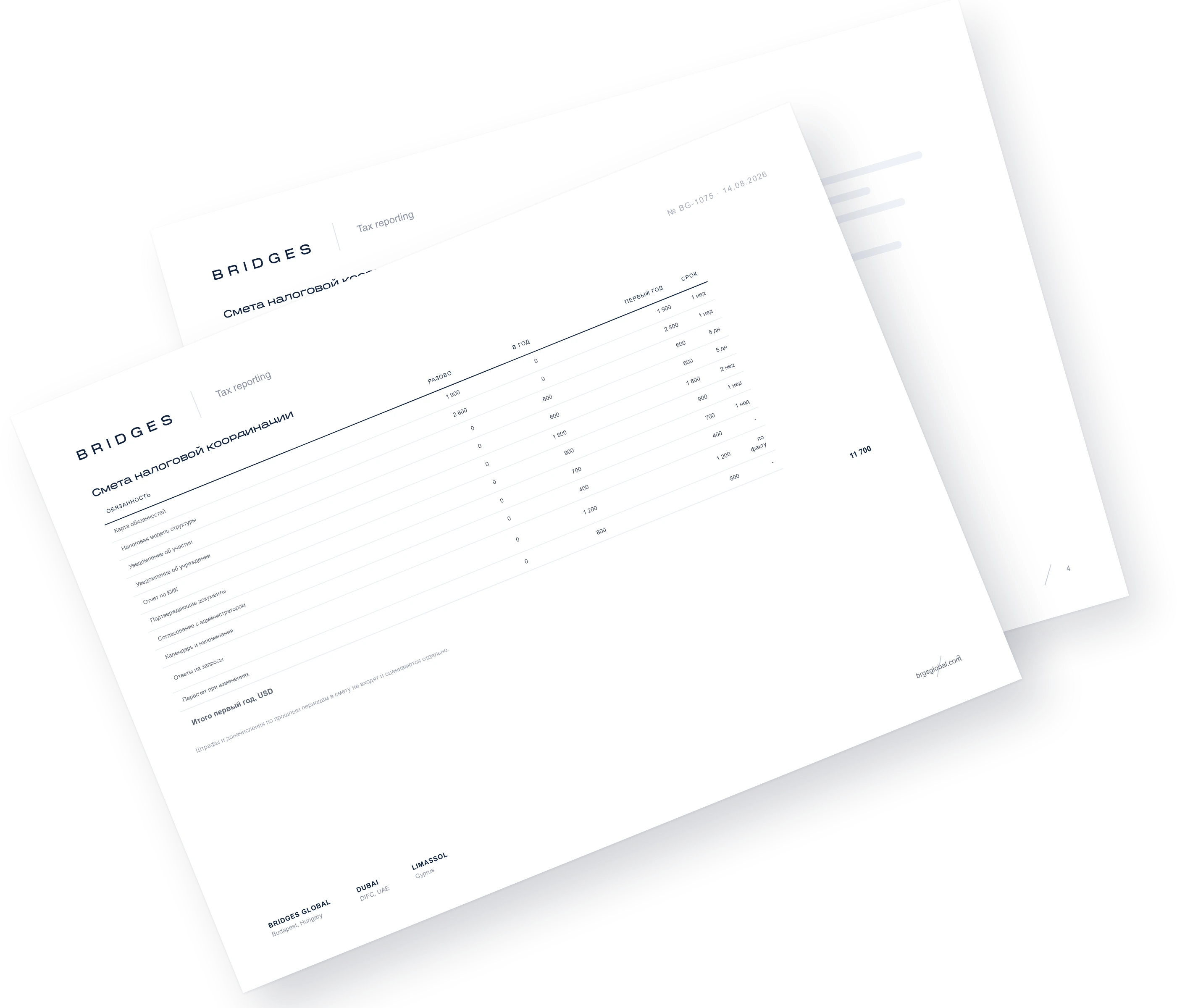
It is calculated by the number of structures and countries, not by the size of the capital.
The number of structures and companies
Every entity in the chain of ownership creates its own set of obligations and its own reporting.
The number of jurisdictions
Obligations arise in your country of residency and in the country of the structure — and sometimes where the assets sit as well.
The state of affairs
Running things to plan costs less than putting right a situation with missed deadlines and accumulated questions.
The format
A one-off calculation of the model, or annual support with a calendar and the preparation of every report.
The first assessment of the obligations is made before the agreement: you see the volume of work for the year straight away.
06 / How it works
How we work
From a picture of the obligations to annual support.
Going through the situation
Which structures exist or are planned, where you are resident, what has already been filed.
1–2 days
The map of obligations
The full list: what has to be filed, where and by when, for each country and each structure.
1 week
Putting it in order
If there are gaps, we prepare the notifications and the explanations and assess the risks and consequences.
2–4 weeks
Preparing the reporting
The notifications, the CFC reports, the annexes and the supporting documents, to the deadline.
by the calendar
Annual support
We keep the calendar, remind you of the deadlines and recalculate the model when things change.
The filing deadlines are set by law and do not move — so the work is planned backwards from them.
07 / Preparation
What we will need from you
The calculation rests on actual data, not on assumptions.
The documents on the structures
The constitutional documents, the details of shareholdings and control, the trust deeds and foundation charters.
The financial statements
The accounts of the foreign companies and structures for the reporting periods, and the account statements.
Your tax status
Where you are resident, how many days you spend in which countries, which returns you have filed before.
What has been filed before
The notifications, the reports and the correspondence with the tax authority — so that the new does not contradict the old.
The documents are sent over secure channels; confidentiality is an obligation under the agreement.
08 / Team
Who runs the work
The tax part is run by a specialist adviser; a lawyer answers for the structure’s documents.
 Dmitry NagyInternational Tax ConsultantThe tax model, the CFC rules, the reporting and the requests
 Robert HaasCorporate LawyerThe structure’s documents and agreement with the administrator
 Irina ShternHead of Hungary OfficeThe calendar of deadlines and gathering the documents
 Tomas LinderCompliance and AML OfficerChecks and legalisation
10 / Questions
Answers to common questions
Yes, if you are a tax resident of a country where such a duty exists. In Russia the notification of participation and of the establishment of a structure is filed within set periods, and there is a fine for every entity missed. Owning it is lawful — what is punished is the silence, not the structure.
If you control a foreign company or structure, its undistributed profit may in certain conditions be brought into your tax base even though the money stayed in the company’s account. There are exemptions and thresholds — and it is exactly those we work out in the model.
Go through the situation rather than wait. We assess what has been missed, work out the risks and prepare the documents. Putting things right voluntarily almost always costs less than the tax authority getting there first on exchange data.
You should assume so: the automatic exchange of information works between most jurisdictions, the ones once thought closed included. We plan on that assumption rather than on a hope of going unnoticed.
Yes — by the choice of jurisdiction, the form of the structure, the way distributions are made and, where it fits, a change of tax residency. The difference between planning and evasion is that the first rests on real facts and is disclosed in the reporting, while the second hides.
We prepare the calculations, the notifications and the annexes and hand them to you to file, or file them under a power of attorney where that is allowed. The taxpayer bears the responsibility for what is filed — which is why we show every calculation and explain its logic.
In Russia, within the period set by law from the date the participation arose, and the report on a controlled foreign company is filed every year. We put the exact dates in your calendar of obligations: they depend on whether you are an individual or a legal entity.
A fine for each entity not notified. The sum is not catastrophic, but the fines add up across every company and every period, and the very fact of not filing draws attention to the rest of the picture.
In certain conditions, yes — that is the point of the CFC rules. There are exemptions: by the size of the profit, by the effective tax rate in the company’s country, by the type of activity. It is those exemptions we check in the calculation.
Account information: the balance at the end of the period, the turnover, the details of the holder and of the controlling persons. The individual transactions are not passed on, but a discrepancy between the balance and your return is visible at once.
So that the reporting in the country of the structure and your own return do not contradict each other. The commonest problem is that the administrator filed one set of figures and the taxpayer stated another, and the question that arises is not about the quality of the work but about the discrepancy itself.
INITIAL ASSESSMENT
Tell us what outcome your family needs
We will design a solution for your case, choose the country and the right status, and take the whole process through to the result.
