Residency · UAE
Life in Dubai in retirement 2026: the retirement visa, budget, healthcare, and climate

Updated: June 2026·13 min read·Expert reviewed
Terms and costs verified: June 2026
Contents
Retiring to the UAE has stopped being a fantasy: since 2018 the country has had a retirement visa for people over 55 - issued for 5 years and renewable. Dubai offers what's lacking back home: zero tax on pension and passive income, safety on par with the world's best cities, a warm winter, and strong healthcare. But there are two sides to the coin - summer heat, mandatory medical insurance that gets pricier with age, and the need to document income or assets. We break it down point by point: what conditions the retirement visa has, how much money is really needed to live in Dubai in retirement, and how healthcare and climate work.
Why retirees choose Dubai: a breakdown
Dubai long ago stopped being a city just for young expats and businesspeople. More and more people of pre-retirement and retirement age consider retiring to the UAE a deliberate life scenario, not an exotic choice. There are several reasons, and they're quite down-to-earth.
First - money. There's no personal income tax in the UAE, meaning your pension, dividends, rental, or investment income aren't taxed at the emirate or federal level. For someone who's given part of their income to the state for decades, this is a tangible difference in the wallet every month.
Second - safety. Dubai consistently ranks among the world's safest megacities: low street crime, well-oiled urban infrastructure, cleanliness. For an older person, calmly walking in the evening with no looking over your shoulder isn't a small thing, it's quality of life.
Third - climate and healthcare. From October to April there's mild warmth here instead of slush and cold. Clinics are equipped to world standards, doctors speak English, and at many - Russian too. We'll break down the downsides worth knowing, with no embellishment, next - summer heat, mandatory medical insurance, and the income confirmation requirement.
- Zero taxeson pension, dividends, rent, and capital gains for individuals.
- Safety- one of the lowest crime levels among megacities.
- Climate- a comfortable winter from October to April.
- Healthcareof world class and a developed Russian-speaking environment.
The UAE retirement visa 55+: what it is and who it suits
The retirement visa is a special five-year residence permit for foreigners over 55 that the country introduced to attract well-off people for a calm retirement period. This isn't a tourist stamp or a one-off permit: the visa gives full-fledged resident status with Emirates ID, the right to rent or buy housing, open accounts, and sponsor family.
The key idea is simple: the state doesn't pay you a pension and doesn't take on social obligations, but in exchange offers a convenient jurisdiction for living to those able to support themselves. So the whole point of the visa conditions revolves around one thing - proving financial self-sufficiency.
Who this route suits:
- Established professionals and entrepreneurs55+, wrapping up an active career, with savings and assets.
- Property ownersin the UAE who want to legalize long-term residence.
- Recipients of stable passive income- rent, dividends, an annuity, a private pension.
- Married couples- the primary holder sponsors a spouse and children.
We keep a detailed breakdown of the visa route itself, documents, and renewal in a separate article onthe UAE retirement visa. Here we'll focus on the full picture of life in retirement: budget, healthcare, climate.
Retirement visa conditions 2026: a "condition - threshold" table
Let's move to the numbers - they're the foundation of the decision to retire to the UAE. There's one basic requirement: age from 55 at the time of retiring. Then one of the financial conditions must be met - not all at once, but a choice. General thresholds apply at the federal level, but when filing specifically from Dubai the income bar is higher, which is important to account for in advance.
| Visa condition | The 2026 threshold |
|---|---|
| Age | from 55 at the time of retiring |
| The "savings + property" route | savings from 1,000,000 AED AND property from 1,000,000 AED |
| The "income" route (federal) | annual income from 180,000 AED (a source in the country or abroad) |
| The "income" route when filing from Dubai | fixed annual income from 240,000 AED |
| Work experience | at least 15 years of work in the UAE or abroad |
| Visa term | 5 years, renewed if conditions are maintained |
| Medical insurance | mandatory, a valid policy is a condition of issuance and renewal |
| Family | the holder sponsors a spouse and children |
An important caveat: the "savings + property" route needs both conditions at once - savings and property, a million dirhams each. The income route, however, is self-sufficient: confirm income - condition met. Which path to choose in your specific case depends on your asset structure, and it's worth calculating in advance. The thresholds are given per official data and may be clarified, so check current requirements at the portal ofthe UAE government (u.ae).
How much is needed to live in Dubai in retirement: a realistic budget
The most common question is how much money is needed to live in Dubai in retirement. The answer: the range is wide, because Dubai can be both affordable and luxurious. Per approximate 2026 estimates, a couple's comfortable life costs about 17,000-30,000 AED a month (about 4,600-8,200 dollars), and the specific figure depends primarily on the neighborhood and lifestyle.
Let's break down a typical monthly budget for a retired couple (approximately, 2026):
| Expense item | Per month, AED (benchmark) |
|---|---|
| Housing rent (1-2 bedrooms) | 5,000-9,000+ (depends on the neighborhood) |
| Utilities and internet | 1 000-1 800 |
| Groceries | 1 500-2 500 |
| Cafes and restaurants | 1 500-2 500 |
| Transport (taxi/car/metro) | 800-1 500 |
| Medical insurance (two, 55+) | 1 500-3 500 |
| Leisure, communications, other | 1 500-3 000 |
The largest item is rent, eating up 35-50% of the budget. A studio in prestigious Downtown costs noticeably more than an apartment in calm neighborhoods like Jumeirah Village Circle or Barsha Heights, where you can live comfortably and substantially cheaper. For those buying property, rent disappears from expenses entirely - more on this in the article onbuying property in the UAE. We keep a full price breakdown in a separate rundown ofthe cost of living in Dubai.
Renting or buying housing: what's more advantageous for a retiree
Housing is the main budget lever, so the choice between renting and buying should be approached as a financial decision, not an emotional one. Both options work, the question is the planning horizon and capital structure.
Rentalis good for flexibility. You don't freeze capital, can try different neighborhoods, easily move. The downside - a monthly payment and dependency on rising rental rates, which can be noticeable in popular neighborhoods. Many newcomers start exactly with renting for a year or two, to understand where they're more comfortable.
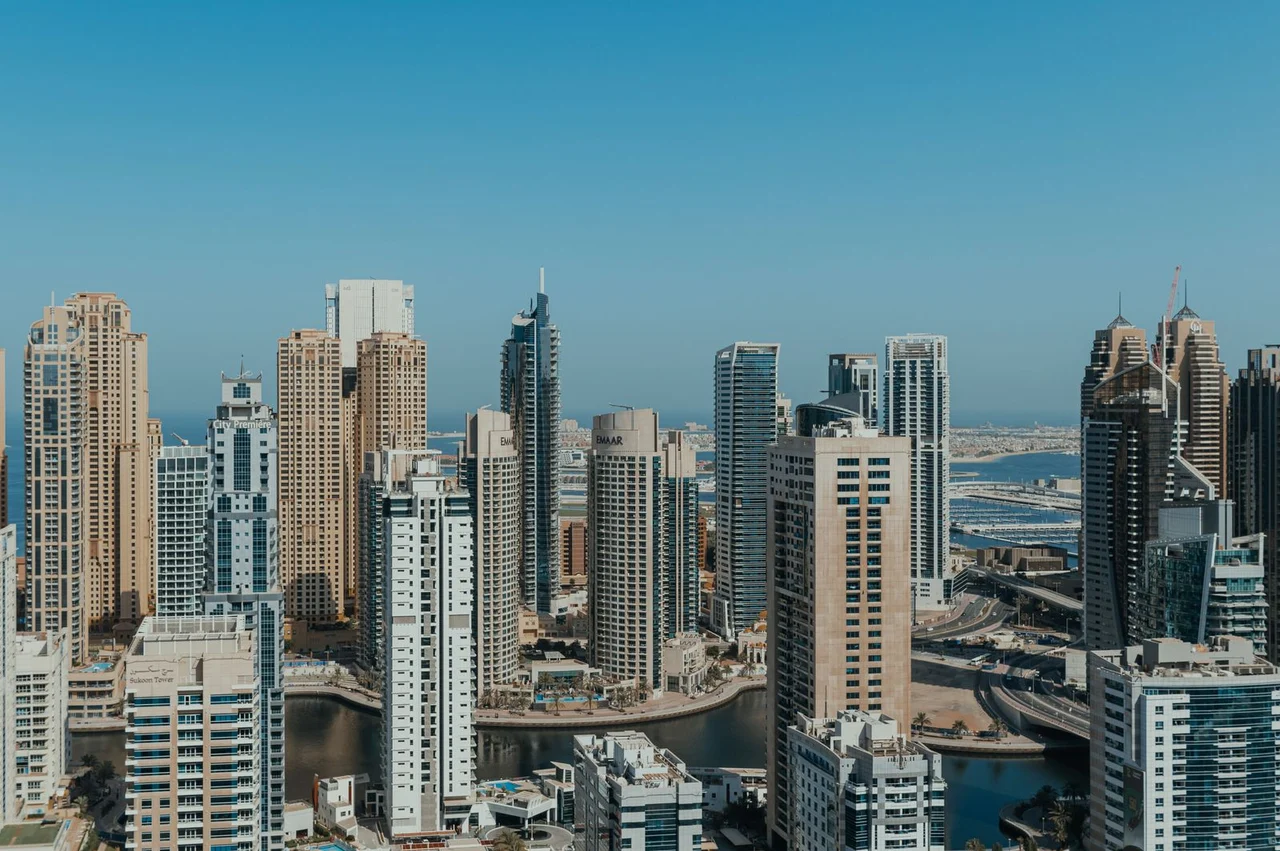
Purchaseis logical for those moving seriously and for the long term. Foreigners buy freehold property in specially designated zones - Dubai Marina, Downtown, Palm Jumeirah, Business Bay, Dubai Hills, and others. There's no annual property tax here, a Dubai Land Department (DLD) fee of about 4% plus administrative fees is paid upon purchase. Buying property from 1 million AED also closes one of the elements of the retirement visa's financial route.
For a retiree the picture is often this: if there's free capital and a desire to settle for a long time - buying removes the largest expense item and works for the visa. If mobility matters or you're still looking around - start with renting. Details of ownership routes are covered in the guide onproperty in the UAE.
Healthcare in Dubai: level, clinics, and accessibility
For a person 55+, the quality and accessibility of healthcare are often the decisive factor in moving. And here Dubai has a strong position: healthcare is organized to world standards, the private sector is developed, equipment is modern, and queues are incomparable to state clinics back home.
What sets Dubai's healthcare apart:
- A strong private sector.Networks of private clinics and hospitals with modern equipment, international protocols, and accreditations.
- Language accessibility.Doctors speak English, many clinics have Russian-speaking specialists and interpreters - for an elderly patient this removes huge stress.
- Speed.Booking a specialist and tests take days, not weeks and months.
- Geography.The Dubai Healthcare City medical cluster and clinics in all neighborhoods - getting to a doctor is easy.
The flip side - healthcare is paid, and without insurance bills can be high. That's exactly why an insurance policy is mandatory in the UAE. A detailed breakdown of the system's structure, hospitals, and clinic-choosing logic - in the article onhealthcare in Dubai. And about the insurance itself and its cost for a retiree - in the next section.
Medical insurance for a retiree: mandatory and gets pricier with age
This is one of the most important and sections. In 2026, medical insurance is mandatory in all seven emirates, and without a valid policy the resident visa won't be issued or renewed. For the retirement visa this simply means: no insurance - no status. So it needs budgeting for right away.
The main feature for people 55+ is the age surcharge. Insurers apply an increasing coefficient to the tariff for age 55+, and after 65 premiums grow even more noticeably because of health risks. This is normal practice, but you need to be ready for it: what costs a thirty-year-old symbolic money will cost a retiree many times more.
Cost benchmarks for 2026 (per person, per year):
- Basic plans- conditionally from a few hundred to 1,500 AED, but for an elderly person this is usually the lower bound with limited coverage.
- Mid-range plans- approximately 3,000-7,000 AED.
- Premium planswith a wide network and international coverage - 10,000-20,000 AED and above.
For a retiree 55+, the real tariff is almost always closer to the upper part of the range or higher because of the age surcharge and possible chronic conditions. So medical insurance - for two, accounting for age and the needed coverage - is worth calculating before the move, not after. This is the item where saving can end up costing the most.
Dubai's climate: a mild winter versus summer heat
Climate is the second reason after taxes people come to Dubai in retirement. But here too it's important to understand both sides, so the move doesn't turn into a disappointment.
Winter (October-April)- the best time and the main argument. Daytime temperature is comfortable, summer-warm, evenings are pleasant, humidity is moderate. This is the season of walking along the waterfronts, the beach, open terraces, and active outdoor life. For those tired of a long cold winter back home, such weather is a real gift for health and mood.
Summer (June-September)- a trial. Daytime heat exceeds 40-45 degrees, high humidity adds up near the coast. Minimal time is spent outside during this period: the city lives in air-conditioned spaces - malls, restaurants, clinics. For an elderly person, heat isn't just discomfort but a burden on the heart and blood vessels, so in summer it's important to avoid long sun exposure.
Many retirees solve this simply: they spend winter in Dubai and leave for the hottest months - back home, to Europe, or to the mountains. It turns into a kind of seasonal migration for comfort. A detailed breakdown of the weather by month - in the article onthe climate and weather in Dubai.
Pros and cons of life in retirement in Dubai: no illusions
Let's gather the whole picture -, from both sides. Dubai isn't perfect and doesn't suit everyone, but for a certain retiree profile it's a very strong solution.
Pros:
- Zero taxeson pension, rent, dividends, and capital gains.
- Safetyon par with the world's best megacities.
- The winter climate- warm sun instead of slush for half the year.
- World-class healthcarewith Russian-speaking doctors and no queues.
- Infrastructure- transport, delivery, services, cleanliness.
- A Russian-speaking environmentand a large expat community.
Cons:
- Summer heat- three to four months of difficult climate.
- Mandatory medical insurance, getting pricier with age.
- High rentin popular neighborhoods.
- Income or assets need confirming- the entry threshold isn't for everyone.
- Citizenship can't be bought- the visa gives residency, but not a UAE passport.
The conclusion is simple: if you have stable income or capital, value safety and warmth, are ready for paid healthcare and a summer departure - Dubai will become a very comfortable base for retirement. If the budget is right at the financial threshold's edge - it's worth soberly calculating all items in advance.
Family, bank, and daily life: what else to account for when moving
The visa is only the first step. For life in retirement in Dubai to be calm, a few more everyday questions need closing, which are often forgotten at the start.
- Family.The retirement visa holder sponsors a spouse and children - the family moves together, not separately. Medical insurance and Emirates ID are also needed for each family member.
- Bank account.Residency opens access to local banks. It's important for a retiree to open an account for paying rent, utilities, and insurance. Banks run a serious check (KYC/AML) and may request documents on the source of funds - this is routine, for which papers need preparing in advance.
- Transferring the pension and income.It's worth thinking through in advance exactly how you'll receive the pension or passive income in the UAE - through an international transfer, to a local or foreign account.
- Housing and neighborhoods.For a calm retirement, quiet, green neighborhoods within walking distance of clinics, shops, and parks are often chosen, rather than a noisy center.
- Emirates ID.This is your main document in the country - it's used to open accounts, sign contracts, and visit clinics.
All these steps are interconnected: insurance is needed for the visa, the visa for Emirates ID, the ID for the bank and rental. Building the chain in the correct order is half the success of a calm move.
Common mistakes when moving for retirement: an expert's view
Over years of practice we see that a retirement move is derailed or made more costly not by rare circumstances, but by the same typical miscalculations. Let's break them down so you avoid them.
- Underestimating medical insurance.People calculate the budget by tariffs for young people and forget the 55+ age surcharge. Calculate the policy for two by the real age - this is a large item.
- Confusion in the visa's financial routes.The "savings + property" route requires both conditions at once, and the income threshold when filing from Dubai is higher than the federal one. The route choice needs calculating in advance.
- The illusion about citizenship.The visa gives residency, but not a UAE passport - citizenship can't be bought. If the goal is specifically a passport, Dubai isn't for that.
- Calculating the budget with no summer.Air conditioners, trips for the hot months - this is real money people forget to budget for.
- Ignoring taxes back home.UAE residency doesn't automatically cancel previous tax obligations - the dual residency question is better resolved before the move.
A retirement move forgives a lot, but doesn't forgive an approximate budget and haste. The more precisely insurance, housing, and taxes are calculated in advance, the calmer the first year goes.
Taxes for a retiree in the UAE: why the pension isn't taxed
Dubai's main financial magnet for a retiree is the tax system. There's no personal income tax in the UAE. This means your pension, dividends, deposit interest, rental property income, and capital gains aren't taxed locally. For someone retiring, this is a direct boost to disposable income.
What's important to understand about the tax picture:
- 0% on individuals' income- on pension, rent, dividends, interest, capital gains. There's also no inheritance tax for individuals.
- VAT 5%- there's a consumption tax: it's already built into the prices of goods and services, everyone pays it.
- 9% corporate tax- concerns company profit above 375,000 AED, doesn't concern an ordinary retiree if they don't run a business here.
- Tax residency- to use UAE tax resident status and double-taxation avoidance treaties, it's important to genuinely spend enough time in the country and arrange the needed certificates.
A separate nuance is taxes back home. Getting UAE residency by itself doesn't automatically cancel tax obligations in your former country of residence: much depends on where you remain a tax resident and which treaties apply. It's better to calculate this question with a consultant before moving, so zero taxes in the UAE don't turn into reassessments elsewhere.
"When a person 55+ comes to me with the idea of retiring to Dubai, the first thing I ask them to calculate isn't the visa, but two things: medical insurance at the real age and the monthly budget adjusted for summer. This is exactly where nice plans fall apart. A policy for a retiree costs many times more than for a young expat because of the age surcharge, and air conditioners and leaving for the hot months are real money people forget to budget for. But when the budget is calculated, the picture becomes very attractive: zero tax on pension and income, safety, a warm winter, and world-class healthcare with no queues. And one more thing I always mention: the retirement visa gives residency, but not a passport - UAE citizenship isn't sold. If the goal is clear and the money is calculated in advance, the move goes calmly."
Not sure which country and status to choose?
We will compare suitable residency programs on budget, timelines and stay requirements - with a full cost calculation for your family.
Free of charge, we reply right away, no obligation.
Conclusion: who should move to Dubai for retirement
Life in retirement in Dubai isn't a scenario for everyone, but for a certain profile of person it's almost ideal. If you have stable passive income or capital, value personal safety, are tired of a long cold winter, and want access to strong healthcare with no months-long queues - the UAE gives a rare combination of these benefits, and at zero tax on income too.
Who should look more closely or choose another option: those whose budget is right at the visa's financial threshold, who have a hard time with heat with no chance to leave for summer, or who are specifically looking for a second passport - UAE citizenship can't be gotten for money, the visa gives only residency.
The optimal strategy for most is to calculate three key items in advance, before the move: the suitable retirement visa route, medical insurance accounting for age, and a realistic monthly budget adjusted for the neighborhood and summer. Then moving to the UAE for retirement becomes not a leap into the unknown, but a weighed decision. Starting points for the calculation - our articles onthe UAE retirement visa, the cost of living in Dubaiand healthcare in Dubai. Current visa requirements are always worth checking at the portal ofthe UAE government (u.ae).
Frequently asked
Questions people ask before deciding
01From what age can the UAE retirement visa be obtained?
The retirement visa is available from age 55 - the age must be reached at the time of retiring. The visa is issued for 5 years and renewed if at renewal time you still meet the financial conditions. This is full-fledged resident status with Emirates ID, not a tourist stamp.
02How much money is needed for the UAE retirement visa in 2026?
One of the conditions must be met: savings from 1 million AED together with property from 1 million AED, or annual income from 180,000 AED by the federal threshold. When filing specifically from Dubai, the fixed income bar is higher - from 240,000 AED a year. At least 15 years of work experience is also required.
03How much is needed to live in Dubai in retirement per month?
Per approximate 2026 estimates, a couple's comfortable life costs about 17,000-30,000 AED a month (about 4,600-8,200 dollars). The largest item is rent (35-50% of the budget). In calm neighborhoods like JVC, living is noticeably cheaper than in the center, and buying housing removes rent from expenses.
04Is pension taxed in the UAE?
No. There's no personal income tax in the UAE, so pension, dividends, interest, rental income, and capital gains aren't taxed locally. There's only 5% VAT, built into the prices of goods and services. At the same time, UAE residency doesn't automatically cancel tax obligations back home - this question is worth calculating in advance.
05Is medical insurance mandatory for a retiree in the UAE?
Yes, in 2026 medical insurance is mandatory in all seven emirates. Without a valid policy, the resident visa won't be issued or renewed. For the retirement visa this is critical: insurance is a condition of issuing and renewing status. A policy is needed for each family member, including the spouse.
06Why is medical insurance more expensive for a retiree in Dubai?
Insurers apply an age surcharge to the tariff for people 55+, and after 65 premiums grow even more noticeably because of health risks. Basic plans conditionally cost from a few hundred to 1,500 AED a year, mid-range 3,000-7,000, premium 10,000-20,000 and above. For a retiree, the real tariff is usually closer to the upper part of the range.
07What's the climate in Dubai like and is heat hard for a retiree?
From October to April the climate is mild and warm - this is the best time and the main argument for moving. But summer (June-September) is a trial: heat above 40-45 degrees and high humidity. For an elderly person this is a burden on the heart, so many retirees leave for the hottest months, spending only the comfortable season in Dubai.
08Can housing be bought in Dubai in retirement and is it needed for the visa?
Yes, foreigners buy freehold property in special zones - Marina, Downtown, Palm Jumeirah, Business Bay, and others. There's no annual property tax, a DLD fee of about 4% is paid upon purchase. Buying property from 1 million AED also closes one of the elements of the retirement visa's financial route.
09Can family be relocated under the UAE retirement visa?
Yes, the retirement visa holder sponsors a spouse and children - the family moves together. Medical insurance and Emirates ID are arranged for each family member. This is convenient for couples retiring together: the primary applicant meets the financial conditions, and the spouse gets status as a family member.
10Does the UAE retirement visa give citizenship or a passport?
No. The retirement visa gives resident status (a residence permit) for 5 years with the right of renewal, but not citizenship. A UAE passport can't be bought - citizenship is granted only by decree of the authorities for exceptional individuals. If your goal is specifically a second passport, this route doesn't cover it.
11What's more advantageous for a retiree - renting or buying housing in Dubai?
Renting gives flexibility and doesn't freeze capital, but it's a monthly payment and dependency on rising rates. Buying is logical for those moving for the long term: it removes the largest expense item, there's no annual property tax, and buying from 1 million AED also works for the visa. Many start with renting for a year or two, then buy.
12Can you apply for the UAE retirement visa from Russia and other CIS countries?
Yes, citizenship and country of residence don't restrict access to the retirement visa - it's important to meet the 55+ age threshold and one of the financial conditions. Russians enter the UAE visa-free for 90 days for tourism, but living there requires exactly resident status. Banks run an enhanced source-of-funds check - documents are worth preparing in advance, all strictly within the law.
Transparency
How this material was prepared
- Author
- Viktoria Lebedeva, managing Director, Private Clients, BRIDGES
- Terms and costs last verified
- June 2026
- Sources
- official government authorities of the relevant country and state publications
- Methodology
- government minimum requirements are stated separately from due diligence charges, state fees, legal and banking costs
Sources and methodology
Figures, terms and timelines are checked against official sources as of June 2026. Link availability verified in August 2026. Third-party blogs and agent websites are not used as a source of programme terms.
- [1]Federal Authority for Identity, Citizenship, Customs and Port Security (ICP)Visas, residence statuses, Emirates IDicp.gov.ae/en
- [2]Official portal of the UAE GovernmentGolden visa and residence visasu.ae/en/information-and-services/visa-and-emirates-id/residence-visas/golden-visa
Methodology: tables and charts state government minimum investment requirements; due diligence charges, state fees, legal, banking and other costs are calculated separately and are not included in the minimum thresholds.
About the author
Related materials
What to read next
 ArticleUAE citizenship by investment in 2026: is there a program and what really works?
 ComparisonDubai or Abu Dhabi in 2026: where to live, work and buy property
 AnalysisWhat is due diligence and why the Caribbean is rejecting applications
Personal programme selection is conducted by Anna Kovalevskaya, Head of Legal, BRIDGES.
Residency in UAE: timelines and requirements
Grounds, document list, presence requirements and what is needed for renewal.