Residency · Cyprus
Villa or apartment in Cyprus in 2026: what to choose for living, investment and permanent residence

Updated: June 2026·12 min read·Expert reviewed
Terms and costs verified: June 2026
Contents
The same budget in Cyprus can be invested in two completely different ways: in an apartment in a city complex or in a villa with a pool by the sea. The decision affects not only the quality of life, but also maintenance costs, rental yield, resale rate and even how the application for permanent residence will go. We analyze both options according to the numbers for 2026 -, without advertising gloss, so that you choose according to your task, and not according to a beautiful picture.
The big question is: are you buying a lifestyle or an asset?
Before comparing prices per meter, answer yourself one question: what comes first for you - the comfort of your family or the work of money. Almost everything else depends on it. A villa is about space, privacy, a pool and a garden, about a house in which they live, and not from which they calculate income. An apartment is about manageability, liquidity and predictable rental flow in the city.
In Cyprus, both formats are suitable for life, investment, and receiving Cyprus permanent residence permit. But they behave differently at each stage: at entry, at maintenance, at rental and at sale. Therefore, there is no universal answer - there is an answer for a specific purpose. Below we break down both options across all key parameters, using 2026 numbers, so you can make an informed decision.
Let’s immediately state something important: for the permanent residence program under Regulation 6.2, housing (both apartment and villa) must be a new building purchased directly from the developer - first sale. Secondary housing does not qualify for this program. We will analyze this nuance in detail further; it greatly influences the choice of object.
Entry price and cost per square meter
If you look at the median figures for the market in 2026, the picture is not obvious. The median apartment in Cyprus costs about 460,000 €, the median villa or house costs about 792,000 €. That is, in absolute terms, the threshold for entering a villa is noticeably higher: a house is always larger in area and almost always has land underneath it.
But the price per square meter turns in the opposite direction. Apartments cost around 3,856 €/m², villas around 3,537 €/m². There is no paradox here: apartments compete in the dense urban range and cost more per meter, while villas push up the total price due to their large area and plot, but the meter is cheaper.
- Apartment. Lower the amount at the entrance, higher the price per meter. You can meet the budget of 300,000-460,000 € and get a ready-made liquid object.
- Villa. The total amount is higher (often from 600,000-800,000 € for a decent house by the sea), but there is more space and your own land, which becomes more expensive over time.
To enter permanent residence at the threshold of 300,000 € + VAT, a new building apartment is a more affordable starting point. It is more difficult to find a villa for this amount, but it is possible - for example, a compact house or townhouse in a developing area. We have collected a detailed layout for the purchase in the material how to buy property in Cyprus.
Maintenance costs: where is a villa more expensive?
The purchase is a one-time expense, but the maintenance goes with you every year, so you need to calculate it in advance. Here the gap between formats is most obvious.
The owner of an apartment pays on average about 1,700 € per year, the owner of a villa with a private pool - about 2,900 € per year. Per month it looks like this: a modest apartment with moderate general fees costs 80-150 € per month, and a large villa with a pool and garden costs 250-400 € per month.
- Apartment. The main article is management fee, the general fee of the complex. It includes cleaning of the territory, elevators, lighting of halls and parking lots, maintenance of fire safety systems, sometimes a swimming pool and a gym for the entire house. The payment is predictable and fixed.
- Villa. Everything is on the owner: chemistry and cleaning of the pool, gardener and watering, facade care, repair of own roofing and engineering. Property taxes on a house with a lot are also usually higher. But there are no general fees from the complex and neighbors that affect the budget.
The conclusion is simple: the apartment is cheaper and easier to maintain, the costs are transparent and transferred to the management company. A villa requires more money and more attention - especially if you do not live in Cyprus permanently.
Rental yield: city versus sea
If an object is purchased for the sake of income, profitability is the decisive parameter, and here the formats differ fundamentally. According to 2026 market data, rental yields across Cyprus are around 5.45% for apartments and around 2.96% for houses.
The difference is explained by the logic of demand. An apartment in the city (Limassol, Nicosia, Larnaca) is rented consistently and all year round: it is rented by company employees, students, and relocants. The flow is smooth, downtime is short, control is simple. A villa by the sea is a different story: in the summer it can be expensive for short-term rentals, but in the winter demand drops, seasonal downtime appears, and the gross rate of the house rarely catches up with the apartment in terms of invested capital.
- Apartment in the city. Stable long-term tenant, smooth cash flow, yield of about 5%. The best choice for passive income.
- Villa by the sea. A high check during the season for short-term rentals, but winter downtime and a lower final profitability. It works if you actively manage and catch the season.
We have included a detailed analysis of rates and factors in a separate article about rental yield in Cyprus - there are numbers by city and type of object.
Rent management and commissions
Income on paper and income in your pocket are different amounts, and management eats up the difference. Especially if you are outside of Cyprus and cannot personally greet guests and repair the air conditioner.
For long-term rental of an apartment, the services of a management company cost about 100 € per month - this is approximately 6% of the rent. The manager finds a tenant, collects money, and responds to everyday problems. For a villa for short-term rental (Airbnb format), the professional management fee is noticeably higher - on average 15% of rental income, which, with revenue of about 60,000 € per year, means about 9,000 € of management costs.
- Apartment. Cheap and simple management, ~6% of the bet. One long-term tenant - minimum hassle.
- Villa. Expensive management, ~15% for short term: cleaning between guests, check-in, pool, reservations. Management is almost mandatory unless you're on an island.
For the remote owner, this often tips the scales: a single-tenant apartment with low-cost management can be managed from anywhere in the world, while a short-term rental villa effectively becomes a small hotel business.
We will help you choose the right programme
We compare timelines, amounts and requirements for your family and tell you which option works best.
Liquidity and resale
Any asset is sold once, and the speed of exit is also part of the investment result. Here the formats have different audiences of buyers.
An apartment is a mass and liquid product. In the 2026 market, 71% of transactions with apartments were for properties less than 250,000 €, that is, the main demand is concentrated in the affordable segment, where apartments are lived. Such an object is easier to evaluate, easier to show, easier to sell - there are many buyers, the price is transparent.
A villa is a more piecemeal product. For houses, 41% of transactions were in the segment up to €250,000, the rest were more expensive, and the higher the check, the narrower the circle of buyers. A good villa by the sea can rise in price more than an apartment, but it can also take longer to find a buyer for it: the market for expensive houses is thinner and more sensitive to moods.
- Apartment. High liquidity, quick exit, transparent valuation. Suitable if flexibility and the ability to sell without a long wait are important.
- Villa. Potentially higher capital gains, but longer exposure period and lower demand. Suitable for a horizon of years, not a quick turnaround.
What is suitable for permanent residence and a bridge to EU resident status
Now about the main thing for those who buy real estate for status. According to the Cyprus permanent residence program Regulation 6.2 (Category 6.2), both an apartment and a villa are suitable for housing - the format is not limited. But there are strict conditions, and you need to know them before the transaction.
- Sum. Investment from 300,000 € + VAT in real estate.
- New building only. Housing (apartments, houses, townhouses) is accepted ONLY as a first sale new building - directly from the developer. Secondary, previously owned housing does not qualify under Reg 6.2. Any residential property for permanent residence is a new property from the developer.
- Up to two objects. You can collect the amount from one or two housing units, but strictly from ONE developer.
- Commerce as an alternative. Commercial real estate (office, store) is Option B, it can be secondary and also gives permanent residence.
- Income outside Cyprus. €50,000 per main applicant + €15,000 per spouse + €10,000 per child (salary, pension, dividends, interest, rent).
- Lifetime status. Maintenance - visit to Cyprus once every 2 years. No language or residence is required (the B1 certificate is only needed for citizenship, not for permanent residence).
- Family. Main applicant + spouse + dependent children under 25 years of age.
It is important to be : Cyprus is a member of the EU, but is not yet part of the Schengen zone, so permanent residence in Cyprus does not itself provide visa-free entry into Schengen. This is a lifelong resident status of an EU country with the right to permanently live on the island, but not a Schengen visa.
Both a new-build apartment and a new-build villa equally pass the threshold of 300,000 € + VAT, so here the choice again comes back to your goal - to live, rent or hold the asset. Do you want to analyze your situation and select an object that will fit the program and solve your problem? Discuss your scenario with BRIDGES GLOBAL experts - Let’s break down exactly your case by numbers.
For family life: which is more comfortable?
If an object is purchased primarily to live in, the logic changes - not profitability and liquidity, but daily comfort come to the fore.
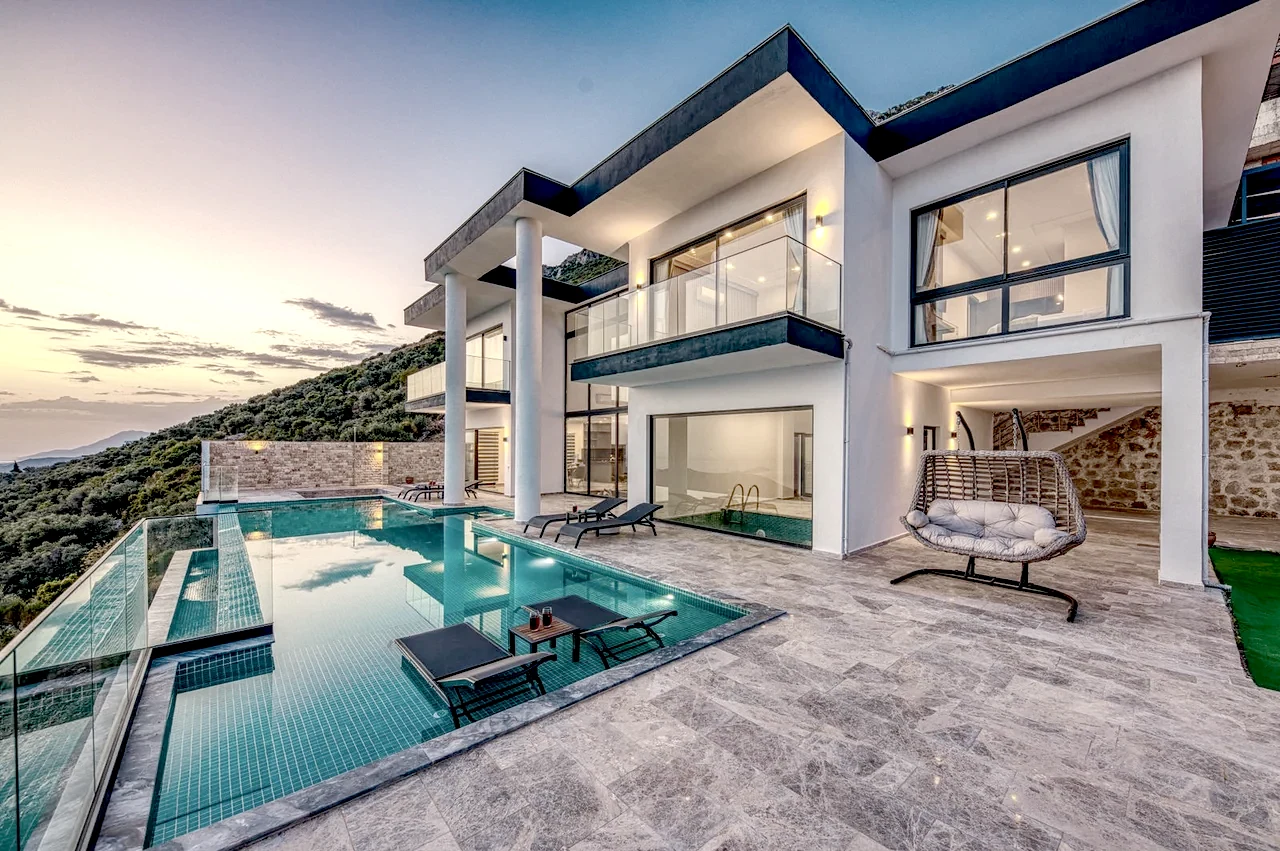
The villa gives privacy, a private pool, a garden, space for children and cars, silence without neighbors behind the wall. This is a format for a family that plans to live on the island for most of the year and values space. Minus - all the worries about the house are on you: pool, garden, repairs, security.
An apartment in a good complex means hassle-free service: security, concierge, communal pool and gym, maintenance is handled by the management company. You can lock the door and leave for six months without worrying about your home. This is a convenient option for those who live in two countries or come seasonally.
- Family with children, lives in Cyprus permanently. The villa often wins - space and privacy are more important than savings.
- Living in two countries, seasonal visits. More often than not, the apartment wins - they locked it and left, the complex's service takes care of everything.
“Clients often come with a ready-made solution - I want a villa by the sea or I want an apartment for rent - and are surprised when we first suggest breaking down the problem into numbers. A villa and an apartment are not a matter of taste, they are two different financial scenarios. If the goal is a stable income and easy management from abroad, an apartment in the city almost always beats a villa in terms of profitability and liquidity. If the life of the family, space and horizon for years come first, the villa justifies the higher costs and hassle. But for permanent residence it is important to remember one thing: housing under the program is accepted only as a new building directly from the developer, and here the savings on title verification are more expensive than any favorable price. We always start not with the object, but with your goal - and then we select the format for it.”
Remote maintenance and management
Most of our clients do not live in Cyprus all year round, so the issue of remote control is not theoretical, but very practical. And it often becomes the decisive argument.
The apartment in the complex manages itself almost by itself. Common areas, swimming pool, security - in the hands of the management company, your worries are reduced to payment of a management fee and, upon delivery, to inexpensive rental management. An elevator breaks down or a pipe bursts in the entrance - this is the complex's problem, not yours.
A villa at a distance requires a built-in system: you need a gardener, pool maintenance, a person who will check the house after a storm, a response to minor accidents. Without a manager, the villa, standing unattended, quickly loses its appearance - the pool turns green, the garden becomes overgrown. Therefore, the remote owner must immediately add regular management to the cost of the villa.
- Apartment. Minimum involvement, the infrastructure of the complex works for you. Ideal for owner abroad.
- Villa. Requires a personal manager or a service company, otherwise the house will deteriorate. More expensive and more troublesome at a distance.
Title Deed: nuances of property rights
Title Deed is a title, the official certificate of ownership from the Land Registry. In Cyprus, there is a separate story associated with it, which must be understood before purchasing, especially when dealing with a new building.
Many new and under-construction properties are sold before an individual title is officially issued: the developer must first subdivide the lot, obtain a final certificate of completion, and register each unit as a separate unit. The process of dividing a single development title into individual ones can take months, and in complex cases, years.
The main risk is called the trapped buyers problem: if a developer mortgages the entire plot to the bank and does not pay the debt, buyers without a separate title may find that their home is legally tied to someone else's debts. The State has strengthened the protection by Law 132(I)/2023: the seller is now required to attach a 5-day search certificate from the Land Registry to the sales contract, and it has legal force.
- New building apartment. Most often purchased at a stage when the individual title has not yet been released. It is mandatory to check the encumbrances of the site and the reputation of the developer.
- Newly built villa on a separate plot. Subdividing a plot is usually easier and the risk of trapped buyers is lower, but checking the title and history of the land is still necessary.
Practical conclusion: when purchasing any property in Cyprus - both for life and for permanent residence - legal verification of the title and encumbrances is mandatory. This is the part of the deal that you can't skimp on.
Comparison Chart: Villa vs Apartment
Let's summarize all the key parameters in one table so that the entire solution is before your eyes.
| Parameter | Villa | Apartment |
|---|---|---|
| Entry price (median) | about 792,000 € (higher amount) | about 460,000 € (lower amount) |
| Price per m² | approx. 3,537 €/m² (below) | approx. 3,856 €/m² (above) |
| Content per year | about 2,900 € (swimming pool, garden, higher tax) | about 1,700 € (management fee) |
| Rental yield | about 3% (seasonal) | about 5.4% (stable) |
| Management Commission | about 15% (short term) | about 6% (long term) |
| Liquidity | lower, longer sale | above, quick sale |
| Capital gains | potentially higher | moderate, stable |
| Remote control | more complicated, service needed | simpler, keeps the complex |
| For permanent residence Reg 6.2 | yes, new building first sale | yes, new building first sale |
| Best for | family life, privacy | income and liquidity |
Who is the villa suitable for?
The villa is a choice with the heart, backed by a long horizon. It is justified when comfort and space are more important than quick profitability, and you are ready to invest both money and attention into maintenance.
- A family who moves to live in Cyprus. Permanent residence, children, a private yard and a swimming pool - the villa reveals itself in everyday life.
- An investor with a horizon for years. If the goal is capital growth and own land, and not the maximum current rental flow, a villa by the sea can overtake an apartment in terms of final value.
- Owner ready to manage. Someone who either lives on the island or is willing to pay a service company to maintain the house.
A villa is not the best choice for passive income and for those who value the ability to sell quickly. But in terms of quality of life, little can compete with it.
Who is the apartment suitable for?
An apartment is a rational choice based on numbers. It wins where profitability, liquidity and ease of management are important.
- Investor for rental income. Stable yield of about 5%, inexpensive management, year-round demand in the city - the apartment is created for passive flow.
- Remote owner. For those who do not live in Cyprus and want the property to be managed almost by itself, the infrastructure of the complex makes this possible.
- The one who enters permanent residence at the minimum threshold. A new-build apartment is easier to manage within €300,000 + VAT than a villa, and can be resold faster if plans change.
- Who values flexibility? High liquidity allows you to exit an asset without a long wait for a buyer.
We have discussed the complete investment strategy - from choosing a city to the structure of the transaction - in the material Cyprus property investment guide.
We will send a document checklist for your case
Leave your details: we will put together documents and timelines for your family.
Legal and financial due diligence before the transaction
Whatever format you choose, the outcome of the transaction is determined not by the picture of the object, but by how the documents are verified and the money is confirmed. Especially when the purchase simultaneously becomes an application for permanent residence.
Before purchasing, it is important to check the title and encumbrances of the plot (protection from history of trapped buyers), the reputation and financial condition of the developer, the availability of a 5-day search certificate according to law 132(I)/2023, the correctness of the contract and payment schedule. A separate layer is confirmation of the source of funds and income for the permanent residence program.
- Income from the USA. IRS Forms 1040-NR and K-1 with Apostille are accepted.
- Income from trading. Confirmed by the consolidated audit report.
- Payment from a foreign corporate account. It is necessary to prove UBO - the final beneficiary.
- Bank blocking. The obtained permanent residence permit removes many banking restrictions for non-residents.
- Stuck case. The protracted consideration is accelerated by a pre-trial claim (Legal Notice) addressed to the Minister of Internal Affairs.
Current requirements and forms should always be checked with official sources - the Cyprus government services portal gov.cy and the website of the Ministry of Internal Affairs moi.gov.cy. Rules and thresholds are periodically updated, and you need to rely on the original source.
- Cypriot permanent residence vs Cypriot citizenship: what to choose
- Cyprus Permanent Residency Law: Regulation 6(2)
- Northern Cyprus Citizenship (TRNC): what yes
- How much does Cyprus citizenship cost
- Cyprus permanent residence or Turkish residence permit: what to choose
- Investing in Cyprus real estate: guide
Frequently asked
Questions people ask before deciding
01What is more profitable in Cyprus - a villa or an apartment?
Depends on the goal. In terms of rental income and liquidity, an apartment is more profitable: the yield is about 5.4% versus about 3% for a house, costs are lower and management is easier. For family life, privacy and long-term capital growth, a villa often wins. There is no universal answer - the solution depends on your problem.
02Are both a villa and an apartment suitable for permanent residence in Cyprus?
Yes, both formats are subject to the Regulation 6.2 program with an investment of 300,000 € + VAT. But housing (both apartment and villa) is accepted only as a new building, first sale directly from the developer. Secondary housing is not suitable for this program - for secondary housing there is a separate path through commercial real estate.
03Is it possible to buy a secondary villa or apartment for permanent residence?
Secondary housing does not fall under Regulation 6.2 - residential properties must be new buildings from the developer. The exception is commercial real estate (office, store) under Option B: it can be secondary and also gives permanent residence. If you are considering a secondary property, it is wiser to discuss the commercial option.
04How much does it cost to maintain a villa and apartment in Cyprus per year?
According to 2026 data, the owner of an apartment pays on average about 1,700 € per year, the owner of a villa with a pool - about 2,900 € per year. The villa adds pool cleaning, gardener, house maintenance and higher tax; The main item for the apartment is the management fee of the complex.
05What is the rental yield for an apartment and a villa?
Based on the 2026 market, the yield is about 5.45% for apartments and about 2.96% for houses. An apartment in the city is rented consistently all year round, a villa by the sea gives a high price in the season, but is idle in the winter. An apartment is more effective for passive income.
06What is easier to sell - a villa or an apartment?
Apartment. This is a mass liquid product with a wide range of buyers and a transparent price - 71% of transactions with apartments in 2026 fell on the segment up to 250,000 €. The villa takes longer to sell: the market for expensive houses is thinner, although the potential for price growth for a good villa is higher.
07What is Title Deed and why is it important?
Title Deed is a title, a certificate of ownership from the Land Registry. For new buildings, it is often not issued immediately: the developer needs to divide the plot and register each unit. It is important to check the encumbrances of the site so as not to end up in a situation of trapped buyers, when the housing is tied to the debts of the developer.
08Does Cyprus permanent residence give the right to live in Schengen?
No. Cyprus is a member of the EU, but is not yet part of the Schengen zone, so permanent residence in Cyprus does not itself provide visa-free entry into Schengen. This is a lifelong resident status of an EU country with the right to permanently live on the island, but not a Schengen visa.
09What income is needed for permanent residence in Cyprus?
Confirmed income outside Cyprus from €50,000 per year for the main applicant, plus €15,000 for the spouse and €10,000 for each minor child. The source may be salary, pension, dividends, interest or rental income. The origin of funds must be documented.
10Do I need to live permanently in Cyprus after obtaining permanent residence?
No. The status is for life, residence on the island is not required - it is enough to visit Cyprus once every 2 years to maintain the status. Language is also not needed: the B1 certificate is required only for citizenship, not for permanent residence.
11Is it possible to manage a villa or apartment remotely?
It’s easy to own an apartment: the infrastructure of the complex is maintained by a management company, and long-term rentals are managed inexpensively (about 6% of the rent). A villa at a distance requires a built-in service - gardener, pool maintenance, house control; short-term villa rentals are more expensive to manage (about 15%).
12Where to start choosing between a villa and an apartment?
From the formulation of the goal: to live, rent out or hold the asset, and over what horizon. Next - the budget, the requirement for a new building for permanent residence, calculation of maintenance and profitability, legal verification of the title. BRIDGES GLOBAL experts will help you break down your scenario by numbers and select an object that will both solve the problem and go through the program.
Transparency
How this material was prepared
- Author
- Anna Kovalevskaya, head of Legal, BRIDGES
- Terms and costs last verified
- June 2026
- Sources
- official government authorities of the relevant country and state publications
- Methodology
- government minimum requirements are stated separately from due diligence charges, state fees, legal and banking costs
Sources and methodology
Figures, terms and timelines are checked against official sources as of June 2026. Link availability verified in August 2026. Third-party blogs and agent websites are not used as a source of programme terms.
- [1]Ministry of Interior of the Republic of CyprusResidence conditions and statuses for foreign nationalswww.moi.gov.cy/moi/moi.nsf/index_en/index_en
- [2]Cyprus Tax DepartmentTax residency and rateswww.mof.gov.cy/mof/tax/taxdep.nsf/index_en/index_en
Methodology: tables and charts state government minimum investment requirements; due diligence charges, state fees, legal, banking and other costs are calculated separately and are not included in the minimum thresholds.
About the author
Related materials
What to read next
 ArticleCyprus citizenship by descent: right of blood in 2026
 ComparisonNorthern and Southern Cyprus: Key Differences and Where to Buy Real Estate in 2026
 AnalysisWhat is due diligence and why the Caribbean is rejecting applications
How a programme is chosen: goals breakdown
Budget, family, timelines and relocation plans - which answers lead to which programme.
