Citizenship · Vanuatu
Vanuatu citizenship timeline: how long each stage takes to the passport

Updated: September 2026·17 min read·Expert reviewed
Terms and costs verified: September 2026

Contents
Vanuatu citizenship by investment takes roughly 2-3 months from filing with the Financial Intelligence Unit to the passport. The application is filed in two rounds: first the FIU check on a short package, then the full package for the Citizenship Commission, which sits twice a month. Below: the timing of each stage, what shifts the passport date and how to plan the application from the nearest sitting.
How long Vanuatu citizenship takes: in brief
In brief: 2-3 months from FIU filing to the passport with a complete document set. Before filing, another 1-3 weeks go on first-stage documents, or 3-6 weeks for applicants from Russia. The whole process is remote; in person the applicant only gives biometrics.
Vanuatu Citizenship Office stage procedure, timeline benchmarks from BRIDGES practice as of September 2026
The timeline has three parts. The first depends on the applicant: how quickly police clearances are issued and source-of-funds documents are collected. The second depends on the state: the FIU check and the Commission’s decision. The third depends on the calendar: the Commission sits twice a month, and an application that misses a sitting waits for the next. The process from the first document to the oath is described in how to get Vanuatu citizenship.
Timelines are the same for both programmes: the DSP with a non-refundable contribution from $130,000 and the CIIP fund at $157,000 for a family of up to four. The payment order is the same: only the FIU fee is paid at filing, and the contribution is paid after approval.
Timings by stage: from the first check to the passport
In brief: each stage has its own benchmark. Without additional requests the first check and first-stage documents take about a week, the FIU check up to 7 working days, preparation for the Commission 3-5 weeks, approval and contribution 7-14 days, and the passport 1-3 weeks.
| Stage | Benchmark | Depends on |
|---|---|---|
| Preliminary check | 1-2 working days | Completeness of information on background and income |
| Agreement and FIU fee | 1 working day | The applicant and the bank |
| First-stage documents | 3-5 working days | Issue time of police clearances |
| FIU check | up to 7 working days | The Financial Intelligence Unit, replies to requests |
| Personal documents and source of funds | 1-2 weeks | The applicant, archives, banks |
| Translation and certification | 3-5 working days | Name checks, notary |
| Forms and filing with the Commission | 8-10 working days | The applicant’s signatures, the sitting date |
| Approval and contribution | 7-14 days after the decision | The Commission, the bank transfer |
| Biometrics, oath, passport | 1-3 weeks | The biometrics city, delivery |
The stages do not run strictly in sequence. While the FIU checks the applicant, original certificates, medical reports and source-of-funds documents are collected, and translation and certification are ordered after the check clearance. So the total is shorter than the sum of the rows and is set by the document that takes longest to prepare. A detailed map of the stages with the documents at each step is in stages of Vanuatu citizenship.
Why the application is filed in two rounds
In brief: first the FIU checks the applicant on a short package, and only after a positive clearance is the full package for the Commission collected. This way the applicant does not spend weeks and money on translation and certification before the check result is clear.
For the first round, a certified passport copy is prepared for each member, and for each adult a police clearance, a second identity document and a CV in English. Under the official DSP checklist, children aged 12 to 18 also provide a police clearance and go through the FIU check. The check fee is paid once per application: $5,000 under the DSP and $8,000 under the CIIP fund.
The second round starts after the FIU clearance. For it, birth and marriage certificates, diplomas, employment letters, medical certificates, photographs, the asset form, a 6-month bank statement and documents on the origin of capital are prepared. All documents are translated, certified and checked for name spelling against the passport data page. The list for each member is in documents for Vanuatu citizenship.
Two rounds change planning. The first 2-3 weeks go on the check rather than collecting the whole package, and if the FIU identifies a risk, the applicant learns of it before spending on the full document set.
Commission sittings: how the calendar affects the timeline
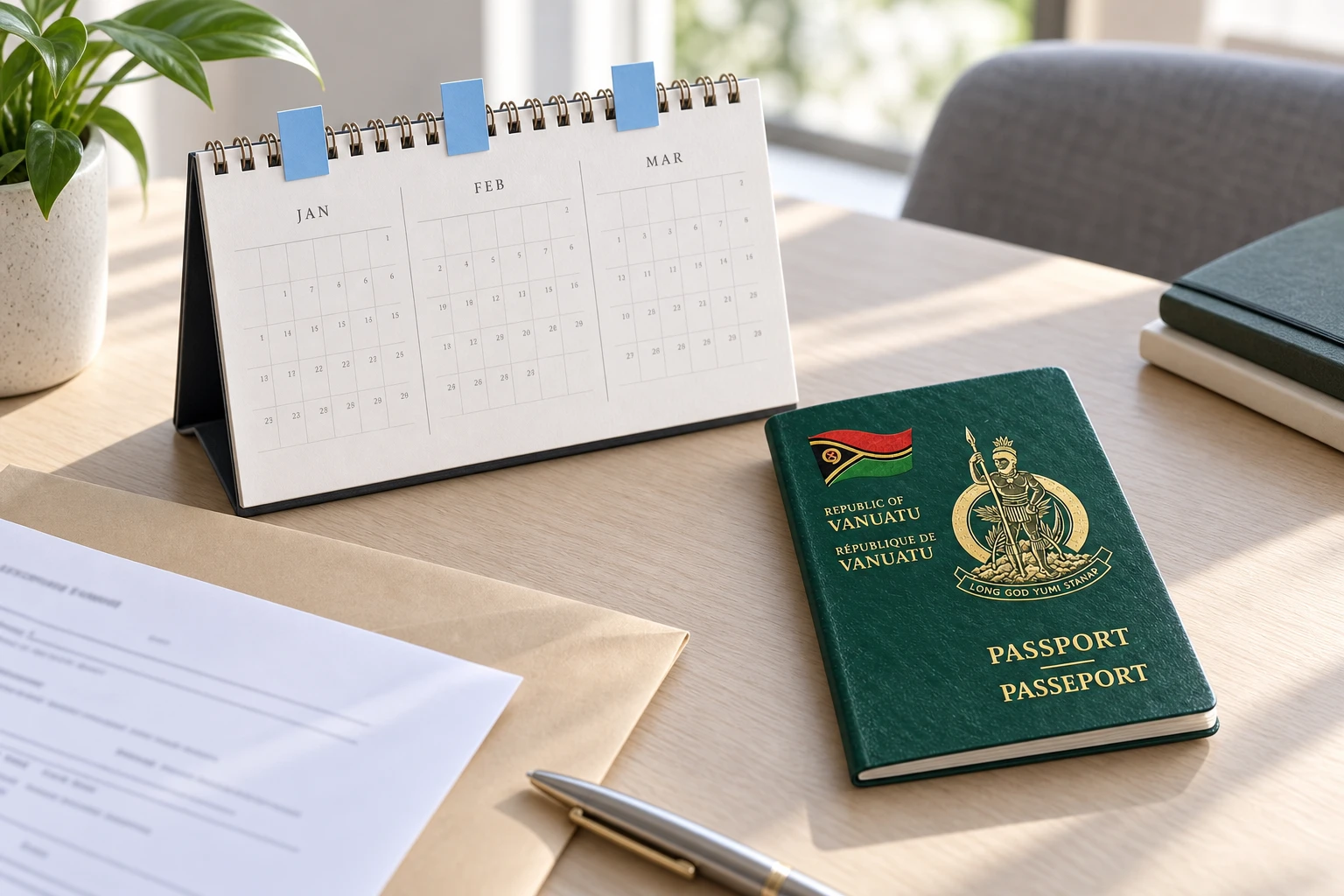
In brief: the Citizenship Commission sits twice a month, and completed forms must be with the agent 5 days before the sitting. An application a day late waits for the next sitting, and the timeline shifts by up to two weeks.
At this stage the programme forms are completed for each member: the passport application, the birth registration form, and for the CIIP fund the fund form. All documents are cross-checked, the applicant confirms the data and signs the forms. Review and additions take 8-10 working days.
Preparing for the Commission and waiting for approval together take longer than the FIU check
Vanuatu Citizenship Office stage procedure, timeline benchmarks from BRIDGES practice as of September 2026
So the application calendar is built backwards from the sitting date: when the forms must be with the agent, by which day signatures are needed, when translations finish. This calculation shows whether the application can make the nearest sitting or the realistic target is the next one. A shift of one sitting adds up to two weeks to the passport date, and this is the main buffer lost when documents are collected without a calendar.
The FIU check: what extends the timeline
In brief: without additional requests the check takes up to 7 working days. Each request stops the clock until the reply, so the reply is prepared within 1-3 working days and with documents rather than an explanatory letter.
The Financial Intelligence Unit checks each member over 18: convictions, sanctions and wanted lists, public offices, courts and bankruptcies, online footprint and the origin of money. A request comes when the package has a gap: an unclear source of capital, different name spellings, a previous visa refusal, a link to a sensitive jurisdiction.
- Source of funds. Capital is proven with a chain of documents: a sale contract, a statement showing receipt, a dividend resolution, a tax return. A complex structure of several companies almost always raises a question.
- Background. Previous visa refusals, several citizenships, public offices of the applicant or relatives are disclosed in advance, not in reply to a request.
- Family. The main applicant goes through the FIU check, and the overall timeline is set by the member with the most complex profile.
The BRIDGES preliminary check before filing identifies these questions in 1-2 working days, and answers are prepared before the FIU fee is paid. How due diligence works is covered in due diligence for Vanuatu citizenship.
After approval: contribution, biometrics, oath and passport
In brief: after the Commission’s decision, the approval letter is issued and the DSP contribution paid within 7-14 days. Then members give biometrics, the applicant takes the oath by video call, and the passport is issued and delivered within 1-3 weeks.
Under the DSP the contribution is paid after approval on an invoice issued for the application. Under the CIIP fund the $157,000 contribution is likewise paid after approval, in a single payment, so the bank channel is checked in advance for the transfer to go through on time after the decision. In both cases the payment channel is checked in advance: a bank that takes long to review a large transfer delays the issue by the length of that review.
Biometrics remain the only mandatory trip. They are given in Dubai, Hong Kong, Moscow, St Petersburg or Port Vila, and the timing depends on free appointments in the chosen city. The oath is taken by video call, after which the certificate of citizenship is issued, and the passport is issued by the Vanuatu Immigration and Passport Services for 10 years. All budget items, including passport and ID card fees, are in the cost of Vanuatu citizenship.
Get advice on your application timeline
We will give you a timeline from the nearest Commission sitting: documents, filing, contribution and biometrics for your family.
What a specific application’s timeline depends on
In brief: the timeline is affected by the country issuing documents, the transparency of the source of funds, the background, the family composition, the payment channel and the date of the nearest Commission sitting. Two applicants who filed on the same day may receive passports a month apart.
- The country issuing documents. Police clearances and apostilles take a few days in some countries and several weeks in others. If certificates are needed from both the country of citizenship and the country of residence, the slower one sets the timeline.
- Certificate validity. The police clearance must be no older than 3 months on the filing date. A certificate ordered too early expires while other documents are collected.
- Source of funds. Salary, the sale of an asset or dividends with documents are settled straight away. Loans between related parties, crypto-assets and a chain of companies need additional documents.
- Family composition. Each member adds documents and translations, and children from 18 go through the FIU check. A family of four is processed in one application, but it has twice as many documents as a single applicant.
- Payment channel. The sender’s bank and the correspondent bank review a large transfer, and time must be allowed for this before the payment date.
- Sitting date. An application ready a day before the form deadline goes to the nearest sitting; one that is late goes to the next.
- Quality of scans and translations. An illegible stamp, a cropped corner or a translation with a different spelling of the name goes back for rework and costs the application from three days to two weeks.
- Filing season. In late December and early January authorities work short weeks: certificates and apostilles are issued more slowly, and the gap between Commission sittings is longer.
In practice timelines hold even under a hard deadline. How an applicant received a passport by the date of a deal is shown in the case a passport in 52 days for a deal in Singapore, and processing a family in one application in the case four passports in two months.
The spread is visible in a simple comparison. For an applicant with a salary and one certificate, preparation takes two weeks and the whole application fits into two months. For the owner of a company stake who sold an asset and transfers money through a third bank, preparation takes six weeks: a sale contract, account statements for the period and an explanation of the payment chain are needed. A month and a half of difference before filing turns into a month of difference in the passport date.
Timelines for applicants from Russia
In brief: preparing documents from Russia takes 3-6 weeks, because the police clearance is ordered from the Interior Ministry and Russian documents are apostilled. After filing, the timeline is the same 2-3 months. After receiving the passport, a Russian citizen notifies the Interior Ministry of the second citizenship within 60 days. Applicants from other countries should check their own certificate and apostille lead times in the same way.
The police clearance is ordered first, before collecting the other documents, but so that it is no older than 3 months on the filing date. Certificates, source-of-funds documents and statements are prepared in parallel. If the applicant does not live in Russia, a certificate is also ordered in the country of residence, and the slower authority sets the timeline.
Apostilles on Russian documents are affixed where they were issued: birth and marriage certificates by the regional civil registry, educational documents by another authority. The timing depends on the region, so apostilles are ordered at the same time as the police clearance, not after it.
A payment from Russia is planned separately: a large transfer goes through currency control and correspondent bank checks. The notification of a second citizenship is filed within 60 days of receiving the passport, or, if the citizen is abroad, within 60 days of entering Russia. The fine for missing the deadline under Article 19.8.3 of the Code of Administrative Offences is RUB 500 to 1,000. All duties to Russian authorities are covered in Vanuatu citizenship for Russian citizens.

Time to Europe: a Vanuatu passport and residence
In brief: the Vanuatu passport is obtained in 2-3 months, then as a Vanuatu citizen the applicant applies for residence in Greece or Hungary. A Vanuatu passport has had no visa-free entry to the Schengen area since 4 February 2023, so the route to Europe goes through residence.
Greek residence under the Golden Visa programme is obtained with a property threshold from €250,000 to €800,000 depending on the region and property. Review takes roughly 6-12 months, longer in Attica. During the review a certificate of application is issued, which does not give the right to travel in the Schengen area, so trips before the card is issued are planned on a visa. Hungary’s programme gives a 10-year permit for an investment of €250,000 in a real estate fund.
If the goal is European residence, both timelines are combined into one plan: first the Vanuatu passport, then the residence documents, which partly overlap with the Vanuatu package. Conditions for Vanuatu citizens are on Greek residence for Vanuatu citizens, and visa rules before residence in the Vanuatu passport and Schengen.
How not to lose weeks: a preparation plan
In brief: the fastest applications are those where certificates are ordered first, the source of funds is proven before filing, the calendar is built from the Commission sitting date and requests are answered within 1-3 working days.
- A preliminary check before payments. Background and source-of-funds risks are identified in 1-2 working days, before the FIU fee.
- Police clearances first. They take the longest to issue, but with validity on the filing date in mind.
- Documents in parallel. While the FIU check is under way, certificates, medical reports and capital documents are collected.
- One spelling of the name. All documents and translations are checked against the passport data page, so certification does not have to be redone.
- A calendar from the sitting. The date the forms go to the agent is counted 5 days before the sitting, and signatures and translations are planned backwards from it.
- The payment channel in advance. The bank and details are checked before filing, and for the CIIP fund before the payment date.
- A reply to a request within 1-3 working days. With documents that settle the question, not an explanatory letter.
- Booked biometrics. The city and date are chosen before approval so as not to wait for a free slot.
This plan removes the main sources of lost time: reordering certificates, repeat certification and a missed sitting. The rest of the time is set by the FIU check and the Commission’s decision, which the applicant influences only through the completeness of the package.
Download the filing document checklist
We will send a list for each member of the application: what the applicant prepares, what BRIDGES translates and certifies, and in what order the papers go.
Related: applying with a record or after a refusal, what applications are refused for, who can be included in the application, guide to conditions and cost, programme speed index.
How BRIDGES runs the application calendar
In brief: the application has one case manager, all dates sit in a shared calendar with reminders, the client receives a short weekly report, and if a deadline is at risk the client hears the same day, with the reason and the solution.
- One case manager. One person handles the application from the first check to the passport, and verbal arrangements are confirmed in writing.
- A shared calendar. Documents, notary, filing, the Commission sitting and biometrics sit in one schedule with reminders 3 days and 1 day ahead.
- A weekly report. What is done, what is in progress, what is needed from the client and the next date.
- Feedback on files. For each document separately: accepted or what to redo.
- A warning about a shift. If a deadline is at risk, the client learns the same day, together with the solution.
The cost for your family is shown by the cost calculator, and the scope of services is described on Vanuatu citizenship by investment.
Frequently asked
Questions people ask before deciding
01How long does Vanuatu citizenship take?
Roughly 2-3 months from FIU filing to the passport with a complete document set. Before filing, 1-3 weeks go on first-stage documents, or 3-6 weeks for applicants from Russia.
02Which stage takes the longest?
Preparing the full package for the Commission sitting and waiting for approval. The FIU check without additional requests takes up to 7 working days.
03Why is the application filed in two rounds?
First the FIU checks the applicant on a short package, then the full package for the Commission is assembled. This way the applicant does not spend time and money on translations before the check result.
04How often does the Citizenship Commission sit?
Twice a month. Completed forms must be with the agent 5 days before the sitting, otherwise the application waits for the next one, and the timeline shifts by up to two weeks.
05What happens after the Commission’s decision?
Within 7-14 days the approval letter is issued and the DSP contribution is paid. Then biometrics, the oath by video call, and issue and delivery of the passport within 1-3 weeks.
06When are the DSP and CIIP fund contributions paid?
The DSP contribution is paid after Commission approval. The $157,000 CIIP fund contribution is likewise paid after approval, in a single payment.
07Do I need to travel to Vanuatu?
No. The only mandatory trip is for biometrics, given in Dubai, Hong Kong, Moscow, St Petersburg or Port Vila. The oath is taken by video call.
08What can delay the process?
Forms missing the Commission sitting, FIU requests, an expired police clearance, different name spellings across documents and a delayed bank payment.
09How long must the police clearance be valid?
It must be no older than 3 months on the filing date. It is ordered first, but with its validity in mind.
10Are children checked?
Yes. Under the official DSP checklist, children aged 12 to 18 provide a police clearance and go through the FIU check; adult members are checked in full.
11How much does the FIU check cost?
The fee is paid once per application: $5,000 under the DSP and $8,000 under the CIIP fund. It is not refunded on refusal.
12How long does it take for applicants from Russia?
Preparing documents from Russia takes 3-6 weeks because of the Interior Ministry certificate and the apostille; after filing the timeline is the same 2-3 months. The Interior Ministry must be notified of the second citizenship within 60 days.
13Does a Vanuatu passport give visa-free entry to Schengen?
No, since 4 February 2023 the EU has fully suspended visa-free travel for Vanuatu citizens. The route to Europe goes through residence in Greece or Hungary.
14How long does the route to European residence take?
The Vanuatu passport takes 2-3 months, then Greek residence is reviewed in roughly 6-12 months. Both timelines are planned in one schedule.
Transparency
How this material was prepared
- Author
- Elena Titova, client Relationship Manager, BRIDGES
- Terms and costs last verified
- September 2026
- Sources
- official government authorities of the relevant country and state publications
- Methodology
- government minimum requirements are stated separately from due diligence charges, state fees, legal and banking costs
Sources and methodology
Figures, terms and timelines are checked against official sources as of September 2026. Link availability verified in August 2026. Third-party blogs and agent websites are not used as a source of programme terms.
- [1]Vanuatu Citizenship OfficeOfficial conditions of the citizenship programmevancitizenship.gov.vu
- [2]Vanuatu Department of ImmigrationEntry, visas and statusesimmigration.gov.vu
Methodology: tables and charts state government minimum investment requirements; due diligence charges, state fees, legal, banking and other costs are calculated separately and are not included in the minimum thresholds.
About the author
Related materials
What to read next
 ComparisonSecond citizenship in 3-6 months: Caribbean, Türkiye or Vanuatu in 2026
 AnalysisWhat is due diligence and why the Caribbean is rejecting applications
 ArticleBanks in Vanuatu and accounts abroad: what a bank checks for a Vanuatu citizen
Personal programme selection is conducted by Anna Kovalevskaya, Head of Legal, BRIDGES.
We can help you get a Vanuatu passport by your date
We check whether the application can make the nearest Commission sitting and take the process on ourselves.
