Citizenship · Vanuatu
Taxes in Vanuatu: why the passport does not free you from home-country taxes

Updated: September 2026·15 min read·Expert reviewed
Terms and costs verified: September 2026

Contents
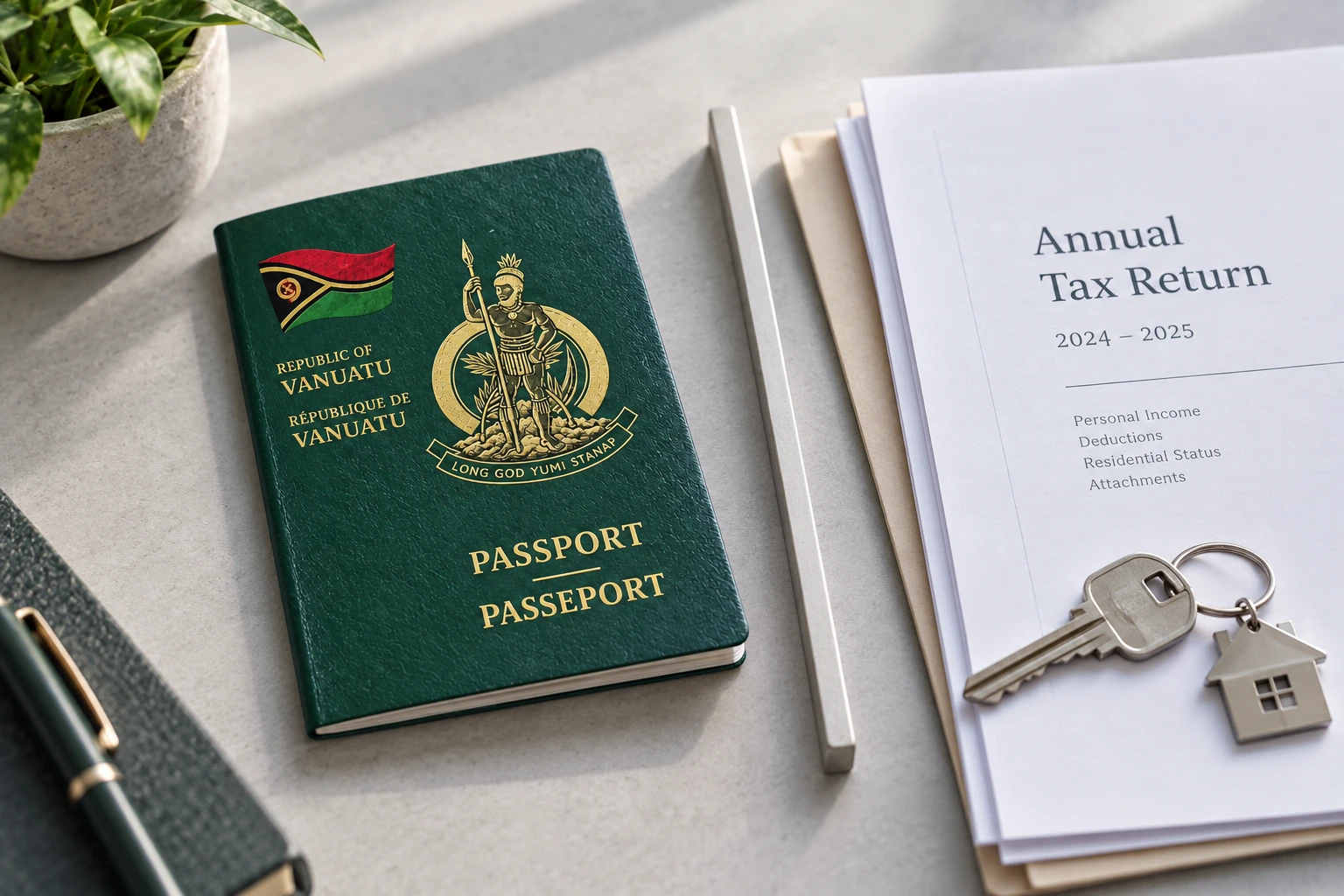
Vanuatu has no personal income tax, capital gains tax or inheritance tax. The state collects VAT at 15%, rental tax at 12.5%, excise, customs duties and licence fees. But a Vanuatu passport does not in itself make you a Vanuatu tax resident or cancel taxes at home: a Russian citizen, for example, who lives in Russia for more than 183 days a year pays personal income tax on worldwide income. Below: Vanuatu’s tax system based on official data, taxes on property and business, and what changes for home-country tax residents, with Russia as the worked example.
Update 20 October 2026. On 9 October 2026 the EU Council updated its tax blacklist and Vanuatu stayed on it. What this means for the passport and for companies is in our article on the EU blacklist in October 2026.
Taxes in Vanuatu: in brief
In brief: there are no direct taxes on individuals’ income and capital in Vanuatu; the main taxes are indirect: VAT at 15% and rental tax at 12.5%. Tax residence is determined by where you live under the rules of the country where you live, so a Vanuatu passport gives mobility, while a tax effect appears only when you change your country of residence.
Vanuatu Customs and Inland Revenue, vanuatucustoms.gov.vu as of 15.09.2026
Taxes and licences in Vanuatu are managed by the Department of Customs and Inland Revenue. It administers VAT, rental tax, excise, customs duties and business licences. A Vanuatu citizen does not file an income tax return, and there is no citizenship tax and no annual passport payments. How to obtain citizenship and what it costs is covered in Vanuatu citizenship by investment.
Which taxes exist in Vanuatu
In brief: Vanuatu’s tax system is built on consumption and fees: VAT, rental tax, excise, customs duties and licence fees. Individuals’ income, capital gains and inheritance are not taxed.
| Tax or fee | Rate | Who pays |
|---|---|---|
| Personal income tax | none | not levied |
| Capital gains tax | none | not levied |
| Inheritance tax | none | not levied |
| VAT | 15% | buyers of goods and services in Vanuatu, importers |
| Rental tax | 12.5% of gross rent | residential landlords, if the rent is not subject to VAT |
| Excise and customs duties | at the tariff for the goods | importers and producers |
| Business licence | by category of activity | any company or sole trader in Vanuatu |
Since 1 January 2020 Vanuatu has applied the Tax Administration Act No. 37 of 2018. It introduced tax identification numbers (TINs), uniform accounting rules, late penalties and registration of tax agents. Turnover tax on professional and business services was abolished from the same date, and for commercial banks the licence fee is calculated as 5% of turnover.
For a citizen who does not live in Vanuatu or do business there, these taxes hardly arise: VAT is paid on purchases on the islands, rental tax only when letting housing, and a licence only when doing business.
VAT at 15%: what is taxed and what is exempt
In brief: VAT was introduced in 1998 at 12.5%, and in 2018 the rate was raised to 15%. The tax is included in the price of most goods and services and charged on imports, while financial services and education at accredited institutions are exempt.
VAT is charged by registered taxpayers: companies and sole traders carrying on taxable activity. The registration threshold is VT 4 million of turnover; below it, registration is voluntary. The tax works on a credit basis: a business deducts VAT paid to suppliers, and the final burden falls on the end buyer.
Some supplies are zero-rated: they count as taxable, but no tax is charged on them. Exempt supplies, such as financial services, are not subject to VAT at all. For an individual this means a simple rule: 15% VAT is already included in the price of purchases in Vanuatu, and there is no separate reporting on it.
Download the Vanuatu tax memo
Leave your contacts and we will send a memo: which taxes the country has, VAT, rent, a company and tax residence.
Tax on property and rent
In brief: Vanuatu’s tax service taxes rental income. Long-term residential rent is taxed at 12.5% of gross rent, the first VT 200,000 of an individual’s income is exempt, and commercial and short-term rent is subject to VAT. Local charges and land lease terms are checked for the specific property.
Rental tax is paid on the full rent, and expenses cannot be deducted. Returns are filed twice a year: for 1 December to 31 May by 28 June, and for 1 June to 30 November by 28 December. If the landlord is registered for VAT or their commercial rental income exceeds the VT 4 million threshold, VAT is charged instead of rental tax. Records are kept for at least 5 years.
Foreigners hold land in Vanuatu on long-term leases, not in ownership: under the Constitution land belongs to its customary owners. Lease deals and letting are planned with these rules in mind, and there is no need to buy property for citizenship under the investment programme. How the option of investing in an approved project’s property works is covered in DSP or the CIIP fund.
A company in Vanuatu: licence, TIN and VAT
In brief: any business in Vanuatu obtains a licence under the Business Licence Act and a TIN. With turnover above VT 4 million, a company registers for VAT, and if it lets housing, it reports rental tax.
- Business licence. Needed by any person or company carrying on activity for profit. Banks, trust and investment companies, law firms and designated agents need additional permits from the relevant authorities.
- TIN. A tax number is issued to VAT and rental taxpayers and business licence holders, as well as on registering a vehicle and obtaining a driving licence.
- Changes of details. The tax office is notified of changed contacts within 21 days, and of leaving Vanuatu permanently at least 14 days in advance.
- Records. Transaction records are kept for at least 5 years after the end of the tax period.
For a business owner outside Vanuatu something else matters more: the taxes on their company’s profit are set by the country where the company is registered and managed, and for tax residents of some countries, such as Russia, also by controlled foreign company rules. These rules are covered in CFC rules and currency control with Vanuatu citizenship. Registration, a licence and an account are handled by the service a company and account in Vanuatu.
The passport and tax residence
In brief: citizenship and tax residence are not linked. A person becomes tax resident where they live, under that country’s rules, while a Vanuatu passport changes only the right to enter and reside.
If a Russian citizen, for example, gets a Vanuatu passport and continues to live in Russia for more than 183 days in 12 months, they remain a Russian tax resident with all the duties. If they move to another country, that country sets the tax rules: number of days, place of residence, centre of business interests. A Vanuatu passport helps a move, because it widens the list of countries for travel and provides a basis for residence permits, but tax status is changed by actually moving. Details in tax residence and the Vanuatu passport.
Home-country taxes with a Vanuatu passport: Russia as an example
In brief: a Russian tax resident pays personal income tax on all income, including foreign income, on a progressive scale of 13-22%, declares foreign income and notifies the tax service of foreign accounts and companies. A Vanuatu passport does not change these duties. Tax residents of other countries should check the equivalent rules at home.
A person is a Russian tax resident if they were in Russia for at least 183 days in 12 consecutive months. Since 2025 residents pay personal income tax on a scale: 13% on income up to RUB 2.4 million a year, 15% up to 5 million, 18% up to 20 million, 20% up to 50 million and 22% above. A resident declares foreign income on form 3-NDFL by 30 April of the following year. A non-resident pays personal income tax only on income from Russian sources, as a rule at 30%.
- Foreign accounts. A currency resident notifies the tax service of opening an account abroad and reports cash flows annually. A citizen who is outside Russia for more than 183 days a year is released from some of these duties.
- Foreign companies. A stake in a foreign company and controlled foreign companies require notifications to the tax service, and CFC profit is accounted for under the Tax Code.
- Second citizenship. Notification of the Interior Ministry within 60 days. Missing the deadline carries a fine of RUB 500 to 1,000 under Article 19.8.3 of the Code of Administrative Offences, and failing to notify up to RUB 200,000 under Article 330.2 of the Criminal Code.
There is no double tax treaty between Russia and Vanuatu, but for an individual this rarely matters: Vanuatu does not tax personal income. All duties to Russian authorities are collected in Vanuatu citizenship for Russian citizens.
Tax information exchange and bank accounts
In brief: Vanuatu takes part in international tax information exchange. The International Tax Cooperation Act No. 7 of 2016 provides for automatic exchange of account information with countries with which Vanuatu has an agreement, and the competent authority sits within the Department of Customs and Inland Revenue.
Vanuatu Customs and Inland Revenue, Russian Tax Code as of September 2026
When opening an account, banks ask for the client’s tax residence and the tax number of the country of residence, and account data is reported by residence, not by citizenship. Besides automatic exchange, Vanuatu has agreements on exchange of tax information on request, for example with Australia, France and Finland. So a Vanuatu passport does not hide accounts: it changes the client’s document, but not their tax residence.
A lawful tax benefit is built on changing where you live and reporting correctly, not on hiding accounts. How confidentiality of the status and information exchange work is covered in confidentiality of Vanuatu citizenship and CRS.

When Vanuatu’s tax system has an effect
In brief: the tax effect goes to those who change their country of residence and establish tax residence in a country with a suitable regime. For those who stay where they live now, the passport gives mobility and a route to residence permits, but no tax savings.
- Moving abroad. An entrepreneur moves to a country with no income tax or a suitable regime and ceases to be tax resident at home. A Vanuatu passport makes travel and opening accounts easier.
- A family with assets in several countries. Vanuatu has no inheritance tax, but an inheritance is taxed under the rules of the country where the heirs live and the assets are located, so the transfer of capital is planned for all countries at once.
- Living in Vanuatu. A citizen who actually lives in Vanuatu pays no income tax, but pays VAT on purchases and rental tax if they let housing.
- Staying at home. Taxes and reporting remain in full, and the passport works as a travel document and a basis for residence in Europe.
How citizenship passes to children and what happens to assets on inheritance is described in inheritance and Vanuatu citizenship, and an example of a family with assets in several countries is shown in case: inheritance and zero taxes. If the family is considering life on the islands, the conditions are collected in moving to Vanuatu.
Get advice from a tax lawyer
A lawyer will work out where the family will be tax resident after the passport and a move, and which reports to file at home.
Taxes when moving to Europe on a residence permit
In brief: with a Vanuatu passport, the way to live in Europe is through residence in Greece or Hungary. If the family spends more than 183 days a year in the country of residence, it becomes tax resident there, and taxes are planned before the move.
A Vanuatu passport has had no visa-free entry to the Schengen area since 4 February 2023, so the route to Europe goes through residence: Greek residence under the Golden Visa programme with a property threshold from €250,000 to €800,000, or Hungary’s programme with a 10-year permit. The residence permit itself does not make you tax resident if you live in another country, but moving there permanently changes your tax status under the rules of the country of residence.
So the order of steps is: a Vanuatu passport in 2-3 months, choosing the country of residence, calculating taxes in the future country of residence, and only then moving. Conditions for Vanuatu citizens are on Greek residence for Vanuatu citizens.
How BRIDGES takes taxes into account when arranging citizenship
In brief: before filing we work out where the applicant will be tax resident, which home-country notifications are needed after the passport and how the citizenship payment fits with reporting on foreign accounts.
- Source of funds. We prepare documents on the origin of capital for the FIU check so that they match the applicant’s tax reporting.
- The payment account. We choose the bank and take any home-country notification of a foreign account into account in advance.
- Duties after the passport. Home-country notifications, such as Russia’s 60-day Interior Ministry notice, and reporting on accounts and companies.
- Relocation. Combining a Vanuatu passport with residence in Europe or a move to another country.
What a zero tax gives in practice and where its limits are is covered in the analysis zero tax in practice. The cost of citizenship for your family is shown by the cost calculator. We help you relocate quickly, reliably and lawfully.
Frequently asked
Questions people ask before deciding
01Is there personal income tax in Vanuatu?
No. Vanuatu has no personal income tax, capital gains tax or inheritance tax. The main taxes are indirect: VAT and rental tax.
02What is the VAT rate in Vanuatu?
15%. VAT was introduced in 1998 at 12.5%, and in 2018 the rate was raised to 15%. Financial services and education are exempt.
03Is there a property tax?
Rental income is taxed: long-term residential rent at 12.5% of gross rent, with the first VT 200,000 of an individual’s income exempt. Commercial and short-term rent is subject to VAT.
04Does a Vanuatu passport make me a Vanuatu tax resident?
No. Tax residence is determined by where you live, under the rules of the country where you live, not by citizenship.
05Does a Vanuatu passport free me from taxes at home?
No. If, for example, a Russian citizen is in Russia for at least 183 days in 12 months, they remain a Russian tax resident and pay personal income tax on worldwide income. The same logic applies in most countries.
06What are the personal income tax rates for a Russian resident?
Since 2025 a progressive scale: 13% up to RUB 2.4 million a year, 15% up to 5 million, 18% up to 20 million, 20% up to 50 million and 22% above.
07Must the Russian tax service be notified of an account in a Vanuatu bank?
A Russian currency resident notifies the tax service of opening a foreign account and reports cash flows annually. Some duties are lifted if the citizen spends more than 183 days a year abroad.
08Does Vanuatu take part in tax information exchange?
Yes. The International Tax Cooperation Act No. 7 of 2016 provides for automatic exchange of account information with countries with which Vanuatu has an agreement.
09Can accounts be hidden with a Vanuatu passport?
No. Banks report data by the client’s tax residence, not by citizenship. The passport does not change tax residence.
10Is there corporate income tax in Vanuatu?
A company in Vanuatu obtains a business licence and a TIN and registers for VAT with turnover above VT 4 million. Turnover tax on business services was abolished from 1 January 2020, and banks pay a licence fee of 5% of turnover.
11Is there a double tax treaty between Russia and Vanuatu?
No. For an individual this rarely matters, because Vanuatu does not tax personal income.
12What taxes arise when moving to Greece on a residence permit?
If the family spends more than 183 days a year in Greece, it becomes tax resident in Greece. Taxes are calculated before the move.
13Are there annual payments for Vanuatu citizenship?
No. There is no citizenship tax and no annual fees; the passport is renewed after 10 years at the passport service tariff.
Transparency
How this material was prepared
- Author
- Dmitry Nagy, international Tax Consultant, BRIDGES
- Terms and costs last verified
- September 2026
- Sources
- official government authorities of the relevant country and state publications
- Methodology
- government minimum requirements are stated separately from due diligence charges, state fees, legal and banking costs
Sources and methodology
Figures, terms and timelines are checked against official sources as of September 2026. Link availability verified in August 2026. Third-party blogs and agent websites are not used as a source of programme terms.
- [1]Vanuatu Citizenship OfficeOfficial conditions of the citizenship programmevancitizenship.gov.vu
- [2]Vanuatu Department of ImmigrationEntry, visas and statusesimmigration.gov.vu
Methodology: tables and charts state government minimum investment requirements; due diligence charges, state fees, legal, banking and other costs are calculated separately and are not included in the minimum thresholds.
About the author
Related materials
What to read next
 ComparisonSecond citizenship in 3-6 months: Caribbean, Türkiye or Vanuatu in 2026
 AnalysisWhat is due diligence and why the Caribbean is rejecting applications
 ArticleBanks in Vanuatu and accounts abroad: what a bank checks for a Vanuatu citizen
Personal programme selection is conducted by Anna Kovalevskaya, Head of Legal, BRIDGES.
We can help you obtain a Vanuatu passport with taxes in mind
We take the application through to the passport and point out your home-country duties after you receive it.