Citizenship · Vanuatu
Living in and moving to Vanuatu: the cost of life in Port Vila and who it suits

Updated: September 2026·24 min read·Expert reviewed
Terms and costs verified: September 2026
Contents
Vanuatu is sold as a tropical paradise with zero taxes and a fast passport. But obtaining citizenship is one thing, and living on Pacific islands thousands of kilometres from familiar civilisation is quite another. We look at what life in Port Vila costs, what healthcare and connectivity are like, what cyclones and earthquakes mean, and above all who a move really suits, and who should see the passport only as a back-up option.
Moving to Vanuatu: in brief
Vanuatu is an archipelago of 80+ islands in the South Pacific, between Australia, Fiji and New Caledonia. The capital, Port Vila on Efate, is the only place in the country with relatively developed infrastructure: banks, restaurants, a private clinic, English-language schools, a rental market for foreigners. Beyond the capital real Melanesia begins: villages, dirt roads, subsistence farming.
In short: Vanuatu is a wonderful place for a holiday and deliberate downshifting, but a demanding one for permanent life. The cost of living in Port Vila is comparable to Europe (imports are expensive), healthcare covers only basic cases, and serious treatment has to be obtained abroad. On the other hand, there is no tax on income, worldwide income, capital gains or inheritance, the climate is tropical all year round, and the ocean is within walking distance.
It is important to separate two different decisions. Obtaining Vanuatu citizenship by investment and moving there to live are not the same thing. The passport does not oblige you to spend a single day in the country: there is no residence requirement, no exams and no integration requirement. How citizenship differs from a residence permit is covered in the comparison of Vanuatu residence and citizenship. That is why most investors take a Vanuatu passport as a plan B and a tax base and live elsewhere entirely. Those who move to the islands seriously and for the long term are a minority, and they need a clear-eyed understanding of what they are taking on.
We will map your route to Vanuatu citizenship
We review your family, source of funds and timing and tell you which route fits.
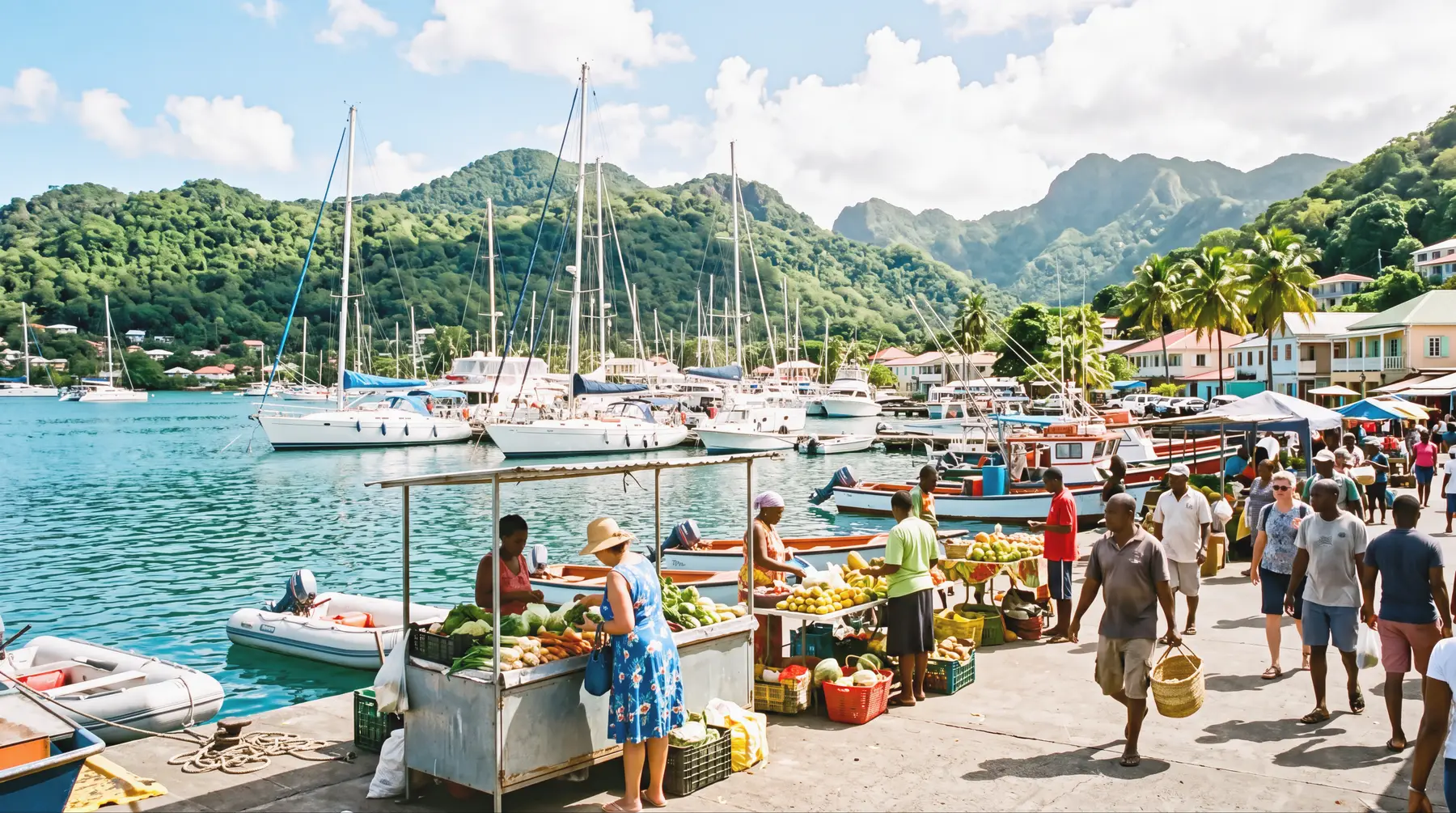
What life in Port Vila costs
The main myth about Pacific islands is that they are cheap. In fact almost everything except local vegetables, fruit and fish is shipped in, and import prices are noticeably higher than the palm-tree picture suggests. According to cost-of-living services for 2026, a single expat in Port Vila spends roughly from USD 2,800 a month, a digital nomad about USD 3,000-3,100, and a family around USD 5,000 or more. That is the level of an average European city, only without European service and infrastructure.
Rent is the biggest item. A one-bedroom flat in central Port Vila costs roughly USD 650-975 a month, a three-bedroom family house USD 1,600-2,400, and a spacious oceanfront villa easily exceeds USD 3,000. Housing near hotels and tourist areas costs more. Good rental stock is scarce, so good options go quickly, especially furnished houses with a generator and a backup water tank.
What else to budget for:
- Food. Local fruit, vegetables and fish at the market are affordable and fresh. Imported food, cheese, alcohol and household chemicals are noticeably more expensive than on the mainland.
- Transport. A ride in a local minivan costs about USD 1.25. But for life outside town your own four-wheel drive is almost essential: some roads are rough.
- Electricity. One of the most expensive in the region; air conditioning runs a lot in the tropics, and bills grow.
- Insurance. Full health insurance with evacuation is a mandatory item, more on it below.
If you plan to live on passive income or a salary from abroad, zero taxes partly offset the high prices: how taxation works is covered in the article on Vanuatu taxes, and the conditions for being treated as a resident in the article on tax residence. We look at the tax picture in more detail in the article on the Vanuatu citizenship programme.
| Cost item | Per month |
|---|---|
| Single expat, all costs | from USD 2,800 |
| Digital nomad | USD 3,000-3,100 |
| Family with children | from USD 5,000 |
| Flat in central Port Vila | USD 650-975 |
| Three-bedroom house in the suburbs | USD 1,600-2,400 |
| Oceanfront villa | from USD 3,000 |
| A ride in a local minivan | USD 1.25 |
Payments within the country are made in the national currency, the vatu: symbol VT, international code VUV, issued by the Reserve Bank of Vanuatu. At the Reserve Bank rate on 15 September 2026, one US dollar was VT 116.54. Bank cards are accepted in towns, while on the outer islands cash vatu are needed. Exchange rates against other currencies and the currency’s denominations are collected in the reference article where Vanuatu is and how the country works.
Housing and rent: what can be rented and bought
Vanuatu’s property market is small and concentrated around Port Vila and the second-largest town, Luganville on Espiritu Santo. For people moving, the key question is renting, since buying land as a foreigner has an important peculiarity.
Land. Under the Constitution all land in Vanuatu belongs to its customary Melanesian owners and clans. A foreigner cannot buy land outright, only take it on a long-term lease, usually 50 or 75 years with the option to renew. This is normal practice, but it needs care: the cleanliness of the leasehold, the consent of the customary owners and the absence of disputed claims must be checked with a local lawyer. Buildings on the land can be your property.
What expats rent. The most popular format for people moving is renting a furnished house or townhouse in the suburbs of Port Vila: Pango, Mele, Bellevue. The budget for a decent family house is USD 1,600-2,400 a month, and for a flat in the centre USD 650-975. When choosing housing, look at the things that matter on the islands:
- A backup generator: power cuts happen, especially in cyclone season.
- A water tank and filtration: mains water is not available everywhere, and rainwater is collected in tanks.
- Condition after the December 2024 earthquake: some buildings in Port Vila were damaged; check the structure and earthquake resistance.
- Satellite internet or fibre: more on this separately below.
Buying housing to let as an investment makes sense only with caution: the market is narrow, liquidity is low and natural risks are high. For most people moving, it is wiser to rent for the first year and look around rather than rush into buying. How the market works and what foreigners buy is covered in the overview of the Vanuatu property market.
Healthcare: the limits
This is the key section for anyone seriously considering a move, especially with children or at an older age. Healthcare in Vanuatu is basic and covers only simple cases. We will speak plainly, because lives depend on it.
The country has several public hospitals and one private clinic, plus health posts on the islands. The main hospital, Vila Central Hospital in Port Vila, periodically receives visiting specialist teams from Australia and New Zealand: cardiologists, orthopaedists, ophthalmologists. Per capita health spending is just over USD 100 a year, and that explains a lot: equipment, specialists and medicines are chronically short. Foreigners have no access to public insurance and pay for treatment in cash.
The main conclusion: in the case of serious illness, severe injury, complicated childbirth or cancer, the patient is evacuated abroad, most often to Australia, New Zealand or New Caledonia. A medical air evacuation costs roughly GBP 35,000-50,000 per flight. Therefore:
- Private international insurance covering medical evacuation is not an option but a prerequisite for moving. The recommended evacuation cover is from GBP 500,000.
- Insurance for a middle-aged person (a Cigna Global-level plan) costs roughly USD 100-120 a month, and more with extended evacuation cover.
- It is better to keep a stock of prescription and chronic medication in advance: pharmacies have a limited range.
- A visit to a private doctor in Port Vila costs about USD 40, for routine matters.
If you or your relatives have chronic conditions requiring regular monitoring by strong specialists, permanent life on the islands is a risky decision. This is one of the main reasons many choose the Vanuatu passport as a tool and live where healthcare is stronger.
We will calculate a relocation budget for your family
Leave your contacts and we will put together a first-year budget with rent, insurance, school and flights and show where costs exceed expectations.
Schools, internet and communications
Education. For families with children, Port Vila has private schools teaching in English and French, a legacy of the joint Anglo-French administration of the islands before independence in 1980. The quality of international programmes varies and the choice is limited, and towards the final years many expats send their children to study in Australia or New Zealand. Public schools are aimed at locals and use English, French and Bislama (the local creole). For a family used to a wide choice of schools and activities, island reality will be noticeably more modest.
Internet and communications. Until recently the country depended on a single submarine cable, ICN1. The magnitude 7.3 earthquake in December 2024 damaged this cable and caused a nationwide communications outage, exposing the infrastructure’s vulnerability. Satellite internet came to the rescue: after the earthquake more than 300 Starlink terminals were quickly deployed, restoring connectivity for residents, businesses and emergency services. Today satellite internet is the realistic way to work remotely and reliably without depending on terrestrial infrastructure.
What you need to know about connectivity:
- Mobile and 4G work in Port Vila, but speed and stability lag behind developed countries.
- For remote work a backup channel is practically essential: satellite plus mobile.
- The UTC+11 time zone is convenient for working with Australia, Asia and the Russian Far East, but creates a large gap with Europe and the Americas.
- Power cuts directly affect connectivity, so an uninterruptible power supply is essential.
For a disciplined remote worker with a satellite link and backup power, working from Vanuatu is quite realistic. For those who need glitch-free daily video calls and low latency, it is a compromise to be ready for.
“When a client tells me they want a Vanuatu passport to move to a tropical paradise, I always ask back: have you been there in cyclone season and tried to see a proper doctor? In nine cases out of ten it turns out the person needs not an island but a tool: a fast second document, tax neutrality and a back-up option. And that is an entirely workable strategy: a Vanuatu passport does not oblige you to live there for a single day. But a serious move to the islands suits only those who have soberly weighed healthcare, natural hazards and isolation, and consciously chosen that pace of life. Accuracy matters more here than attractive promises.”
 Anna KovalevskayaHead of the BRIDGES legal department
Climate and natural risks: cyclones, earthquakes, volcanoes
Vanuatu’s climate is tropical maritime: warm all year, with temperatures mostly 22-30 C, and humid. The dry, cooler season runs roughly from May to October and is the best time for living and travel. The wet, hot season runs from November to April, and it coincides with cyclone season. This is the flip side of the tropical paradise that people are warned about in advance.
Vanuatu consistently ranks among the countries with the highest natural disaster risk. Three threats come together here:
- Tropical cyclones. From November to April the islands regularly face powerful cyclones capable of destroying houses, bringing down power lines and disrupting supplies. Housing and lifestyle have to be planned with this in mind.
- Earthquakes and tsunamis. The archipelago lies on the New Hebrides Trench, one of the most active tectonic plate boundaries on the planet. The magnitude 7.3 earthquake in Port Vila on 17 December 2024 killed 14 people, injured hundreds and affected about a third of the country’s population. It also caused a small tsunami and damaged critical infrastructure.
- Active volcanoes. The islands have active volcanoes, including the famous Yasur on Tanna and submarine vents. They are a tourist attraction, but also a risk factor.
What this means in practice: a house should be earthquake-resistant, with a store of water and food in case of being cut off, a generator and an evacuation plan. Property insurance against natural disasters is mandatory and not cheap. Life on the islands requires psychological readiness for the fact that natural hazards here are not abstract but a regular part of life.

Safety, work, business and the expat community
Safety. By regional standards Vanuatu is a calm country with friendly people and low violent crime. The main risks are everyday ones: petty theft, especially in tourist spots, and road safety on poor roads. The main threats to life here come not from crime but from natural hazards and the distance to serious healthcare, as described above.
Work and business. The local job market is tiny, salaries are low, and moving to be hired locally is practically unrealistic unless you are a specialist with an international organisation, a hotel or an NGO. Realistic ways to earn:
- Remote work for a foreign employer: the main option for people moving.
- Tourism business: guesthouses, diving, tours, cafés, a niche but highly dependent on tourist flows and natural risks.
- Online business and consulting with clients outside the country.
Zero taxes make Vanuatu an attractive base for those who earn online, but running a business aimed at the local market is hard because of the small population and logistics.
The expat community. Port Vila has a stable, if small, foreign community: Australians, New Zealanders, French people, entrepreneurs and retired downshifters. That is a plus: a newcomer will get advice on housing, schools, lawyers and doctors. The downside is a narrow social circle, and someone used to a big city may feel cramped and lonely. English is widely spoken in the capital, so there is no language barrier for everyday life.
Who a move suits and who it does not
Now the main point: Vanuatu is not a universal place for permanent residence. It suits some people very well and is completely wrong for others. Here is a sober assessment.
Who a move suits:
- A remote worker with a stable income and discipline, ready to work over satellite internet in the UTC+11 time zone. Zero taxes are a serious bonus here.
- A deliberate downshifter who consciously trades the urban rat race for a slow island pace, the ocean and a simple life, and understands what they are giving up.
- An ocean and nature lover: a diver, a yachtsman, an angler, someone for whom the tropics and the sea matter more than infrastructure.
- A financially independent person with good insurance and no acute medical needs, for whom Vanuatu is one of several homes.
Who a move does not suit:
- Families with chronic conditions or elderly relatives who need strong doctors nearby: the risk is too high.
- Those counting on visa-free Schengen: the Vanuatu passport does not have it (more below).
- Those who want a career or local employment: there is practically no local market for this.
- People who cope badly with isolation, heat, humidity and natural hazards.
- Families for whom a wide choice of schools and a rich urban environment for their children matters.
If you are in the second group, that is no reason to give up on the passport. It is a reason not to confuse citizenship with moving. The next section is about exactly this link.
Citizenship and actually moving: why these are different decisions
The key idea of the whole article: a Vanuatu passport does not oblige you to live on the islands. The programme has no residence requirement: no need to spend a certain number of days in the country, no language or history exams, no need to physically move. You receive citizenship and decide yourself whether to use it as a place to live, a tax base or simply a back-up document.
That is why most investors take Vanuatu citizenship not to move but as a plan B and a mobility tool. The logic is simple:
- Speed. The DSP (Development Support Program) grants citizenship in roughly 2-3 months, one of the fastest processes. This is valued by those who need a second document urgently.
- Taxes. Zero tax on income, worldwide income, capital gains and inheritance makes Vanuatu a convenient tax base for entrepreneurs and investors.
- Dual citizenship is allowed: there is no need to give up your first passport.
- A non-refundable contribution. Citizenship is granted for a donation, roughly from USD 130,000 for one applicant and more for a family (always check the current 2026 amount individually). It is a non-refundable payment, and you should know this in advance.
At the same time, do not believe advertising promises of visa-free Europe: the Vanuatu passport no longer has visa-free Schengen access, more in the section below. The document’s real value lies in speed, tax neutrality and basic mobility to a number of destinations, not in free entry to the EU.
So the decision splits into two independent ones: do you need a second passport, and do you want to live there. They can be combined or not. BRIDGES experts will help you work out which scenario is yours: request a consultation.
How to decide and where to start
If this article has interested rather than put you off, here is a practical plan for approaching the question without illusions or mistakes. The decision about Vanuatu, both the passport and a move, is best made in stages, not on the emotion of beautiful photos.
Step 1. Define the goal. Be honest with yourself: do you need a second passport as a tool (mobility, taxes, plan B), or do you really want to move and live on the islands? Everything else depends on this. The two decisions do not have to go together.
Step 2. Check the medical factor. If there are chronic illnesses, small children or elderly relatives, assess how realistic life is far from strong healthcare and what insurance with evacuation costs. This is often the decisive point.
How this choice looked for a retired couple is shown in the case of wintering far from home. Step 3. Go on a scouting trip. Before buying anything or arranging a move, check the entry procedure in the article on the tourist visa to Vanuatu and spend at least a few weeks in Port Vila in the dry season. Look at housing, schools and the clinic, test the internet and talk to the local expat community.
Step 4. Calculate the budget in full. Include rent, insurance, a generator, water storage, flights, children’s education and an evacuation scenario, not just the basic figures from tables.
Step 5. Understand the citizenship programme. If the decision favours the passport, study the conditions of the Vanuatu citizenship programme: amounts, the document list and timelines. It is a non-refundable contribution, so mistakes are not an option.
BRIDGES supports Vanuatu citizenship turnkey and helps weigh the relocation scenario soberly, without embellishment. We work with real facts, including inconvenient ones, because your decision depends on accuracy. Book a consultation, and we will look at your specific situation: whether you need a passport, whether it is worth moving and how to build a plan without risks.
Download the island housing checklist
We will send a list of what to check before signing a lease: generator, water tank, condition after the earthquake, internet and a clean leasehold.
Common mistakes and what to check before deciding
Over years of working with Pacific programmes we see the same set of misconceptions on which people lose money and time. Here are the main mistakes and what needs checking; it will save you from unpleasant surprises.
Mistake 1. Believing in visa-free Schengen. This is the most common and most expensive misconception. The EU suspended visa-free travel for Vanuatu citizens back in 2022, and on 12 December 2024 formally terminated the visa waiver agreement. The Vanuatu passport has no visa-free entry to Schengen, and none is foreseen: its return would need a new agreement, for which no timeline has been announced. If a consultant promises you Europe on a Vanuatu passport, they are either uninformed or misleading you. Check against primary sources: the official website of the Council of the EU. The current list of destinations is collected in the article on visa-free countries for the Vanuatu passport.
Mistake 2. Confusing the passport with a move. Obtaining citizenship does not require living in the country, nor does it automatically make life there comfortable. Decide these questions separately.
Mistake 3. Underestimating healthcare and natural hazards. Basic healthcare and three types of natural risk are not details but decisive factors for permanent life. Check insurance with evacuation cover from GBP 500,000 and the earthquake resistance of the housing.
What must be checked before deciding:
- Current DSP amounts and conditions for 2026: they are being refined, and the contribution is non-refundable.
- The real visa-free list of destinations, not inflated by advertising; after the EU cancellation it is shorter.
- The legal cleanliness of the leasehold on land, if you plan to rent or build.
- The quality and coverage of health insurance, including evacuation.
- The condition of housing after the 2024 earthquake and the presence of a generator, water tank and satellite internet.
- The intermediary’s reputation: work only with a licensed agent who checks the source of funds.
Our comparison Vanuatu vs Dominica, the article Vanuatu vs Nauru, the overview of the fastest second citizenship programmes and the guide to Caribbean passports will help you compare Vanuatu with the alternatives.
Frequently asked
Questions people ask before deciding
01Do I have to live in Vanuatu if I obtain citizenship?
No. The Vanuatu citizenship programme has no residence requirement: there is no need to spend a certain number of days in the country, take exams or physically move. Many investors use the passport as a plan B and a tax base, while living in other countries.
02What does life in Port Vila cost in 2026?
Roughly from USD 2,800 a month for a single expat, about USD 3,000-3,100 for a digital nomad and from USD 5,000 for a family. Imports are expensive, so the real cost of living is comparable to an average European city.
03Can a foreigner buy land in Vanuatu?
No, land cannot be bought outright: under the Constitution it belongs to its customary owners. A foreigner can take land on a long-term lease (leasehold), usually for 50-75 years with renewal. Buildings on it can be owned. A local lawyer must check that the leasehold is clean.
04What is healthcare like in Vanuatu?
Basic. Public hospitals and one private clinic in Port Vila cover simple cases. Serious treatment, severe injuries and operations require evacuation to Australia, New Zealand or New Caledonia. Private insurance covering medical evacuation is a must for anyone moving.
05Does the Vanuatu passport have visa-free Schengen access?
No. The EU suspended visa-free travel for Vanuatu citizens in 2022 and formally terminated the agreement on 12 December 2024. A Vanuatu passport currently has no visa-free entry to Schengen, and no date for its return has been announced. Advertising promises of Europe on this passport are untrue.
06What is the internet like in Vanuatu, and can I work remotely?
Terrestrial connectivity depended on a single submarine cable, which was damaged in the 2024 earthquake. The realistic way to work reliably today is satellite internet (Starlink), of which more than 300 terminals were deployed after the earthquake. Remote work is possible with a backup channel and an uninterruptible power supply.
07What natural risks does Vanuatu have?
Three main ones: tropical cyclones (November-April), earthquakes and tsunamis (the archipelago sits on an active plate boundary; a magnitude 7.3 earthquake in December 2024 claimed 14 lives), and active volcanoes. Housing should be earthquake-resistant, with a water store, a generator and an evacuation plan.
08Is Vanuatu safe?
By regional standards, yes. Violent crime is low and people are friendly. The main everyday risks are petty theft in tourist areas and road safety. The main threats to life come not from crime but from natural hazards and the distance to serious medical care.
09Can I find work or run a business in Vanuatu?
The local job market is tiny, salaries are low, and being hired locally is almost unrealistic. Realistic scenarios: remote work for a foreign employer, online business and consulting, or tourism (guesthouses, diving). Zero taxes make the country a convenient base for online income.
10What taxes are there in Vanuatu?
Vanuatu has no tax on income, worldwide income, capital gains or inheritance: the rate is 0%. This is one of the main reasons investors use Vanuatu citizenship as a tax base, even without moving to the country.
Transparency
How this material was prepared
- Author
- Irena Sokolovska, head of European Practice, BRIDGES
- Terms and costs last verified
- September 2026
- Sources
- official government authorities of the relevant country and state publications
- Methodology
- government minimum requirements are stated separately from due diligence charges, state fees, legal and banking costs
Sources and methodology
Figures, terms and timelines are checked against official sources as of September 2026. Link availability verified in August 2026. Third-party blogs and agent websites are not used as a source of programme terms.
- [1]Vanuatu Citizenship OfficeOfficial conditions of the citizenship programmevancitizenship.gov.vu
- [2]Vanuatu Department of ImmigrationEntry, visas and statusesimmigration.gov.vu
Methodology: tables and charts state government minimum investment requirements; due diligence charges, state fees, legal, banking and other costs are calculated separately and are not included in the minimum thresholds.
About the author
Related materials
What to read next
 ComparisonSecond citizenship in 3-6 months: Caribbean, Türkiye or Vanuatu in 2026
 AnalysisWhat is due diligence and why the Caribbean is rejecting applications
 ArticleBanks in Vanuatu and accounts abroad: what a bank checks for a Vanuatu citizen
Personal programme selection is conducted by Anna Kovalevskaya, Head of Legal, BRIDGES.
We can help you obtain Vanuatu citizenship
We prepare the documents and take the application through to the passport. Moving is not required: the programme has no residence requirements.
