Citizenship · Vanuatu
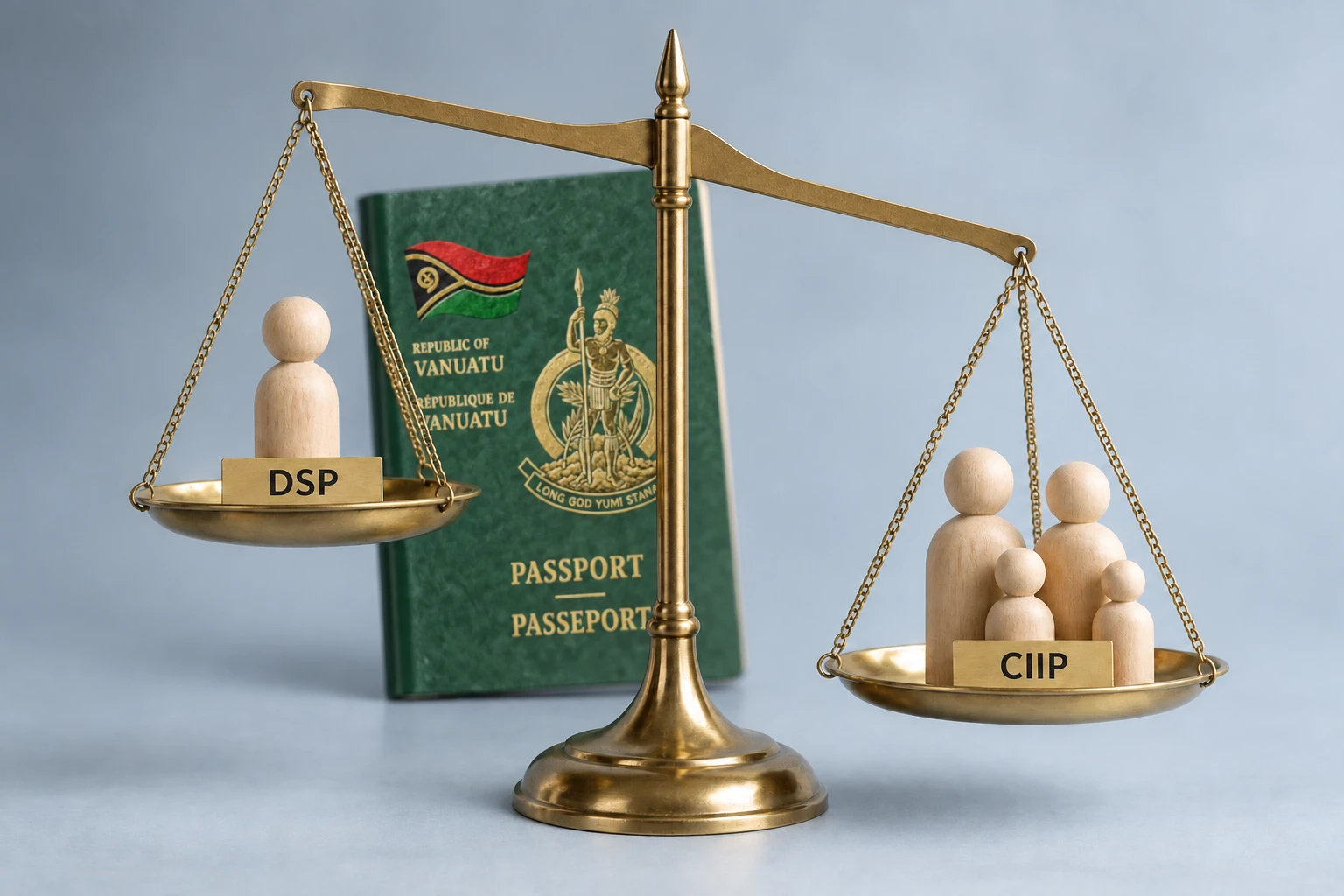
DSP or the CIIP fund: the contribution suits one person, the fund with a return suits a family of four
Updated: September 2026·16 min read·Expert reviewed
Terms and costs verified: September 2026
Contents
Vanuatu citizenship by investment is obtained under two programmes in operation: the DSP with a non-refundable contribution from $130,000, and the CIIP fund at $157,000 for a family of up to four, of which the state returns $50,000 after 5 years. For a single applicant the DSP is $30,000 cheaper; for a family of four the fund is $20,000 cheaper at the point of payment. Below: turnkey totals by family size, how the fund works, the payment order, early exit and a rule for choosing.
DSP or the CIIP fund: in brief
In brief: a single applicant does better with the DSP, a family of three or more with the CIIP fund. For a couple, what decides it is whether they are ready to leave $50,000 in the fund for 5 years. The passport, citizen’s rights and processing time are the same in both programmes.
The difference between the programmes is in how the payment works. Under the DSP the money goes to the Vanuatu budget and is not returned, and the amount grows with each member of the application. Under the CIIP fund one sum covers a family of up to four, and after 5 years the state buys back the stake and returns $50,000. In both programmes the contribution is paid after Commission approval; before the decision the family pays only the FIU fee.
The turnkey total in the BRIDGES budget: for one applicant $135,000 under the DSP against $165,000 under the fund; for a family of four $185,000 under the DSP against $165,000 under the fund, or $115,000 net of the return. How the citizenship programme works as a whole is described in how the Vanuatu citizenship programme works.
Which citizenship programmes Vanuatu has
In brief: for most applicants the choice is between the DSP and the CIIP fund. The REO option with investment in property has operated since 23 July 2021, but its amount is not in the published fee schedule. The Financial Intelligence Unit names the VCP programme alongside the DSP and CIIP, while the published tariff relates to the DSP.
| Name | What it is | Status as of September 2026 |
|---|---|---|
| DSP, Development Support Program | A non-refundable contribution to the budget by family size | In operation, tariff published by the Citizenship Office |
| CIIP, Capital Investment Immigration Plan | A contribution with $50,000 invested in an approved fund and returned after 5 years | In operation |
| VCP, Vanuatu Contribution Program | A contribution programme | Named by the FIU alongside the DSP and CIIP; conditions checked with an agent |
| REO, Real Estate Option | Investment in property in one of 4 approved projects plus fees | Operating since 23 July 2021; amount not in the published fee schedule |
The confusion over names arose because over the years the programme’s forms and operators changed. For the applicant one thing matters: the passport is issued by the state on the decision of the Citizenship Commission, and the payment goes under one of the two programmes in operation. If an offer names a programme whose amount is not published in the fee schedule, the conditions and the payee are checked before signing. How the property option works and why the BRIDGES budget does not calculate it is covered in how REO works.
How the DSP and the CIIP fund differ
In brief: the DSP is a non-refundable contribution that grows with each member; the CIIP fund is one sum for a family of up to four with $50,000 returned after 5 years. The fund has a higher FIU check fee: $8,000 against $5,000.
Vanuatu Citizenship Office, BRIDGES client handling procedure as of September 2026
Under the DSP the contribution grows in steps: $130,000 for one, $150,000 for a couple, $165,000 with a child, $180,000 with two children. A second adult adds $20,000, and each of two children $15,000. It is paid on a treasury invoice after preliminary approval, so if the application is refused at the check stage, no contribution is paid.
Under the CIIP fund the $157,000 contribution is the same for one applicant and for a family of up to four. Of this sum, $50,000 is invested in a government-approved fund, and after 5 years the state buys back the stake and returns the money. The payment is made in full after Commission approval, while the payment account and source-of-funds documents are prepared in advance: a Vanuatu bank checks the payer separately from the FIU.

Beyond the contribution, the budget adds only the FIU fee: $5,000 under the DSP and $8,000 under the fund, for the whole application. Translation, certification and bank fees are calculated separately as invoiced and are the same for both programmes. A breakdown of all budget items is collected in how much Vanuatu citizenship costs for a family.
Turnkey calculation by family size
In brief: for one applicant the DSP is $30,000 cheaper than the fund, for a couple $10,000 cheaper at the point of payment. From three people the fund is cheaper at the point of payment, for a family of four by $20,000, and with the return the difference from the DSP over five years is $70,000.
One applicant: the DSP
The DSP costs a single applicant $135,000 turnkey: a $130,000 contribution and the $5,000 FIU check. The fund costs $165,000 at the point of payment and $115,000 net of the return. The return covers the difference, but $30,000 has to be paid up front, and $50,000 stays in the fund for five years. So the budget recommends the DSP for a single applicant. The decision for any family comes down to three questions: how many people are in the application and whether $50,000 can stay in the fund for five years. How the non-refundable contribution works is covered in the DSP programme.
A couple: the time horizon decides
For a couple the DSP costs $155,000 and the fund $165,000 at the point of payment. Net of the return the fund comes to $115,000, that is $40,000 cheaper than the DSP, but only after five years. A couple who may need the $50,000 sooner is suited by the DSP. A couple ready to keep the money in the fund for the whole period does better with the fund.
A family of three: the fund
A family of three pays $165,000 under the fund and $170,000 under the DSP. The fund is $5,000 cheaper at the point of payment and returns $50,000 after 5 years. For such a family the budget recommends the fund, if the money can stay in it for the whole period.
A family of four: the fund
A family of four pays $165,000 under the fund and $185,000 under the DSP: a $20,000 difference in favour of the fund on the day of payment. After 5 years $50,000 comes back, and the family’s cost of citizenship is $115,000. How a family of four filed one application and received passports in two months is shown in case: a family of four with one contribution.
A family of five or more
For a fifth and each further member both programmes add a contribution, which the budget calculates by the person’s age and status: a child under 18, a dependent child under 25, a parent. Which programme is better for a large family depends on the number and age of members, so the budget calculates both for the actual family. The exact total is shown by the budget for your family.
We will arrange citizenship through the fund with a $50,000 return
We will discuss the CIIP fund terms, early exit and the payment procedure.
How the CIIP fund works
In brief: the $157,000 contribution is paid in a single payment after Commission approval, and $50,000 of it is invested in a government-approved fund. After 5 years the state buys back the stake and returns $50,000; leaving earlier is possible with loss of part of the amount.
What the money is invested in
CIIP funds are approved by the Government of Vanuatu and finance projects in the country’s economy. The first approved project was the CNO Future Fund, linked to coconut oil production, which is why the cost calculator calls this option the “Coconut oil fund”. A fund linked to cocoa production was approved later. The fund is chosen at filing, and citizenship and the passport do not depend on the choice of fund.
Early exit from the fund
Under the programme terms the stake is bought back after 5 years, and then the $50,000 is returned in full. Leaving earlier is possible, but with loss of part of the amount: the deduction is set by the fund agreement. So before choosing the fund, the family assesses whether this money may be needed in the next five years. If so, the DSP may be more convenient even for a family of three.
What is needed for the fund payment
The fund payment goes through a Vanuatu bank, which checks the payer separately from the FIU. For a CIIP application a separate form is completed for each member, and for the main applicant an asset report in US dollars, a bank statement for the last 6 months, a professional reference and recent proof of address are prepared. The statement is ordered first: it usually takes the longest to obtain.
If the funds come from the sale of a business, property or digital assets, documents on the origin of the money are attached to the payment. How capital from cryptocurrency is proven is covered in a Vanuatu passport for a crypto investor.

How the DSP programme works
In brief: under the DSP only the check fee is paid on filing, and the contribution is paid after preliminary approval on a Vanuatu treasury invoice. The money goes into the country’s budget and is not returned.
The DSP payment order reduces the applicant’s risk: the large sum goes when the Commission has already decided. If the check is not passed, no contribution invoice is issued, and only the FIU fee, translations and document preparation have been paid. A demand to pay the whole DSP contribution when signing the agreement contradicts how the programme works.
The DSP suits those who do not want to tie up money for five years and those applying alone. Citizenship under both programmes is the same: a 10-year passport, entry to 46 countries without a visa and another 42 with a visa on arrival, and passing citizenship to children. The steps from the preliminary check to the passport are described in how to get Vanuatu citizenship step by step.
Payment order under the DSP and the CIIP fund
In brief: in both programmes only the FIU check fee is paid before the Commission’s decision: $5,000 under the DSP and $8,000 under the fund. The contribution is paid after approval, with 3 months allowed for it and the oath, and after 5 years the fund returns $50,000.
| Stage | DSP programme | CIIP fund |
|---|---|---|
| Before filing | Translation and certification of documents, support under the agreement | Translation and certification of documents, support under the agreement |
| Filing | FIU check fee $5,000 | FIU check fee $8,000 |
| Commission approval | Contribution from $130,000 on a treasury invoice | Contribution of $157,000 in a single payment for a family of up to four |
| Issue | Certificate of citizenship and passports | Certificate of citizenship and passports |
| After 5 years | No payments and no return | $50,000 returned on buy-back of the stake |
The payment order is checked against the agreement before signing. A demand to pay the contribution when signing contradicts the procedure of both programmes. For the fund, the agreement is also checked for the fund’s bank details, early exit terms and the stake buy-back procedure. Government payments and the fund contribution go to official accounts, not to an intermediary’s account.
Who the DSP suits and who the CIIP fund suits
In brief: the DSP suits a single applicant and families who value free liquidity. The CIIP fund suits families of three or more who are ready to leave $50,000 in the fund for 5 years.
The choice of programme does not change applicant requirements: age 18 or over, no convictions or sanctions, a lawful source of funds, proven assets and a medical certificate are the same for the DSP and the fund.
The DSP programme
- a single applicant: a total of $135,000 against $165,000 under the fund;
- a couple who may need the $50,000 in the next five years;
- an applicant for whom a lower check fee matters: $5,000 against $8,000 under the fund;
- a family planning large expenses straight after the passport, such as Greek residence.
The CIIP fund
- a family of three: $165,000 against $170,000 under the DSP, plus $50,000 returned;
- a family of four: a saving of $20,000 at the point of payment and $70,000 over five years;
- a couple ready to keep the money in the fund for the whole period: $115,000 net of the return;
- a family that wants to recover part of the cost of citizenship after five years.
If European residence is planned after the passport
Many families obtain a Vanuatu passport as a first step to residence under the Greek Golden Visa programme or Hungary’s programmes. The budget for the European step starts from €250,000 in Greece, so when choosing a Vanuatu programme, consider how much free money will be needed right after the passport. The DSP does not tie up funds, while the fund returns $50,000 only after five years. The procedure for Greek residence for Vanuatu citizens is shown on Greek residence for Vanuatu citizens.
The family receives Vanuatu passports in roughly 2-3 months, then applies for Greek residence as Vanuatu citizens, and the whole turnkey package takes up to 9 months. Certificates, apostilles and translations are prepared with both applications in mind, so documents are not collected twice.
Vanuatu citizenship and Greek residence turnkey in 9 months
We calculate both Vanuatu programmes together with the Greek budget and arrange passports and residence in one package, preparing documents for both applications at once.
The family composition determines not only the choice of programme but also the document package: who can be included and which proof is needed for adult children and parents is covered in Vanuatu citizenship for the whole family.
Mistakes in choosing a programme
In brief: the most common mistakes are comparing only the contributions, forgetting the time in the fund and choosing a programme before calculating for the exact family.
- Comparing only contributions. The difference between the programmes shows in the turnkey total, where the fund has a higher FIU fee and documents are counted for each member.
- Ignoring the time in the fund. The $50,000 is returned after five years, and early exit costs part of the sum.
- Filing a family of four under the DSP without calculating the fund. Such a family overpays $20,000 at the point of payment and gets no $50,000 return.
- Paying into the fund without a verified account. After approval 3 months are allowed for the contribution and oath, and a payment rejected by the bank delays the passports.
- Not reading the early exit terms. The deduction is written in the fund agreement and is checked before payment.
What to check before choosing a programme
In brief: before choosing a programme, check the family composition, how long the money can stay in the fund, the payment account and the payment order in the agreement. The budget must calculate both programmes.
Before choosing the DSP or the CIIP fund
- The budget is calculated under both programmes for the exact family
- It is clear whether the $50,000 may be needed before five years
- The payment account is open and verified before filing
- The agreement sets out the payment order: the contribution after Commission approval, only the FIU fee before the decision
- Early exit terms and refunds on refusal are written into the agreement
After receiving the passport the family will need a bank account for life and business: which banks work with Vanuatu citizens is described in a bank account with a Vanuatu passport. BRIDGES calculates both programmes, checks documents before filing and takes the application through to delivery of the passports: the scope of services is shown on support under the Vanuatu programme.
Frequently asked
Questions people ask before deciding
01Which is better value: the DSP or the CIIP fund?
For a single applicant the DSP: $135,000 against $165,000 turnkey. For a family of three or more the CIIP fund: a family of four pays $165,000 against $185,000 and gets $50,000 back after 5 years.
02How much does the CIIP fund cost?
A contribution of $157,000 in one sum for a family of up to four, and an FIU check fee of $8,000. The turnkey total is $165,000 for any family of up to four.
03Is money returned from the CIIP fund?
Yes, $50,000 after 5 years: the state buys back the stake in the fund. The rest of the contribution is not returned.
04Can I leave the CIIP fund before five years?
Yes, but with loss of part of the amount. The deduction on early exit is set by the fund agreement, so it is checked before payment.
05What is the Vanuatu coconut oil fund?
That is what the cost calculator calls the CIIP option with the CNO Future Fund, the programme’s first approved project. It is linked to coconut oil production, while citizenship and the passport do not depend on the choice of fund.
06When is the contribution paid under the DSP and the CIIP fund?
In both programmes after Commission approval: 3 months are allowed for the contribution and the oath. Before the decision only the FIU fee is paid: $5,000 under the DSP and $8,000 under the CIIP fund.
07Is the VCP programme in operation?
The Financial Intelligence Unit names the VCP alongside the DSP and CIIP, but the Citizenship Office’s published tariff relates to the DSP. VCP conditions are checked with a licensed agent.
08Is the passport different under the DSP and the CIIP fund?
No. The passport, citizen’s rights, processing time and passing citizenship to children are the same in both programmes.
09Which programme is better for a couple?
At the point of payment the DSP is $10,000 cheaper: $155,000 against $165,000. Net of the $50,000 return the fund costs $115,000. The choice depends on whether the couple is ready to leave the money in the fund for 5 years.
10What happens to the contribution on refusal?
The contribution is not paid on refusal under either the DSP or the CIIP fund: it is paid after approval. The FIU fee is not refunded in either programme.
11Through which bank is the CIIP fund contribution paid?
The fund payment goes through a Vanuatu bank, which checks the payer separately from the FIU. For it, a 6-month bank statement, proof of address and source-of-funds documents are prepared.
12Are applicant requirements the same for the DSP and the CIIP fund?
Yes. Age 18 or over, no convictions or sanctions, a lawful source of funds and a medical certificate are required in both programmes. The amount, payment order and FIU fee differ.
13Can property be bought instead of paying a contribution?
The REO option has operated since 23 July 2021: investment in property in one of four approved projects plus fees. Its amount is not in the published fee schedule, so the BRIDGES budget does not calculate it.
14How much does it cost for a family of five?
For a fifth and each further member both programmes add a contribution by the person’s age and status. Which programme is better depends on the composition, so the budget calculator works out both.
Transparency
How this material was prepared
- Author
- Andres Ferreira, head of Investment Advisory, BRIDGES
- Terms and costs last verified
- September 2026
- Sources
- official government authorities of the relevant country and state publications
- Methodology
- government minimum requirements are stated separately from due diligence charges, state fees, legal and banking costs
Sources and methodology
Figures, terms and timelines are checked against official sources as of September 2026. Link availability verified in August 2026. Third-party blogs and agent websites are not used as a source of programme terms.
- [1]Vanuatu Citizenship OfficeOfficial conditions of the citizenship programmevancitizenship.gov.vu
- [2]Vanuatu Department of ImmigrationEntry, visas and statusesimmigration.gov.vu
Methodology: tables and charts state government minimum investment requirements; due diligence charges, state fees, legal, banking and other costs are calculated separately and are not included in the minimum thresholds.
About the author
Related materials
What to read next
 ComparisonSecond citizenship in 3-6 months: Caribbean, Türkiye or Vanuatu in 2026
 AnalysisWhat is due diligence and why the Caribbean is rejecting applications
 ArticleBanks in Vanuatu and accounts abroad: what a bank checks for a Vanuatu citizen
Personal programme selection is conducted by Anna Kovalevskaya, Head of Legal, BRIDGES.
We will obtain citizenship under the chosen programme
We will explain the filing procedure, documents and timelines under the DSP or the CIIP fund.
