Citizenship · Vanuatu
7 myths about Vanuatu citizenship that get in the way of a decision

Updated: September 2026·14 min read·Expert reviewed
Terms and costs verified: September 2026

Contents
Vanuatu citizenship is obtained lawfully through a designated agent, every applicant is checked by the FIU, and the country itself has been a member of Interpol since 20 November 2018. Even so, myths persist around the programme, from “an offshore haven for evaders” to “a passport that is good for nothing”. We check 7 myths against official sources and the cost calculator.
Myths about Vanuatu citizenship: in brief
In brief: the programme is legal and checks every applicant, Vanuatu cooperates with Interpol and exchanges tax information, and the passport opens 46 countries without a visa with another 42 giving a visa on arrival. Your first citizenship is kept, and the CIIP fund returns $50,000 after 5 years.
Most myths come from outdated data on visa-free travel with the EU, confusion between citizenship by investment and offshore companies, and retellings without sources. A general overview of the programme is in Vanuatu citizenship by investment, and what citizenship changes in family life in a Vanuatu citizen’s rights in practice.
Where the myths come from and how to check them
In brief: myths most often rely on pre-2023 data, intermediaries’ advertising and forum retellings. Each claim is checked against the primary source: Government of Vanuatu websites on the .gov.vu domain, Vanuatu’s page on the Interpol website and EU decisions.
| What is checked | Where |
|---|---|
| Types of citizenship, tariffs, agents | vancitizenship.gov.vu |
| 2026 commission of inquiry report | pmo.gov.vu |
| Interpol membership | Vanuatu’s page on interpol.int |
| Taxes and information exchange | doft.gov.vu |
| EU visa regime | Council of the EU Decisions 2022/366, 2022/2198 and Regulation 2025/11 |
If a claim cannot be confirmed by any of these sources, it is not used in making a decision. Official Government of Vanuatu websites end in .gov.vu: this warning is published on the Citizenship Office website.
Myth 1. “Vanuatu is an offshore haven for tax evaders”
In brief: false. Citizenship by investment does not exempt you from taxes in your country of residence, and Vanuatu takes part in automatic exchange of account information under the International Tax Cooperation Act No. 7 of 2016.
Taxes are paid in the country of tax residence, not by passport. Vanuatu has tax information exchange agreements with Australia, France and Finland, in force since 2011. Within the country there is VAT at 15% and rental tax at 12.5%, and a TIN has been mandatory since 1 January 2020.
Every applicant is checked by the FIU: background, convictions, sanctions lists, source of funds. The Citizenship Commission has revoked about 30 citizenships granted in breach of the law. The tax side is covered in taxes for a Vanuatu citizen.
Myth 2. “Vanuatu is not a member of Interpol”
In brief: false. Vanuatu has been a member of Interpol since 20 November 2018, and the Interpol National Central Bureau operates in Port Vila.
The National Central Bureau connects the country’s police with other Interpol members and the General Secretariat through the secure I-24/7 communications network. This means wanted notices and police requests from other countries reach Vanuatu through the same channels as any member country.
For a bona fide applicant this fact works for the passport’s reputation: Vanuatu citizenship is not seen as a way to hide. The programme does not suit people who are internationally wanted or under sanctions, and the FIU check screens them out before the Commission’s decision. Details in Vanuatu citizenship and a criminal record.
Myth 3. “No trip to the islands means a grey scheme”
In brief: false. The application is filed by a designated agent from the Citizenship Office list, and documents are certified in the country of residence. The applicant attends in person only for biometrics in Dubai, Hong Kong, Moscow, St Petersburg or Port Vila.
Filing through an agent is part of the programme procedure: the Citizenship Office website publishes the list of designated agents, with 6 DSP agents for 2026, and a separate list of revoked ones. This procedure reflects the programme’s logistics, not its legal status.
A sign of a grey scheme is something else: no agent from the list, payment to a personal card, “a passport without a check”. How to check an offer is covered in Vanuatu passport scams.
Processing without a trip to the islands also works for people with busy schedules. The head of a medical technology company received a Vanuatu passport in 51 days and spent about 40 minutes of personal time on signatures and a video call. Details in case: the oath without a trip to Vanuatu.
Myth 4. “A Vanuatu passport is good for nothing”
In brief: false. A Vanuatu passport opens 46 countries without a visa, another 42 give a visa on arrival, 3 admit holders with an electronic eTA, and about 39 countries issue a visa online.
Without a visa, a Vanuatu citizen can enter Hong Kong for up to 90 days, Singapore, Malaysia and the Philippines for up to 30 days, Fiji for up to 120 days, and Antigua and Barbuda, Barbados and Dominica for up to 180 days. In Asia, Thailand, Sri Lanka and the Maldives are open on a visa on arrival for 30 days, Nepal for 90 and Armenia for 120, while the UAE and Georgia issue an eVisa online.
Schengen and the UK require a visa: the EU fully suspended visa-free travel from 4 February 2023, and the UK introduced visas on 19 July 2023. To live in Europe, Vanuatu citizens arrange residence in Greece or Hungary. The list of destinations is in visa-free countries for the Vanuatu passport, and how banks and border officers accept the passport in is the Vanuatu passport recognised.
For many families a Vanuatu passport works as a back-up document: travel, accounts and plans do not depend on one passport, and citizenship passes to children by descent. This scenario is covered in the Vanuatu passport as a plan B.
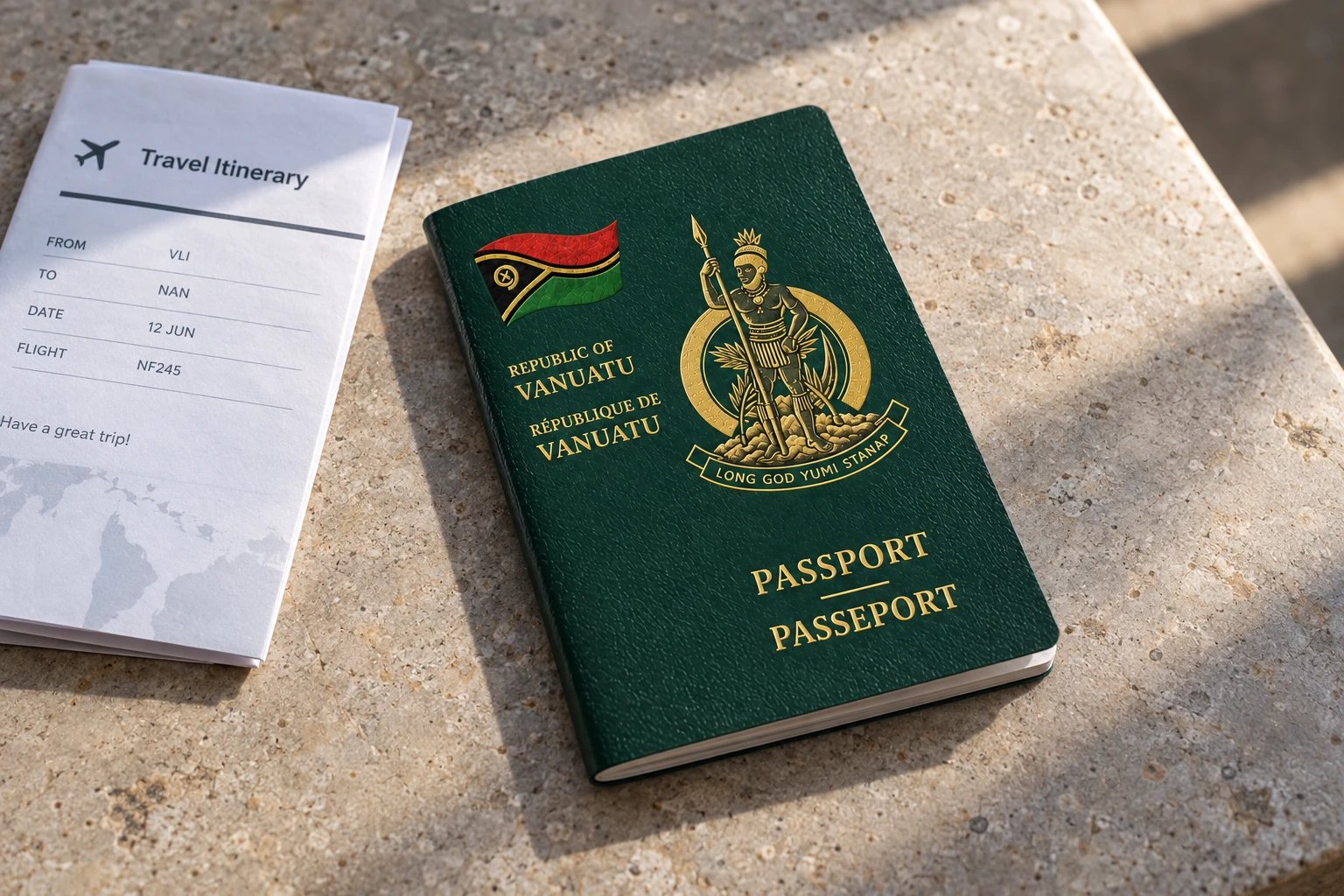
Myth 5. “A passport in a few weeks, and the check can be skipped”
In brief: false on both counts. From filing the full package to approval takes 2-3 months, and the FIU check is mandatory for every adult and children from 18.
The Commission sits twice a month, so the timeline is made up of the check and the sitting schedule, not the intermediary’s speed.
BRIDGES client handling procedure, Vanuatu Citizenship Office
The FIU check takes up to 7 working days, the Commission reviews applications at sittings twice a month, and after approval the contribution is paid, biometrics given and the oath taken. Another 2-4 weeks go on collecting and certifying the applicant’s documents. If the check needs additional information, the reply is sent within 1-3 working days.
An offer to “save on the check” or “speed things up for a surcharge” has nothing to do with the programme. Stages week by week are in Vanuatu citizenship timelines.
We will check the background and source of funds before payments
In 1-2 working days we assess the background, sanctions risks and money documents and tell you what to prepare for the application.
Myth 6. “I will have to give up my first citizenship”
In brief: false as far as Vanuatu is concerned: it recognises dual citizenship. What matters is your home country’s law. Russian law, for example, does not prohibit a second citizenship, but a Russian citizen notifies the Interior Ministry within 60 days.
In the Russian case, under Article 11 of Federal Law No. 138-FZ the notice is filed within 60 days of acquiring citizenship, or, if acquired abroad, within 60 days of entering Russia. For failing to file, Article 330.2 of the Russian Criminal Code sets a fine of up to RUB 200,000 or community service of up to 400 hours. The notice is not a permission and does not require renouncing any citizenship. Some other countries restrict or do not recognise dual citizenship, so check your own rules before filing.
On Russian territory a person with two passports is treated only as a Russian citizen. Details in the Vanuatu passport for Russian citizens.
Myth 7. “The contribution cannot be returned under any option”
In brief: true only for the DSP. Under the CIIP fund a family of up to four pays $157,000, and $50,000 is returned after 5 years.
The DSP contribution ranges from $130,000 for one person to $180,000 for a couple with two children and is not refunded. The CIIP fund works differently: the contribution is paid in one sum after Commission approval, and part of it is returned after 5 years. So a single applicant or a couple does better with the DSP, and a family of three or more with the fund.
After 5 years the state buys back the fund stake and returns $50,000; the DSP contribution stays in the budget.
Vanuatu Citizenship Office, BRIDGES programme database as of September 2026
A comparison of both programmes for your family is shown by the budget for your family, and the choice is discussed in the DSP and VCP programmes.
What Vanuatu citizenship costs
In brief: turnkey, the DSP costs $135,000 for one applicant and $185,000 for a family of four. Under the CIIP fund the total is $165,000, or $115,000 after the $50,000 return after 5 years.
| Item | DSP | CIIP fund |
|---|---|---|
| FIU fee | $5,000 per application | $8,000 per application |
| Translation and certification | as invoiced | as invoiced |
| When the contribution is paid | after Commission approval | after Commission approval |
The FIU fee is paid per application, not per member. Budget items and payment recipients are covered in the cost of Vanuatu citizenship and additional costs.
How the FIU check works
In brief: the FIU checks sanctions lists, convictions, publications and courts, source of funds and politically exposed status. Adult members and children aged 12 to 18 provide a police clearance no older than 3 months on the filing date.
Children aged 18 to 25 provide the full adult document set and proof of study and support. If a question arises about one member, it is disclosed as fully as a question about the main applicant, because it affects the review of the whole application.
Difficult facts in the background are reported before filing: a preliminary check in 1-2 working days shows the risk before the non-refundable fee is paid. The check procedure is in checking a Vanuatu citizenship applicant.
Vanuatu among investment programmes
In brief: Vanuatu is chosen for its 2-3 month timeline and entry threshold from $130,000. Contributions in Caribbean programmes start from $200,000 in Dominica and reach $250,000 in St Kitts and Nevis, but their passports keep visa-free access to Schengen.
The choice depends on the task. For speed and budget Vanuatu fits; for Europe, Vanuatu works as a first step to residence in Greece or Hungary. For the US E-2 investor visa, Grenada is considered. Comparisons are in Vanuatu or Dominica and Vanuatu or Nauru.

Which documents are needed
In brief: the main applicant prepares 11 certified documents, an adult member 7, a child 3. The package includes a passport, a police clearance, a second identity document, birth and marriage certificates, a medical certificate and source-of-funds documents.
Documents are translated into English and certified, and names are checked against the passport. The police clearance is obtained no earlier than 3 months before filing. The full list is in documents for Vanuatu citizenship.
Download the standard document checklist
Leave your contacts and we will send a checklist: 11 documents for the main applicant, 7 for an adult and 3 for a child, with translation and certification.
What happens after receiving the passport
In brief: the passport is issued for 10 years, there are no residence or visit requirements, and children born after citizenship is granted acquire it by descent. Taxes are determined by tax residence, not by the passport.
Vanuatu has no personal income tax, capital gains tax or inheritance tax, but moving tax residence requires a separate decision under the rules of the country a person is leaving. Rights and duties are covered in rights and duties of a Vanuatu citizen.
Another common myth concerns the status itself: Vanuatu citizenship does not need to be renewed or confirmed by visits. Only the passport is renewed after 10 years, and the Commission revokes citizenship only on legal grounds: deception in obtaining it, breach of the Citizenship Act or the Constitution, and failure to observe the restrictions of the law.
Programme risks and how to remove them
In brief: programme conditions change, Schengen and the UK require a visa, and intermediaries without a designated agent put money at risk. Each of these risks is closed by a check before payment.
- Programme conditions. Tariffs and the check procedure are verified on the filing date on the Citizenship Office website.
- Travel to Europe. A Schengen visa is obtained at a consulate, and to live in Europe residence in Greece or Hungary is arranged.
- Agent. The agent’s name is checked against the Citizenship Office list, and government payments go on invoices to official details.
The full review is in passport risks and how to remove them.
Who Vanuatu citizenship suits
In brief: the programme suits those who need a second passport in 2-3 months with a budget from $135,000 for one person, as well as families building a route to Europe through residence who want citizenship for their children and future generations.
- Entrepreneurs travelling in Asia and Oceania. Hong Kong, Singapore, Malaysia, the Philippines and Fiji without a visa.
- Families of four or more. The CIIP fund with $50,000 returned after 5 years.
- Families planning Europe. Vanuatu citizenship now, Greek or Hungarian residence as the next step.
For the US E-2 investor visa, EU citizenship or visa-free Schengen, other programmes are considered. The article is Vanuatu citizenship worth it will help check your case.
How BRIDGES checks the facts about the programme
In brief: BRIDGES addresses the client’s doubts using official sources, runs a preliminary check in 1-2 working days, names the designated agent before the agreement and calculates the DSP and the CIIP fund for the specific family.
If after the review Vanuatu does not suit the client’s task, we say so before the agreement and suggest programmes that do. The family calculation is on the Vanuatu citizenship programme page.
Frequently asked
Questions people ask before deciding
01Is Vanuatu a member of Interpol?
Yes. Vanuatu has been a member of Interpol since 20 November 2018, and its National Central Bureau operates in Port Vila.
02Is the Vanuatu citizenship programme legal?
Yes. The application is filed by a designated agent, every applicant is checked by the FIU, and the Citizenship Commission decides under the Citizenship Act Cap 112.
03Do I need to travel to Vanuatu to obtain citizenship?
There is no need to go to the islands. Documents are certified in your country of residence, the agent files the application, and biometrics are given in person in Dubai, Hong Kong, Moscow, St Petersburg or Port Vila.
04How many countries does a Vanuatu passport open?
46 countries are open without a visa, another 42 give a visa on arrival, 3 admit holders with an eTA, and about 39 issue a visa online. Schengen, the UK and the USA require a visa.
05How long does it take?
Roughly 2-3 months without relocating. The FIU check takes up to 7 working days, the Commission sits twice a month and the passport is issued in 1-3 weeks.
06Will I lose my first citizenship?
Not because of Vanuatu: it recognises dual citizenship. Check your home country’s rules: Russian law, for example, does not prohibit a second citizenship, but requires notifying the Interior Ministry within 60 days.
07Can the contribution be returned?
Under the DSP, no. Under the CIIP fund a family of up to four pays $157,000 after approval, and $50,000 is returned after 5 years.
08Who is better off with the DSP and who with the CIIP fund?
A single applicant or a couple with the DSP: $135,000 and $155,000 turnkey. A family of three or more with the CIIP fund: $165,000 turnkey, of which $50,000 is returned after 5 years.
09When is the contribution paid?
Under both programmes after Commission approval. Before the decision only the FIU fee is paid: $5,000 under the DSP and $8,000 under the CIIP fund per application.
10Can the FIU check be skipped?
No. The main applicant goes through the check. Offers to bypass it have nothing to do with the programme.
11How much does Vanuatu citizenship cost for a family of four?
Under the DSP about $185,000 turnkey. Under the CIIP fund about $165,000, of which $50,000 is returned after 5 years.
12Does Vanuatu citizenship exempt me from taxes?
No. Taxes are paid in the country of tax residence. Vanuatu takes part in automatic exchange of account information.
Transparency
How this material was prepared
- Author
- Andres Ferreira, head of Investment Advisory, BRIDGES
- Terms and costs last verified
- September 2026
- Sources
- official government authorities of the relevant country and state publications
- Methodology
- government minimum requirements are stated separately from due diligence charges, state fees, legal and banking costs
Sources and methodology
Figures, terms and timelines are checked against official sources as of September 2026. Link availability verified in August 2026. Third-party blogs and agent websites are not used as a source of programme terms.
- [1]Vanuatu Citizenship OfficeOfficial conditions of the citizenship programmevancitizenship.gov.vu
- [2]Vanuatu Department of ImmigrationEntry, visas and statusesimmigration.gov.vu
Methodology: tables and charts state government minimum investment requirements; due diligence charges, state fees, legal, banking and other costs are calculated separately and are not included in the minimum thresholds.
About the author
Related materials
What to read next
 ComparisonSecond citizenship in 3-6 months: Caribbean, Türkiye or Vanuatu in 2026
 AnalysisWhat is due diligence and why the Caribbean is rejecting applications
 ArticleBanks in Vanuatu and accounts abroad: what a bank checks for a Vanuatu citizen
Personal programme selection is conducted by Anna Kovalevskaya, Head of Legal, BRIDGES.
Vanuatu citizenship and Greek residence turnkey in 9 months
We arrange Vanuatu passports in 2-3 months and Greek residence for the whole family in one package, preparing documents for both applications at once.
