Asset protection · International
Automatic exchange under CRS: what information about your accounts tax authorities receive
Updated: November 2026·12 min read·Expert reviewed
Terms and costs verified: November 2026

Contents
Banking secrecy in the old sense ended about ten years ago. Since 2017 banks, brokers, asset managers and insurers in most countries have reported every year on the accounts of foreign clients to the tax authorities of the countries where those clients are tax resident. This is automatic exchange under the OECD Common Reporting Standard, or CRS. We look at what information is sent, whom it covers, how the standard deals with companies and trusts, and what it means for asset protection.
Key points
- CRS is an OECD standard adopted in 2014. The first exchanges took place in 2017, and more than a hundred countries now apply it.
- Name, address, TIN, country of residence, account number, year-end balance and income are reported: interest, dividends and proceeds from the sale of assets.
- For accounts of passive entities and trusts, controlling persons are disclosed: settlor, trustees, protector, beneficiaries.
- Information goes to the country of tax residence, not citizenship. The bank asks for a self-certification listing all countries of residence.
- Russia receives information from the countries on the Federal Tax Service list. Some countries have suspended exchange with Russia, but this does not cancel a resident's duty to report accounts.
What CRS is and where it came from
The Common Reporting Standard was developed by the OECD at the request of the G20. It grew out of the US FATCA law, which since 2014 has required foreign banks to report to the US on the accounts of American taxpayers. CRS made the same thing multilateral: each participating country collects information from its financial institutions on non-residents' accounts and once a year sends it to the owners' countries of residence.
The mechanism rests on a multilateral competent authority agreement and each country's domestic law. Financial institutions must identify where their clients are tax resident, collect the information and send it to their tax authority. That authority in turn sends the data to partners with which it has activated exchange.
What information is reported
| What is reported | Details |
|---|---|
| Who the owner is | Name, address, country of tax residence, TIN, date and place of birth |
| Which account | Account number, name and identifier of the financial institution |
| How much is in it | Balance or value at year end or on closure of the account |
| What income | Interest, dividends, other income, gross proceeds from the sale of financial assets |
| Who controls | For passive entities and trusts, controlling persons: settlor, trustees, protector, beneficiaries |
Based on the OECD Common Reporting Standard.
Not only bank accounts are covered. Financial institutions also include custodians and brokers, investment entities and funds, and insurers issuing policies with a cash value. So information on life insurance policies with a surrender value and on brokerage portfolios is reported too.
The standard essentially provides no thresholds for individuals: even a small account is reported. A threshold exists for entity accounts opened before the standard came into force, but general due diligence rules apply to new accounts.
For which period and when information is exchanged
Information is collected for the calendar year. The financial institution reports to its own tax authority in the first half of the following year, and exchange between countries takes place no later than nine months after the year ends, that is, by 30 September. So the tax authority of the country of residence receives data on an account for 2025 by autumn 2026.
Closing an account does not take it out of the exchange: the bank reports the closure and the data as at the closure date. Moving money to another bank in the same country or another country changes nothing either: the new bank will collect a self-certification and report under its own rules. So the idea of "closing the account before the reporting date" does not work.
The key word is residence, not citizenship
Information goes to the owner's country of tax residence. When an account is opened, the bank asks for a self-certification: all countries where you are tax resident and a TIN for each. The bank checks the answers against documents and other indicators: address, phone number, place of birth, standing orders to another country. If the indicators contradict the self-certification, the bank may ask for an explanation and, in case of doubt, report to several countries.
This has an important consequence for holders of a second citizenship. Another country's passport does not by itself change tax residence. If you actually live in Russia, spend more than 183 days a year there and have told the bank you are resident in your second passport country, the bank may send the information to the wrong place and you may face questions about the accuracy of your self-certification. The OECD has specifically warned about the risk of citizenship and residence by investment schemes being used to circumvent CRS, and banks examine such cases particularly closely. See our articles second passport and banks and whether to notify of second citizenship.
Self-certification in practice
A self-certification is a short form, but it determines where the information goes. It lists all countries of tax residence and the TIN in each. If a country does not issue TINs, this is noted with an explanation. By signing, the client confirms the information is accurate and undertakes to inform the bank of changes, such as relocation, within the period the bank sets.
Sometimes a person is tax resident in two countries at once under their domestic rules. Both countries are then listed, and the question of where tax is paid is settled under the double tax treaty, if there is one. The bank may ask for a tax residence certificate, a lease, documents on work or the children's schooling. The more consistent the documents, the fewer the questions. An error or omission in a self-certification is not a formality: in a number of countries false statements carry liability, and the bank may close the account.
When information goes to several countries
If a client has several countries of residence or the bank sees conflicting indicators, the information may be sent to each of those countries. For example, a person declared UAE residence, but the bank holds a Russian address and phone number, and regular transfers go to Russia. The bank may report to both the UAE and Russia unless the client explains the conflict with documents.
So on relocation it is important to update details at all banks and brokers: address, phone and self-certification. Conversely, if residence has not changed, do not declare a country where you do not actually live. On proving residence in the Emirates, see UAE tax residence.

Companies and trusts in the exchange
It is often thought that a company account avoids the exchange. It does not. The standard divides entities into active and passive. If a company earns mainly passive income, such as interest, dividends or rent, or simply holds assets, the bank identifies its controlling persons and reports them to their countries of residence. Family wealth holding companies are almost always passive.
For trusts the rule is even broader. The controlling persons of a trust are the settlor, trustees, protector, beneficiaries and anyone else who in fact controls the trust. Private foundations are treated similarly: information on the founder, council members, protector and beneficiaries is reported. A trust or foundation may itself be a financial institution and report directly. More on structures in our articles on trusts and private foundation or trust.
| Common belief | Reality |
|---|---|
| A company account is not exchanged | The bank discloses the controlling persons of a passive entity |
| A trust hides the owner | The settlor, trustees, protector and beneficiaries are included in the data |
| A second passport takes you out of the exchange | The bank asks about all countries of tax residence, not citizenship |
| Crypto is beyond control | The EU applies crypto-asset exchange rules from 2026, and the OECD is rolling out a similar standard |
| The US participates in CRS | The US applies its own FATCA regime and does not participate in CRS |
Nikos PappasBanking Relations Specialist, BRIDGES
Opening accounts abroad? We will check where the information will go and what to file with the tax authority
We will reconcile tax residence, self-certification and notifications so the bank and the tax authority have no questions.
Russia and CRS
Russia joined automatic exchange and since 2018 has received information on its residents' accounts abroad. The list of states with which automatic exchange of financial information takes place is approved by the Federal Tax Service and is updated. Since 2022 some countries have suspended exchange with Russia, so the volume of information the Russian tax authority receives has fallen.
This does not change a resident's obligations. Russian tax residents who are currency residents notify the tax authority of opening accounts abroad and report account movements every year, except in cases exempt by law. Whether the bank's country is on the exchange list affects some exemptions from reporting but not the duty to notify itself. Details are in our article on notifying the tax authority of a foreign account. If you have foreign companies and trusts, also check the CFC rules.
How the tax authority uses the information
The tax authority compares the information received through exchange with what the resident has filed: notifications of opening accounts, reports on account movements, tax returns and CFC notifications. If the CRS data shows an account the resident did not report, or income not reflected in a return, the authority sends a request for explanations and documents.
Such a request must be answered on the merits and on time: explain the origin of funds, show the notifications filed and, if necessary, file missing notifications and amended returns. How to do this properly is covered in our article on answering a tax authority request about a foreign account. It is much easier if all notifications were filed in advance and the bank's data matches yours.
The exchange is linked with other sources too. Information on the owners of companies and trusts is held in beneficial ownership registers, and tax authorities of different countries also exchange information on request under tax information agreements. So the tax authority's picture is usually fuller than the owner thinks.
Crypto-assets: a new stage of exchange
For a long time crypto-assets were thought to be outside the exchange. That is changing. The OECD adopted the Crypto-Asset Reporting Framework, which requires service providers to report on clients and transactions. In the EU similar rules were introduced by the DAC8 directive: they apply from 1 January 2026, with the first exchanges planned for 2027. At the same time the OECD updated CRS itself, adding e-money and central bank digital currencies.
For crypto holders the conclusion is the same as for bank accounts: information on exchange accounts will be available to the tax authorities of the country of residence. Protecting crypto-assets rests on correct tax residence, documents on the origin of funds and a lawful structure, not on anonymity. We help with legalising crypto capital and preparing documents for banks.
Insurance policies and investment funds
For CRS purposes an insurance policy with a surrender value is a financial account, and the insurer is a reporting institution. The policy's surrender value at year end is reported, and on payout the amount paid. Holdings in investment funds are also reported if a reporting institution holds them. So a policy or fund does not make capital invisible, but keeps its legal advantages: the succession arrangements, management and protection under the law of the policy's country.
The US: FATCA instead of CRS
The US does not participate in CRS. Instead FATCA applies: foreign financial institutions report to the US on accounts of American taxpayers, but the US sends other countries less information than it receives. Because of this, American trusts and accounts are sometimes seen as a way to stay outside the exchange. But that does not make them hidden: for Russian tax residents the duties to report accounts and CFCs apply regardless of the bank's country, and US states themselves disclose ownership information in a number of cases.
What this means for asset protection
The main conclusion: asset protection cannot be built on secrecy. Any account, portfolio, policy, company or trust abroad is very likely to become known to the tax authorities of your country of residence. So lawful protection rests on other things: a sound ownership structure, clear tax residence, filed notifications, and documents on the source of wealth. This is covered in our overview of asset protection.
There is a positive side too. A transparent structure that hides nothing from the tax authority passes bank reviews more easily, gets accounts faster and does not create a risk of additional assessments years later. For the family this means fewer surprises and lower costs of disputes.
What to do now
List of accounts
List all accounts, brokerage portfolios, policies and crypto exchanges abroad, your own and your family's.
Residence
Determine where you are tax resident this year and in past years.
Self-certification
Check that each bank has the correct residence and TIN.
Notifications
Check whether all account and CFC notifications have been filed with the tax authority.
Documents
Gather evidence of the source of funds for each large account.
Common mistakes
- Telling the bank you are resident in your second passport country without living there. This is an error in self-certification with consequences.
- Assuming a company account is not disclosed. Passive entities disclose their controlling persons.
- Not filing notifications because the country does not exchange with Russia. A resident's duty does not depend on it.
- Building protection on secrecy. It does not work and creates risks.
What this means for you. CRS does not prevent you from protecting capital, but it makes secrecy-based schemes pointless. What works is a transparent structure with correct residence and filed notifications. We will help check your accounts and structures and prepare documents for banks and the tax authority.
You can start with an online consultation. On opening accounts, see our bank accounts page and bank catalogue, and on an EU account without residence, see our article for Russians. Terms: CRS, FATCA, KYC.
Share this article
Still have questions? We'll answer for your case
Tell us what you want to solve, and an expert on the topic will contact you.


Frequently asked
Questions people ask before deciding
01What is CRS?
The OECD Common Reporting Standard, under which financial institutions report each year on non-residents' accounts to their countries of tax residence.
02What information is reported?
Name, address, TIN, country of residence, account number, year-end balance, interest, dividends and proceeds from the sale of assets.
03Is the owner of a company or trust disclosed?
Yes. For passive entities and trusts the bank reports controlling persons: settlor, trustee, protector and beneficiaries.
04Does a second passport take you out of the exchange?
No. Information goes to the country of tax residence, not citizenship. The bank checks all countries of residence.
05Does Russia receive CRS information?
Yes, from the countries on the Federal Tax Service list. Some countries have suspended exchange with Russia, but a resident's duty to report accounts remains.
06Does the US participate in CRS?
No, the US applies its own FATCA regime.
About the author
Related materials
What to read next
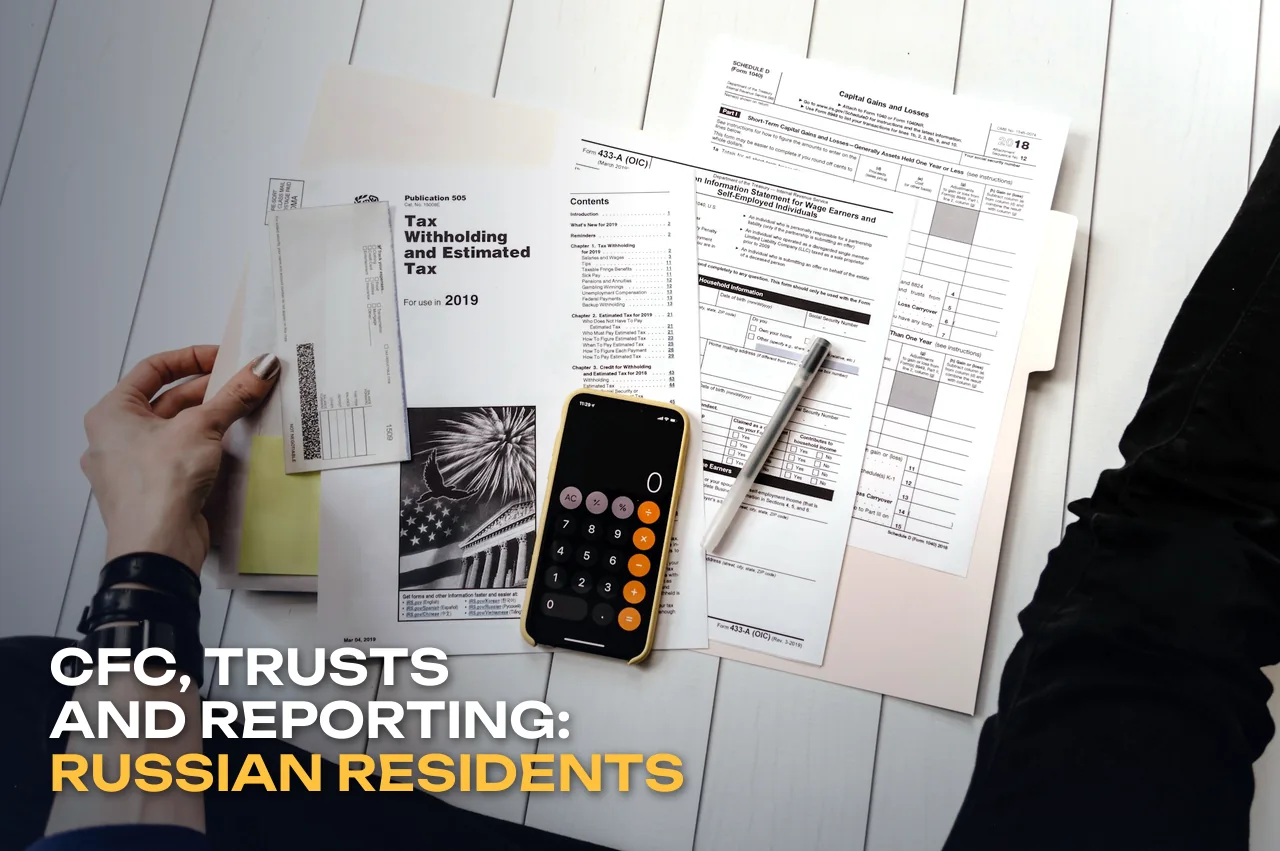 ArticleTrusts and foreign companies of Russian residents: CFC rules, notifications and tax
 ArticleBeneficial ownership registers: who sees the owner of a company or trust in the EU, UAE and offshore
 AnalysisA Second Passport and Banks: What It Solves and What It Does Not
News+3 stories on 11 November
Related news
 Saint Lucia · 11 NovSaint Lucia replies to the EU on its citizenship programme: letter withheld, programme open
 Greece · 11 NovGreece introduces a 10% tax on cryptocurrency gains from 2027
 Malaysia · 11 NovMalaysia reopens DE Rantau on 1 December: up to four years, but USD 36,000 for tech roles
Personal programme selection is conducted by Anna Kovalevskaya, Head of Legal, BRIDGES.
Have accounts abroad? Write to us and we will check residence and notifications
We will reconcile self-certification, tax authority notifications and source of funds documents for each bank.