BRIDGES Insights · Russia
Telling the state about a second passport and a foreign account: the decision stays with you

Updated: October 2026·11 min read·Expert reviewed
Terms and costs verified: October 2026
Contents
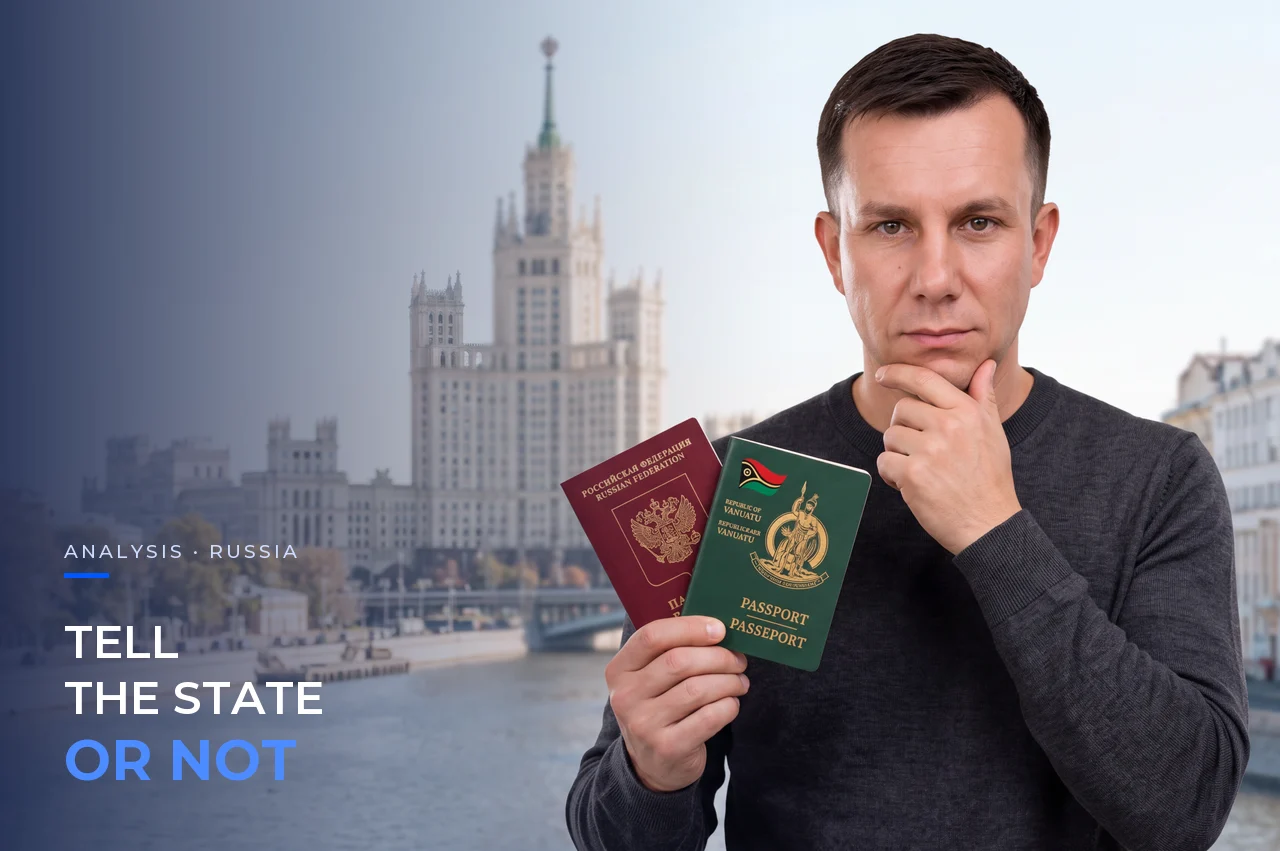
The most common question after a passport arrives is not "where shall we fly" but "do I have to tell the state". My clients split almost exactly in half: half notify the Ministry of Internal Affairs and the tax service in the first month, half do not. I will not advise here, and not out of politeness. This decision is about your risk and your life, and it is yours to make. My job is different: to lay out everything that is known, without scare stories and without fairy tales. The choice is then yours.
In brief
- A Russian citizen reports a second citizenship or residence permit to the Ministry of Internal Affairs within 60 days. If you are abroad, the period runs from entering Russia.
- A currency resident reports an account with a foreign bank to the tax service within a month.
- Failing to notify the Ministry is a criminal offence: a fine up to RUB 200,000 or up to 400 hours of community work.
- Failing to notify the tax service is an administrative fine of RUB 4,000-5,000.
- Our clients split roughly 50/50. We give no advice: the decision is yours.
What the law requires
In short: a second passport or residence permit goes to the Ministry within 60 days, a foreign account to the tax service within a month. The cost of a mistake differs: a criminal article in the first case, a fine in the second.
Two different obligations, two authorities and two very different costs of getting it wrong. They are constantly confused, so here they are in one table.
| Second citizenship or residence permit | Account with a foreign bank | |
|---|---|---|
| Who is told | Ministry of Internal Affairs | Federal Tax Service |
| Law | Citizenship Law 138-FZ, Article 11 | Currency Regulation Law 173-FZ, Article 12 |
| Deadline | 60 days from receipt, or from entering Russia if you were abroad | 1 month from opening |
| Late filing | RUB 500-1,000, Article 19.8.3 of the Administrative Code | RUB 1,000-1,500, Article 15.25(2) of the Administrative Code |
| Not filing | criminal Article 330.2: a fine up to RUB 200,000 or up to 400 hours of community work | RUB 4,000-5,000, Article 15.25(2.1) |
| Lawful exemption | none; the duty arises on entering Russia | more than 183 days abroad in a year |
What this means for you. A mistake with the account costs a few thousand roubles. A mistake with citizenship is a criminal article. They are not the same and are best decided separately.
Why the state wants this information
In short: the Ministry needs the data to enforce restrictions on people with a second citizenship, the tax service to see money and taxes.
The state wants to know more and more about its citizens, and frankly I am not happy about it. But each requirement has its own logic, and it is useful to understand it.
- The Ministry keeps track of those who hold a second passport or residence permit. A person with a second citizenship cannot be a civil servant, a member of parliament or a judge, or hold a number of posts. The notification makes these restrictions work.
- The tax service follows the money: where it came from, where it went, whether tax is paid on interest and income abroad. The account notification is the entry into currency control.
- Data exchange. Some countries exchange financial information with Russia. The tax service may learn of the account without you, or may not. It depends on the country.
What this means for you. The state does not ask out of curiosity. Behind each requirement are specific restrictions or taxes, and those are what you should measure against yourself.
How the state finds out on its own
In short: there are several ways, and none depends on your willingness to tell.
The first thing to understand: a citizen enters and leaves Russia on the Russian passport. You do not show the second passport at the border. That does not mean nobody knows about it.
- Banks and data exchange. When you open an account abroad, the bank asks for all your citizenships and tax residence. Some countries pass such data to Russia under automatic exchange, some have suspended it. You will not know in advance which data will arrive.
- Documents you file in Russia yourself. Inheritance, property deals, children's paperwork, notarised powers of attorney. In forms and document checks the second passport surfaces more often than people think.
- People around you. Former partners, ex-spouses, competitors. In a dispute, information about a second citizenship becomes an argument against you.
- Public portals and consulates. If you have ever filed documents as a foreigner or registered a child at a consulate, a trace remains.
I am not trying to scare anyone. I am saying that "nobody will find out" is a bet, not a plan. A bet can be made consciously if you know what losing costs.
What this means for you. When deciding not to notify, start not from "nobody will find out" but from "they may find out", and ask whether you are ready for that.
What notifying gives you
In short: notifying buys peace of mind and clean money, and you pay with visibility.
- Peace of mind. The law is complied with, there is no criminal risk, the record is clean.
- Freedom to enter. You can travel to Russia and live there without wondering what will surface at the next check.
- Clean money. An account known to the tax service is easier to use for large deals, property purchases and transfers home.
- Heirs. Declared assets are easier to pass on.
The price of notifying is that you are visible. You enter the list of people with a second citizenship, which closes the road to public service and might one day become the basis for new restrictions that do not exist today.
Why people do not notify
In short: people do not notify because they do not want to be on lists and because they live abroad. Not notifying the tax service can be lawful; not notifying the Ministry is lawful only until you enter Russia.
I will retell what I hear at meetings. Not as a recommendation, but as a picture.
- "I do not want to be on a list, and nobody knows what will be done with those lists tomorrow."
- "I live abroad and do not go to Russia." The law has its own logic here: if you received the passport abroad, the 60 days start only on entering Russia.
- "For the account, I spend more than 183 days abroad and am not obliged to notify." That is a direct lawful exemption.
- "The risk is small, and the account fine is less than a dinner."
Now the cost. Failing to notify the Ministry is not a fine on a receipt but criminal Article 330.2: up to RUB 200,000 or up to 400 hours of community work. A conviction, even with a fine, stays on your record: it is asked about in public service hiring, visa forms and bank checks. And if the passport was received abroad, the 60 days start from the first entry into Russia.
What this means for you. With a bank account a mistake costs money. With citizenship a mistake costs an entry in your record. That is the key difference to keep in mind.
- Notify≈50%50.0%
- Do not notify≈50%50.0%
BRIDGES observation of clients in 2023-2026
Six life situations
In short: the deadline and the duty itself depend on where you live and what exactly you received.
Most confusion comes from people trying on someone else's situation. "I was told I don't have to notify" - told by whom, and about what? Here is how it looks case by case.
| Your situation | Ministry of Internal Affairs | Tax service |
|---|---|---|
| You live in Russia and got the passport without leaving | 60 days from receipt | If you have a foreign account: a month from opening |
| You live in Russia and got the passport abroad | 60 days from your first entry into Russia | A month from opening the account |
| You live abroad and do not visit Russia | The duty arises only on entry | More than 183 days abroad a year: no notification |
| You got a residence permit, not a passport | The same: 60 days | Same rules for the account |
| Your child has a second passport | Parents notify | For the child's account, the legal representative |
| You gave up the second citizenship | You may file a notice of loss | On closing the account, a notice within a month |
What this means for you. Find your row. If you sit between two rows, for example half a year there and half here, go by the stricter one.
We will check notification deadlines for the whole family
Tell us who in the family received a second passport or residence permit and where accounts are held. We will send a deadline table for each person.
How our clients decide
In short: those whose life is in Russia notify; those who live abroad more often do not.
About half of our clients notify the Ministry in the first month and never think about it again. These are usually people who live in Russia, run a business here, own assets and return regularly. The other half do not notify. More often these are people who live abroad and come to Russia rarely or not at all.
People ask me: "What would you do?" I answer: I do not advise. I do not know where you will live in five years, what your business is or how you treat risk. I know something else: the decision must be a conscious one. The worst outcome is not choosing to notify or not, but simply forgetting, then entering Russia three years later without realising the law has already been broken. I see that more often than I would like.
Taxes on a foreign account
In short: notifying about an account and paying tax on its income are separate duties. You can notify and still break the law by not declaring the interest.
If you are a Russian tax resident, that is, you spent 183 days or more in the country in 12 months, interest, dividends and other income abroad are taxed in Russia. You calculate the tax yourself: the 3-NDFL return is filed by 30 April of the following year and the tax paid by 15 July. The rate for such income is 13%, and 15% on the part above RUB 2.4 million a year.
If tax has already been withheld in the country of the account, it can be credited where a double tax treaty applies and you have confirmed the withholding with a bank document.
A separate matter is the annual cash flow report by 1 June. It is filed even when there is no tax. All the steps are in our guide to notifying the tax service of a foreign account.
What this means for you. If you decide to notify about the account, finish the job: the notice, the 1 June report and the income return. Half the way protects less than it seems.
If you decide to notify
In short: two notices, two authorities, four ways to file. It takes one evening.
- Ministry of Internal Affairs: at the migration unit, through the Gosuslugi portal, at a consulate abroad or through a representative with a notarised power of attorney. Deadline 60 days.
- Tax service: through the taxpayer's online account on form KND 1120107. Deadline one month.
- Parents file the Ministry notification for their children.
- Keep the confirmation of receipt: a coupon, a stamp or a receipt.
I will review your situation: no advice, only facts
Describe where you live, where you travel and which documents you have received. I will show which obligations actually arise and when.
Where people go wrong most often
In short: people go wrong not in the choice but in the details.
- Mixing up the Ministry and the tax service. They told the tax service about the account and think "everything is reported". That is not a report about citizenship.
- Forgetting the children. Parents file for minors. Missing a child's notice is also a breach.
- Counting from the wrong date. For the Ministry it is the date of receipt or first entry into Russia; for the tax service, the account opening date.
- Notifying about the account but skipping the 1 June report. That is a separate duty with a separate fine.
- Deciding the same for the whole family. Spouses and children may have different situations and deadlines.
What to check for yourself
In short: five questions after which the decision will be yours, not accidental.
My list
- Where I live most of the year and how many days I spent in Russia in the last 12 months
- Which documents I received: passport, residence permit, for whom in the family
- When I last entered Russia and whether I plan to
- Whether I have foreign accounts and when they were opened
- Whether I work, or plan to, where a second citizenship is prohibited
What to remember
- Two obligations, two authorities, two costs: the Ministry means a criminal article, the tax service an administrative fine.
- The Ministry deadline is 60 days, or from entering Russia if you are abroad.
- The tax service deadline is a month; the exemption is more than 183 days abroad in a year.
- You make the decision. What matters is making it consciously, not forgetting it.
- To be continued: next time we look at what happens to notifications when you change your country of residence.
How this material was prepared
Prepared by Sergey Evdokimov, Managing Partner at BRIDGES. Rules were checked against the Citizenship Law, the Currency Regulation Law, the Tax Code, the Administrative Code and the Criminal Code on 11 October 2026. The share of clients who notify is our observation for 2023-2026.
- Notification of a second citizenship or residence permit - Federal Law of 28.04.2023 No. 138-FZ on Citizenship of the Russian Federation, Article 11; Ministry of Internal Affairs procedure.
- Liability - Article 19.8.3 of the Code of Administrative Offences and Article 330.2 of the Criminal Code.
- Foreign account notification - Federal Law No. 173-FZ, Article 12; Federal Tax Service Order of 26.04.2024 No. SD-7-14/349@.
- Account fines - Article 15.25 of the Code of Administrative Offences.
- Breakdown of client decisions - our practice.
- All facts checked on 10 October 2026.
Frequently asked
Questions people ask before deciding
01Must I notify the Ministry of a second citizenship?
Yes, for a Russian citizen it is an obligation under Article 11 of the Citizenship Law. The deadline is 60 days from receiving the document, or from entering Russia if it was received abroad.
02What happens if I do not notify the Ministry?
For late filing, a fine of RUB 500-1,000. For not filing, criminal Article 330.2: a fine up to RUB 200,000 or up to 400 hours of community work.
03Do I report a residence permit?
Yes. The obligation also covers a residence permit or other document of permanent residence abroad.
04What happens if I do not notify the tax service of an account?
An administrative fine of RUB 4,000-5,000, or RUB 1,000-1,500 for filing late.
05What do you advise?
We give no advice. We show the obligations, deadlines and the cost of each decision. The client decides.
06Will a border guard learn about the second passport?
A citizen enters Russia on the Russian passport and does not show the second one. But it can come to light through bank data, documents and transactions in Russia.
07Do I report a residence permit if I do not live there?
Yes. The law refers to receiving a residence permit or other document of permanent residence, not to actually living there.
08Do I pay tax on interest from a foreign deposit?
If you are a Russian tax resident, yes: the 3-NDFL return by 30 April, tax by 15 July, 13% and 15% on income above RUB 2.4 million.
09Can I notify the Ministry after missing the deadline?
Yes. Late filing carries a fine of RUB 500-1,000, which is milder than the consequences of not filing.
About the author
Related materials
What to read next
 ArticleNotifying the Russian tax service of a foreign account: deadline, form and fines in 2026
 ComparisonAntigua and Barbuda or Grenada: Family Passport for Large Families in 2026
 AnalysisWhat is due diligence and why the Caribbean is rejecting applications
Personal programme selection is conducted by Anna Kovalevskaya, Head of Legal, BRIDGES.
We will review your obligations to the Ministry and the tax service
Where you live, where your accounts are, which documents you hold: we show what the law requires of you and when.