News · Montenegro
Montenegro: residence with the right to work for EU citizens investing from EUR 250,000
Updated: October 2026·12 min read·Expert reviewed
Terms and costs verified: October 2026
Contents
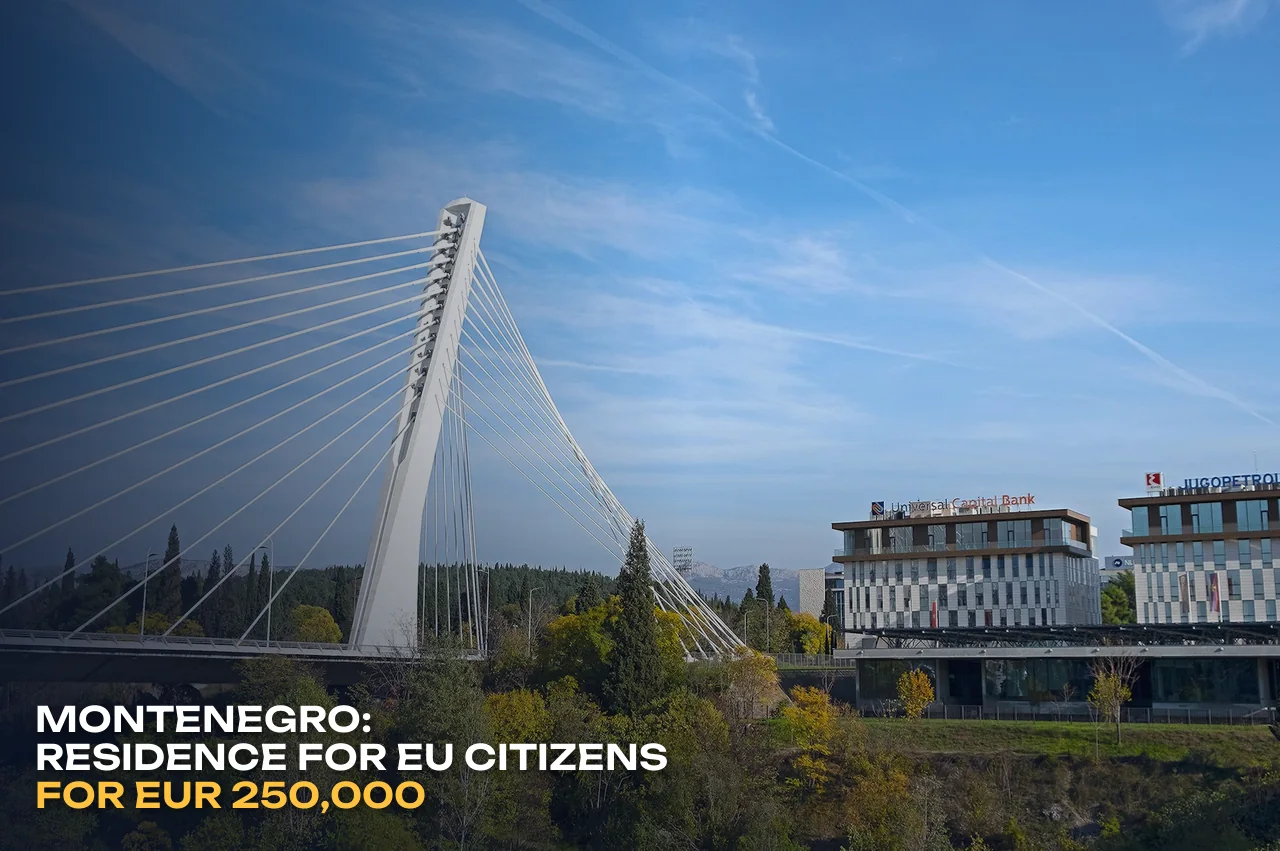
From 27 October 2026 Montenegro has a new ground for residence: an EU citizen who has invested at least EUR 250,000 in a Montenegrin business can get a residence and work permit for up to three years. Parliament adopted the amendments to the Law on Foreigners on 15 October, and the text was published in the official gazette on 19 October. I have read the new article in full and explain who it suits, what counts as an investment, how this path compares with the usual grounds, and what the law does not yet say.
In brief
- The Law amending the Law on Foreigners was adopted by the Parliament of Montenegro on 15 October 2026 and published in the Official Gazette of Montenegro No. 154/2026 of 19 October.
- The law enters into force on the eighth day after publication, that is, on 27 October 2026.
- The new article follows Article 70v, so it is Article 70g. It gives an EU citizen a temporary residence and work permit for an investment of at least EUR 250,000.
- What counts: capital put into a Montenegrin company, buying a stake, or money held in escrow until it goes into an approved venture. Buying a home is not on the list.
- The permit is issued for up to three years and renewed for another three. Family can join. The holder must spend at least 15 days in the country during the permit term.
- The new article does not apply to non-EU nationals: the existing grounds remain for them.
What the new article says
The amendments are extensive: 55 articles. Most of them deal with illegal employment of foreigners, protection of exploited workers, returns and fines for employers. The investment ground takes up one article, but for our readers it is the most interesting one. The law inserts it after Article 70v under the heading Employment of an EU citizen in connection with investing in Montenegro.
In essence: a temporary residence and work permit in connection with investment may be issued to a sole trader or company owner who is an EU citizen. The applicant must meet the general conditions in points 4 to 8 of Article 43(1) of the law and provide proof of having invested at least EUR 250,000 in Montenegro. Those general conditions are a valid passport or identity card, no entry ban, no prison sentence of more than six months in Montenegro or in the country of origin, and no threat to security or public health. For the conviction point you will need a criminal record certificate from your country of citizenship.
| Condition | What the law says |
|---|---|
| Who can apply | a sole trader or company owner who is an EU citizen |
| Minimum amount | EUR 250,000 invested in Montenegro |
| What counts | capital put into a new or existing Montenegrin company, buying a stake in one, money held in escrow until it goes into an approved business venture |
| Source of funds | must be proven |
| Permit term | up to 3 years, renewable for another 3 years |
| Right to work | yes, it is a temporary residence and work permit |
| Family | close family members can join |
| Presence in the country | at least 15 days during the permit term |
| In force from | 27 October 2026 |
A renewal application goes to the Ministry of Interior at the place of residence no later than 30 days before the permit expires. It must include a valid passport or an EU identity card issued by a member state and proof of investments made. Those last words matter: at renewal the authorities will check not a promise to invest but that the money has actually been invested.
What this means for you. This is a full residence and work permit, not a property-based permit. A company owner can work in their own business in Montenegro legally from day one.
Who the new ground suits
EU citizens only. The article says so three times: in the condition for issue, in the renewal rules and in the presence requirement. A non-EU national with the same amount and the same business cannot apply under this article.
Who benefits in practice? Entrepreneurs from EU countries who want to move part of their business to the Adriatic. And people who already hold a second EU citizenship, for example those who have obtained Bulgarian citizenship, Hungarian citizenship, or Greek, Romanian or another EU nationality, but want to live and do business in Montenegro. For them the new article opens a three-year permit instead of annual renewals.
If you do not yet have an EU passport and are choosing where to start, a comparison of two popular options is in the article on Bulgaria and Hungary. EU citizenship gives the freedom to live and work across the Union, and with the new article also a more convenient investor status in Montenegro.
What this means for you. If you hold an EU passport and plan a business in Montenegro, the new article is for you. If you do not, look at the usual grounds: a company, property or remote work.
Need residence in Montenegro? Write to us and we will handle it
Describe your situation briefly and we will tell you where to start.
What counts as an investment and what does not
The law names three forms of investment. The first is a direct capital contribution to a new or existing company registered in Montenegro. The second is buying a stake in a Montenegrin company. The third is placing money in an escrow account until it is directed into an approved business venture in Montenegro. In all three cases you must prove the source of funds.
Property purchases are not on the list. A EUR 300,000 flat in Budva does not count as an investment under this article. Homeowners keep a separate ground, which we covered in our news item on the new Law on Foreigners. If a company buys a hotel or commercial premises for its business, the question becomes how the capital contribution is structured. I would check such arrangements with a lawyer before the deal.
The escrow option is convenient if the business is only starting: the money sits in a special account and goes into the project as it becomes ready. But the law speaks of an approved venture and does not say who approves it or how. The answer will most likely come from ministry practice and secondary rules. For now I would rely on a direct capital contribution or a share purchase: these are easier to prove both at issue and at renewal.
For a capital contribution the company must be registered and have a bank account. It is best to prepare company registration and a corporate account in parallel: the bank will also ask about the source of funds, and one set of documents saves time.
What this means for you. Only investment in a business counts. The money must pass through a Montenegrin company, and its origin must be documented.
How the new path differs from the usual residence grounds
Until now a foreigner in Montenegro had several familiar grounds. Property owners get a permit based on ownership: since January 2026 non-EU nationals need a tax valuation of at least EUR 150,000, while EU, EEA and Swiss citizens are exempt from the threshold. Entrepreneurs register their own company and work in it as director. Remote workers use the digital nomad status. All these grounds are described in detail in the article on Montenegro residence permits.
| Ground | Who can use it | Permit term | What to watch |
|---|---|---|---|
| Investment from EUR 250,000 (new article) | EU citizens only | up to 3 years plus 3 | the money must genuinely go into a business |
| Property | everyone; for non-EU nationals a tax valuation from EUR 150,000 | up to 1 year, renewed annually | a right to live, not a ground to work |
| Own company and work as director | everyone | up to 1 year, renewed annually | the company must operate, not exist on paper |
| Digital nomad | remote employees and freelancers with income from abroad | under the category rules | no work on the local market |
The main difference is the term. Under the law, an ordinary temporary residence permit and a residence and work permit are issued for up to one year and must be renewed every year. The new article gives up to three years at once and another three on renewal. For an investor that means fewer visits to the ministry, fewer certificates and less risk of missing a deadline.
The second difference is the reference to the general conditions. The ordinary grounds require all the conditions of Article 43: means of subsistence, accommodation, health insurance, documents and no obstacles. The new article refers only to points 4 to 8, that is, documents, no entry ban, no convictions and no security threats. The points on means, accommodation and insurance are not mentioned. How the ministry reads this will become clear from the first applications. I would still prepare a full set.
The third difference is presence. A minimum of 15 days over the entire permit term is a light requirement compared with the usual logic of temporary residence, where long absences put renewal at risk. More on this below.
If you are comparing Montenegro with its neighbours, see the articles on Serbia and Montenegro and on Montenegro and Greece. The path through your own company is covered in detail in our guide to Montenegro residence through a company.
What this means for you. For an EU citizen with a business plan the new article is more convenient than the director route: three years instead of one. For a flat owner without a business, the property ground remains simpler and cheaper.
The investor's family
The law says it directly: close family members may join an EU citizen holding an investment permit for family reunification. Who counts as close family is defined in the Law on Foreigners in the article on family reunification: spouses, their minor children, including children of one spouse and adopted children, and parents or adoptive parents of minor children. In exceptional cases the law also allows other relatives for personal or humanitarian reasons.
Family members apply for a reunification permit. As a general rule it runs no longer than the permit of the person they join. They will need marriage and birth certificates with an apostille and a sworn translation. EU citizens in the family keep their own status and rights. How to gather documents for the whole family and in what order to apply is described in our guide to residence for families.
What this means for you. Family can be included. Prepare marriage and birth documents early: the apostille and translation take longer than you expect.
Taxes: what changes and what does not
The new article does not change taxes. Tax consequences arise from the investment itself and from where you actually live. A company in Montenegro pays corporate income tax on a progressive scale: under Montenegrin law the rate rises with the size of the profit, from 9% on small profits to 15% on large ones. Dividends, the director's salary and contributions are taxed separately, and the total burden is best calculated for your specific structure.
A residence permit does not by itself make you a Montenegrin tax resident. Tax residence depends on where you actually live: your home, your centre of vital interests and the number of days spent in the country in a year. If you spend 15 days in Montenegro over three years and live in your EU country, you will most likely remain tax resident there. If you genuinely relocate, your residence may move to Montenegro. To confirm your status with a bank or tax office you will need a tax residency certificate.
What this means for you. Before investing EUR 250,000, calculate the taxes for the company and for you personally in both countries. A mistake about tax residence costs more than advice before the deal.
15 days of presence and the absence rule
The requirement to spend at least 15 days in Montenegro over the entire permit term is the lightest of all Montenegrin grounds. It is designed for an investor who manages a business and visits the country from time to time.
But the Law on Foreigners also contains general rules on when a residence and work permit lapses, including an absence from the country of more than 30 days without notifying the police. The new article does not say directly whether these rules apply to investors. The logic of the amendments suggests that the special 15-day rule should take priority, but ministry practice will settle it. Until the first decisions I would notify the police of long trips and keep proof of travel.
What this means for you. 15 days is a minimum, not a goal. If the business in Montenegro operates and you take part in it, there will be fewer questions at renewal.
What is still unclear
- Who approves the business venture when the money sits in escrow, and on what criteria.
- Which documents the ministry will accept as proof of the investment and of its completion at renewal.
- Whether an investor must prove means of subsistence, accommodation and insurance, even though the article does not refer to those points.
- Whether years under this permit count towards permanent residence in the same way as under other grounds.
- What happens after six years: a new permit under the same article or a switch to another ground.
Secondary rules and the first decisions will answer these questions. We are following the practice and will update this article when guidance appears. How costs and timelines are formed in such matters is explained in our guide on calculating costs and timelines.
What to do if you are an EU citizen considering an investment
Check your citizenship and documents
An EU passport or identity card, a criminal record certificate from your country of citizenship and country of residence, family documents with an apostille and translation.
Choose the form of investment
A new company, a stake in an existing one, or escrow. For a first application a direct capital contribution or share purchase is more reliable.
Prepare proof of source of funds
Statements, contracts, tax returns, documents on asset sales. Without them the investment will not be accepted.
Register the company and open an account
The contribution must pass through a Montenegrin company. The bank will check the same documents as the ministry.
Apply for the permit and add your family
Once the investor has a permit, apply for family reunification. Renewal no later than 30 days before expiry.
If you first want to understand whether the new article suits you or another ground is better, book an online consultation. General information about the country and all programmes is on the Montenegro page, and other BRIDGES services are on the home page.
Want Montenegro residence through investment? We will help you get it
We set out each step from the first documents to the final status, with timings.
Daniel KovachSenior International Law Attorney, BRIDGES
How this article was prepared
The article is based on the text of the Law amending and supplementing the Law on Foreigners, adopted by the Parliament of Montenegro on 15 October 2026, signed by the President on 16 October and published in the Official Gazette of Montenegro No. 154/2026 of 19 October 2026 (registration number 2625, in force from 27 October 2026), and on the current Law on Foreigners of Montenegro: Articles 43, 44, 65 and 83 on general conditions, family and lapse of permits. The EUR 150,000 threshold for property-based residence comes from the amendments that took effect in January 2026. Corporate income tax rates are taken from the Montenegrin corporate income tax law; we calculate the total burden for each specific structure. There are no secondary rules for the new article yet. This article does not replace advice on your own situation.
Share this article
Frequently asked
Questions people ask before deciding
01From what date does the new ground apply?
The law was published in the Official Gazette of Montenegro No. 154/2026 on 19 October 2026 and enters into force on the eighth day, 27 October 2026.
02Can a non-EU national apply?
No. The article covers EU citizens only. Others keep the existing grounds: a company, property, employment or digital nomad status.
03Can I buy a EUR 250,000 flat and get this permit?
No. The law counts only a capital contribution to a Montenegrin company, buying a stake or money held in escrow until it goes into an approved business venture. Homeowners have a separate ground.
04How long is the permit issued for?
Up to three years, renewable for another three. A renewal must be filed no later than 30 days before expiry, with proof of investments made.
05Can my family be included?
Yes. Close family members can join the investor through family reunification: a spouse, minor children and other persons the law treats as close family.
About the author
Related materials
What to read next
 ComparisonSerbia or Montenegro: which residence permit to choose for relocation in 2026
 ComparisonMontenegro or Greece: Residence Permit by the Sea - Balkans or EU in 2026
 NewsMontenegro visa for Russians from 1 November 2026: who needs it and how to apply
News+6 stories on 26 October
Related news
 Montenegro · 13 OctMontenegro visa for Russians from 1 November 2026: who needs it and how to apply
 Montenegro · 11 OctMontenegro's new Law on Foreigners: property residence from €150,000 stays
 Austria · 25 OctAustria: Ukrainians with temporary protection can get a regular residence permit without leaving the country
Personal programme selection is conducted by Anna Kovalevskaya, Head of Legal, BRIDGES.
Need residence in Montenegro? Write to us and we will handle it
We break the costs down item by item: mandatory payments, fees and services, with nothing hidden.
