News · Malta
Malta raises its tourist eco-contribution to EUR 8 and EUR 10 a night from 2027

Updated: October 2026·10 min read·Expert reviewed
Terms and costs verified: October 2026
Contents
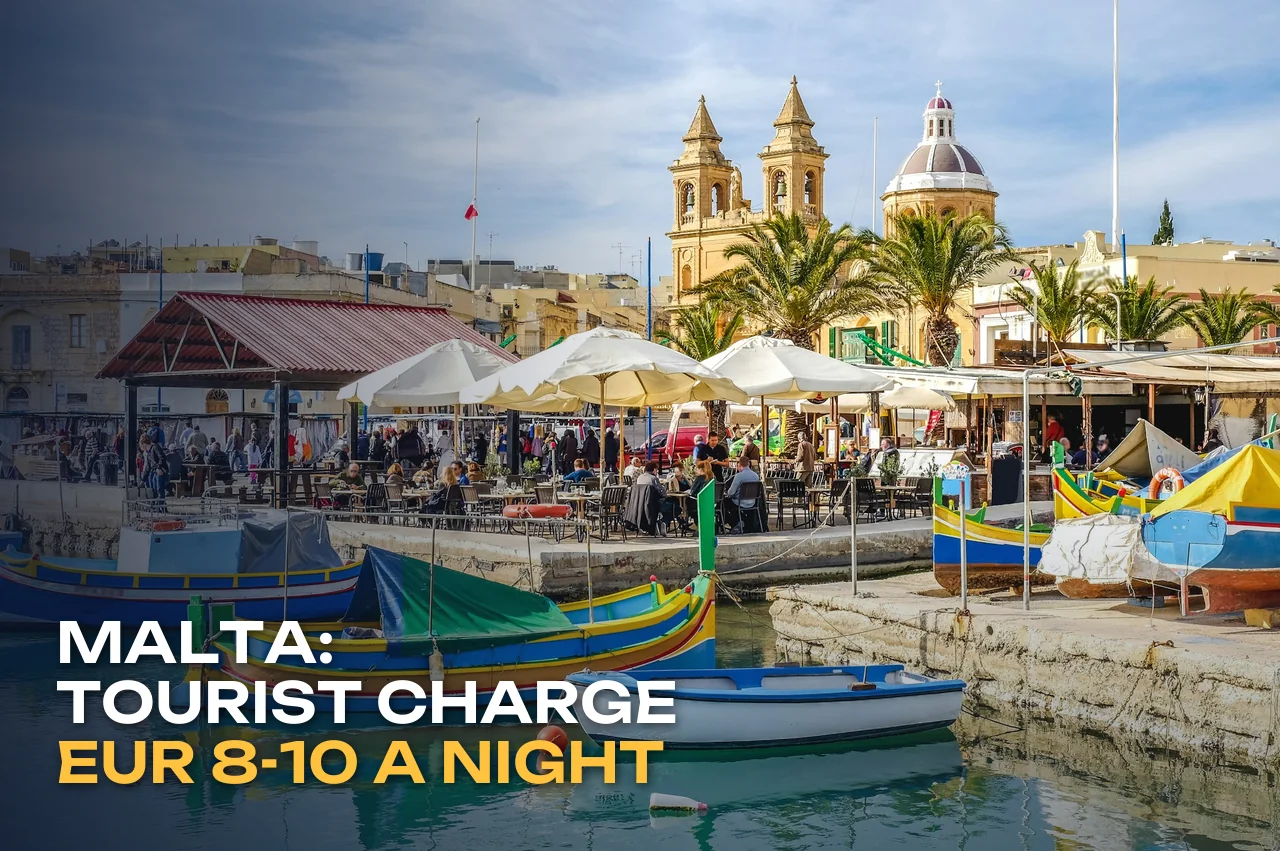
From 1 January 2027 Malta will raise its tourist eco-contribution to EUR 8 a night in hotels and EUR 10 a night in short-let flats, up from EUR 1.50 now. Finance Minister Clyde Caruana announced this in the 2027 budget on 26 October 2026. For a couple, a week's holiday will cost roughly EUR 90-120 more because of the charge alone. I explain how the charge will be calculated, who is exempt and what it means for owners who let flats to tourists.
In brief
- From 1 January 2027 the eco-contribution for tourists aged 18 and over will be EUR 8 a night in hotels and other collective accommodation, capped at EUR 64 per person per trip.
- In short-let accommodation, including flats booked through online platforms, it will be EUR 10 a night, capped at EUR 80 per person.
- The charge is currently EUR 1.50 a night; before that it was EUR 0.50.
- Foreign students at English language schools are exempt. The government expects about EUR 182 million a year and promises to spend it on tourism infrastructure.
- Hoteliers and Gozo tourism associations criticised the measure; the final rules will be set in a legal notice.
How much tourists will pay
The charge is paid by adult tourists for each night, but with a cap per trip. In a hotel the cap is reached on the eighth night: 8 nights at EUR 8 is EUR 64, after which nothing more is due. In short-lets the cap also corresponds to eight nights: 8 at EUR 10 is EUR 80. So long stays are cheaper per night, while short breaks see the sharpest rise.
| Where the tourist stays | Now | From 1 January 2027 | Cap per trip |
|---|---|---|---|
| Hotel and other collective accommodation | EUR 1.50 a night | EUR 8 a night | EUR 64 per person |
| Short-let accommodation, including flats booked via online platforms | EUR 1.50 a night | EUR 10 a night | EUR 80 per person |
| Foreign students at English language schools | pay | exempt | - |
| Children and teenagers under 18 | do not pay | do not pay | - |
Let us work through a few typical trips. A couple on a weekend break, 3 nights in a hotel: 2 people times 3 nights at EUR 8 is EUR 48 instead of EUR 9 now. A week in a hotel, 7 nights for two: EUR 112 instead of 21. Two weeks in a rented flat: each person pays at most EUR 80, so EUR 160 for two instead of 42. A family with children under 18 pays only for the adults.
The minister did not explain in detail why short-lets carry a higher rate, but the budget's logic is clear: Malta has long been trying to curb the growth of flats taken off the long-term rental market and let to tourists. A higher charge makes such lets slightly more expensive for the guest and slightly less attractive for the owner. As now, the host collects the charge and pays it to the state.
What this means for you. If you are planning a trip to Malta in 2027, budget EUR 8-10 a night per adult on top of the accommodation price. For stays longer than a week the cap limits the total.
Why Malta is raising the charge
Malta introduced the eco-contribution in 2016; the money goes into a fund that finances regeneration and tourism infrastructure projects. The current EUR 1.50 rate is one of the lowest among Mediterranean resorts. The new EUR 8-10 puts Malta near the top of the European list alongside major cities, although the per-trip cap softens the blow for those who come for longer.
The government links the decision to the pressure tourism puts on a small island: Malta is one of the most densely populated countries in the EU, and in recent years tourist numbers have been several times the resident population. The Finance Ministry estimates the charge will bring in about EUR 182 million a year. The same budget announced new charges for foreign workers from outside the EU; we covered them separately: Malta's budget raises charges for non-EU residents.
What this means for you. The charge is a visitor fee, not a property tax. It does not affect the terms of residence, permanent residence or buying property, but it does affect the yield of flats let to tourists.
What it means for owners who let flats
For owners who let flats to tourists the news cuts both ways. On the one hand, the guest pays the charge on top of the price, so on paper the owner's income does not change. On the other hand, the guest compares the full cost of the trip. A difference of EUR 2 a night per person between a hotel and a flat is small, but for a family of four adults for a week it is already EUR 56. The Gozo Tourism Association openly criticised the fact that short-lets are charged more than hotels.
If you are buying property in Malta with nightly lets in mind, bear in mind that the state is steadily tightening this segment. We covered the general rules on buying and taxes in our pieces on Malta real estate and Malta property taxes. How to calculate rental yield including charges is explained in the glossary. Other countries are taking similar steps: we covered short-term rental rules in Cyprus in the article on short-term lets in Cyprus, and yields in Greece in a separate piece.
If you hold permanent residence in Malta under the MPRP or a nomad residence permit, the eco-contribution does not apply to you as a resident: it is paid by guests at accommodation. But relatives and guests who stay in a hotel or a rented flat will pay the new rates.
What this means for you. Owners of tourist lets should recalculate 2027 yields given that the trip will cost guests more. The charge does not apply to long-term lets.
How the charge is collected and what hosts must do
Since 2016 Malta's eco-contribution has been collected by the accommodation provider: a hotel, guesthouse or a flat owner licensed by the tourism authority. The host collects the charge from the guest, issues a receipt and pays the money to the state. According to the budget announcement, the new rates do not change this procedure; only the amount changes. For flat owners this means that from 2027 they will have to collect noticeably more money from guests, and any accounting mistakes will be more costly.
In Malta, letting to tourists is allowed only with a tourism authority licence. Unlicensed flats let through online platforms remain a breach, and the higher charge is likely to lead to more inspections: the state has an interest in every night being recorded. If you own a flat and are considering nightly lets, start by checking whether a licence can be obtained for your building and area. Separate rules apply in apartment blocks, where the decision may depend on neighbours and the management company.
A question the budget has not yet answered concerns day visitors and cruise passengers. They do not stay overnight on the island and are not covered by the current eco-contribution. The minister's speech said nothing about them, so there is no basis to assume cruise passengers will pay. It is also unclear how the charge will apply to guests staying in Malta for a month or longer under a lease: under the logic of the current rules, long-term lets are not subject to the charge, but the exact boundary will be set by the legal notice.
What this means for you. If you let a flat to tourists, check your licence and guest records now. In 2027 the charge will be 5-7 times higher, and mistakes will be more visible to guests and inspectors alike.
Buying property in Malta to let? We will work out the yield
We will factor in the new charges, taxes and demand and send you a calculation.
Malta is not alone: tourist charges in Europe in 2027
Rising tourist charges in 2027 are a Europe-wide trend. Cities and regions use them to pay for cleaning, transport and the protection of historic centres, and at the same time to curb mass tourism. Below are several decisions announced in recent months. The figures come from city authorities and tourism associations.
| Destination | What changes in 2027 | Status |
|---|---|---|
| Malta | EUR 8 a night in hotels, EUR 10 in short-lets | announced in the budget of 26 October 2026 |
| Venice | 72 charging days for day visitors instead of 60 | city decision of 15 October 2026 |
| Barcelona | city surcharge of EUR 6 from April 2027 | approved schedule |
| Basque Country | tourist tax from 1 January 2027 | approved |
| Vienna | accommodation tax of 8% from 1 July 2027 | approved |
| Amsterdam | tax rising to 16% in 2027 | city proposal |
For travellers the key point is that such charges are almost never included in the booking price: they are collected on site. So when comparing destinations, add the charge to the accommodation price. Similar payments are appearing outside Europe too: for example, Thailand plans an entry fee and a departure tax from 2027, and the UAE has long had a nightly tourism fee. Country pages are available for Spain, Italy and Greece.
What this means for you. If you are choosing where to go in 2027, compare the full cost of the trip including charges. Malta stops being a cheap option on this item, but it remains in Schengen and the euro area, which makes travel easier.
Why the tourism industry is unhappy
The Malta Hotels and Restaurants Association warned that raising the charge to EUR 8 a night could hurt the island's competitiveness. Its argument is that Malta competes for tourists with Greece, Cyprus, southern Italy and Spain, where charges are lower or linked to hotel category, and for family holidays a difference of a few dozen euros can decide the destination. The industry also feels it has been asked to carry too large a share of the budget's financial burden.
The Gozo Tourism Association separately criticised the higher rate for short-lets: the neighbouring island of Gozo has many small guesthouses and flats, and the gap with hotels is especially sensitive for them. The Malta Chamber of Commerce, by contrast, supported the higher charge, on condition that the money genuinely goes into improving tourism infrastructure rather than disappearing into the general budget. The government promises exactly that.
What comes next. Budget measures are usually adopted without major changes, but specific exemptions and the collection procedure may be refined after consultations with the industry. So the EUR 8 and EUR 10 rates and the EUR 64 and EUR 80 caps should be treated as the base case rather than final figures until the legal notice is published.
Entering Malta: what else to know
Malta is part of the Schengen area. Citizens of countries that need a visa still need a Schengen visa; the procedure is covered in the article on the Schengen visa for Malta and in our piece on the Malta visa for Russians. Since April 2026 the Entry/Exit System has been operating at Schengen external borders, while the launch of ETIAS for visa-exempt travellers has been postponed; details are in our news story on ETIAS timing and border checks and the article on EES and ETIAS. What changed in entry rules during 2026 is covered in the Malta visa in 2026.
What to do
Planning a trip in 2027
Add EUR 8 a night in a hotel or EUR 10 in a flat for each adult. Remember the per-trip caps: EUR 64 and EUR 80.
Booking ahead
The charge is collected on site at the rate for the date of stay, not the booking date. Stays after 1 January 2027 will be charged at the new rates.
Letting a flat to tourists
Recalculate the price and yield for 2027 and update the listing so guests see the charge in advance.
Buying property to let
Compare nightly and long-term letting, taking into account the charge and the restrictions on short-lets.
Watch for the legal notice
The collection procedure and exemptions will be fixed in a government document. We will update this story when it is published.
A country overview is on the Malta page and in the Malta guide. Living costs are covered in the article on the cost of living in Malta, daily life in life in Malta. Routes to an EU passport through Malta are described on the Malta citizenship page. To discuss a purchase or a move, book an online consultation; all BRIDGES services are on the home page.
Thinking of living in Malta? We will find the right status
We will compare permanent residence, tax statuses and the nomad permit.
Maria StavruReal Estate Analyst, BRIDGES
How this article was prepared
Sources: the Maltese Finance Minister's 2027 budget speech of 26 October 2026; budget analyses by audit firms; local press reports on the budget and tourism association reactions. Information on charges in other cities is based on announcements by city authorities and the European tourism association as of October 2026. The legal notice setting the new eco-contribution rates had not been published as of 27 October 2026. Trip calculations are our estimate based on the announced rates. This article does not replace a consultation.
Share this article
Frequently asked
Questions people ask before deciding
01How much will Malta's eco-contribution be in 2027?
EUR 8 a night in hotels, capped at EUR 64 per person per trip, and EUR 10 a night in short-lets, capped at EUR 80. It is EUR 1.50 now.
02Who is exempt?
Tourists under 18 and, according to the budget announcement, foreign students at English language schools. Residents of Malta do not pay.
03When will the new charge apply?
From 1 January 2027, once the legal notice is published. The rate depends on the date of stay.
04Is the charge included in the booking price?
Usually not: the accommodation collects it on site and pays it to the state.
05Does it apply to permanent residents of Malta?
No, it is paid by guests in hotels and rented accommodation. But guests of permanent residents who stay in such accommodation will pay.
About the author
Related materials
What to read next
 ArticleCost of living in Malta 2026: rent, groceries, family budget
 ArticleReal estate in Malta: prices, buying as a foreigner, AIP permission, and taxes
News+10 stories on 27 October
Related news
 Malta · 27 OctMalta: the 2027 budget raises charges for non-EU residents
 Malta · 16 OctMalta changes tax statuses for foreigners from 2027: a EUR 35,000 minimum and property from EUR 700,000
 Thailand · 23 OctThailand plans a THB 450 entry fee and a THB 1,000 departure tax: what changes for tourists and residents
Personal programme selection is conducted by Anna Kovalevskaya, Head of Legal, BRIDGES.
Buying property in Malta to let? We will work out the yield
We will factor in the new charges, taxes and demand and send you a calculation.
