News · Spain
Ibiza prepares a record EUR 4.2 million fine for tourist letting without a licence

Updated: October 2026·10 min read·Expert reviewed
Terms and costs verified: October 2026
Contents
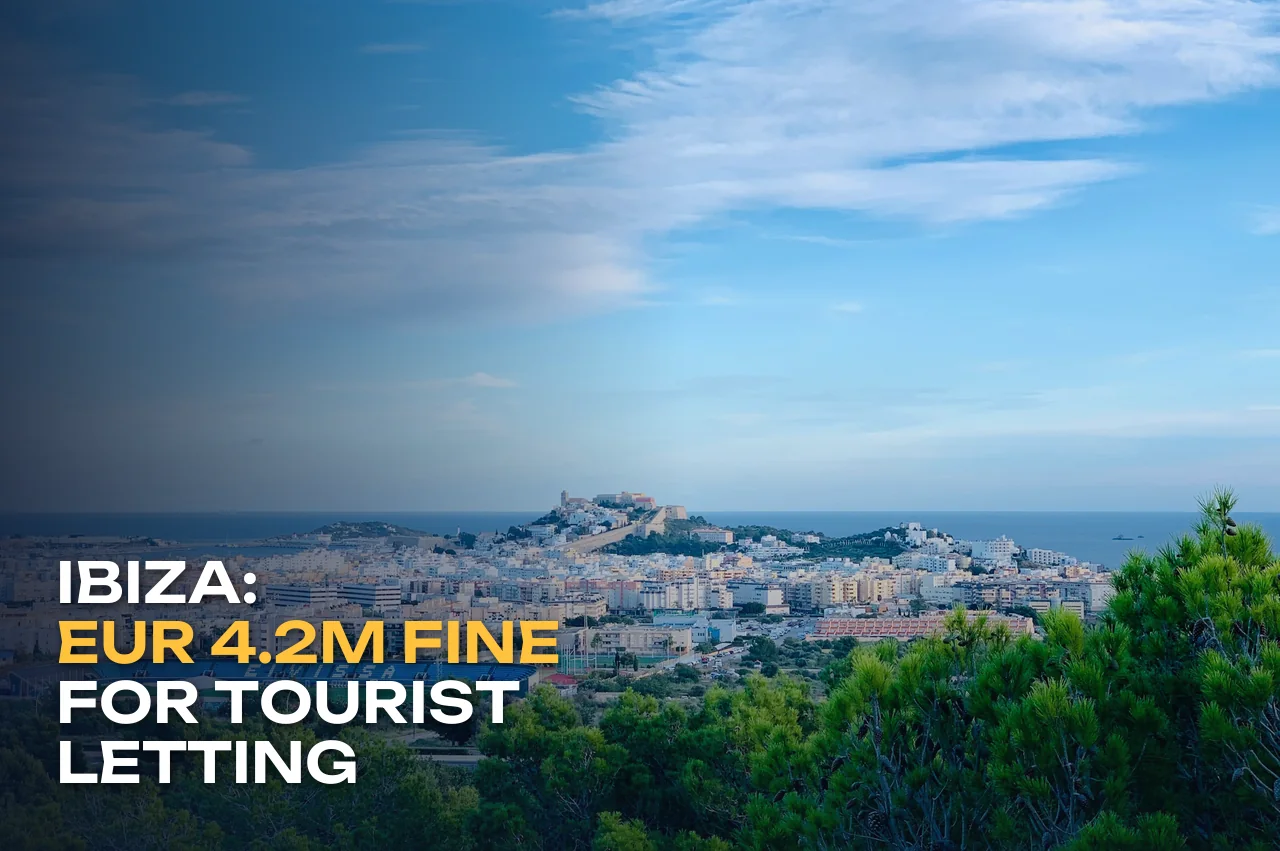
The city of Ibiza is preparing a record fine of EUR 4.2 million for letting a residential building to tourists without a licence. The amount equals 75% of the building's assessed value, about EUR 5.6 million. Mayor Rafael Triguero announced it on 21 October 2026; the fine still has to be approved by the city government. I explain the law behind the fine, why the Balearic Islands are so tough on illegal tourist rentals, and what to check if you are buying a home in Spain to let.
In brief
- On 21 October 2026 Ibiza mayor Rafael Triguero announced a EUR 4.2 million fine for illegal tourist rental in one residential building. It is a record for the city.
- The fine is calculated as 75% of the building's assessed value, about EUR 5.6 million. Under the Balearic planning law it can range from 50% to 100% of the value.
- The city government must formally approve the fine, in the coming weeks according to the mayor.
- From June to October 2026 the city inspected 99 homes, drew up 14 reports and sealed 7 flats.
- Earlier fines in 2025-2026 ranged from EUR 276,000 to 795,000. The latest, in June 2026, was EUR 793,443.

What happened
Ibiza mayor Rafael Triguero spoke about the fine on 21 October 2026 during the annual debate on the state of the city. It concerns a residential building that, according to the city hall, was used to house tourists without permission. The fine of EUR 4.2 million is based on the building's assessed value of about EUR 5.6 million, at a rate of 75%. The mayor stressed that this is the largest fine ever in the city's fight against illegal tourist rentals.
The decision is not yet final. The case must complete its procedure, after which the city government will approve the fine; the mayor expects this in the coming weeks. The owner is entitled to challenge the decision administratively and in court. The city hall has not named the owner or the address of the building, nor how many flats in it were let to tourists. The final decision will be published after approval by the city government.
| Indicator | Value |
|---|---|
| Fine | EUR 4.2 million for one building |
| Basis | 75% of the building's assessed value, about EUR 5.6 million |
| Status | awaiting approval by the city government in the coming weeks |
| Law | Balearic Islands Law 12/2017 on urban planning, article 167.4 |
| Fine range under the law | 50% to 100% of the building's value |
| Inspections June - October 2026 | 99 homes, 14 reports, 7 flats sealed |
| Earlier fines 2025-2026 | EUR 276,000 to 795,000 |
What this means for you. This is an announced, not an approved, fine. But the calculation itself shows what an owner risks: in the Balearics the fine for illegal tourist rental is based on the property's value, not on income.
The legal basis for the fine
The basis is Balearic Islands Law 12/2017 on urban planning. Its article 167.4 allows a change of a building's use without permission to be punished with a fine of 50% to 100% of its value. The authorities treat using a residential building as tourist accommodation without a licence as exactly such a change of use. That is why the fine is calculated not on income earned but on the building's value, and the amounts are far higher than under tourism legislation.
Balearic tourism rules apply in parallel. Homes may be let to tourists only with a licence and a registration number, and in apartment buildings on Ibiza new tourist rentals are effectively banned. The total number of tourist beds on the islands is capped, and new licences are rarely issued. Breaches of tourism rules carry their own fines, which the Ibiza island council also actively applies: in 2025 it collected more than EUR 3 million in such fines.
At national level, since 1 July 2025 Spain has had a single register of short-term rentals. Every listing on tourist platforms must carry a registration number, and platforms must remove listings without one. This has made inspections easier: the authorities can see which properties are being let without permission.
What this means for you. On Ibiza a fine for illegal tourist rental can equal half or all of the property's value. Buying a home for tourist letting without checking the licence is a direct financial risk.
How the city checks tourist rentals
According to the mayor, from June to October 2026 city inspectors checked 99 homes, drew up 14 breach reports and sealed 7 flats. Over 2025-2026 the city approved four fines for illegal tourist rental, from EUR 276,000 to 795,000. The latest, in June 2026, was EUR 793,443.74. The EUR 4.2 million fine is several times the previous record.
The city hall links its toughness to the housing crisis. Ibiza is one of the most expensive housing markets in Spain: local residents, doctors, teachers and seasonal workers cannot find affordable flats, and a large share of housing goes to tourist rentals. The mayor said the city leads in reducing illegal tourist supply. Palma de Mallorca, Barcelona, Madrid and other Spanish cities pursue similar policies.
| What to check | Why it matters |
|---|---|
| Tourist rental licence | without it you cannot let to tourists; whether it transfers with the property depends on island rules |
| Building type | in the Balearics tourist rental in apartment buildings is heavily restricted |
| Registration number | since 2025 listings on platforms in Spain must carry a number from the single register |
| Permitted use | changing a home's use without permission is grounds for a fine from 50% of value |
| Long-term letting | a legal source of income, but with rent increase limits in some areas |
Buying a home to let? We will check the rental rules before the deal
We will tell you whether the property can be let to tourists and what it can earn legally.
Igor VencReal Estate Managing Director, BRIDGES
What it means for home buyers in Spain
For a foreign buyer the main conclusion is simple: a tourist licence in the Balearics is a valuable asset in its own right, not a formality. If a property has none, you cannot count on short-term letting. If the seller says the flat can be let to tourists, this must be confirmed by documents: a licence, a registration number and a check that tourist rental is allowed in that particular building. The new owner bears the risk if this goes wrong.
Yields should therefore be calculated on long-term letting. Spain has a housing law that allows rent increases to be capped in stressed areas; see our story on the rent cap. How foreigners can rent is covered in our article on renting for foreigners, and prices versus wages in a separate story. The wider European picture is in our pieces on rent growth in Europe and rents in autumn 2026. The term rental yield is explained in the glossary.
Since 3 April 2025 Spain's golden visa for property purchases has been closed; more on the term is in the glossary. So buying a home in Spain no longer grants residence. For a move there remain non-lucrative residence for the financially independent, described in our guide, and the digital nomad visa with its own guide and blog article.
What this means for you. If you are buying a home in the Balearics as an investment, calculate income from long-term letting. Tourist letting is possible only with a licence, which new properties almost never get.
How a foreigner buys a home in Spain and what about taxes
Any foreigner can buy property in Spain; there are no nationality restrictions. A deal requires a foreigner identification number (NIE) and a Spanish bank account; the contract is signed before a notary, and ownership is recorded in the land registry. Before signing, a lawyer checks the registry extract: who the owner is, whether there are mortgages or charges, whether the description matches the cadastre, and whether the use has been changed without permission. It was this last point that proved decisive in the Ibiza case.
When buying a resale home in the Balearics you pay property transfer tax on a progressive scale, roughly 8% to 13% depending on the price. New builds carry 10% VAT and stamp duty instead. On top of that come notary, registration and legal costs. If the buyer does not live in Spain, they pay tax on rental income: 19% for EU residents and 24% for others. Even if the property is not let, a non-resident pays tax on deemed income from ownership.
These costs should be built into the calculation in advance. Together with the restrictions on tourist letting, they make buying on Ibiza for income less profitable than nightly rates on platforms suggest. The investment is more often justified if the property is for your own use, with letting as additional rather than main income.
Why the Balearics restrict tourist rentals
The Balearic Islands receive millions of tourists every year, and there is not enough housing for permanent residents. Island and city authorities have for several years capped the number of tourist beds, stopped issuing new licences in apartment buildings, and stepped up inspections and fines. The central Spanish government supports this direction too, having introduced the single register of short-term rentals and required platforms to remove listings without a number.
For owners with a legal licence this is rather a plus: competition from illegal properties is falling. For those who planned to let without permission, the risks have multiplied. The Ibiza fine shows that the authorities are ready to apply the harshest sanctions the law allows rather than stopping at warnings. We expect that once this fine is approved, other towns on the islands will treat it as a benchmark.
Short-term rentals in other countries
Spain is not alone. Almost all southern European countries popular with investors restrict tourist rentals. In Greece golden visa holders have been banned from short-term letting since 2024, and in October 2026 the migration minister promised to revoke visas for getting around the ban via sublets; see our story on golden visa revocations in Greece and our analysis of sublet schemes through companies. Cyprus requires a licence and registration, covered in our article on short-term rentals in Cyprus and the term on the licence.
If rental income matters to you, compare markets by long-term rental yield: in Greece and in Portugal. To choose a country to live in, see our comparisons Cyprus or Spain and Portugal or Spain. Everything about the country is on the Spain page.
If you already own a home in the Balearics
If you already own a flat or house on Ibiza, Mallorca or Menorca and let it to tourists, first check your documents: whether you have a tourist licence, whether the property is entered in the regional register and whether you have a number in Spain's single register. The number must appear in every listing on platforms. If there is no licence, it is safer to stop short-term letting and move to long-term letting with a contract under the Spanish residential tenancy law.
If a management company handles letting for you, find out who is responsible to the authorities. A fine under the planning law is issued to the owner, not the intermediary. If you receive a notice of inspection or a breach report, do not ignore it: deadlines for objections are short, and a lawyer may be able to get the amount reduced if the breach was a one-off or the property has already been brought into line.
What to do
Check the licence
Ask the seller for the tourist licence and registration number. Verify them in the official register.
Check the building
Find out whether tourist rental is allowed in that building. On Ibiza it is effectively banned in apartment buildings.
Recalculate the yield
Base your income on long-term letting. Unlicensed tourist letting can cost more than the property itself.
Check permitted use
Make sure the property is registered as housing and its use has not been changed without permission.
Use a lawyer
A legal check before the deal costs far less than a possible fine.
If you want to discuss buying property in Spain or another European country, book an online consultation; all BRIDGES services are on the home page.
Buying in Spain? We will check the property and the licence
We will check documents and rental rules before you sign.
Igor VencReal Estate Managing Director, BRIDGES
How this article was prepared
Sources: the speech by Ibiza mayor Rafael Triguero at the state-of-the-city debate on 21 October 2026; Balearic Islands Law 12/2017 on urban planning; Ibiza island council data on fines for illegal tourist rentals; the rules of Spain's single register of short-term rentals. This article does not replace a consultation.
Share this article
Frequently asked
Questions people ask before deciding
01What is the EUR 4.2 million fine on Ibiza for?
For using a residential building for tourist rental without permission. The city hall calculated the fine as 75% of the building's assessed value, about EUR 5.6 million.
02Has the fine been approved?
No. The mayor announced it on 21 October 2026, and the city government is to approve it in the coming weeks. The owner can appeal.
03What law is the fine based on?
Balearic Islands Law 12/2017 on urban planning. Article 167.4 allows a change of a building's use without permission to be fined at 50-100% of its value.
04Can I let a flat to tourists on Ibiza?
Only with a tourist licence and registration number. In apartment buildings new tourist rentals are effectively banned.
05Does buying a home in Spain give residence?
No. Spain's golden visa for property was closed on 3 April 2025. For a move there remain non-lucrative residence and the digital nomad visa.
About the author
Related materials
What to read next
 NewsSpain rent cap 2026: freeze above Serpavi, 2% limit and lease extensions
 GuideRenting a home in Spain as a foreigner in 2026: prices, the contract and tenant rights
 NewsSpain: housing up 80% in ten years while wages rose 28%
News+7 stories on 28 October
Related news
 Spain · 24 OctThe Canary Islands propose selling homes only to those who have lived there 10 years: what it means for buyers
 Spain · 11 OctSpain rent cap 2026: freeze above Serpavi, 2% limit and lease extensions
Personal programme selection is conducted by Anna Kovalevskaya, Head of Legal, BRIDGES.
Buying a home to let? We will check the rental rules before the deal
We will tell you whether the property can be let to tourists and what it can earn legally.
