News · Antigua and Barbuda
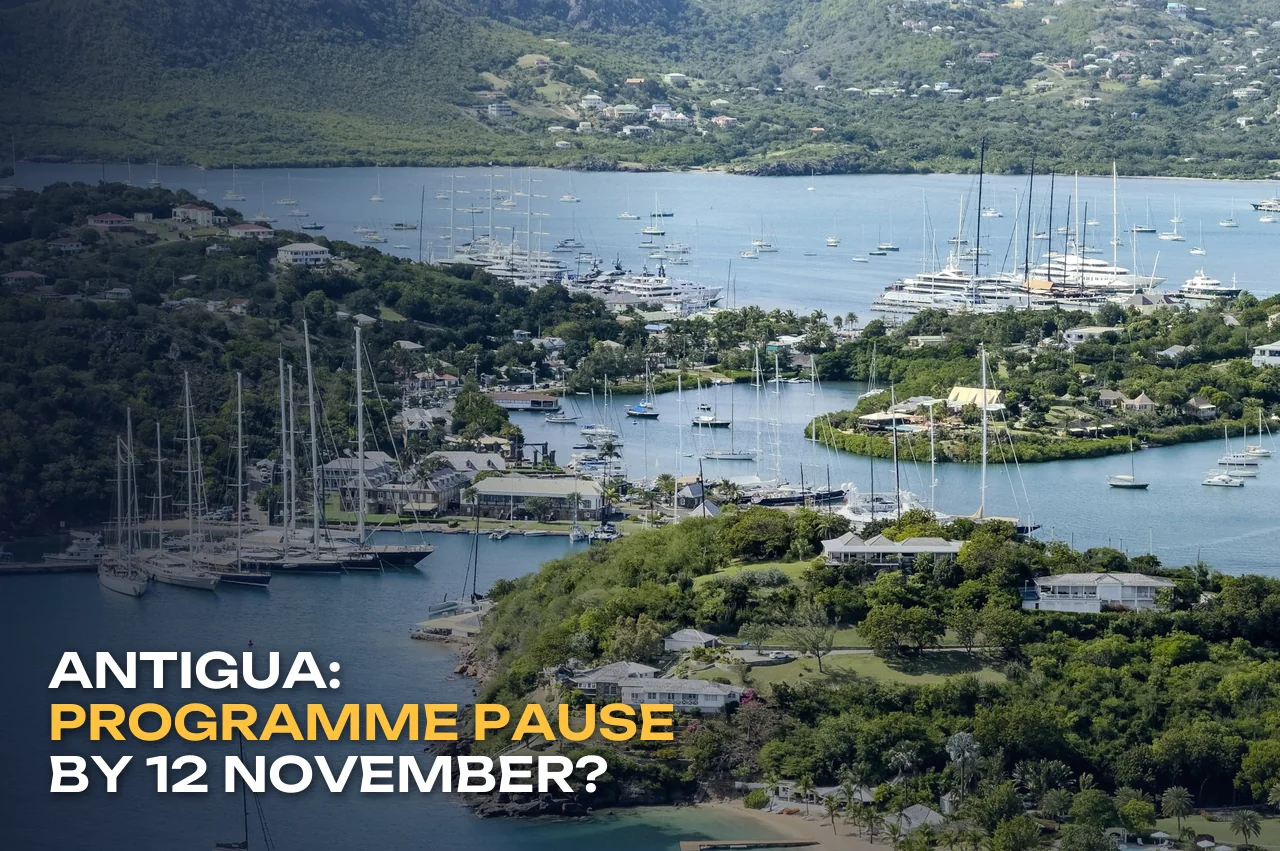
Antigua and Barbuda: the citizenship programme may be paused by 12 November
Updated: October 2026·16 min read·Expert reviewed
Terms and costs verified: October 2026
Contents
On Saturday 24 October 2026 the Prime Minister of Antigua and Barbuda, Gaston Browne, said Cabinet is leaning towards suspending the citizenship by investment programme by 12 November. The aim is to keep visa-free Schengen access for the country's citizens. According to him, no final decision has been made. The Prime Minister's words are known from the local press: as of 26 October there is no official statement on the government website. I explain what is known for certain, what remains unknown and what to do if you have already applied or are only choosing a programme.
In brief
- According to local press reports, on 24 October Prime Minister Gaston Browne said it is "very likely" the programme will be suspended on 12 November 2026. Cabinet has not yet decided.
- According to the Prime Minister, the 12 November deadline was set by EU representatives at a technical meeting with representatives of five Caribbean states earlier that week.
- The legal basis is EU Regulation 2025/2441, in force since 30 December 2025: the mere operation of an investor citizenship scheme can now justify suspending visa-free travel.
- In June the European Commission asked for the programme to be phased out by 1 June 2028. At the time the government replied that the programme would continue.
- What happens to pending and approved applications has not been announced officially. Visa-free travel for Antiguan citizens applies now: 90 days in any 180-day period.
What the Prime Minister said and what is certain
According to local outlets, including the Antigua Observer newspaper, Prime Minister Browne spoke on his Saturday radio programme. He said that during the week EU representatives had held talks with technical representatives of the Organisation of Eastern Caribbean States members that run citizenship programmes. According to him, the EU offered two options. The first is to keep the programmes and risk losing visa-free Schengen access. The second is to commit by 12 November to suspending the programmes and keep visa-free travel.
The Prime Minister said Cabinet discussions had begun and suspension was emerging as the most likely option, but "no final determination has been made". He also proposed convening the region's heads of government early the following week to agree a joint response. Visa-waiver arrangements with the EU are bilateral, so, as Browne put it, each country will ultimately take its own decision. Besides Antigua and Barbuda, the countries concerned are Dominica, Grenada, Saint Kitts and Nevis and Saint Lucia.
The official side of the story is backed by documents. On 6 July 2026 the Office of the Prime Minister published a press release: in a letter dated 25 June 2026, Commissioner Magnus Brunner asked Antigua and Barbuda to phase out the programme by 1 June 2028, with a 24-month transition period. By September 2026 the EU asked for interim measures: full exclusion of applicants subject to EU restrictive measures and reinforced vetting of all other nationalities. According to the same document, the Commission will reflect the country's response in its report on the suspension mechanism in December 2026.
At that time the government's position was firm: the programme is a pillar of non-tax revenue, it cannot be dropped without replacement, and it will continue. On 12 July OECS heads of government in Roseau agreed a common position and a high-level mission to Brussels. If Cabinet does choose suspension, it will be a notable turn: from "the programme will continue" to a voluntary pause for the sake of visa-free travel. We followed the timeline in our news on how the EU gave five Caribbean states until June 2028.
| Date | What happened | Source |
|---|---|---|
| 26 November 2025 | the EU adopted Regulation 2025/2441 revising the visa suspension mechanism | Official Journal of the EU |
| 30 December 2025 | the regulation entered into force: an investor citizenship scheme became a ground for suspension in its own right | Official Journal of the EU |
| 25 June 2026 | letter from Commissioner Magnus Brunner: phase out the programme by 1 June 2028 | government press release of 6 July |
| 12 July 2026 | OECS heads of government agreed a common position and a mission to Brussels | government press release of 13 July |
| 24 October 2026 | Prime Minister: Cabinet leans towards suspending the programme by 12 November | local press |
| 12 November 2026 | date by which, according to the Prime Minister, the EU expects a commitment to suspend | local press |
| December 2026 | Commission report on the suspension mechanism assessing the country's response | government press release of 6 July |
What this means for you. For now this is a statement of intent, not a decision. The programme formally operates and the rules on the Citizenship by Investment Unit website have not changed. But I would not plan on everything staying as it is: fewer than three weeks remain until 12 November.
Why the EU sets a condition: Regulation 2025/2441
Visa-free travel for citizens of Antigua and Barbuda rests on EU Regulation 2018/1806, which lists the country among visa-exempt states, and on a bilateral agreement with the EU. Citizens enter Schengen for 90 days in any 180-day period. We described where the passport takes you in our article on visa-free countries for the Antiguan passport.
On 26 November 2025 the European Parliament and the Council adopted Regulation 2025/2441, which revised the visa suspension mechanism. It was published in the Official Journal of the EU on 10 December and entered into force on 30 December 2025. The new ground for suspension is stated plainly: a visa-exempt country runs a scheme under which citizenship is granted, in exchange for pre-determined payments or investments, to people with no genuine link to that country. Previously the EU had to show risks arising from specific passports. Now the operation of the programme itself is enough.
The regulation also lengthened the time frames. A first suspension is introduced by a Commission act for 12 months and can then be extended by a further 24 months. A suspension can cover specific categories of citizens rather than all of them. There is a precedent: in 2022 the Council of the EU partially suspended visa-free travel for Vanuatu, and at first visas were required only for holders of ordinary passports issued after 25 May 2015, the year the programmes started. Later visa-free access for Vanuatu was closed entirely; we have a separate article on what happened to the Vanuatu programme after the visa-free suspension.
What this means for you. If the programme is kept, the EU has a legal ground for suspension, and the Vanuatu precedent shows it is used. That is why the 12 November deadline and the choice between the programme and visa-free travel look like a real fork, not a negotiating tactic.
Why it is hard for the country to give up the programme
Antigua and Barbuda launched its citizenship programme in 2013. The Speech from the Throne of 20 November 2025 states that it accounts for more than 10% of the country's GDP. According to local press reports, in April 2026 Prime Minister Browne said at the launch of his party's election manifesto that the programme had brought in more than 1.4 billion over 11 years. The reports give the figure in Eastern Caribbean dollars; at the fixed rate of 2.70 to the US dollar that is about USD 520 million. We did not find an official year-by-year breakdown with this figure on the government website, so we cite it as the Prime Minister's words as reported by the press.
Hence the July position: the government asked the EU for concrete, binding measures to replace this income. The press release states plainly that the EU's offers of development support are neither framed as replacement revenue nor quantified. According to press reports, on 24 October the Prime Minister did not say whether the government is discussing compensation or other revenue sources in case of a pause.
What this means for you. For an applicant this means one thing: the decision on a pause is both political and financial. It may be taken, postponed or made partial. So look not at headlines but at the official text of the Cabinet decision when it appears.
The programme today: amounts, fees and payment order
As of 26 October 2026 the Citizenship by Investment Unit (CIU) publishes the same conditions as before. There are four main options, and government fees and due diligence are added to each. All amounts are in US dollars, according to the official CIU website.
| Option | Amount | Government fees | Key condition |
|---|---|---|---|
| National Development Fund contribution | from USD 230,000 per application | 10,000 for one person; 20,000 for a family of up to 4; plus 10,000 for each additional member | non-refundable, paid after approval |
| Real estate in an approved project | from USD 300,000 | same as the fund option | cannot be resold for 5 years |
| Business | from USD 1,500,000, or from 5,000,000 jointly | same as the fund option | the business must be approved by Cabinet first |
| University of the West Indies fund | from USD 260,000 for a family of 6 or more | included; 10,000 for each additional member | one family member gets a year of tuition |
| Due diligence | 8,500 for the main applicant | 5,000 for a spouse; 2,000 per child aged 12-17; 4,000 per dependant aged 18+ | not refunded if refused |
The payment order matters right now. On submission the applicant pays the full due diligence fee and 10% of the government processing fee. The fund contribution, the balance of the processing fee and passport fees are paid only after the approval letter, within 30 days. For real estate, the contract with the developer is signed on condition that citizenship is approved. So during processing the applicant mainly has fees at risk, not the main amount. We described the full budget in our article on the cost of Antiguan citizenship in 2026, and the general method is in the guide on how costs and timelines are calculated.
There is one more programme condition that those who already hold a passport should remember: under CIU rules a citizen can be deprived of citizenship if they do not spend at least 5 days in the country during the five calendar years after obtaining it. The region is moving towards stricter presence requirements; a country-by-country comparison is in our article on 30 days of presence in the Caribbean.
Already applied for Antigua? We will tell you what to do next
Describe your situation briefly and we will tell you where to start.
What happens to pending and approved applications
Officially, this is unknown. As of 26 October neither the government nor the CIU has announced how a pause would affect applications under review, approved applications and real estate projects linked to the programme. The local press specifically notes that the Prime Minister did not explain this. So what follows is not fact but my assessment of the possible scenarios and what they depend on.
- Approved applications where the money has been paid. This is where there is most certainty: citizenship has been or is being registered, and the certificate of registration has been issued. When programmes close or pause, countries usually complete what has started, but there is no official confirmation for Antigua.
- Approved applications where the 30-day payment window is still open. The most sensitive group. If a pause takes effect on 12 November, the key question is whether contributions will still be accepted under approval letters issued earlier. This should follow directly from the Cabinet decision.
- Applications under review. Two scenarios are possible: they are processed under the old rules or frozen together with new intake. Under CIU rules the due diligence fee is not refunded, so ask your agent in writing what would happen to it.
- New applications after 12 November. If Cabinet approves a pause, new intake will most likely stop. The Prime Minister did not say how long a pause would last.
A separate note on real estate. Buyers in approved projects sign a contract conditional on citizenship approval. If the programme is paused before approval, the fate of the contract will depend on its wording: check what it says about refunding the deposit and about deadlines. We wrote separately about how a property purchase under the Antigua programme works.
What this means for you. If you have already applied, do not wait for news in silence. Ask your licensed agent for a written status of the application and an answer on what happens to it and to the fees already paid in case of a pause. If you hold an approval letter, discuss payment within the 30 days, but only after the agent has confirmed the procedure.
What this means for existing citizens of Antigua
Today visa-free travel applies to all citizens of Antigua and Barbuda, including those who obtained a passport through the programme. The logic the EU proposed, according to the Prime Minister, is a pause of the programme in exchange for keeping visa-free travel. If the country makes the commitment, existing citizens will in all likelihood continue to travel to Schengen without a visa. Nobody has announced new rules for passports already issued.
The risk arises if the country keeps the programme. The EU could then launch a suspension. Under the regulation it may cover specific categories of citizens, and the Vanuatu experience of 2022 shows that passports issued during the years the programme operated are affected first. But this is not a forecast for Antigua: there is no EU decision on the country, and I will not guess its form. The local press notes that losing visa-free access would also affect citizens by birth who travel to Europe for work, family or holidays.
For trips to Europe it is also worth remembering the EU's new border systems: entry and exit registration is already running, while the ETIAS launch has been postponed; details are in our news on the ETIAS timeline and full border checks. Antigua allows dual citizenship, so many people hold the passport as an additional one; see our article on dual citizenship in Antigua.
What this means for you. If you already hold an Antiguan passport, there is nothing you need to do urgently. Keep the passport valid, meet the 5-day presence requirement and keep copies of the certificate of registration. If an EU decision were ever to affect the passport, documents showing the date you obtained citizenship would be needed first.
If you are choosing a programme now
The main question is why you want the passport. If it is for visa-free Schengen travel, Antigua is now a programme with an uncertain future: either it pauses, or the country risks visa-free access. If it is for travel to other countries, a back-up document, family or tax planning, the decision is less acute, but I would not file in the last days before a possible pause without written assurances from the agent.
Families should note that the university fund option is designed for families of six or more, while the development fund contribution does not grow with family size; only the fees do. How the programme treats a family is described in our article on Antiguan citizenship for families, and the general rules are in the guide on citizenship for the whole family. Documents for any Caribbean programme need a sworn translation and an apostille: it is worth preparing them in advance so that you lose no time whichever country you choose.
Antigua's processing times are usually measured in months, not weeks; details are in our article on Antiguan citizenship timelines. In my assessment it is unrealistic for a new applicant to file and be approved before 12 November. General information on the country and the programme is collected on the page on Antigua and Barbuda and in our guide to Antigua.
What this means for you. Right now it makes sense to prepare documents and compare programmes, and to file after the official Cabinet decision. That way you do not pay non-refundable fees for an application that may be frozen.
Choosing a second passport? We will compare the options
We compare price, timing and what each option gives your family.
Sofia MendesInvestment Programs Expert, BRIDGES
Alternatives: other Caribbean states, Vanuatu, Turkey
The other Caribbean programmes - Grenada, Saint Kitts and Nevis, Dominica and Saint Lucia - received the same letters from the Commission and face the same choice. The Antiguan Prime Minister said plainly that each country will decide for itself. So switching to a neighbouring programme does not settle the Schengen question: it only removes the risk of Antigua's specific pause, if the neighbours decide differently. Requirements for applicants in the region are also getting stricter, for example in-person attendance in the Caribbean and the residence requirement in Saint Kitts. How these countries compare with Antigua is shown in our Saint Kitts versus Antigua comparison.
The Vanuatu citizenship programme already operates without visa-free Schengen access: the visa regime for Vanuatu citizens has applied since 3 February 2025. People choose it for speed, for the absence of a requirement to visit the country and as a first step on a European path: with a Vanuatu passport you can obtain a residence permit in Greece. We compared the two programmes in the article Vanuatu or Antigua.
If the goal is Europe specifically, it sometimes makes more sense to look straight at an EU residence permit rather than a passport with visa-free travel; there is a comparison in our article on the Greek golden visa and Caribbean passports. Among citizenship programmes that do not depend on EU visa-waiver decisions there is also Turkey, but it has a different entry threshold and different timelines. Our glossary explains what an investor citizenship programme is and how due diligence works.
What this means for you. No programme now guarantees visa-free Schengen access for years ahead. Choose by your goal: travel, a back-up passport, family, a path to residence in Europe. And assume the rules in the region will keep changing.
What to do before 12 November
If you have applied
Ask your agent for a written status and an answer on what happens to the application and fees in case of a pause. Keep all receipts and CIU letters.
If you hold an approval letter
Check the date of the letter and the 30-day payment window. Pay only once the agent confirms the procedure, not on the basis of rumours.
If you are only choosing
Do not pay non-refundable fees before the official Cabinet decision. Prepare documents, translations and apostilles: they will be useful for any programme.
If you already hold the passport
Check the passport's validity and the 5-day presence requirement. Keep a copy of the certificate of registration of citizenship.
Follow official sources
A decision should appear in a Cabinet report or a government press release, and the conditions on the CIU website. We will update this news when that happens.
If you need an assessment of your situation, book an online consultation or see the conditions on the page on the Antigua and Barbuda citizenship programme. All our programmes are on the BRIDGES home page.
How this article was prepared
Official sources: Regulation (EU) 2025/2441 of the European Parliament and of the Council of 26 November 2025 revising the suspension mechanism (Official Journal of the EU, 10 December 2025); press releases of the Office of the Prime Minister of Antigua and Barbuda of 6 and 13 July 2026; the Speech from the Throne of 20 November 2025; the investment option and fee pages on the official website of the Citizenship by Investment Unit (CIU), checked on 26 October 2026; the Council of the EU press release of 3 March 2022 on the partial suspension of visa-free travel for Vanuatu. As of 26 October 2026 the list of government press releases and the Cabinet reports contain no statement on suspending the programme. The Prime Minister's words of 24 October, the 12 November deadline and the figure of 1.4 billion Eastern Caribbean dollars are cited from local press reports. This article does not replace advice on your own application.
Share this article
Frequently asked
Questions people ask before deciding
01Has the Antigua citizenship programme already been suspended?
No. According to local press reports, on 24 October 2026 the Prime Minister said Cabinet leans towards a suspension by 12 November, but no final decision has been made. As of 26 October the conditions on the CIU website are unchanged.
02Why does the EU want the programme suspended?
Since 30 December 2025 EU Regulation 2025/2441 has applied: operating an investor citizenship scheme without a genuine link between applicants and the country became a ground in its own right for suspending visa-free travel.
03What happens to applications already submitted?
This has not been announced officially. Ask your licensed agent for a written status of the application and the procedure in case of a pause. Under CIU rules the due diligence fee is not refunded.
04Will existing Antiguan citizens keep visa-free travel?
Visa-free travel applies now: 90 days in any 180-day period. According to the Prime Minister, suspending the programme is meant precisely to preserve it. There is no EU decision on visas for Antigua.
05What are the alternatives?
Grenada, Saint Kitts and Nevis, Dominica and Saint Lucia face the same choice. Vanuatu already works without visa-free Schengen and can serve as a step towards residence in Greece. The choice depends on your goal.
About the author
Related materials
What to read next
 ArticleHow much does Antigua and Barbuda citizenship cost in 2026
 ComparisonVanuatu or Antigua and Barbuda: citizenship by investment in 2026
 AnalysisThirty days in five years: how the Caribbean presence requirement changes the choice between the islands and Vanuatu
News+6 stories on 26 October
Related news
 Saint Kitts and Nevis · 25 OctSaint Kitts and Nevis: citizenship for children and grandchildren of citizens born abroad after 1983
 Italy · 25 OctItaly debates a citizenship bill: B1 certificate for all applicants and new grounds for revocation
 Portugal · 23 OctPortugal: 690,000 citizenship applications await a decision as the queue grows 38% in a year
Personal programme selection is conducted by Anna Kovalevskaya, Head of Legal, BRIDGES.
Choosing a second passport? We will compare the options
We compare price, timing and what each option gives your family.
