BRIDGES Insights · Caribbean
Caribbean passports under EU pressure: what happens to issued passports and how to choose a programme now

Updated: October 2026·15 min read·Expert reviewed
Terms and costs verified: October 2026
Contents
Five Caribbean states sell citizenship by investment, and all five now face the same choice: keep the programme or keep visa-free Schengen travel for their citizens. The EU set a deadline of 1 June 2028, but events have moved faster: on 24 October 2026 the Prime Minister of Antigua and Barbuda said the cabinet was leaning towards pausing the programme by 12 November. I have put together what is known for certain, the scenarios I see and the signs that will show which one is playing out. I also cover what happens to passports already issued and what to do if you are choosing a programme, have already applied or are already a citizen.
In brief
- Since 30 December 2025 Regulation (EU) 2025/2441 has applied: the mere operation of a citizenship by investment programme is now a self-standing ground for suspending visa-free travel.
- In letters dated 25 June 2026 the European Commission asked Antigua and Barbuda, Dominica, Grenada, St Kitts and Nevis and Saint Lucia to wind down their programmes by 1 June 2028.
- According to local press reports, on 24 October the Prime Minister of Antigua said suspending the programme by 12 November was the most likely option. There is no official decision as of 26 October.
- The Vanuatu precedent shows the EU can start with some passports only: in 2022 visas were first required for passports issued after the schemes were launched.
- Suspension of visa-free travel does not cancel citizenship. Only the way you enter Schengen changes.
- My view: the base case is a pause in one or more states by the end of 2026 with visa-free travel preserved.
What is happening: the EU changes the rules, the Caribbean negotiates
I will start with the legal basis, because everything else depends on it. Visa-free travel for citizens of the five states rests on Regulation (EU) 2018/1806 and bilateral agreements: 90 days in Schengen in any 180-day period. The EU has long had a suspension mechanism, but it was triggered by rising irregular migration and asylum refusals. On 26 November 2025 the European Parliament and the Council adopted Regulation 2025/2441, which entered into force on 30 December 2025. It added a new ground: a country grants citizenship in exchange for pre-determined payments or investments to people with no genuine link to it. Previously the EU had to prove a risk from specific passports. Now the existence of the programme is enough. Our glossary explains how a citizenship by investment programme works.
The regulation also extended the time frames. A first suspension is introduced by a Commission act for 12 months and can then be extended by another 24 months. And it can apply not to all nationals of a country but to specific categories. This matters for people who already hold a passport, and I come back to it below.
On 25 June 2026 the European Commissioner for Internal Affairs and Migration sent letters to the five governments. The published press release of the Office of the Prime Minister of Antigua and Barbuda shows that the EU asks for the programme to be wound down by 1 June 2028 with a 24-month transition, and for interim measures by September 2026: no applicants subject to EU restrictive measures and stronger checks on everyone else. The Commission will reflect the states' replies in its report on the suspension mechanism in December 2026. We keep the timeline in our news story on how the EU gave five Caribbean states until June 2028.
In the summer Antigua took a firm line: the programme is a pillar of non-tax revenue and cannot be dropped without a replacement. On 12 July the heads of government of the Organisation of Eastern Caribbean States agreed a common position and a mission to Brussels. Then on 24 October, according to local press reports, Prime Minister Gaston Browne said that at a technical meeting the EU offered a choice: keep the programmes and risk visa-free travel, or commit by 12 November to suspending them. The cabinet, he said, was leaning towards the second option, but no final decision had been made. Details are in our news story on how Antigua's programme may be paused by 12 November.
What this means for you. Visa-free travel works today for all five states, and there is no EU decision on visas for Caribbean passports. But the conversation has changed: the question is no longer whether the programmes will close, but how and when.
Why this is not a bluff: what the EU did with Vanuatu
The EU has already used this tool against a country with a citizenship programme. Vanuatu went all the way from partial suspension to a full visa requirement in three years.
| Date | What the EU decided on Vanuatu |
|---|---|
| 3 March 2022 | the Council partially suspended the visa waiver agreement: visas became necessary for holders of ordinary passports issued from 25 May 2015, the launch date of the citizenship schemes |
| 8 November 2022 | the Council suspended the agreement in full; from 4 February 2023 all Vanuatu nationals need a visa |
| 3 February 2025 | Regulation (EU) 2025/11 entered into force, moving Vanuatu to the list of countries whose nationals need a visa |
The main lesson for Caribbean passport holders is in the first row. In 2022 the Council restricted visa-free travel not by how citizenship was obtained but by the passport issue date: visas became necessary for all holders of ordinary passports issued from 25 May 2015. That means citizens by birth were also affected if they received or renewed a passport after that date. Passports issued earlier kept working without a visa for some time.
The second lesson is about sequence. The partial measure did not satisfy the EU because, in the Council's assessment, Vanuatu did not engage in meaningful dialogue, and eight months later the suspension became full. The third lesson is about demand. Nobody took citizenship away, the passport kept working for travel around the world, for banks and for business, and the programme did not disappear. We wrote in detail about why demand for Vanuatu did not fall after the EU visa suspension and about what it would take for Europe to restore visa-free travel for Vanuatu.
What this means for you. If a Caribbean state keeps its programme, the EU has both a legal ground and a tested way of acting. That is why I see the 12 November deadline as a real fork in the road, not a negotiating tactic.
Three scenarios and the signs that show which one is playing out
What follows is my opinion, not fact. I rely on the text of the regulation, the Commission's letters, the official positions of governments and the way the EU acted with Vanuatu. I will not guess exact dates: nobody knows them yet, including the governments themselves.
| Scenario | What happens | Signs to watch | What it means for a passport holder |
|---|---|---|---|
| Optimistic | the EU accepts the joint regulator, the common minimum and stronger checks; programmes wind down by 1 June 2028 on schedule, visa-free travel stays | the Commission's December report contains no suspension proposal; the states and the EU announce an agreed transition schedule | visa-free travel works, fewer new applications over time |
| Base case | one or more states pause new applications in November 2026, the others negotiate a transition period | an official Antigua cabinet decision by 12 November; similar statements from other governments; the EU does not trigger suspension | visa-free travel stays, the window for new applications narrows and differs by country |
| Hard | a state keeps its programme, the Commission suspends visa-free travel for 12 months with a possible 24-month extension | refusal to pause, a suspension proposal in the Commission's report, a Commission suspension act | a Schengen visa is needed, possibly only for some passports; citizenship stays |
Optimistic scenario. The Caribbean states are not arriving in Brussels empty-handed. Since 1 July 2024 all five have held a common minimum of USD 200,000 and do not undercut each other. In September 2025 an agreement was signed on the regional regulator ECCIRA with a single standard for vetting applicants. If the EU accepts this and agrees to a wind-down schedule to June 2028 without a pause, buyers will still have time. I consider this scenario the least likely: the regulation names the programme itself as the ground, not the quality of its management.
Base case. Antigua announces a pause and the other states make their own decisions: the Antigua Prime Minister said plainly that each country has its own visa waiver with the EU. Some will follow, some will negotiate longer. The main sign is an official Antigua cabinet decision by 12 November and similar statements on the official websites of the governments of St Kitts, Dominica, Grenada and Saint Lucia. The second sign is a December Commission report without a suspension proposal.
Hard scenario. One of the states refuses to pause, and the Commission triggers suspension. Signs: a public refusal by the government, a suspension proposal in the Commission's report, then a Commission act. Time passes between these steps, so I do not expect visa-free travel to vanish overnight.
What this means for you. Watch three documents rather than headlines: the Antigua cabinet decision by 12 November, statements by the other governments and the Commission's report in December 2026.
Choosing a second passport? We will help you compare
We compare price, timing and what each option gives your family.
What happens to passports already issued
This is the question we have been asked most often in recent weeks. I answer in order: what is known from EU rules and what remains my assessment.
Citizenship stays. Suspension of visa-free travel is an EU visa policy measure. It does not cancel citizenship and does not invalidate the passport. The passport will keep working for travel to non-EU countries, for banks and for the family. Only the state itself can revoke citizenship under its own law, and EU decisions do not affect that.
If a state takes a pause, existing citizens will most likely keep visa-free travel. The logic the EU offered, according to the Antigua Prime Minister: a programme pause in exchange for keeping visa-free travel. Nobody has announced new rules for passports already issued.
If the EU introduces a suspension, it may be partial. The regulation allows it to be limited to specific categories of nationals, and the Vanuatu example shows what that looks like: a cut-off by passport issue date. For the Caribbean states such a cut-off would work differently. The St Kitts and Nevis programme has run since 1984, Dominica's since 1993, Antigua's since 2013, Grenada relaunched its programme in 2013 and Saint Lucia launched in 2016. The older the programme, the more passports fall under any date. This is reasoning, not a forecast: there is no EU decision on any of the five states, and I will not guess its form.
Renewing a passport is a separate question. With a cut-off by issue date, a new passport received to replace an old one could fall under the restriction even if citizenship was obtained long ago. So I would not replace a valid passport without need in the coming months, but I would not keep a passport close to expiry either: an expired document does not work in any scenario.
Besides the visa question, Caribbean passport holders' obligations to the state are changing too: the region is moving towards a physical presence requirement. A country-by-country comparison is in our article on how the 30-day presence requirement changes the choice between the Caribbean and Vanuatu, and for St Kitts in the news story on the residence requirement on the island.
What this means for you. If you already hold a passport, nothing needs to be done urgently. Keep the passport valid, meet the presence requirements and keep your certificate of registration of citizenship: under any cut-off you will need to prove the date and basis.
What to do now: three situations
The advice differs for those who are only choosing, those who have already applied and those who are already citizens. Here is how I would act in each situation.
Choosing a programme
Ask yourself why you need the passport beyond Schengen: banks, business, travel around the world, a back-up document for the family. If visa-free Schengen travel is the only goal, a Caribbean programme in 2026 becomes a high-risk bet. Compare the five states by price, timing and family composition in our comparison of Caribbean passports.
Preparing documents
Translations and apostilles are needed for any programme, so they can be done now: sworn translation and an apostille are not tied to a specific country. I would not pay non-refundable fees before official decisions.
Already applied
Ask a licensed agent for the written status of your application and an answer on what will happen to it and to the fees already paid if the programme is paused. Keep all receipts and letters from the citizenship unit. The due diligence fee is usually not refunded on refusal.
Holding an approval letter
Check the date of the letter and the deadline for paying the main contribution. Pay once the agent has confirmed the procedure, not on the basis of rumours. If not all the family is in the application, ask whether relatives can be added now: after the programme closes this may no longer be possible.
Already a citizen
Check the passport's validity, keep the certificate of registration and follow the presence requirements. For travel to Europe also take into account the EES border system: details are in the news story on ETIAS timing and full border checks.
If children and parents are part of the application, see the general rules in our guide on citizenship and residence for the whole family. How the full amount with fees and checks adds up is explained in the guide on how costs and timelines are calculated.
Already applied for Caribbean citizenship? We will tell you what to do
Describe your situation briefly and we will tell you where to start.
Sergey EvdokimovManaging Partner, BRIDGES
Alternatives: other Caribbean states, Vanuatu, EU residence
Other Caribbean programmes. Grenada, St Kitts and Nevis, Dominica and Saint Lucia received the same letters as Antigua and Barbuda. Switching to a neighbouring programme removes the risk of a specific pause, but not the Schengen question. It makes sense if the states take different decisions and one of them keeps accepting applications under clear rules. The programmes also differ beyond Schengen: Grenada, for example, gives the right to apply for the US E-2 investor visa. I would make the decision after 12 November, when the positions of all five governments become clear.
Vanuatu. Vanuatu citizenship already lives with a Schengen visa requirement, so EU decisions on the Caribbean do not affect it. People choose it for speed, for the absence of a requirement to visit the country and as the start of a European path: with a Vanuatu passport you can apply for residence in Greece, as our news story on how a Vanuatu passport opens access to Greek residence explains. A comparison is in our article Vanuatu or the Caribbean.
EU residence. If the goal is Europe specifically, it is sometimes more logical to obtain a residence permit inside the EU straight away rather than a passport with visa-free travel. The Greek Golden Visa gives the right to live in the country and travel within Schengen, but it is residence, not citizenship. We compared both options in our article Greek Golden Visa or Caribbean citizenship.
Separately for Russian citizens: Schengen visas on a Russian passport are issued ever more strictly, and a back-up document is best prepared in advance. I wrote about this in my article on why a Schengen plan B is best put together before 2027.
What this means for you. No citizenship programme today guarantees visa-free Schengen travel for years ahead. Choose according to your goal and assume the rules will keep changing.
What we advise our clients
Our position at BRIDGES is simple. We do not push clients to file in the last days before a possible pause and we do not promise that a programme will process an application in time. Nor do we promise that visa-free travel will be preserved: that is a decision for the EU and governments, not for agents.
If a client needs a second passport for several purposes and is ready for a scenario with a Schengen visa, a Caribbean programme remains a workable option, but I suggest choosing the country after 12 November and with written terms in case of a pause. If a client needs visa-free Schengen travel specifically for ten years ahead, we show options without this dependence: EU residence, or a combination in which a second passport opens the way to European residence. How visa-free access for investment passports has changed in recent years is shown in our article on what happened to visa-free travel for investment passports.
We collect the latest regional updates in our Caribbean news section. If you would like to discuss your situation, book an online consultation. All the programmes we work with are on the BRIDGES home page.
How this article was prepared
The article was prepared by Sergey Evdokimov, Managing Partner of BRIDGES. Primary sources: Regulation (EU) 2025/2441 of the European Parliament and of the Council of 26 November 2025 revising the visa suspension mechanism (Official Journal of the EU, in force since 30 December 2025); the Council of the EU press release of 3 March 2022 on the partial suspension of the visa waiver agreement with Vanuatu and Council Decision (EU) 2022/366; the Council press release of 8 November 2022 on the full suspension of the agreement from 4 February 2023; Regulation (EU) 2025/11 moving Vanuatu to the visa-required list from 3 February 2025; press releases of the Office of the Prime Minister of Antigua and Barbuda of 6 and 13 July 2026; statements by the Government of Saint Lucia in September and October 2026; agreements of the Organisation of Eastern Caribbean States of 2024-2025 on the common minimum and the ECCIRA regulator. The Antigua Prime Minister's words of 24 October 2026 and the 12 November deadline are cited from local press reports: there is no official statement on the government website as of 26 October. The scenarios and assessments are my opinion. This article does not replace advice on your own situation.
Share this article
Frequently asked
Questions people ask before deciding
01Will visa-free Schengen travel be cancelled for Caribbean passports?
As of 26 October 2026 there is no decision. The EU can suspend visa-free travel under Regulation 2025/2441 if a state keeps its programme. Antigua is discussing a programme pause to keep visa-free travel.
02What happens to my passport if visa-free travel is suspended?
Citizenship and the passport remain. A visa will be needed to enter Schengen. Based on the Vanuatu precedent, a restriction may at first apply only to passports issued after a certain date.
03Is it worth applying for Caribbean citizenship now?
If you need the passport for several purposes and are ready for a Schengen visa, yes, but I would wait for the decisions due by 12 November and get written terms in case of a pause.
04What should I do if I have already applied?
Ask your agent for the written status of the application and an answer on what happens to it and to the fees if there is a pause. Keep the receipts and letters from the citizenship unit.
05What are the alternatives?
Other Caribbean programmes if the states take different decisions, Vanuatu citizenship as the start of a European path, and EU residence such as the Greek Golden Visa.
About the author
Related materials
What to read next
 ComparisonCaribbean Passport: 5 Citizenship Programs Through Investment in 2026
 AnalysisVanuatu after the EU visa-free suspension: why demand did not fall
 AnalysisThirty days in five years: how the Caribbean presence requirement changes the choice between the islands and Vanuatu
News+6 stories on 26 October
Related news
 Caribbean · 11 OctNo more Caribbean passport without a trip: biometrics and interviews
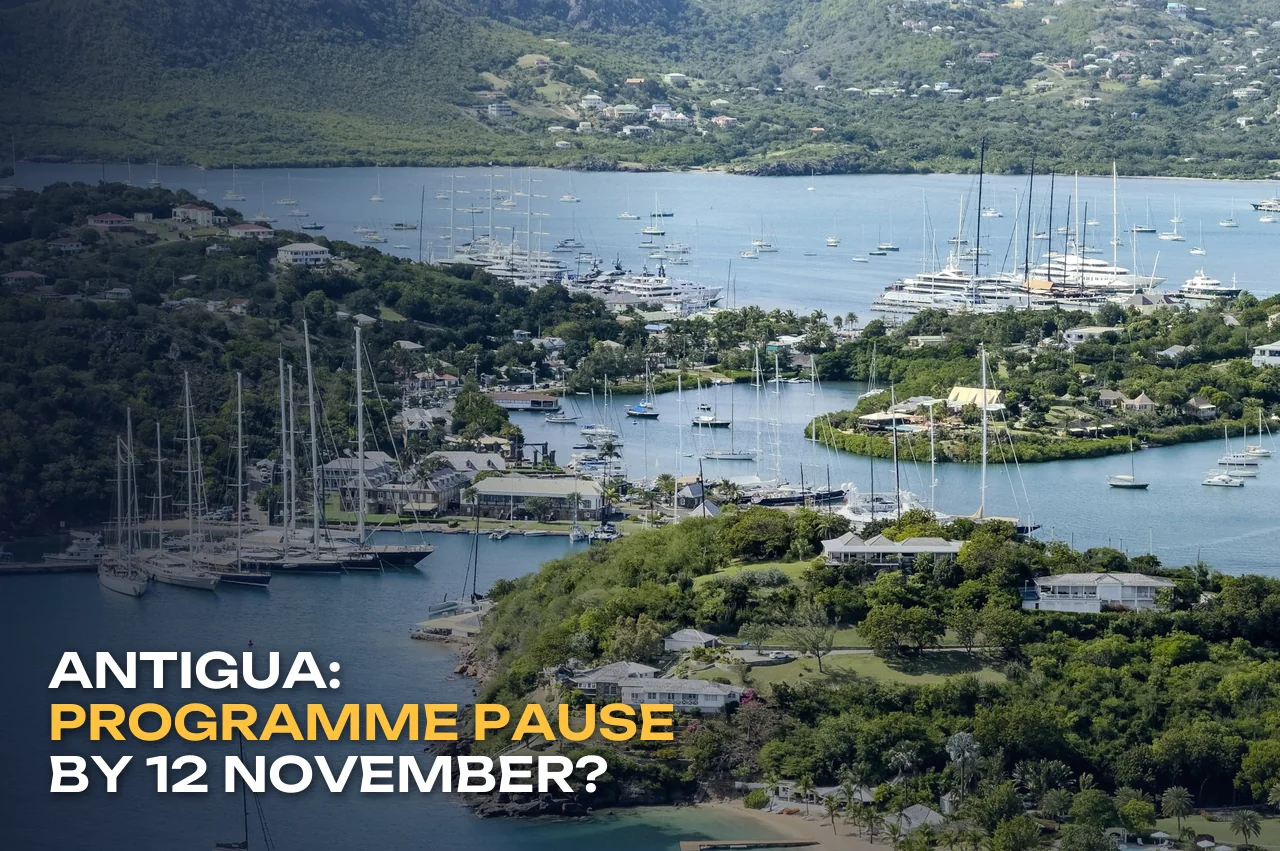 Antigua and Barbuda · 26 OctAntigua and Barbuda: the citizenship programme may be paused by 12 November
 Montenegro · 26 OctMontenegro: residence with the right to work for EU citizens investing from EUR 250,000
Personal programme selection is conducted by Anna Kovalevskaya, Head of Legal, BRIDGES.
Want a second passport without extra risk? We will help you choose
We set out each step from the first documents to the final status, with timings.
