Updated
SRV-DS-ST
Settlement and capital
Running the settlement on a dealthe payment will arrive
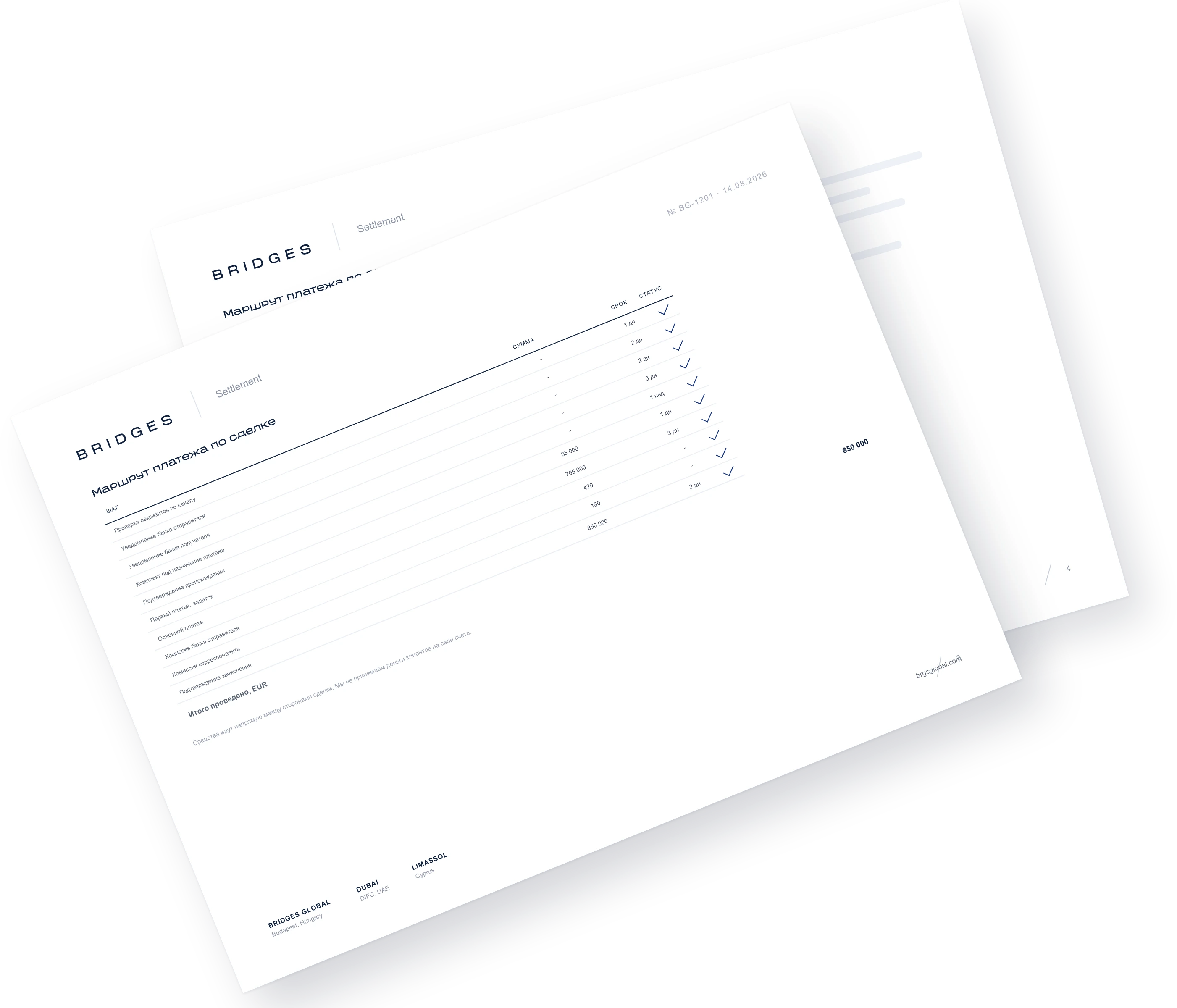
Buying a property or paying for a programme is half the job. The other half is making the payment so that the bank lets it through, the seller has the money on time and the tax authority is left with no questions. We build that route and run it for you — from the first conversation with the bank to confirmation that the money has landed.
- We agree the route of the payment with the bank before the transfer, not after it is blocked
- We prepare the documents and the reference the way compliance reads them
- We correspond with the banks and the seller — the client does not have to work it out
01 / The service
Why the payment is the riskiest part of a deal
The contract is signed, the clock is running, the money is there — and the payment hangs in a check. The sender’s bank wants a justification, the recipient’s bank does not understand the reference, the seller threatens to terminate. The cause is almost always the same: the settlement was begun without being prepared.
The bank checks every large transfer
Compliance looks at whether the payment fits your profile, whether the recipient is clear and whether the origin of the funds is evidenced. An unfamiliar operation with no documents is stopped automatically.
The payment reference decides a great deal
The wording in the reference field is the first thing the bank reads. An imprecise or over-general phrase turns an ordinary payment into a matter for investigation.
The deadlines in the contract do not wait
A deal has a deadline and penalties for delay. A week spent sorting things out with the bank can cost the deposit or the deal itself.
Two banks, not one
The payment is checked on the sender’s side and on the recipient’s, and there may be a correspondent bank between them. Both sides have to be prepared.
02 / Situations
When we run a settlement
Situations where the client does not have to work it out themselves.
Buying property abroad
The deposit, the main payment, the taxes and the duties. We agree the route with the bank, the notary and the seller and make the payments to the deal’s schedule.
Paying for a citizenship or residency programme
The state contribution is accepted from the applicant’s account and checked by the state. We prepare the payment so that it does not become the reason the application is delayed.
Settlement on a business deal
Buying a shareholding, paying for equipment, settling with a foreign supplier — with documents prepared for each payment.
Capital in cryptocurrency
You have to settle and the asset is in crypto: we build a lawful path from the asset to a bank transfer to the seller.
Moving a large sum between your own accounts
A change of bank or of the jurisdiction where it is held: the receiving bank checks the origin of the incoming funds too.
The payment has hung or come back
We go through the reason, prepare the answer to the bank and make the payment again so that it goes through.
03 / Honest limits
What we do not do
The limits are firm: they protect you and us alike.
We do not make payments on the client’s behalf
We do not take your funds into our accounts and pass them on. The instruction to transfer is given by the client from their own account — that is the only lawful arrangement.
We do not split payments to get round controls
Breaking a sum up so as not to cross a checking threshold is a direct sign of evasion. The banks recognise it, and the consequences fall on the client.
We do not use third parties’ accounts
A payment in the name of a friend, a relative or a familiar company raises questions for you and for the recipient. We do not build arrangements with intermediaries.
We do not tailor the reference for convenience
The payment reference must reflect the real substance of the operation. Wording that does not match the deal is not cleverness but a risk.
If there is no lawful route for a particular operation, we say so directly rather than trying at random at your expense.
04 / Scope of work
What the work covers
The whole circuit of a settlement: from checking it will go through to confirmation that it has landed.
Checking the payment will go through
Before the transfer we establish whether your bank will let such an operation through, whether the recipient’s bank will accept it and whether there are country or sector restrictions in the chain.
The route of the settlement
We settle which account and which currency to pay from, whether an intermediate account is needed and how to split the payments across the stages of the deal.
The documents behind the payment
The contract, the invoice, the evidence of the origin of funds, the explanations of the deal — the set the bank expects and that removes the questions in advance.
Agreeing it with the bank
We tell the bank about the coming operation in advance and agree the wording of the reference. Compliance that has been warned does not block a payment.
Running the payment
We follow the transfer, answer the banks’ requests along the way and track it through to the recipient.
Dealing with the recipient
Correspondence with the seller, the notary or the state body: we confirm the payment and remove the questions about timing.
We prepare, agree and run it. The money stays in the client’s accounts throughout and leaves on their instruction.
05 / Cost
What the cost depends on
It is calculated by the complexity of the route and the amount of preparation, not as a percentage of the sum.
The source of the funds
Money in an existing account is the simple case. The sale of assets, cryptocurrency or capital from several sources calls for separate preparation.
The number of banks and countries
Every bank in the chain and every jurisdiction adds its own requirements and correspondence.
The type of deal
Paying for a programme to standard details is simpler than settling the purchase of a property with deposits, escrow and taxes.
Urgency
Work to tight deadlines on a deal that is burning means rebuilding the queue — that shows in the estimate.
The first assessment of whether the payment will go through is made before the agreement: you know in advance whether the route works and what the preparation will cost.
06 / How it works
How we work
The preparation comes before the payment — that is the whole point of the service.
Going through the deal
What you are buying, from whom, in which country, from what source you are paying and what the deadlines in the contract are.
1 day
Checking it will go through
We assess the route: the sender’s bank, the recipient, the restrictions in the chain. We say plainly if the route does not work.
2–3 days
Preparing the documents
The set behind the payment: the contract, the justification, the evidence of the origin of funds, the wording of the reference.
3–10 days
Agreeing it with the bank
We tell the bank in advance, remove the questions before the transfer and where needed file the documents beforehand.
2–5 days
Making the payment
The client gives the instruction; we follow it through and answer the banks’ requests.
1–10 days
Confirmation and closing
We obtain confirmation that it has landed, hand the documents to the recipient and file the set for the records.
The time a payment takes is set by the banks. Our work is to see that it does not stop in a check.
07 / Preparation
What we will need from you
The sooner you hand the documents over, the calmer the deal goes.
The contract or the terms of the deal
What is being bought, from whom, for how much, by when and on what payment schedule.
The recipient’s details
The full bank details of the seller or the state body, the correspondent bank included.
Details of the sending account
Which bank and which jurisdiction the funds sit in and what limits and requirements that bank has.
The documents on the origin of funds
The base of the set: evidence of the source of the capital the payment comes from.
No documents are needed at the first consultation — we discuss the deal and the route in words.
08 / Team
Who runs the work
A settlement is run by a lawyer together with a tax adviser — the payment and its consequences are inseparable.
 Nikos PappasBanking Relations SpecialistThe route of the payment, the documents and correspondence with the banks
 Klara RihterHead of Compliance and Due DiligenceThe tax consequences of the settlement and the reporting
 Martina VeberHead of Case ProcessingCoordination with the seller, the notary and the client
 Irina ShternHead of Hungary OfficeClients in Central Europe
10 / Questions
Answers to common questions
No. We prepare the payment, agree it with the bank, gather the documents and run the correspondence — but the instruction to transfer is given by you from your own account. Arrangements where the money goes through an intermediary’s accounts are read by banks instantly, and they create risks for everyone involved. Our value is that you do not have to work the process out, not that we hold your money.
You can, and small sums go through without difficulty. The problems start with large payments to another country: the bank wants a justification, and by then it is too late to explain — the money has hung and the contract’s clock is running. We do that work before the transfer.
That happens even with good preparation. Then we answer the bank’s request, supply what is missing and get it put through. If the bank will not pass the operation as a matter of principle, we prepare an alternative route through another institution.
Directly, rarely: most sellers and notaries accept only a bank transfer. The working path is to evidence the origin of the crypto asset, cash it out through a licensed venue into your account and pay by an ordinary transfer. A separate service handles that.
No, we do not take a percentage of the payment. The cost depends on the complexity of the route and the amount of document preparation and is fixed in an estimate before the work starts.
Yes. We check the client’s sanctions profile and the chain of the payment before the work starts and build the route within the restrictions in force. If there is no lawful path for a particular operation, we say so directly rather than trying at random.
The check runs on the recipient’s bank’s side and at the correspondent too. A large transfer to a new country is a routine reason for a request. A bank warned in advance puts it through faster and without a stop.
Yes: a prepared set of documents and a direct approach to both ends of the chain. What works worst is waiting — a payment can sit for weeks while nobody answers the request.
A precise, verifiable wording that matches the contract: the subject, the number and the date of the document. General phrases such as payment under a contract with no details are the commonest reason for a request.
Technically it can, but it raises questions both with the bank and in the deal itself: the payer does not match the buyer. It is better to arrange a distribution or a loan first and then pay from the right person.
No, and nobody can: the decision is the bank’s. What we answer for is that the route is chosen correctly, the documents are prepared and both sides are warned in advance — and that is the difference between a payment that arrives and one that hangs.
INITIAL ASSESSMENT
Tell us what outcome your family needs
We will design a solution for your case, choose the country and the right status, and take the whole process through to the result.