Residency
Life in Budapest 2026: areas, prices and infrastructure through the eyes of those who live here
Updated: June 2026·16 min read·Expert reviewed
Terms and costs verified: June 2026
Contents
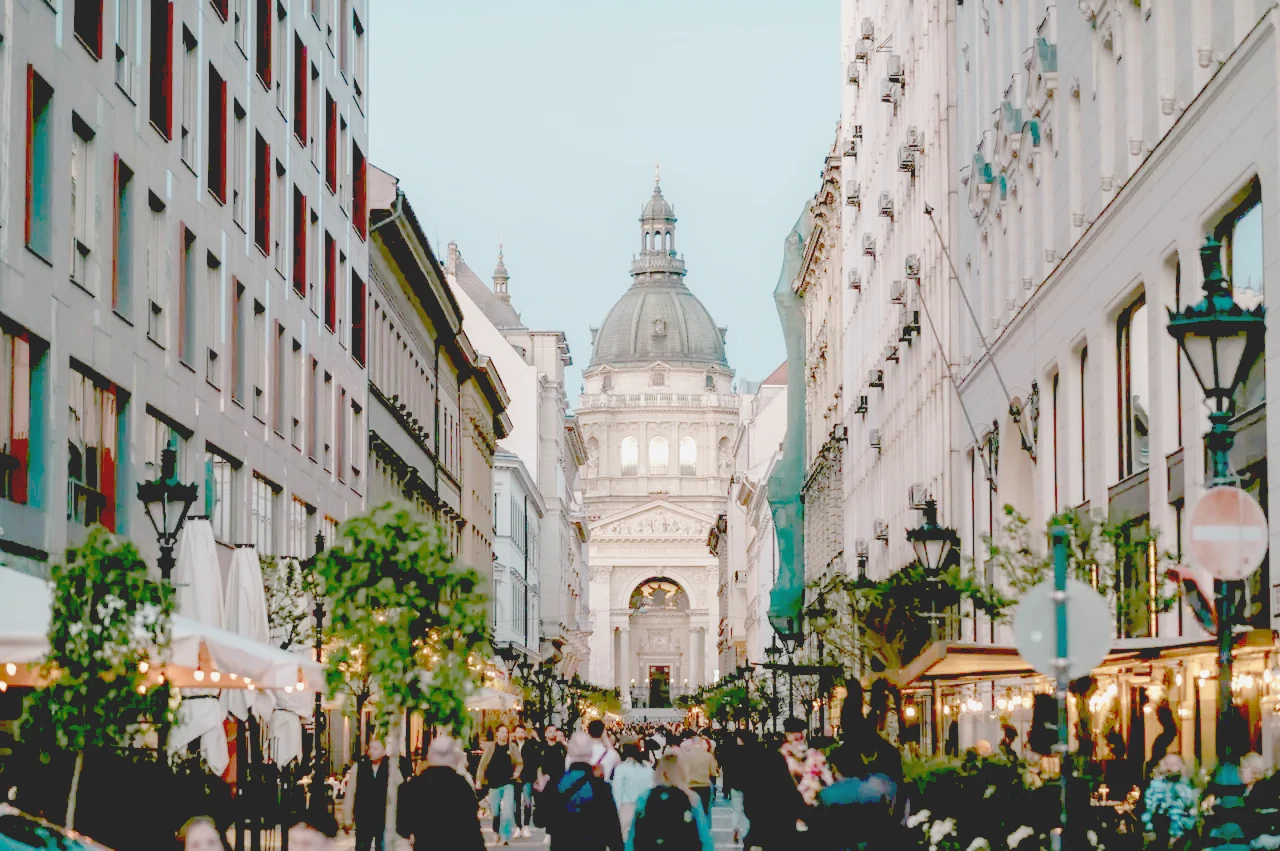
Budapest is divided into 23 districts, and the choice between the hills of Buda and the busy rhythm of Pest determines what your life will be like here, much more than it seems when you move in. This guide contains an analysis of the areas, real rental and purchase prices for 2026, transport, schools, safety and where the international community has settled. No advertising language: just what we see from our office in Budapest every day.
Briefly: what is important to know about the districts of Budapest
Buda is hills, greenery, silence and families; Pest is a flat, dense, convenient city with a metro, offices and nightlife. Rent of a one-room apartment in the center - 250,000-350,000 HUF per month, purchase at a median of about 1.4 million HUF per square. The most convenient areas for foreigners: V, VI, VII, IX, XIII in Pest and II, XI, XII in Buda.
Further, in detail: how the areas differ, how much it costs to live, where to send children to school and where to find an international community. If your move to Budapest is related to legalization, start with basic articles about Hungarian residence permit for investmentandHungarian citizenship - the choice of area often depends on why you are here.
Buda vs Pest: two different lives in one city
The Danube divides the city into two parts, and this is not a formality. Buda is the right bank, hilly, with forests, villas and a calm rhythm. Pest is the left bank, flat as a table, with straight avenues, metro, theaters, cafes and most of the work places. Hungarians joke that they live in Buda and work in Pest - and there is a lot of truth in this.
Buda will suit you if you value silence, travel with children, love morning jogs in the forest and are willing to pay for clean air and a view of the city. The downside is that it gets empty early in the evening, and it can be inconvenient on the hills without a car.
Pest is for you if you need a metro nearby, restaurants and bars within walking distance, proximity to offices and a livelier pace. The downside is that it is noisier, denser, the courtyards are wells and there is less greenery.
- Air and greenery: definitely Buda (district XII is the cleanest in terms of air).
- Transport and metro: Pest - all three metro lines (M1-M3) and most of the M4 are here.
- Nightlife: Pest, especially district VII (romkochmy, bars).
- Price per meter: premium Buda (Rozsadomb, Hegyvidek) costs almost twice as much as the outlying Pest.
There is no universal answer. Families with children often choose Buda, young people and working professionals - Pest. More information about specific areas below.
Overview of areas: a short map for selection
Districts are numbered with Roman numerals from I to XXIII in a spiral from the center. You don't need to remember everything - just know the key ones. Here is a guideline: who is the area for and how much does it cost on average to rent a decent apartment (1-2 rooms) in 2026.
| District | Shore | For whom | Rent, HUF/month |
|---|---|---|---|
| V (Belvaros-Lipotvaros) | Pest | Center, status housing, business | 350 000-520 000 |
| VI (Terezvaros) | Pest | Youth, professionals, culture | 280 000-400 000 |
| VII (Erzsebetváros) | Pest | Nightlife, rentals, students | 260 000-380 000 |
| IX (Ferencvaros) | Pest | Renovated center, young families | 250 000-380 000 |
| XIII (Ujlipotváros) | Pest | Office workers, calm center | 270 000-420 000 |
| II (Rojadomb, Pacharette) | Buda | Families, diplomats, premium | 350 000-550 000 |
| XI (Uibuda) | Buda | Families, students, price/life balance | 250 000-400 000 |
| XII (Hedvidek) | Buda | Families with children, clean air | 320 000-520 000 |
| VIII (Jozsefvaros) | Pest | Mixed: Corvin - ok, outskirts - be careful | 200 000-330 000 |
| III (Obuda) | Buda | Quiet families, cheaper | 220 000-340 000 |
The figures are indicative ranges for the first half of 2026; The specific rate depends on the renovation, floor, and how long the apartment has been on the market. Rent growth in 2026 has slowed to about 4% per year after 6-9% in 2025.
Best areas for families with children
Families in Budapest are almost unanimously drawn to Buda for the air, greenery and proximity to international schools. Three favorites:
- District II (Rojadomb, Pacharette): green streets, villas, embassies, international schools nearby. The most prestigious residential address in Buda. Renting a family apartment starts from 350,000 HUF, houses and penthouses are several times more expensive.
- XII district (Hegyvidek, Svabhegy): translated as “mountain region”. Forest at the end of the bus route, the cleanest air in the city, winding quiet streets. A favorite area for families with small children.
- District XI (Uybuda): a reasonable balance - greenery, embankment, developed infrastructure and at the same time prices are lower than in II and XII. A good choice if your family budget is limited.
In Pest, families are more likely to look at a renovated IX (Ferencvaros) - The area has changed a lot in recent years, new buildings, parks and an embankment have appeared. If you are moving for a long time and are thinking about the future citizenship of your children, look at the path from residence permit to Hungarian citizenship - the area of residence does not affect this, but the planning horizon should be kept in mind immediately.
For students and youth
Young people and students choose Pest - life is in full swing there, it’s cheaper to rent a room and everything is nearby. Key areas:
- VII (Erzsebetváros): the heart of nightlife, famous ruin bars (romkochmy), cafes, constant demand for rentals. Noisy, but fun and inexpensive by the standards of the center.
- VIII (Józsefváros), Corvin zone: student hub close to Semmelweis universities and clinics. The renovated part of the area is quite comfortable, and rent here is one of the most affordable among the central ones - from 200,000 HUF.
- VI (Terezvaros): along Andrássy Avenue and Király Street - a creative, lively environment, convenient for those who work in the creative industries.
- XI (Uibuda): on the Buda coast - the Budapest Technical University (BME) is located here, so there is a lot of student housing.
For renting a room or studio, the budget starts from around 180,000-190,000 HUF per month in more remote areas. The cheapest way to get around is with a student pass, which costs significantly less than usual for students.
For business and work
If you work or open a business, the logic of choice is different - proximity to office clusters and the metro is more important than silence.
- V (Belvaros-Lipotvaros): government and business center, banks, headquarters, parliament nearby. The highest rental and purchase rates in the city, but also the most prestigious business address.
- XIII (Uylipotváros and Angjalfeld): business centers have sprung up along the business corridor; The area provides stable demand for long-term rentals from office employees. Calm, yet central.
- VI (Terezvaros): Andrássy Avenue is the address for representative offices and creative companies.
The tax environment in Hungary for business is one of the softest in the EU: corporate tax is 9% (the lowest in the European Union), personal income tax is 15%, while VAT is high - 27%. This makes registering a company here attractive. Details and connection with legalization are in the material about Hungarian residence permit for investment; rates and conditions can be checked on the official tax website NAV (nav.gov.hu).
Renting and purchasing housing: prices 2026 by area
This is the section for which many people open the article. Let's look at rent and purchase separately - figures for the first half of 2026.
Rent. The average rate in the city is about 6,500 HUF per square meter per month: from ~5,500 HUF in outlying areas to ~7,500 HUF in premium locations, and in renovated Lipotváros apartments it reaches up to 9,000 HUF per meter. In terms of apartments:
- studio - from ~190,000 HUF;
- one-room in the center - 250,000-350,000 HUF;
- two-room apartment - on average ~360,000 HUF, from 260,000 on the outskirts to 520,000 in the center and on the hills of Buda.
Purchase. The median price in Budapest is about 1.4 million HUF per m2, the average is ~1.45 million. The range by region is huge:
| Location | Price, HUF per m2 |
|---|---|
| Outlying Pest (eg Csepel) | from ~0.9-1.1 million |
| Average level in the city | ~1.4 million |
| New buildings (5% VAT on qualifying properties) | ~1.77 million |
| Premium Buda: Rozsadomb, Hegyvidek | 1.9-2.6 million |
| Top addresses: Gellerthegy, Pasharet | 2.6 million and above |
Over 2025, prices in Budapest have increased by about 25% in nominal terms - the market is hot, and this should be taken into account when bargaining. If you are considering a purchase as a way to gain status, an important detail: there is currently no classic “golden visa for real estate” in Hungary - an investment residence permit works using other tools, see the article about residence permits in Hungary.
Transport and logistics
Budapest is one of the most convenient cities in Europe for public transport, and this is a strong argument for living without a car, especially in Pest.
- Metro: four branches (M1-M4). M1 is the continent's oldest metro line and a UNESCO site. The main network is in Pest.
- Trams, trolleybuses, buses: dense network; Trams 4 and 6 run around the Big Ring around the clock.
- Suburban HEV trains: connect the center with the suburbs and Buda with Óbuda.
- Schedule: transport operates from approximately 4:30 to 23:30, at night there is a network of night buses.
A single monthly BKK pass for the entire city costs 8 950 HUF and applies to all types of transport. This is about 23 euros per month - several times cheaper than in most Western capitals. Taxis are most reliable through the Bolt or Fotaxi apps. Tariffs and types of tickets are published by the operator on the official website BKK (bkk.hu).
Practical conclusion: in Pest a car is often a burden (paid parking, narrow streets), but on the hills of Buda, especially in the XII district, a car makes life much easier.
Cost of living: realistic budget
Budapest is significantly cheaper than Western Europe: life here is about 36% cheaper than in Berlin, 44% cheaper than in Paris, and half the price of London. Specific targets for 2026:
| Expense item | Amount per month |
|---|---|
| Rent 1 room in the center | 250 000-350 000 HUF |
| Rent 1 room off center | 180 000-260 000 HUF |
| Communal apartment (apartment ~85 m2) | ~50 000-65 000 HUF (€100-150) |
| Products for one | ~90 000-110 000 HUF |
| BKK travel card | 8 950 HUF |
| Lunch at a cafe | ~3 500-5 000 HUF |
Total: a single person needs approximately 350,000-500,000 HUF per month for a comfortable life in Budapest, including rent. For a family with one child - about 800,000-1,100,000 HUF, depending on the area and expenses for a kindergarten or school. The products are cheap: a liter of milk is about 1 euro, a loaf of bread is about 1.3 euros. It is more profitable to shop at markets (Lehel, Big Market) and in the Aldi, Lidl, Spar chains.
Schools and kindergartens
For families with children, education often decides the choice of area. There are about 16 international schools in Budapest - a large selection for a city of this size, and they are noticeably cheaper than their Western European counterparts.
- The International School of Budapest (ISB): IB programs (PYP, MYP, Diploma), strong language training.
- American International School of Budapest (AISB): American program, popular with families from the USA and Canada.
- British International School of Budapest: British program, among foreign languages there is also Russian.
Tuition fees in 2026: from ~5,000 euros per year for preschool programs and up to 20,000 euros and above in high school at the most famous institutions. Preschool and preparatory classes in bilingual schools - approximately 4.5-6.5 million HUF per year (€12,000-17,500). An important nuance: top schools have waiting lists, so you need to sign up in advance, before moving. State kindergartens and schools are free, but education is in Hungarian.
Most international schools geographically gravitate towards Buda (II, XII) and the buffer zones - this is another reason why families choose the hills.
International community
Budapest is a long-time home to many diasporas: Germans, Slovaks, Romanians, Chinese, Vietnamese and a significant Russian-speaking community live here. English is widely spoken in the city, and Russian is among the common foreign languages, so everyday issues can usually be handled without Hungarian.
- Communities and Meetings: Language and thematic clubs are active in the city, including English- and Russian-language ones: meetings, networking, parent chats. The most convenient way to search is through Facebook groups and platforms for expats.
- Education in English and Russian: There is a Russian-language school in Budapest, and some international schools (for example, British International School, Austrian School) offer Russian as a foreign language.
- Service in English and Russian: There are English- and Russian-speaking doctors, lawyers, realtors and hairdressers in the city: demand creates supply.
There are approximately 120,000 foreigners in Budapest, so you definitely won’t be alone. On legalisation and relocation, we at BRIDGES GLOBAL advise in English and Russian, including from our office right in Budapest. If you are choosing between countries, check out our comparison of golden visas of Hungary, Greece and Portugal.
What to consider when choosing an area: checklist from BRIDGES GLOBAL
Before signing a lease or paying a deposit for an apartment, we advise clients to check a few things - those who choose an area “based on photographs” most often stumble over them.
- Air and noise. Buda wins by air, but even there there are busy highways. Visit during rush hour and evening.
- Real route to work/school. Plan your route not according to the map, but according to the BKK schedule - the hills of Buda are beautiful, but the bus to the mountain goes less frequently than the metro.
- Security in neighborhoods. Hungary is generally safe, the theft rate is lower than in many cities in France, Italy, and Germany. Budapest is calm, but it is worth taking a closer look at certain outlying parts of the VIII district (Józsefváros) - at the same time, the renewed Corvin zone is quite comfortable. The main everyday threat is pickpockets in transport and at train stations during rush hour.
- Condition of the house. The old building in the center may have stove or gas heating and high bills in winter - check the utilities before signing.
- Legal purity when purchasing. Check the encumbrances, actual area, status of the new building (VAT rate 5% or 27%) and the history of the property.
- Connection with your status. If the move is tied to a residence permit or future citizenship, the housing area does not directly affect this, but the registration address and type of housing may be important for documents.
We help to go through these steps together with the client - from choosing an area to checking the apartment and dealing with legalization. Basic status scenarios - in materials about Hungarian citizenship by rootsandHungarian residence permit.
“I live and work in Budapest, and over the years I have seen enough of how people make mistakes with the area - they fall in love with photographs of Rozsadomb, and then travel to work in Pest for an hour and a half a day. My advice is simple: first answer three questions - where will you work, do you have children, and what is silence versus movement for you? I almost always recommend Buda to my family, especially the XII district, for the air and schools. For singles and those who live in the city - central Pest, where everything is ten minutes away. And don’t rush to buy: the market has grown by a quarter in a year; first, live in a rental and get a feel for the area with your feet. We at BRIDGES GLOBAL help you not just choose an apartment, but connect it with your status - so that the move is calm and without surprises.”
Bottom line: where to live in Budapest
In short: for families - Buda (II, XII, XI), working professionals and those who love the city - central Pest (V, VI, XIII), students and youth - VII, VIII (Corvin) and XI. The budget for one is 350,000-500,000 HUF per month, for a family - much more, but still two or three times cheaper than London or Paris.
The main rule: do not choose a district remotely. Come, live for several days in different parts of the city, check the route to work and school in real time. And we will help you tie your choice of housing to your legalization - so that moving to Budapest is not just beautiful, but legally clean and calm. It is convenient to start with an analysisHungarian residence permit for investment or Hungarian citizenship.
Frequently asked
Questions people ask before deciding
01Where is it better to live in Budapest - Buda or Pest?
Depends on priorities. Buda - hills, greenery, silence, ideal for families with children (districts II, XI, XII). Pest is flat, with a metro, offices and nightlife, convenient for workers and young people (districts V, VI, VII, XIII). Hungarians say: they live in Buda and work in Pest.
02How much does it cost to rent an apartment in Budapest in 2026?
Studio - from ~190,000 HUF per month, one-room in the center - 250,000-350,000 HUF, two-room - on average about 360,000 HUF (from 260,000 on the outskirts to 520,000 in the center and on the hills of Buda). Converted per meter - on average ~6,500 HUF, in premium Lipotváros up to 9,000 HUF per m2.
03What are the most prestigious areas of Budapest?
In Buda, these are district II (Rozsadomb, Pacharet) and XII (Hegyvidek, Svabhegy, Gellerthegy) - villas, embassies, clean air, price up to 2.6 million HUF per m2 and above. In Pest, the most status address is District V (Belvaros-Lipotvaros) with the parliament and banks.
04Which areas are best for families with children?
Most often, families choose Buda districts II, XII and XI - for greenery, clean air and the proximity of international schools. The renovated IX (Ferencvaros) with new buildings, parks and promenade is popular in Pest.
05How much does it cost to buy an apartment in Budapest?
The median price in 2026 is about 1.4 million HUF per m2, the average is ~1.45 million. Outlying Pest - from ~0.9-1.1 million, new buildings - ~1.77 million, premium Buda (Rozsadomb, Hegyvidek) - 1.9-2.6 million, top addresses (Gellerthegy, Pacharet) - above 2.6 million per m2.
06Is it safe to live in Budapest?
Yes, Budapest is considered one of the safest European cities, the theft rate is lower than in many cities in France, Italy, Germany and Austria. The main everyday threat is pickpockets in transport and at train stations during rush hour. Among the districts, it is worth taking a closer look at the individual outlying parts of VIII (Jozsefváros), while the Corvin zone is quite comfortable there.
07How much does public transport cost in Budapest?
A single monthly BKK pass for the entire city costs 8,950 HUF (about 23 euros) and is valid on the metro, trams, trolleybuses, buses and HEV commuter trains. For students, the travel card is significantly cheaper. Transport runs from approximately 4:30 to 23:30, plus night buses.
08Do you need a car in Budapest?
In Pest, a car is often a burden: paid parking, narrow streets, excellent metro and trams make it unnecessary. But on the hills of Buda, especially in the XII district, where buses run less frequently, a car makes life much easier.
09How much money do you need to live in Budapest per month?
A single person needs approximately 350,000-500,000 HUF per month for a comfortable life, including rent. For a family with one child - about 800,000-1,100,000 HUF, depending on the area and expenses for a kindergarten or school. Living in Budapest is about 36% cheaper than Berlin and half the price of London.
10How much do international schools cost in Budapest?
There are about 16 international schools in the city. Tuition - from ~5,000 euros per year for preschool programs and up to 20,000 euros and above in high school at top institutions (ISB, AISB). Preschool classes in bilingual schools - approximately 4.5-6.5 million HUF per year. Popular schools have waiting lists; you need to sign up in advance.
11Is there an expat community in Budapest?
Yes, Budapest has a large international community: English is widely spoken, and there is a noticeable Russian-speaking community too. There is a British international school, a Russian-language school, thematic and language clubs, and English- and Russian-speaking doctors, lawyers and realtors. In total, there are approximately 120,000 foreigners in the city.
12Which areas are better for students and young people?
In Pest, these are VII (Erzsebetváros) with ruin bars and nightlife, VIII (Corvin zone) next to universities and one of the most affordable rentals from ~200,000 HUF, and VI (Terezváros). In Buda - XI (Ujbuda), where the Budapest Technical University (BME) is located.
About the author
Related materials
What to read next
 ComparisonAntigua and Barbuda or Grenada: Family Passport for Large Families in 2026
 AnalysisWhat is due diligence and why the Caribbean is rejecting applications
 ArticleLife in Abu Dhabi in 2026: how it differs from Dubai, areas, prices, for families
Personal programme selection is conducted by Anna Kovalevskaya, Head of Legal, BRIDGES.
Residency programmes: timelines and requirements
Grounds, document list, presence requirements and what is needed for renewal.
