BRIDGES Insights · Spain
Spain is losing foreign buyers: what it means for buying and moving in 2027

Updated: November 2026·14 min read·Expert reviewed
Terms and costs verified: November 2026

Contents
On 15 October the General Council of Notaries of Spain published figures that capture the mood of the market well. In the first half of 2026 foreigners bought 62,327 homes, 13.0% fewer than a year earlier and the sharpest fall since the first half of 2020. Yet the prices foreigners pay keep rising. Below I set out what we know today, why it matters, the scenarios I see for 2027 and what to do if you plan to buy a home, buy to let, move without a golden visa or sell a property in Spain.
In short
- Foreigners' share of Spanish home purchases has fallen for three years running: 21.3% of all purchases in the first half of 2023, 18.3% in the first half of 2026.
- Non-residents, meaning buyers who do not live in Spain, pulled back the most: down 18.0% to 22,940 deals, the lowest since 2021. Foreigners who live in the country cut their purchases by 9.7%.
- Prices are not falling. Non-residents pay on average EUR 3,493 per square metre, 11.8% more than a year ago. Across the whole market the price per square metre rose 12.8% in August while the number of sales fell 9.8%.
- The property golden visa has been closed since 3 April 2025 and rents have been capped since 8 October 2026. Both decisions work against the non-resident buyer and the investor.
- My main scenario for 2027 is a plateau: foreign demand holds at a lower level and prices rise more slowly but do not fall. Decide on a purchase by your own goal, not by headlines about a falling market.
What we know today
Spanish notaries see every home sale, which makes their statistics the fastest official snapshot of the market. The first-half 2026 data came out on 15 October; our news story on foreign home purchases covers the figures in detail. The key numbers are in the table.
| Indicator, first half of 2026 | Value | What it shows |
|---|---|---|
| Home purchases by foreigners | 62,327, down 13.0% year on year | 71,625 a year earlier, the sharpest fall since the first half of 2020 |
| All home purchases in Spain | 341,283, down 8.4% | foreign demand is falling faster than the market |
| Foreigners' share of purchases | 18.3% | 19.2% in 2025, 20.3% in 2024, 21.3% in 2023 |
| Resident foreigners | 39,387 purchases, 63.2% of foreign deals, down 9.7% | a moderate decline from a high level |
| Non-resident foreigners | 22,940 purchases, down 18.0% | the lowest since the first half of 2021 |
| Price paid by non-residents | EUR 3,493 per sq m, up 11.8% | the highest of all buyer groups |
| Price paid by resident foreigners and Spaniards | EUR 2,102 and EUR 1,971 per sq m | a record gap with non-residents: EUR 1,391 per sq m |
Three points stand out. First, this is not a one-off. The foreign share has been falling since 2023, and the notaries' chart shows foreign purchase volumes shrinking since the second half of 2025. Second, it is mainly non-residents who are leaving: people buying a second home by the sea, a base for a future move or a property to let. Third, the number of deals is falling while prices are rising. The average price paid by foreigners in the first half was EUR 2,644 per square metre, up 9.4% year on year.
The wider market is moving the same way. On 29 October the notaries reported 34,599 home sales in Spain in August 2026, 9.8% fewer than a year before and the eighth monthly decline in a row. The average price still rose 12.8% to EUR 1,959 per square metre. Mortgage loans for home purchases fell 5.6%. Sales dropped in 16 of the 17 regions; only Cantabria grew.
What this means for you. The Spanish market today means fewer deals at higher prices. It is neither a crash nor a boom but a squeeze in which sellers are still holding their prices and some buyers are stepping aside.
Who is leaving and who is staying
By nationality, Moroccans led the first half with 4,960 purchases or 8.0% of all foreign deals, followed by British buyers with 4,541 or 7.3%. Next came Italians with 6.6%, Romanians with 6.4% and Germans with 6.3%. Buyers from other non-EU countries together accounted for 7,822 deals, or 12.5%. But these figures blend two quite different groups.
Among non-residents the leaders are the Dutch with 12.6%, Germans with 11.8%, British buyers with 10.4% and Poles with 8.1%. This is the classic buyer of a second home on the coast. Among residents the leaders are Moroccans, Italians and Romanians: people who already live and work in Spain and buy a home for themselves. It is this second group that is holding the market up. It shrank less and remains high by the standards of the whole series.
Non-residents are concentrated in a few places. The Valencia region takes 40.3% of their purchases and Andalusia 25.3%, followed by the Canary Islands, Murcia and Catalonia. In Madrid non-residents account for just 1.5% of their deals. So 'foreigners are leaving' means far more on the Valencian and Andalusian coast than in the capital.
By region, foreign purchases fell hardest in Cantabria (down 20.5%), the Canary Islands (down 20.3%) and Madrid (down 19.7%). The Balearic Islands and the Valencia region were down 15.4%, Andalusia 12.7% and Catalonia 9.0%. Only Castilla-La Mancha and Extremadura grew. Meanwhile the prices foreigners paid rose in 15 of the 17 regions: by 23.0% in Cantabria, 22.3% in Asturias, 16.4% in Extremadura, 15.6% in the Valencia region, 15.4% in Madrid and 15.1% in Murcia. They fell only in La Rioja and Navarre.
What this means for you. If you are looking at the coast, where non-residents are numerous, your market is changing faster than the national averages suggest. If you are looking at big cities with local demand, the retreat of foreign buyers barely affects prices there.
Why it matters
The notaries do not give reasons, and I will not present my reading as their conclusion. But several government decisions directly affect the very buyers who are leaving fastest.
The first is the golden visa. Organic Law 1/2025 of 2 January 2025 emptied articles 63 to 67 of Law 14/2013 and thereby abolished the investor visa and residence permit in full, in every form: property, capital, bonds and business investment. New applications have not been accepted since 3 April 2025. Applications filed earlier are decided under the old rules, and existing permits remain valid for their term and are renewed under the rules that applied when they were first granted. Our article on the end of Spain's golden visa and the glossary entry on the Spanish golden visa explain the details. For a non-EU buyer who wanted a flat together with a residence permit, that motive has gone.
The second is rent. Decree 29/2026 has applied since 8 October 2026: if a rent is above the Serpavi reference maximum for the area, it is frozen at any review until 31 December 2027; if below, it may rise by no more than 2%. Temporary lets are limited to 12 months with a documented reason, and a tenant whose contract ends before the end of 2028 can ask for an extension on the same terms. A second decree, 28/2026, on extending contracts after 5 or 7 years, was awaiting approval. We explained the mechanics in our news story on the rent cap. For an investor this means one thing: rental income for the next few years is limited by law.
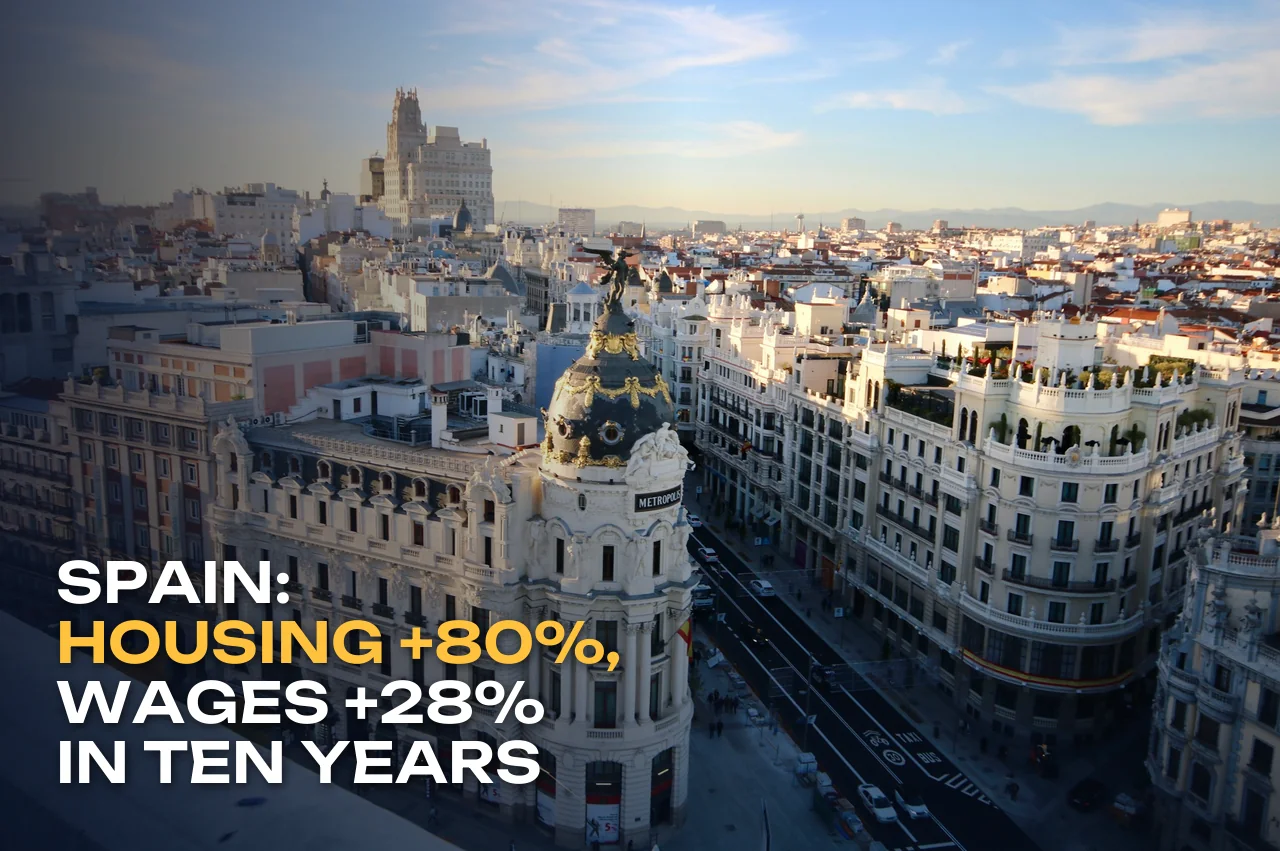
The third is price. According to the national statistics institute data we checked in our piece on house prices and wages, homes became roughly 80% more expensive over 2015-2025, while the average wage rose by about 28% over 2015-2024. In the second quarter of 2026 prices were up 12.2% year on year. Housing is getting more expensive faster than incomes, and affordability has become the main issue ahead of the snap general election on 29 November 2026.
Put these three factors together and the picture is clear. The non-resident has lost residence through purchase, faces capped rental income and pays a record price. The resident who needs a home to live in keeps buying, because the alternative is renting in the same expensive city.
Sergey EvdokimovManaging Partner, BRIDGES
Thinking of buying in Spain? We will check the property and the price before you pay a deposit
We will review the title, charges, any tenancy and local prices and tell you whether the deal makes sense.

Three scenarios for 2027
What follows is not a forecast by the notaries but my own scenarios. For each one I list the signs that will show within three to six months which of them is playing out. The first marker is the notaries' data for the second half of 2026; the second is what the new parliament decides after 29 November.
| Scenario | What happens | Signs that it is playing out | Weight (author's view) |
|---|---|---|---|
| Plateau | foreign demand settles at a new, lower level and prices rise more slowly | a fall of less than 10% in the second half of 2026, slower price growth for non-residents, mortgages stop falling | main |
| Further decline | non-residents keep leaving and the market rests on residents and Spaniards | after the 29 November election rental measures are extended or tightened, non-residents down 15% or more again | significant |
| Reversal | prices stall in some regions and buyers return | price per sq m falls in several regions in a row, non-resident purchases in Valencia and Andalusia grow | small |
I treat the plateau as the main scenario because resident demand remains strong and Spain still lacks housing. As long as sellers are not forced to sell, they hold their prices. In this scenario the fall in deals stops at a new level, and prices rise more slowly than in 2025-2026.
A further decline is possible if, after the election, measures aimed at housing investors become tougher or permanent: the rent freeze is extended, automatic contract renewal is approved, stressed market zones are widened. Non-residents would then keep leaving, and sellers on the coast who need to sell would have to cut prices.
I see a reversal as the least likely outcome over 2027. There are early signs of local cooling: in August the price per square metre fell 7.0% in Navarre and 4.9% in the Balearic Islands. That is not enough to speak of a turn in the whole market. If falls like these spread to several regions for several months running, the buyers who are now waiting will return.
What this means for you. None of these scenarios promises a cheap Spain in 2027. The difference between them is how much prices rise and how easy it will be to let a property.
If you are buying a home to live in
Your main question is not price but the basis for moving. Buying a home no longer gives you residence, so the status comes first: the non-lucrative residence permit for people living on savings and passive income, or the remote work visa for those working for foreign clients or employers. The first route is set out step by step in our non-lucrative residence guide.
I would advise against buying straight away. The first year is easier in a rental, especially since the law now protects tenants well. How to rent and what the contract should contain is covered in our article on renting in Spain as a foreigner. Within a year you will know the neighbourhood, schools, transport and the real price of flats, not the asking prices.
Secure a residence basis
Choose the non-lucrative permit or the remote work visa and gather documents before you move.
Rent first
Sign an ordinary long-term residential lease, not a temporary one.
Watch transaction prices
Use regional prices per square metre from completed sales, not listings.
Check the property legally
Title, debts, charges, building permits and any existing tenant.
Work out the tax
If you spend more than 183 days a year in Spain, you become tax resident there.
There is a short explanation of tax residence in our glossary. Our transaction support service can help with the property check and the purchase itself, and our document services cover the paperwork for residence.
If you are buying to let
This is the group the current situation hurts most. Until the end of 2027 rental income is capped by a freeze or a maximum 2% rise at review, temporary lets have been cut to 12 months with a documented reason, and short-term holiday lets have gone through a single national register since 2025. A non-resident landlord pays tax on rent: according to our article on the rent cap, 19% after expenses for EU residents and 24% on gross rent for everyone else.
At the same time purchase prices have risen. Rental yield is therefore squeezed from both sides: a more expensive entry and slower rent growth. If you buy a flat with a tenant, you also buy their contract, together with their right to an extension.
- Model the yield on the current rent and the decree rules, not on the market rate for the area.
- Ask for the tenancy contract, check it against the Serpavi reference system and note the next review date.
- Do not build a plan on short-term lets without checking regional and city rules.
- Compare Spain with markets where rental rules are lighter for investors before choosing a country.
For a country comparison see Greece vs Spain, Portugal vs Spain and Cyprus vs Spain. You can look for properties in other countries in our real estate section.
If you want residence without a golden visa
In Spain itself the answer is not a purchase but one of the routes the golden visa repeal did not touch. Most often that means the non-lucrative permit or the remote work visa. We compared the non-lucrative permit with Portugal's D7 visa in Portugal D7 vs Spain non-lucrative. You can still buy a home later, once you have the status.
If an investment route to residence matters to you, you need to look elsewhere. The Greek golden visa keeps a property option with different thresholds by region. In the Portuguese golden visa real estate has been excluded and funds and other options remain. Cyprus offers permanent residence through investment. For an overview of European programmes this autumn, see our analysis of EU golden visas in autumn 2026.
If you already hold a Spanish golden visa, there is no reason to panic. Under Organic Law 1/2025, existing permits remain valid for their term, and renewals are assessed under the rules in force when the permit was first granted. What matters is avoiding a gap between documents and filing the renewal on time.
Want to live in Spain without a golden visa? We will find the right residence route
We will look at your income, work and family and tell you which route fits and how long it takes.
Sergey EvdokimovManaging Partner, BRIDGES
If you own property and are thinking of selling
Prices are rising according to the notaries, but there are fewer buyers. For a seller that means a sale may take longer, especially where the market relied on non-residents: the Valencian and Andalusian coast and the Canary and Balearic Islands.
Non-residents still pay the most: EUR 3,493 per square metre against EUR 2,102 for resident foreigners and EUR 1,971 for Spaniards. If your property is aimed at a foreign second-home buyer, you depend on the most nervous group in the market. If it suits a local family, the price will be lower but demand steadier.
- Compare your price with completed sales in your region over recent months, not with your neighbours' listings.
- If a tenant lives in the flat, factor in their right to an extension: a buyer will value the property with that contract attached.
- Prepare documents early: the energy performance certificate, statements of no outstanding debts, cadastral data.
- If the sale is not urgent, wait for the second-half 2026 data and the election result: they will show which scenario is unfolding.
For a large sale or one with a foreign counterparty, checks on the buyer and the source of funds can be handled by our due diligence service.
What I would do now
| Who you are | Main question | What to do now |
|---|---|---|
| Buying a home to live in | a residence basis and the real price of the area | secure a residence permit and rent first, buy later |
| Buying to let | yield under the rent freeze | model on the current rent and the rules until the end of 2027 |
| Want residence without a golden visa | buying a home no longer gives residence | choose the non-lucrative permit or the remote work visa |
| Owner thinking about selling | who is buying in your area now | check regional prices and demand and any tenancy contract |
Put simply, I would not make a decision because of a headline saying 'foreigners are leaving Spain'. For living, Spain remains one of the most comfortable countries in Europe; the way in now goes through a residence status rather than a purchase. For buy-to-let investors the country has become noticeably less attractive than three years ago, and it is worth saying so plainly. For sellers the moment is still good on price, but not on speed.
The next markers are known. The election takes place in November, and after it we will see what happens to the rental measures. In early 2027 the notaries will publish their second-half 2026 data on foreign buyers, which will show whether this is a plateau or a continuing decline. You can discuss your own situation in an online consultation.
How this analysis was prepared
This analysis was prepared on 1 November 2026. Sources: the 15 October 2026 release of the General Council of Notaries of Spain and the analytical report of its statistics centre on home purchases by foreigners in the first half of 2026; the same centre's 29 October 2026 release on home sales in August 2026; Organic Law 1/2025 of 2 January 2025 in the Official State Gazette of Spain, final provision amending Law 14/2013. Figures on rental measures, prices and wages come from our own articles based on Royal Decree-Laws 28/2026 and 29/2026 and data from the national statistics institute. The scenarios are the author's assessment as of 1 November 2026. This material is not a substitute for legal or tax advice on your situation.
Share this article
Frequently asked
Questions people ask before deciding
01Have foreigners stopped buying homes in Spain?
No. In the first half of 2026 they bought 62,327 homes, 13.0% fewer than a year earlier. That is 18.3% of all sales. Purchases by non-residents fell the most, by 18.0%.
02Are house prices in Spain falling?
According to the notaries, no. In August 2026 the average price rose 12.8% year on year to EUR 1,959 per square metre. Prices paid by foreigners rose in 15 of the 17 regions.
03Can I get Spanish residence by buying a home?
No. Organic Law 1/2025 abolished the investor visa in full, including the property route, and new applications have not been accepted since 3 April 2025. The non-lucrative permit, the remote work visa and other routes remain.
04What happens to an existing Spanish golden visa?
Existing permits remain valid for their term. Renewals are assessed under the rules that applied when the permit was first granted.
05Is buying to let in Spain worthwhile now?
Less so than a few years ago. Until the end of 2027 rents are frozen or rise by no more than 2% at review, temporary lets are capped at 12 months and purchase prices are rising. Yield should be modelled on the current rent.
06Which market scenario for 2027 is most likely?
In the author's view, a plateau: foreign demand holds at a lower level and prices rise more slowly but do not fall. The notaries' data for the second half of 2026 will show whether this is right.
About the author
Related materials
What to read next
 NewsSpain: housing up 80% in ten years while wages rose 28%
 NewsSpain rent cap 2026: freeze above Serpavi, 2% limit and lease extensions
News+3 stories on 1 November
Related news
 Spain · 1 NovSpain: foreigners bought 13% fewer homes as the market falls for an eighth month
 Spain · 31 OctSpain: Extremadura will again pay remote workers up to EUR 10,000 to move, but conditions are stricter
 Spain · 28 OctIbiza prepares a record EUR 4.2 million fine for tourist letting without a licence
Personal programme selection is conducted by Anna Kovalevskaya, Head of Legal, BRIDGES.
Want to buy a home or move to Spain? We will build a plan around your goal
We will find a residence route, check the property and work out costs and taxes.
