Updated
SRV-LS-SB
Economic substance
Economic substance for a company to the requirementsof the jurisdiction and the bank
We settle what level of presence a company needs, what it already has and which elements have to be added. We arrange the premises, the management, the staff, the local expenditure and the evidential archive in a composition that matches the real activity.
- We settle the requirements by jurisdiction and by type of activity
- Presence is evidenced by documents and by work actually done
- We work out the budget for the launch and the annual upkeep before the start
01 / Situations
When a company has to evidence a real presence
Substance is the actual work of a company in a jurisdiction: premises, people, management, activity and expenditure on the ground. It differs from a registered address in that the address answers where to send correspondence, while presence answers where the company really works and where its decisions are taken.
The law sets requirements
For particular types of activity the economic substance rules apply, along with the reporting they provide for.
The bank checks the management
Compliance asks for details of the premises, the staff, the director, the expenditure and the place where decisions are taken.
A question of tax residency arises
It has to be evidenced where the company is actually managed and where its economic activity takes place.
A tax regime is to be applied
What is checked is not only the formal conditions of the regime but the requirements as to activity and presence in the jurisdiction.
The company is preparing for a transaction
An investor, a buyer or an auditor checks whether the structure as stated matches the company’s real work.
The business has grown
Staff, clients and turnover have appeared, so the earlier model of presence may no longer match the scale.
02 / Three levels of scrutiny
The law, the tax authorities and the bank assess a company by different criteria
Meeting one set of requirements does not automatically mean meeting the others. The analysis is done separately at each level, and the conclusions are drawn for the particular jurisdiction rather than as a general rule.
The statutory requirements
A number of jurisdictions — the British Virgin Islands, the Cayman Islands, Jersey, Guernsey, the Isle of Man, Bermuda — have economic substance laws. They cover the activities the law lists, set requirements as to management, staff, premises and expenditure and provide for annual notifications and reports. The list of activities and the make-up of the requirements differ from country to country.
The tax analysis
Here what is checked is the place of effective management, the functions performed, the people, the expenditure and the connection of the income with the jurisdiction. That governs the company’s tax residency, whether a regime applies and the position of the country where the owner is. The conclusions are drawn under the law of each country concerned and do not follow automatically from meeting the economic substance requirements.
Bank compliance
The bank assesses where the company works, who takes the decisions, who carries out the operations, what expenditure passes through the account and why this bank was chosen. The bank’s requirements do not coincide with the law’s: it may ask for more and takes its decision on its own.
03 / The elements
Which elements can evidence a company’s real work
Not every element is required of every company. The composition is settled after analysing the law of the jurisdiction, the type of activity and the aims of the structure.
Premises
A workplace or an office matching the scale and character of the activity, with a contract and evidence that it is actually used.
People
A director, employees or contractors with real functions, qualifications and a clear area of responsibility.
Management
Meetings, resolutions, powers and documents that show where the company’s decisions are actually taken.
Activity
The functions and operations the company performs itself: contracts, work with counterparties, performance of obligations.
Expenditure
Rent, pay, services, communications, equipment and other justified local expenditure matching the volume of work.
Accounting and reporting
Documents allowing the activity and the discharge of the duties applying to the company in that jurisdiction to be evidenced.
04 / Diagnosis
How the level of presence required is settled
The same parameters of a company are assessed from three sides. The table shows what is checked in each direction rather than a ready answer: the particular requirements depend on the jurisdiction and the type of activity.
| The statutory requirements | The tax analysis | The bank check | |
|---|---|---|---|
| The jurisdiction | Whether an economic substance law is in force | The country’s residency rules and its own tests | Whether the bank is ready to work with the country of registration |
| The type of activity | Whether the activity is on the list the law covers | Which functions create the income and where they are performed | Whether the activity as stated matches the operations on the account |
| The sources of income | Which activity the income for the period came from | The connection of the income with the jurisdiction and with the company’s functions | Where the funds come from and from which counterparties |
| Where the clients are | Taken into account in assessing the character of the activity | Where value is created and where the connection arises | The geography of the settlements and the reason for the choice of account |
| Where the staff are | Whether there are enough qualified staff in the jurisdiction | Who actually performs the functions and in which country | Who runs the operations and deals with the bank |
| Where the director is | The requirements as to management and direction on the ground | Where the director actually discharges their duties | Who signs the documents and operates the account |
| Where decisions are taken | Where the meetings are held and the key decisions taken | A check on actual management and control | Who gives instructions on the account and from where |
| Premises | Whether there are premises matching the activity | A fixed place of business and its use | Evidence of the address and of its real use |
| Local expenditure | Whether the expenditure in the jurisdiction is sufficient | The economic justification and the connection with the functions | The regularity of payments through the account in the country |
| Bank accounts | The law as a rule sets no direct requirements | Where the settlements are made and how that relates to the activity | Why this bank and this country of account were chosen |
| Contracts | They evidence that the main activity is carried on | Who the party is, who performs and where the obligations are performed | The basis of the payments and whether they match the turnover |
| Licences | The regulator’s requirements as to activity and presence | The effect of regulated status on the tax regime | The right to carry on the activity and admission to service |
| Reporting | Notifications and substance returns, where they are provided for | Tax and financial reporting in the jurisdiction | The documents asked for on a check and on updating the data |
| Tax aims | Meeting the statutory requirements does not replace the tax analysis | Whether the regime and the treaties apply is checked separately | The logic of the structure has to be explicable to the bank |
| A transaction or an inspection | The discharge of the duties for past periods | Open questions and risks from past years | Whether the documents are ready for a request at short notice |
The table scrolls sideways
The analysis starts from what the company already has: its own premises, local or remote staff, a director in the jurisdiction, regular local expenditure, accounting, contracts, equipment, suppliers, meetings and banking activity. The existing elements count where they belong to this company, match its activity and are evidenced by documents. On the results it is clear what already exists, what is missing, what is compulsory, what is recommended and what needs separate evidencing.
05 / Evidence
Presence is evidenced not by a description but by a consistent body of documents
Describing the model proves nothing: the party checking looks at the documents and at whether they agree with each other and with the company’s actual work. The evidential archive is assembled as the work goes along rather than reconstructed before a request.
Premises
The lease, the invoices and payments under it, evidence that the workplace is actually used.
People
Employment or contractor agreements, a description of the duties, the payroll and evidence of payment.
Management
The minutes of meetings, the resolutions of the directors and members, evidence of where the participants were.
Activity
Contracts with clients and suppliers, documents of performance, working correspondence to the extent permissible.
Expenditure and accounts
Invoices for services, communications and equipment, and bank statements showing the company’s regular work.
Accounting and reporting
The accounting records, the tax reporting and the substance returns where they are provided for, and the internal rules.
None of the documents listed is compulsory in every case: the make-up of the file is settled by the jurisdiction, the type of activity and by who exactly is asking — the registrar, the tax authority, the bank or a party to a transaction.
06 / Alternatives
When full substance may be unnecessary or not worth the cost
Some requests are met without creating a presence — and we say so before the work starts.
The company is not caught by the requirements
A check may show that the economic substance law does not apply to the company’s activity and that basic corporate support is enough.
The presence already exists
If the premises, the people, the management and the expenditure really are in the jurisdiction, only documenting them and a few improvements may be needed.
Another jurisdiction suits the business better
If running the model costs more than its business value, it is wiser to compare changing the structure or moving the company to a country with manageable requirements.
The task can be solved another way
Sometimes the bank’s or the counterparty’s question is about documents, reporting or an explanation of the activity rather than about the absence of a presence.
We do not create a presence on paper
Premises that are not used, an employee with no functions and meetings that never happened do not solve the task and increase the risk at the very first check.
We do not promise a result that is a third party’s to give
Recognition of tax residency, the application of a treaty, a reduced rate and the opening of an account remain decisions for state authorities and banks.
The model of presence has to match the company’s real activity and to be economically justified for the owner.

Presence is evidenced by work that is genuinely done on the ground and by the documents that record it.
07 / The scope of work
From analysing the requirements to a working model of presence
We run the project whole: from going through the jurisdiction’s requirements to the archive that evidences the company’s actual work.
Analysis of the jurisdiction and the activity
Which requirements apply to a company in this line of business and what exactly they entail.
A check on the current structure
Ownership, management, contracts, accounts, staff and expenditure — what already exists and how it is documented.
Tax and banking analysis
To the agreed extent: the place of management, the regime, the position of the owner’s country, the questions the bank is likely to ask.
Settling the level required
What is compulsory, what is recommended and what is not required in this company’s particular situation.
Preparing the model and the budget
The make-up of the elements, the order in which they are launched, the cost of setting them up and of running them.
Finding premises
A workplace or an office to match the scale of the activity, the contract and the way its use is evidenced.
Setting up local management
The procedure for meetings and decisions, the powers, the regulations and the paperwork of the governing organs.
Finding staff or contractors
Where the model requires it: the functions, the qualifications, the form of the relationship and the paperwork.
Preparing contracts and regulations
The lease, the employment and contractor agreements, the job duties, the internal rules of work.
Setting up local expenditure
What expenditure arises in the jurisdiction, how it is paid and how it is evidenced.
Setting up accounting and reporting
Putting the accounting in place, the calendar of duties, dealings with the accountant on the ground.
Building the evidential archive
Gathering and ordering the documents that show the company’s actual work.
Preparing the substance reporting
The notifications and substance returns in the jurisdictions where the law provides for them.
Maintaining and updating
Keeping the documents current and following the required actions and deadlines.
BRIDGES GLOBAL answers for the analysis, the design of the model, the coordination and the archive. Opinions on local law are given by local lawyers, the tax position is confirmed by tax advisers, the accounting is done by an accountant, staff are found and engaged by HR specialists, the premises are provided by a landlord and the decision on the account is the bank’s. From the client: the documents, the owners’ decisions and actual participation in the management.
08 / The result
What the company has once the model of presence is launched
The result is measured in documents and a clear list of the duties that follow.
After the analysis, before the work starts
- An opinion on the requirements applying by jurisdiction and type of activity
- An assessment of the current model: what already meets the requirements
- A list of the missing compulsory and recommended elements
- A model of economic substance with the reasoning for its composition
- The budget for the launch and for the regular annual upkeep
- Alternative options, a change of structure or of jurisdiction included
A working infrastructure
- Working premises with a contract, where they are part of the project
- A management model set up and rules for taking decisions
- Documents on the staff or contractors describing their functions
- The procedure for local expenditure and for evidencing it
- Accounting organised and a calendar of reporting
Evidence and upkeep
- An evidential archive covering every element of the presence
- The substance reporting prepared where it is provided for
- A schedule for updating the documents and for the control actions
- A list of the open risks and the limits of the model
We do not promise automatic recognition of tax residency, the application of an international treaty, a reduced rate, a bank’s approval or an absence of questions on inspection: those decisions are taken by state authorities, banks and other parties. Our task is that the company’s actual work is organised and evidenced by documents.
09 / The cost
What creating and maintaining a presence costs
The cost falls into two parts: launching the model and running it. Both are worked out before the work starts — for substance the number that matters is the annual budget.
The jurisdiction
Rent, pay, services and compulsory fees differ several times over from country to country.
The type of activity
Regulated activities and those covered by the law call for a greater volume of presence.
The level required
A workplace and a director is one budget; premises with a team and local functions quite another.
Premises
The format of the workplace, the floor area, the term of the contract and the way its use is evidenced.
People
The number of employees or contractors, their qualifications, the form of the relationship and how they are paid.
Management
How often meetings are held, the director’s role on the ground, the volume of paperwork of the governing organs.
Accounting and reporting
The volume of transactions, the reporting requirements and whether an audit is compulsory.
The evidential archive
The volume of documents, how far back past periods have to be reconstructed and how often it is updated.
What already exists
Existing elements count where they are evidenced by documents: what is missing is built on top.
Outside specialists
Local lawyers, tax advisers, accountants and HR specialists are a separate part of the budget.
After the preliminary analysis you receive the list of applicable requirements, an assessment of the current model, a list of the missing elements, the recommended configuration, the alternative options, the budget for the launch, the regular annual budget and a guide to the stages. The figures are given for the particular jurisdiction and activity, not from a general price list.
10 / How we work
How we work
Every stage ends with a result that shows it is closed.
The analysis
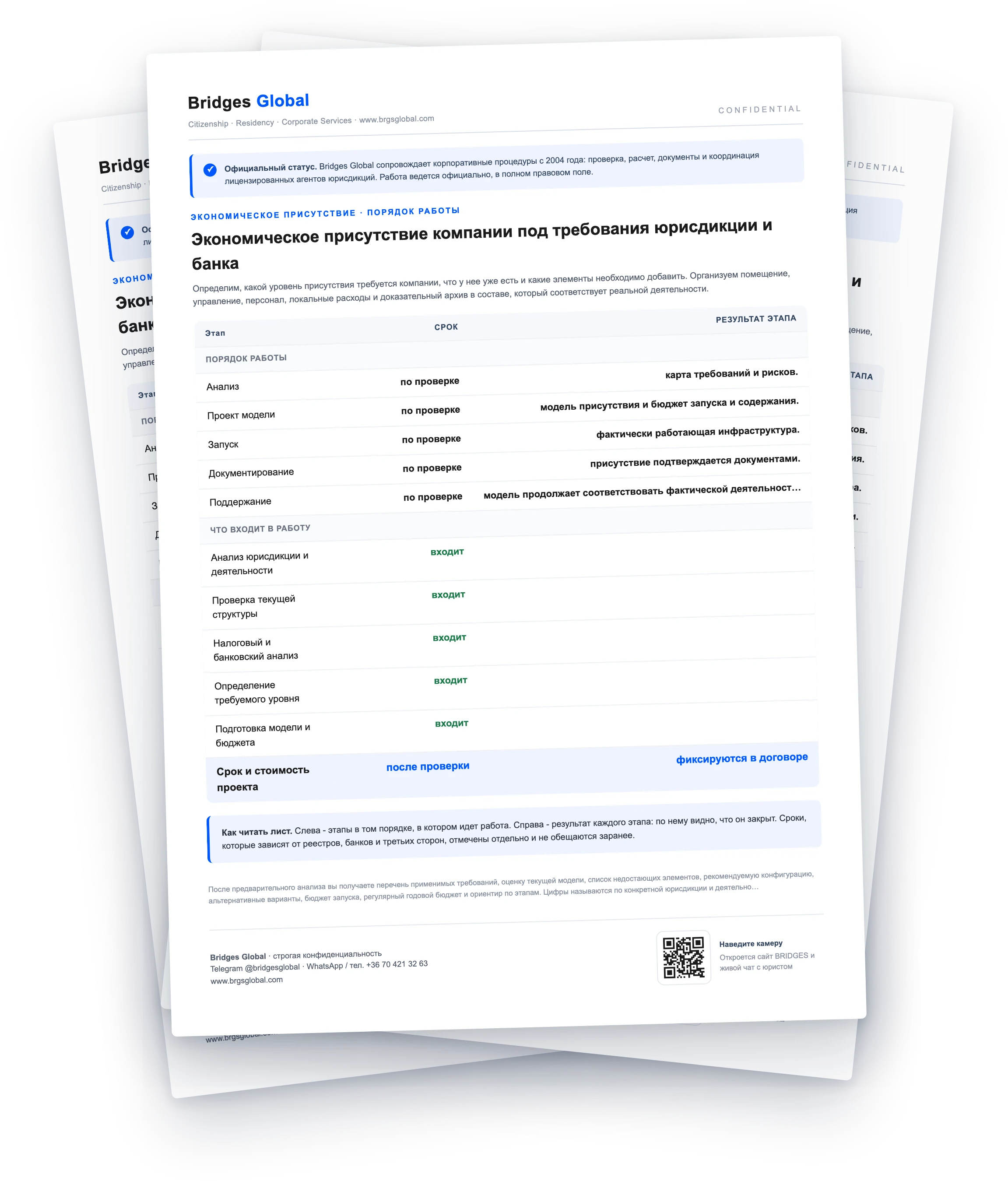
We check the law of the jurisdiction, the activity, the structure and the tax and banking tasks. The result: a map of the requirements and the risks.
The design of the model
We settle the premises, the management, the people, the expenditure, the reporting and the documents. The result: the model of presence and the budget for launching and running it.
The launch
We put the agreed elements in place and arrange the relationships with the landlord, the staff and the contractors. The result: an infrastructure that actually works.
Documenting
We assemble the contracts, the resolutions, the evidence of expenditure and the evidential archive. The result: the presence is evidenced by documents.
Upkeep
We follow the required actions, update the archive and prepare the reporting. The result: the model keeps matching the actual activity.
The timing is given after the particular model has been checked: leases, hiring, registration and banking steps depend on third parties, not on us. We do not give a universal schedule for every jurisdiction.
11 / Preparation
What we will need from you
The full picture is needed before the calculation: the level of presence cannot be settled on incomplete data.
The company’s documents
The constitutional documents, the ownership structure, the current registers, the latest accounts and the licences if there are any.
A description of the activity
What the company does, which functions it performs itself, where the income comes from, where the clients and counterparties are.
People and management
The director and where they work, the staff and contractors, where the company’s decisions are actually taken.
Infrastructure and expenditure
The premises, the bank accounts, the contracts, the regular expenditure, the equipment and the local suppliers.
The aim and the outside request
Why the check is needed: the law, a bank, tax or a transaction, and what exactly the other side asked.
The company’s plans
How the activity will change: turnover, staff, new lines and markets.
Substance calls for the owner and the management to take part in fact. The model cannot exist apart from the company’s real activity: the decisions, the meetings and the functions must genuinely happen as the documents describe.
12 / Team
Who runs the work
The project is run by a BRIDGES GLOBAL coordinator. The tax part is covered by our adviser and the local questions by specialists in the jurisdiction concerned.
 Hanna BergerTrusts and Succession AdvisorThe requirements as to presence, tax residency and the place of effective management
 Eva LauriHead of OperationsManagement, powers and the resolutions of the company’s organs
 Martin DvorzhakDocument Processing SpecialistThe evidential archive of the presence and answers to requests
 Viktoria LebedevaManaging Director, Private ClientsThe standards of work with the client
Management, powers, the resolutions of the organs, the contracts and the company’s regulations.
The make-up of the model, whether the elements match the activity, the evidential archive and the substance reporting.
Accounting for the local expenditure and pay, and the company’s reporting in the jurisdiction.
Performing the functions on the ground, where the agreed model provides for it.
Finding the premises and the staff and arranging the relationships under local law.
One person answerable for the project: the plan, the timing, the dealings between the participants and the final archive.
14 / Questions
Answers to common questions
It is a company’s real economic presence in a jurisdiction: premises, people, management, activity and expenditure on the ground. The term covers both the requirements of the economic substance laws and the wider question — whether the company’s actual work matches what its documents state.
Economic substance laws are in force in the British Virgin Islands, the Cayman Islands, Jersey, Guernsey, the Isle of Man, Bermuda and a number of other jurisdictions. They cover the activities the law lists — banking, insurance, financing and leasing, fund management, headquarters functions, shipping, intellectual property, distribution and service centres, holding activity. The lists and requirements differ from country to country: whether they apply is checked under the law of the particular jurisdiction.
The economic substance reporting requirements in the UAE are limited to the financial years from 1 January 2019 to 31 December 2022: Cabinet Decision No 98 of 2024 lifted their application to later periods and cancelled the penalties for them. That does not mean presence in the UAE has stopped mattering: for the free zone companies’ preferential regime the corporate tax rules require the core income-generating activities to be carried out in the zone and sufficient assets, staff and expenditure to be held for them. That is checked under the tax legislation instead.
A registered address answers where official correspondence should be sent. Presence answers where the company actually works: who takes the decisions, who performs the functions, where the people are and what expenditure arises. An address is the compulsory minimum for registration, but it does not meet the requirements as to presence.
As a rule no. A director in the jurisdiction is one element of management, and they count where they genuinely discharge their duties and take decisions. What is assessed is the whole: where the premises are, who works, which functions are performed, where the meetings are held and where the expenditure goes.
Sometimes yes, sometimes no. For a small company with limited functions a workplace may match the scale of the activity if it is genuinely used and evidenced by a contract and expenditure. For regulated activities and companies with staff, full premises are usually required. The answer is given for the particular jurisdiction and activity.
It depends on the requirements and on which functions the company performs itself. In some places functions may be outsourced to a contractor in the same jurisdiction provided the company keeps control; in others its own staff are required. The number and qualifications of the people are assessed against the volume of activity.
Presence in a jurisdiction is created by people working in that jurisdiction. Staff in other countries do not count towards it and may, moreover, raise questions of a tax connection in the country where they work. Sometimes moving part of the functions on-site costs less than hiring again.
The key decisions have to be taken where the company says its management is, and that has to be visible from the documents: the minutes, the resolutions, who attended the meetings and where they were held. A formal signature on a decision actually taken in another country is weak evidence on an inspection.
The lease and evidence of the use of the premises, the agreements with staff or contractors and the payments under them, invoices for services and equipment, bank statements, contracts with clients and suppliers, the minutes of meetings and the resolutions, the accounting records and the reporting. There is no list compulsory for everyone: what is needed depends on the jurisdiction, the activity and who is asking.
Directly, but not automatically. In many countries a company’s residency is settled by the place of effective management, and in some by the place of registration too. Presence is the main argument on that question, but the conclusion on residency is drawn under the law of each country concerned, the owner’s country included.
No. Treaties have conditions of their own, a test of the business purpose of the structure among them, and the decision on applying them is the tax authority’s. Presence strengthens a company’s position and makes it explicable, but it is not a guarantee — and we do not promise one.
The bank asks where the company works, who takes the decisions, who carries out the operations, whether there are staff and premises, what expenditure passes through the account and why this bank was chosen. Its requirements do not coincide with the law’s: it may ask for more and takes its decision on its own.
It depends on the model. If the owner sits on the governing organs, taking part in meetings there in person is a strong argument. If the management is with a director in the jurisdiction, the owner may not need to travel. The arrangement is settled at the design stage.
The archive lives along with the company: documents are added as meetings, payments, contracts and reporting actions happen. A full reconciliation is usually timed to the annual reporting cycle, and also to the moments when a request from a bank, a tax authority or a party to a transaction is expected.
An exact figure can be given only for a particular jurisdiction and model. The budget is made up of the premises, the pay or contractors’ fees, the director’s services, the accounting and reporting, the compulsory fees and the work of outside specialists. We work out two sums — the launch and the regular annual upkeep — and show them before the work starts.
Compare it with the alternatives. Sometimes documenting the activity that already exists is enough; sometimes it is wiser to change the structure, move the company to a jurisdiction with manageable requirements or reconsider where the activity is actually carried on. We work out both paths; the decision stays yours.
In some cases yes — through redomiciliation, a reorganisation or creating a new structure and moving the activity across. Whether it is permissible is checked in both countries, and the consequences for taxes, contracts, licences and accounts are worked out in advance. A separate service handles that — changing the structure.
Where an economic substance law is in force there are fines, the exchange of information with other countries and, on repeated breaches, up to being struck off the register. Separately from the law, tax consequences and banks’ questions arise: service to a company with no coherent presence may be ended with no law involved at all.
INITIAL ASSESSMENT
Tell us what outcome your family needs
We will design a solution for your case, choose the country and the right status, and take the whole process through to the result.
