Citizenship · Moldova
Moldovan Citizenship by Descent in 2026: Who Is Entitled

Updated: June 2026·5 min read·Expert reviewed
Terms and costs verified: June 2026
Contents
Moldova restores citizenship to descendants of residents of Bessarabia, Northern Bukovina and the Moldavian SSR — without relocation and without giving up your current passport. Dual citizenship has been permitted since 2003, and since 2022 Moldova has been an official candidate for EU membership. Here is who qualifies, which documents are needed and how long it takes.
Who is entitled to citizenship by descent
The Law on Citizenship of the Republic of Moldova No 1024-XIV was adopted on 2 June 2000 and entered into force on 10 August 2000. Besides standard naturalisation, it provides for the recognition of citizenship (redobândirea cetățeniei) for several categories of applicant:
- Direct descendants. People whose parents, grandparents or great-grandparents were born on the territory of present-day Moldova — recognition extends across three generations.
- Descendants of residents of Bessarabia, Northern Bukovina and the Hertsa region. A separate category covers descendants of those who lived in these territories as at 28 June 1940, the date of the Soviet ultimatum to Romania after which these lands became part of the USSR.
- Descendants of residents of the Moldavian ASSR. The same applies to those whose ancestors lived in the Moldavian Autonomous SSR, which existed within the Ukrainian SSR until 1940, on the same date.
- The deported and those who fled. People deported from Moldova or who fled these territories from 28 June 1940 onwards, and their descendants.
- Lawful residents at the date of independence. Those who had a lawful permanent residence in Moldova on 23 June 1990, before independence was proclaimed, and continue to live there.
The key difference from programmes such as the Polish or Hungarian ones: the applicant's age does not matter, but you must prove with documents, beyond doubt, that the ancestor lived in the relevant territory on the relevant date. Oral family history or circumstantial signs — a surname, a dialect — are not enough.
It is worth understanding the difference between recognition (recunoaștere) and restoration (redobândire) of citizenship. Recognition applies to people who never formally held Moldovan citizenship but whose ancestors fall within the categories above; the great majority of applicants from Russia, Ukraine and other CIS countries take this path. Restoration concerns those who were themselves Moldovan citizens and lost citizenship — for example, on acquiring another passport before dual citizenship was legalised in 2003. For them the process is shorter, because the fact of citizenship is already recorded in the civil registry archives.
Documents proving descent
The standard pack for an applicant on the ancestral line:
- Birth and marriage certificates for the whole chain of generations, from the applicant to the Moldovan ancestor, apostilled and translated into Romanian or Russian depending on the filing authority.
- A document confirming the ancestor's citizenship or place of residence: a pre-war Moldovan or Romanian passport, a parish register, or an archive certificate of registered residence in Bessarabia or the Moldavian SSR in 1940.
- In cases of deportation, an NKVD or KGB archive certificate confirming the deportation, requested through the national archives of Russia, Kazakhstan or the other countries to which residents were deported.
- The applicant's travel passport and a certificate of no criminal record.
- The completed application form for the Public Services Agency (ASP) or a Moldovan consulate.
In practice the bottleneck is finding pre-war archive documents. Part of the Bessarabian archives was lost or transferred to Romania, Ukraine and Russia at different times, so requests sometimes have to go to two or three archives at once.
Process and timelines
The application is filed with the Agenția Servicii Publice (ASP) in Moldova or through a Moldovan consulate abroad. The applicant does not need to be in the country while it is examined.
- Gathering and legalising documents - two to six months, depending on whether archive research is needed.
- Filing and initial review - one to two months.
- Examination on the merits - officially up to six months, in practice often stretching to 12-18 months because of the archive-check workload.
- Decision and the passport - after a positive decision, the identity booklet and the travel passport are issued within one to two months.
The realistic overall timeline from start to passport runs from nine months for a simple case with surviving documents to two years where archive requests are needed in several countries.
The cost
There are few direct state fees for recognising citizenship by descent in Moldova, but the associated costs of documents can exceed them several times over:
| Item | Amount |
|---|---|
| State fee for examining the application | ~€50-100 |
| Moldovan travel passport | ~€50-70 |
| Apostille, per document | €10-30 |
| Notarised translation | €15-40 per page |
| Archive request (Russia / Ukraine / Kazakhstan) | €50-300 per certificate |
| Turnkey legal support | €1,500-4,000 |
With a simple chain of documents — two generations, every paper to hand — a realistic budget is €300-700 for legalisation without a lawyer. Where archive research across two or three countries and full support are needed, the total can rise to €3,000-5,000.
Moldova plus Romania: the dual option
A significant share of applicants for Moldovan citizenship by descent are also entitled to Romanian citizenship. Bessarabia was historically part of Romania until 1940, and many families fall under both restoration laws — the Moldovan No 1024-XIV and the Romanian No 21/1991.
Moldova permits dual citizenship, so there is no conflict between the two passports. The processes run through different authorities, independently of each other: Moldovan citizenship through the ASP in Moldova or a consulate, Romanian citizenship through the Autoritatea Națională pentru Cetățenie (ANC) in Bucharest. Many applicants file both in parallel, since the documents — ancestors' birth certificates, archive certificates — overlap to a large extent.
The practical sense of the dual option: the Moldovan passport is usually obtained faster, without the long ANC queues, while the Romanian one gives direct EU citizenship. Some families take Moldovan citizenship first, as a faster and more predictable first step, and Romanian citizenship later, when part of the documents is already legalised.
Moldova as an EU candidate: what it means now
Moldova was granted EU candidate status in June 2022, and in 2024 the European Council approved the opening of formal accession negotiations. That does not mean automatic membership in the coming years: negotiations across every chapter of the acquis communautaire, the body of EU law, traditionally take 8 to 15 years even for the best-prepared candidates.
The practical conclusion for applicants today: a Moldovan passport does not yet carry the rights of an EU citizen — free employment and residence in any member state — but it already gives visa-free entry to the Schengen area (since 2014) and a status that could convert into an EU passport if accession negotiations succeed, on a timeline that is not guaranteed.
Common reasons for refusal
- Insufficient documentary proof of descent. The most common reason: circumstantial evidence — a surname, oral family history — is not accepted without archive documents.
- Errors in translation and apostilles. Inconsistent transliteration of names between documents of different generations is a frequent technical reason for a request for further papers or a refusal.
- The ancestor's place of residence falls outside the law. It is essential to establish precisely whether the territory was part of Bessarabia or the Moldavian SSR in 1940; not every region of present-day Moldova or neighbouring countries qualifies formally.
- A criminal record or legal problems. An unspent conviction in the country of residence is a ground for refusal.
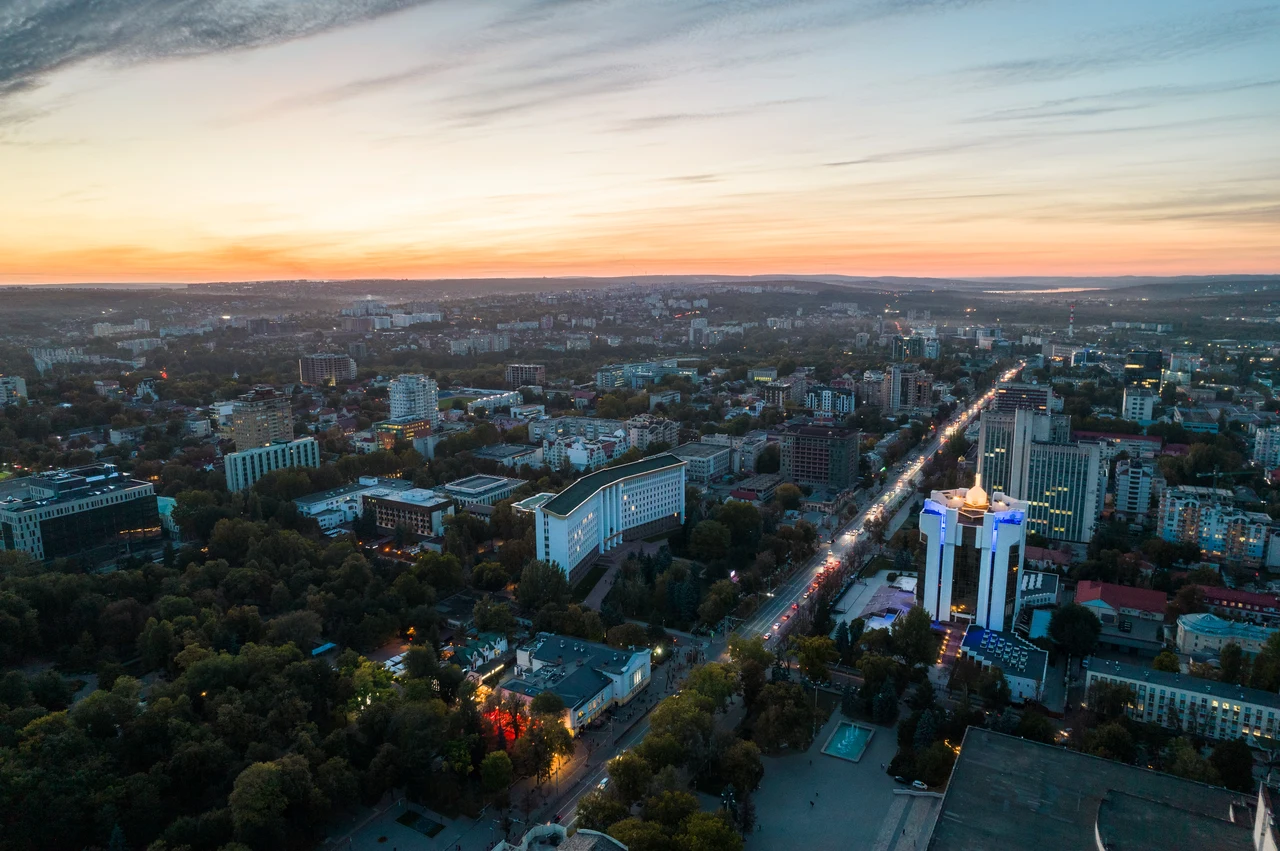
Chișinău: life after the status is granted
Chișinău is a capital of about 500,000 people and one of the most affordable cities in Europe to live in.
- A one- or two-bedroom flat in the centre rents for €300-600 a month.
- A growing IT industry: outsourcing companies and Moldova IT Park, whose residents pay a single 7% tax instead of the standard rates, attract specialists from the CIS.
- Russian is widely spoken, particularly among the older generation and in services, so there is practically no language barrier for people moving from Russia.
- Direct flights to several European capitals and to Istanbul make it a convenient transit hub.
For holders of a Moldovan passport who do not plan to move, citizenship remains above all a mobility instrument — visa-free Schengen — and a potential foundation for Moldova's future EU membership.
For those considering an actual move, Moldova has another advantage: the country is not on sanctions lists and retains banking infrastructure that works with cards and transfers from Russia and the CIS without the restrictions typical of EU banks. An account at a local bank (Moldova Agroindbank, Victoriabank) can be opened in one to two days with a Moldovan identity card or residence permit.
What to choose: citizenship, residence or both
Not everyone considering a connection with Moldova necessarily needs citizenship by descent. There are three realistic scenarios:
- You have documented Moldovan ancestry - the best course is to apply for citizenship by descent: it costs less and is more reliable than any investment alternative, and simply takes time for the archive documents.
- No ancestry, but you need quick entry to the country - Russian citizens enter visa-free, and residence can be obtained through registering a company or through employment, with no need to prove descent.
- You have both Moldovan and Romanian ancestry - it makes sense to apply for both citizenships in parallel, as described above, and decide once they are granted which passport to use in a given situation.
Frequently asked
Questions people ask before deciding
01Who is entitled to Moldovan citizenship by descent?
People who themselves, or whose parents or grandparents, were Moldovan citizens, including historical residents of the Moldavian SSR before 1940 and of Bessarabia.
02What has to be proved to obtain citizenship by descent?
You must document that the ancestor lived specifically on the territory of the Moldavian SSR, not simply 'in the region' — a general historical connection with the area is not enough.
03Is dual citizenship permitted?
Yes, it has been permitted since 2003.
04Is Moldova an EU candidate?
Yes. Candidate status was granted in 2022 and accession negotiations are under way.
05Can Romanian citizenship be obtained at the same time?
Yes. Many Moldovan citizens are also entitled to Romanian citizenship, an EU country. Since Moldova permits dual citizenship, both passports can be obtained through separate processes at the ANC in Romania and the ASP in Moldova, with no conflict between them.
06Does a Moldovan passport give access to Schengen?
Yes, visa-free.
07What is life like in Chișinău?
A capital of about 500,000 people and one of the cheapest cities in Europe: a two-bedroom flat rents for €300-600 a month, with a growing IT scene.
Transparency
How this material was prepared
- Author
- Daniel Kovach, senior International Law Attorney, BRIDGES
- Terms and costs last verified
- June 2026
- Sources
- official government authorities of the relevant country and state publications
- Methodology
- government minimum requirements are stated separately from due diligence charges, state fees, legal and banking costs
Sources and methodology
Figures, terms and timelines are checked against official sources as of June 2026. Link availability verified in August 2026. Third-party blogs and agent websites are not used as a source of programme terms.
- [1]EUR-LexOfficial texts of European Union legislationeur-lex.europa.eu/homepage.html
- [2]European Commission - Migration and Home AffairsEntry and residence rules in the EUhome-affairs.ec.europa.eu/index_en
Methodology: tables and charts state government minimum investment requirements; due diligence charges, state fees, legal, banking and other costs are calculated separately and are not included in the minimum thresholds.
About the author
Related materials
What to read next
 ComparisonAntigua and Barbuda or Grenada: Family Passport for Large Families in 2026
 AnalysisWhat is due diligence and why the Caribbean is rejecting applications
 ArticleCitizenship of Antigua and Barbuda through Investment: Complete Guide 2026
Personal programme selection is conducted by Anna Kovalevskaya, Head of Legal, BRIDGES.
Checklist: citizenship of Moldova by descent
Which documents on the ancestor and each family link are gathered in advance, where they are requested and what slows the review.
