Residency · Cyprus
Life in Paphos in 2026: areas, prices, pros and cons, who is suitable

Updated: June 2026·12 min read·Expert reviewed
Terms and costs verified: June 2026
Contents
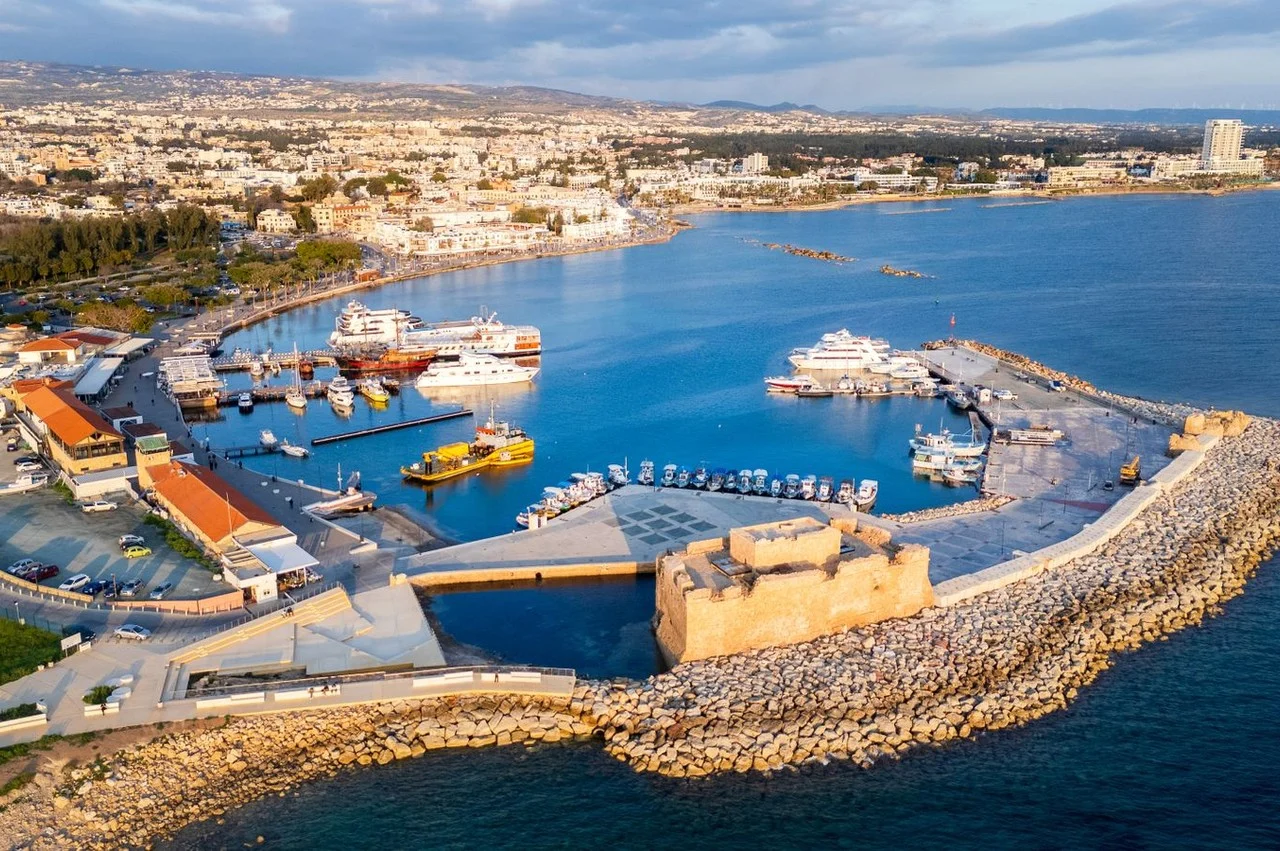
Paphos is the calmest of the big cities in Cyprus: the west of the island, the sea, archeology under UNESCO protection, a measured pace and a large British community. People come here to retire, to work remotely, and for a quality of life without the bustle of the capital. Rent and real estate here are noticeably cheaper than Limassol, there is an international airport and English is spoken on every corner. But Pathos is not about a business career and offices. We analyze by area - from Kato Paphos by the sea to villas in Peyia and Tala - how much it costs to live, for whom the city is ideal, and for whom it will be cramped here.
Paphos is the quiet west of Cyprus, not the second capital
If Limassol is the business and noisy center of the island, then Paphos is its calm counterbalance. It is a small resort town on the southwest coast, surrounded by hills, vineyards and archaeological sites. The historical center and harbor area are included in the UNESCO World Heritage List: ancient mosaics, Tombs of the Kings, a medieval fort - all within walking distance from residential areas.
The pace of life here is fundamentally different. Pathos does not drive you, does not crush you with skyscrapers and traffic jams, and does not require you to be included in the corporate race. People move here for the sea, clean air, mild climate and the feeling that time has slowed down. That's why the city has been attracting British retirees, remote professionals and those tired of big cities for decades.
It is important to immediately set expectations: Pathos is about the quality of life and nature, and not about business opportunities and the nightlife of the metropolis. To understand how it compares to other cities on the island, it is useful to compare it with life in Limassol and go through the general overview best areas to live in Cyprus.
Paphos districts: from the sea to the quiet hills
Paphos is divided into two large parts: the lower town (Kato Paphos) by the sea with a harbor and tourist infrastructure and the upper town (Pano Paphos, the historical center of Ktima), where mainly locals live. But the real expat map is the surrounding villages in the hills and along the coast north of the city. This is where most foreigners settle.
- Kato Paphos - tourist heart by the sea: embankment, restaurants, hotels, archeology. Convenient for living without a car, but noisy in summer, and some establishments close in winter. Suitable for those who want to walk and live in the thick of things.
- Coral Bay and Peyia - hills above the famous Coral Bay beach, villas with swimming pools, sea views, a strong British and international community. A classic choice for those who are looking for a house with a plot.
- Tala and Emba - quiet villages in the hills with villas, taverns and a strong expat community (clubs, quizzes, book clubs). Loved by British pensioners.
- Chloraka - a residential suburb north of the center, by the sea, with supermarkets and schools. Cheaper than Coral Bay and close to the beach - popular with families and retirees.
- Ktima (old town) - historical upper Paphos with cafes, markets and galleries, local life, authentic atmosphere.
We provide a detailed analysis of the entire island with reference to the budget in the material about best areas to live in Cyprus.
Table: Paphos area - character - approximate rent
To make it easier to navigate, we will summarize the main areas in one table. Rental figures are indicative 2026 ranges for long-term rentals; the specific rate depends on the area, renovation, availability of a swimming pool and proximity to the sea. The exact amounts are always confirmed based on current advertisements.
| District | Character | Approximate rent per month |
|---|---|---|
| Kato Paphos | Tourism, by the sea, promenade, walking distance | apartments ~900-1400 € |
| Coral Bay / Peyia | Pool villas, views, Brits and expats | villas ~1500-3000 € |
| Tala/Emba | Quiet hills, villas, pensioners, community | at home ~1200-2200 € |
| Chloraka | Residential suburb by the sea, families, cheaper than Coral Bay | apartments/houses ~800-1500 € |
| Ktima (center) | Old town, locals, authentic, cafe | apartments ~700-1100 € |
The general logic is simple: the closer to the sea and the larger the villa with a pool, the higher the rate. The most affordable entry is apartments in the center and Chloraka, the most expensive are villas in the Coral Bay and Peyia area. For a complete breakdown of costs, see our guide to cost of living in Cyprus.
Prices: why Paphos is cheaper than Limassol
The main economic argument in favor of Paphos is the cost of housing. According to 2026 market estimates, the overall cost of living in Paphos is approximately 30-40% lower than in Limassol, and this difference is almost entirely explained by rent and property prices.
- Rent. A one-room apartment in Paphos can be rented for approximately 800-1300 € per month, while in the center of Limassol similar housing often costs 1300 € and more. According to some estimates, rent in Limassol costs almost twice as much.
- Purchase. The price per square meter in Paphos is noticeably lower than in Limassol. Villas with a pool in the area of Peyia and Coral Bay cost approximately from 250,000 to 500,000 €, two-room apartments - in the region of 120,000-200,000 €.
- Products and life. Food, markets and restaurants in Paphos are also slightly cheaper than in Limassol. Local products - fruits, vegetables, cheese, olive oil, wine - are available and of good quality.
A comfortable budget for a couple in Paphos usually falls within 2200-3000 € per month, excluding large premium rentals. If you plan not to rent, but to buy housing under resident status, take a look at Cyprus property investment guide.
We will find the right basis for residency in Cyprus
We calculate the budget and timing for your family and list the documents you need.
British and English speaking community
Another reason why Paphos is so loved by foreigners is its established English-speaking environment. The city has been a magnet for the British for decades, and today the surrounding villages like Tala, Peyia and Chloraka have a very high proportion of foreign residents - in some areas reaching two-thirds of the population.
What does this give in practice:
- Language. English is understood everywhere here - in shops, restaurants, doctors, and services. Adaptation without knowledge of Greek is smoother than in many other places in the EU.
- Ready community. Social clubs, volunteer groups, English-language church services, quizzes, book clubs and bridge clubs are all already in operation. For retirees, such a built-in social network is often a decisive factor.
- Services for expats. Realtors, lawyers, accountants, doctors, oriented towards foreigners and speaking English.
This mature community infrastructure is something that is missing in new destinations. A newcomer is not left alone with a foreign country: he is quickly drawn into local life. For those who consider Cyprus specifically as a place of peaceful old age, we have put together a separate guide to life in Cyprus for retirees.
Airport, transport and logistics
A big plus of Paphos is its own international airport (PFO), located only about 7 km from the city. This is not a spare site, but a full-fledged hub with direct flights to the UK and a number of European cities, which is especially valuable for the British community and those who often fly to visit their relatives.
In terms of ground transport, the picture is typical for resort Cyprus:
- Buses. Urban and suburban routes link the center, Kato Paphos, Tombs of the Kings, Coral Bay and surrounding villages. This is enough for basic trips, but the schedule is not in the capital.
- A car is almost mandatory. Living without a car is only possible in central pedestrian areas. To really enjoy the hills, beaches and villages, you need a car.
- Distances around the island. To Limassol - about an hour by car, to Larnaca and the eastern beaches (Ayia Napa, Protaras) - much further, about two hours. This is worth considering if you want to regularly visit the east.
Driving on the left in Cyprus is a legacy of the British period, which you quickly get used to. In general, the logistics of Paphos are comfortable for a relaxed life, but they depend on a personal car.
Pros of Paphos: why they choose it
Let's put together the city's strengths in one list - they are what shape its reputation as the best place on the island for a quiet life.
- Calm and measured rhythm. There is no bustle of the big city, no pressure and no race. Ideal for those who value silence.
- Nature and sea. Clean air, hills, vineyards, Avakas gorge, sandy beaches of Coral Bay, sunsets over the sea.
- Prices are lower than Limassol. Renting and real estate are noticeably more affordable with a comparable quality of life.
- English-speaking environment. Large British community, English everywhere, ready-made social clubs.
- Your own airport. International flights 7 km from home, convenient to fly to Europe and the UK.
- Family infrastructure. There are international schools with a British program (including a large ISOP), medicine in the GESI system, plus private clinics.
- Culture and history. UNESCO sites, museums, festivals - a city with character, not just a beach village.
In total, Paphos provides what many people move to Cyprus for: a safe, warm, leisurely life by the sea at a reasonable price.
Families, schools and healthcare in Paphos
Paphos is a calm and safe city, making it convenient for families with children. The social environment is multinational, and children, according to parents, quickly make friends in an international environment.
What is important to know about schools and medicine:
- International schools. There are private schools in Paphos, mainly following the British curriculum. The largest is the International School of Paphos (ISOP) with a large campus and hundreds of students. Estimated tuition costs range from approximately 4,500 € for junior grades to approximately 11,000 € for senior grades, registration fees and textbooks are usually separate.
- Medicine. Cyprus combines the state GESI system and private clinics at reasonable prices. There is a hospital in Paphos for routine tasks, but complex procedures sometimes require a trip to Limassol or Nicosia. Many expats additionally take out private insurance to see specialists without waiting in line.
- Safety and life. Low crime, clean air, proximity to the sea and nature - a comfortable environment for childhood.
The disadvantage for families is the same as in the city as a whole: the choice of international schools and specialized specialists is narrower than in Limassol. If specialized education or medicine is critical, this should be calculated in advance.
Expert's opinion: how to choose an area and not make a mistake
Over the years of working with relocations to Cyprus, we see that disappointment is almost always associated not with the city, but with the wrongly chosen area or scenario. A few practical guidelines before you make your decision.
- First the script, then the area. A pensioner and a remote worker with children need different parts of Paphos. Tala and Peyia - for a quiet life in the hills, Chloraka - a balance of price and sea, Kato Paphos - for those who want to walk.
- Check winter, not just summer. Come in the off-season and see how the area lives in January. What is boiling in the summer can become empty in the winter.
- Pawn the car. Without a car, Paphos is only half revealed.
- Read the status in advance. Decide whether to rent or buy, and under what resident status - this affects both the budget and the choice of housing.
The best strategy is to first live on rent for several months in different areas, and only then buy a home and apply for a long-term status. This way you choose consciously, and not based on a beautiful picture from an ad.
Bottom line: is it worth moving to Paphos?
Pathos is about tranquility, nature and reasonable prices, and not about a career and metropolitan drive. The city is ideal for retirement, remote work and living on passive income: sea, clean air, mild climate, large English-speaking community, its own international airport and costs are noticeably lower than in Limassol.
disclaimers are also important: there are few jobs and business life here, the city is quiet in winter, and the eastern resorts are far away - and you can’t get by without a car. If you are looking for an office career and a big city, Paphos will disappoint. If your priorities are silence, safety, nature and price, this is one of the best places in Cyprus.
The optimal plan is to start by renting in the chosen area, look around during the off-season, and then apply for suitable resident status, if necessary through the purchase of real estate. Materials about life in Limassolandlife in Cyprus for retirees. You should always check the current rules of entry and residence on the official portal Republic of Cyprus (gov.cy).
- Cypriot permanent residence vs Cypriot citizenship: what to choose
- Cyprus Permanent Residency Law: Regulation 6(2)
- Northern Cyprus Citizenship (TRNC): what yes
- How much does Cyprus citizenship cost
- Cyprus permanent residence or Turkish residence permit: what to choose
- Investing in Cyprus real estate: guide
Cons of Pathos: about weaknesses
There are no ideal places, and Paphos is no exception. So that the move does not turn into disappointment, we will analyze the disadvantages frankly.
- There are few jobs and business life. The city's economy is based on tourism and the season. There are no office careers, corporate vacancies and a developed business core, as in Limassol. Pathos - for remote work, retirement or living on rent, and not for local employment.
- It's quieter in winter. From January to March, the city noticeably calms down: some tourist restaurants and establishments close, the embankment becomes empty. For those who need year-round action, this may seem boring.
- Less infrastructure than in Limassol. There is less premium shopping, niche services, international schools and large business structures. Complex medical procedures sometimes require travel to Limassol or Nicosia.
- Need a car. It is difficult to live fully in the hills and villages without a car.
- The east is far away. Larnaca and the eastern resorts are about two hours away; you can’t go spontaneously.
The conclusion is simple: if you need an office career, a business get-together and a metropolitan pace, look away Limassol. If your priority is tranquility, nature and price, the disadvantages of Paphos will hardly affect you.
“When a client says they want to move to Paphos, the first question I ask is: what do you plan to do? If it’s a pension, remote work or living on rent, you probably won’t find a better place on the island: quiet, beautiful, safe, English-speaking and cheaper than Limassol. But if a person expects to find an office job here or build a local business, I warn you - Paphos is not suitable for this, the economy here is resort and seasonal. The second piece of advice is always the same: don’t buy a home on a whim. Rent for several months, live in different areas, be sure to survive the winter, when some establishments close. And only then, when it becomes clear whether this is your rhythm or not, apply for resident status and buy a house. This way the choice is made consciously, and not based on a glossy photograph of the villa.”
Who is Paphos ideal for?
The city is not universal - it is tailored to specific life scenarios. Let's figure out who will really enjoy it here.
- For pensioners. Quiet rhythm, mild climate, ready-made English-speaking community, affordable prices - Paphos has been built for decades as a destination for a quiet old age by the sea.
- Remote specialists. For those whose income does not depend on the local labor market: freelancers, IT specialists, consultants. Good internet, low costs and the sea outside the window are a good base.
- Rentiers and passive investors. For those who live on rental income, dividends or interest and are looking for a beautiful and inexpensive place to live.
- For families who value safety and nature. Low crime, clean air, international schools, it is easy for children to integrate into a multinational environment.
But for whom Paphos is most likely not suitable: young professionals at the beginning of their careers, those looking for hired work locally, and lovers of vibrant nightlife and the big city. For them, Limassol or Nicosia are more logical.
We will send a document checklist for your case
Leave your details: we will put together documents and timelines for your family.
How to gain a foothold in Paphos: residence permit, permanent residence and real estate
Living in Paphos means not just renting a villa, but legally obtaining resident status. Cyprus is a member of the European Union (but is not yet part of the Schengen zone), and for long-term residence a foreigner needs the appropriate status.
Basic routes:
- Permanent residence for investment in real estate. Purchasing a new home from a developer for an amount above the established threshold gives lifelong permanent resident status without language and residence requirements - a visit to the island once every two years. Paphos with its villas and new buildings is a frequent choice for this program.
- Residence permit for financially independent people. For those who live on passive income from abroad: pension, dividends, rent. Suitable for pensioners and rentiers.
- Rent plus long-term visa. If buying is not yet in your plans, you can start with renting and a suitable basis for living.
Which path is optimal depends on your budget, source of income and goals. We discuss the details of purchasing a home under the status in Cyprus property investment guide, and how living expenses work after moving - in the review cost of living in Cyprus.
Frequently asked
Questions people ask before deciding
01How is Paphos different from Limassol for living?
Paphos is a tranquil resort town in the west of the island with a calm pace, nature and a large British community. Limassol is a busy, noisy and expensive center with offices and nightlife. Rent and real estate in Paphos are about 30-40% cheaper, but there are noticeably fewer jobs and business infrastructure here.
02How much does it cost to rent a house in Paphos in 2026?
A one-room apartment can be rented for approximately 800-1300 € per month, depending on the area and proximity to the sea. Villas with a pool in the Peyia and Coral Bay area are more expensive. This is noticeably cheaper than Limassol, where similar housing in the center often costs €1,300 or more.
03Which areas of Paphos are best for expats?
Coral Bay and Peyia - rolling hills with villas and sea views, a classic for the British. Tala and Emba are quiet villages with a strong community, loved by retirees. Chloraka - balance of price and proximity to the sea, convenient for families. Kato Paphos - by the sea, for those who want to walk.
04Is Paphos suitable for retirees?
Yes, this is one of the best destinations for a peaceful retirement in Cyprus. It has a mild climate, a quiet pace, safety, affordable prices and a large English-speaking community with ready-made social clubs. Many British pensioners choose Thale, Peya and Chloraka.
05Does Paphos have its own airport?
Yes, Paphos International Airport (PFO) is located approximately 7 km from the city. It operates direct flights to the UK and a number of European cities, which is especially convenient for the British community and those who frequently fly to see family.
06Is it possible to live in Paphos without a car?
Living without a car is only possible in the central pedestrian areas and Kato Paphos. To fully enjoy the hills, villages and beaches, a car is almost mandatory. Buses cover the main routes, but the schedule is not as dense as in large cities.
07What are the main disadvantages of Paphos?
There are few jobs and business life (the city lives on tourism and the season), in the winter from January to March it becomes noticeably quiet, some restaurants close. There are fewer international schools and premium services than in Limassol, you need a car, and the eastern resorts are about two hours away.
08Is English good in Paphos?
Very good. English is understood everywhere - in shops, restaurants, doctors and services. In villages like Tala and Peyia, the proportion of foreign residents is high, there are many English-speaking clubs and groups, so adapting without Greek is quite possible.
09Are there international schools in Paphos?
Yes, private schools operate mainly according to the British curriculum. The largest is the International School of Paphos (ISOP) with a large campus. The estimated cost of training is from approximately 4,500 € for junior classes to approximately 11,000 € for senior classes. The choice of schools is narrower than in Limassol.
10What is the situation with medicine in Paphos?
Cyprus combines the state GESI system and private clinics at reasonable prices. There is a hospital in Paphos for routine tasks, but complex procedures sometimes require a trip to Limassol or Nicosia. Many expats take out private insurance so they can see specialists without waiting in line.
11Who is Pathos definitely not suitable for?
Young professionals looking for a local office career, those looking for a large job market or a developed business environment, and those looking for a vibrant nightlife and metropolitan pace. For such scenarios, it is more logical to look towards Limassol or Nicosia.
12Does living in Paphos provide visa-free entry into Schengen?
Cyprus is a member of the European Union, but is not yet part of the Schengen zone, so the status of a resident of Cyprus does not in itself provide automatic visa-free entry into Schengen. This should be taken into account when planning trips to Europe. Specific rules should be checked in advance.
Transparency
How this material was prepared
- Author
- Irena Sokolovska, head of European Practice, BRIDGES
- Terms and costs last verified
- June 2026
- Sources
- official government authorities of the relevant country and state publications
- Methodology
- government minimum requirements are stated separately from due diligence charges, state fees, legal and banking costs
Sources and methodology
Figures, terms and timelines are checked against official sources as of June 2026. Link availability verified in August 2026. Third-party blogs and agent websites are not used as a source of programme terms.
- [1]Ministry of Interior of the Republic of CyprusResidence conditions and statuses for foreign nationalswww.moi.gov.cy/moi/moi.nsf/index_en/index_en
- [2]Cyprus Tax DepartmentTax residency and rateswww.mof.gov.cy/mof/tax/taxdep.nsf/index_en/index_en
Methodology: tables and charts state government minimum investment requirements; due diligence charges, state fees, legal, banking and other costs are calculated separately and are not included in the minimum thresholds.
About the author
Related materials
What to read next
 ArticleCyprus citizenship by descent: right of blood in 2026
 ComparisonNorthern and Southern Cyprus: Key Differences and Where to Buy Real Estate in 2026
 AnalysisWhat is due diligence and why the Caribbean is rejecting applications
Personal programme selection is conducted by Anna Kovalevskaya, Head of Legal, BRIDGES.
Residency in Cyprus: timelines and requirements
Grounds, document list, presence requirements and what is needed for renewal.