Living abroad · Hungary
Transport in Hungary: Budapest metro, trains and cars - complete guide

Updated: June 2026·9 min read·Expert reviewed
Terms and costs verified: June 2026
Contents
Hungary is a small country in the heart of Europe. But its transport system is designed in such a way that without understanding the logic, you will waste extra money and time. Budapest is one of the few EU cities with four metro lines, a dense tram network and night routes. Outside the capital there are MÁV railways, which connect all major cities. A car is almost mandatory in the provinces, but in Budapest it is a matter of convenience. This guide contains everything a person who has moved needs to know: how the BKK card works, how much a travel card costs, how to change your license, whether you need a car and what the autobahn matrix is. The figures are current for 2026.
How does transport work in Hungary?
Hungary is a centralized country. Almost everything converges in Budapest. Railways, buses, main roads - everything goes through the capital. This is convenient if you live in Budapest. Less convenient if you want to get from one provincial city to another.
Transport is divided into three levels. The first is urban (BKK in Budapest, local carriers in other cities). The second is intercity (MÁV trains and Volánbusz buses). The third is international (BUD airport, trains to Vienna, Prague, Bratislava). Each level operates according to its own rules and tariffs.
Budapest Metro: four lines and yellow line
The Budapest metro is one of the oldest in Europe. Line M1 (yellow) opened in 1896 and is listed by UNESCO. Currently there are four lines: M1, M2, M3 and M4. They intersect in the center and cover most areas.
Line M2 (red) runs through the city from west to east. M3 (blue) - the longest, north-south. M4 (green) - the newest one, 2014, connects Keli (Keleti) with Buda. The transfers are clearly marked and the scheme is logical.
The interval during rush hours is 2-4 minutes. The rest of the time - 5-7 minutes. The metro operates from 4:30 to 23:00. After midnight there are night buses.
Trams and buses BKK
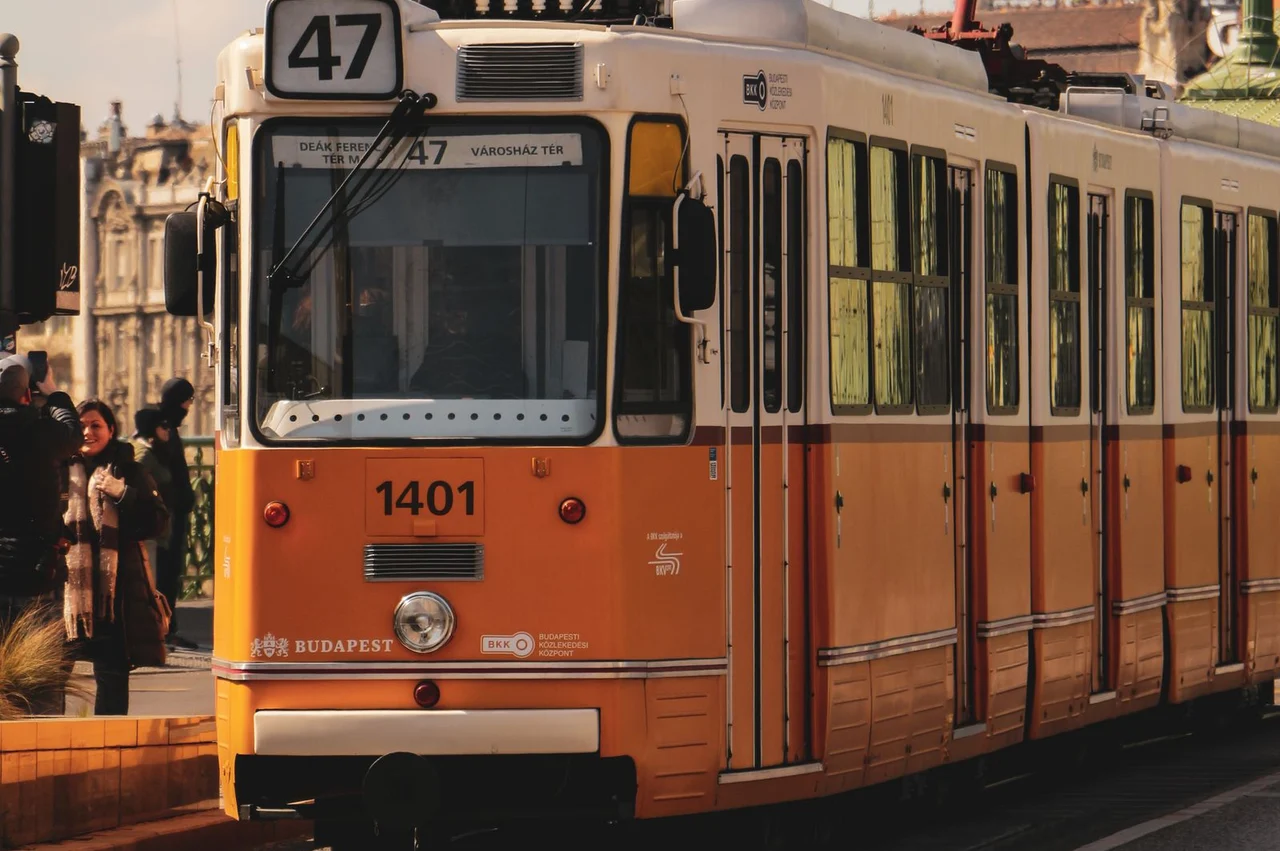
Tram number 2 along the Danube is the busiest in the European Union in terms of number of passengers. It walks along the Pest promenade and shows the city at its best. Tram 4/6 is a ring tram, passes through the Big Ring and is indispensable in the center.
The BKK bus network covers areas where the metro does not reach. In Buda, buses are more important than in Pest: there are steep streets and less metro. In total, there are more than 200 routes in the BKK system.
Night routes operate from 23:00 to 4:30. They are designated by the letter “É” (éjszakai - night). Interval - 15-30 minutes. The night rate does not differ from the day rate if you have a travel pass.
| Type of transport | Routes | Peculiarities |
|---|---|---|
| Metro | M1, M2, M3, M4 | Until 23:00, interval 2-7 minutes |
| Tram | 2, 4/6, 19, 41, etc. | Covers the embankment and rings |
| Bus | 200+ routes | Night routes with "É" |
| Trolleybus | 72, 73, 74, 75, 76, 83 | Pest center only |
Cost of travel passes and BKK tickets
A single single ticket costs about 450 HUF (€1.1). But if you live in Budapest, one-offs are expensive. Travel cards are more profitable from the first week.
| Type | Price (HUF) | Price (€) |
|---|---|---|
| Single ticket | 450 | ~1.10 |
| 24 hour pass | 2 500 | ~6.20 |
| 72 hour pass | 5 500 | ~13.50 |
| Weekly pass | 5 000 | ~12.30 |
| Monthly pass | ~12 000 | ~30 |
| Annual pass | ~109 000 | ~270 |
The pass can be purchased through the BudapestGO app or from vending machines. The Bérlet card (subscription) is linked to a personal card - if lost, it can be restored. Children under 14 years of age and EU pensioners travel free of charge.
We will find the right basis for residency in Hungary
We calculate the budget and timing for your family and list the documents you need.
Taxi and Bolt in Budapest
Bolt is the most popular aggregator in Budapest. Works like Uber: app, map, fixed price before boarding. Cars arrive in 3-5 minutes in the center. The prices are reasonable: a trip around the center is €3-6, from the airport to the center - €15-22.
Főtaxi is the official traditional taxi company. Yellow cars with a clear meter. A little more expensive than Bolt, but reliable if the phone is low. Starting fare is about 700 HUF (€1.7), kilometer - 350-400 HUF (€0.85-1).
Important: in Hungary you cannot stop a random car on the street and negotiate a price. This is illegal. Only official taxis or aggregators. Unregistered "taxi drivers" outside the airport are a classic tourist trap.
Bicycles and scooters: BuBi and MOL Bubi
MOL Bubi is a system of urban bike rentals. About 150 stations throughout Budapest. The first 30 minutes of each trip are free with a daily or weekly pass (~1,500 HUF/day). Great for short trips around the city center.
Electric scooters Lime and Bird operate in tourist areas. Prices are about 200 HUF per unlock and 100 HUF per minute. Expensive for regular trips, convenient for one-time trips.
The cycling infrastructure in Budapest is developing. There are dedicated paths along the embankment and in central areas. In hilly Buda, cycling is more difficult. In other cities of the country, bicycles are normal transport for citizens.
MÁV trains: intercity and international services
Railways of Hungary - MÁV (Magyar Államvasutak). The network is radial: all main lines radiate from Budapest. From the capital there are three main stations: Keleti (eastern), Nyugati (western) and Déli (southern). Keleti is the largest, this is where most international trains come from.
The quality of trains varies. The new Stadler FLIRT and RailJet trains are comfortable, with air conditioning and power sockets. The old regional trains are simpler, but they run well.
| Route | Time | Price from | Train type |
|---|---|---|---|
| Budapest - Vienna | 2 hours 30 minutes | €15 | RailJet / EuroCity |
| Budapest - Bratislava | 2 hours 30 minutes | €10 | EuroCity |
| Budapest - Prague | 6 hours 30 minutes | €25 | EuroCity |
| Budapest - Warsaw | 11 o'clock | €30 | EuroNight |
| Budapest - Debrecen | 2 hours 15 minutes | €7 | Intercity |
| Budapest - Pecs | 3 hours | €8 | Intercity |
It is better to buy tickets in advance at elvira.hu or jegy.mav.hu. Prices increase closer to the date. International routes - via raileurope.com or directly on the ÖBB (Austria) and MÁV websites.
Volánbusz buses: between cities
Intercity buses in Hungary - Volánbusz. The main bus station in Budapest is Népliget. Buses are convenient for routes where trains have transfers or rarely.
Prices are slightly lower than train prices. For example, Budapest - Balatonfured - about €5-7. But the bus is often not faster in terms of time: roads, traffic jams. During rush hours, the bus from Budapest may be 20-40 minutes late.
FlixBus also operates in Hungary. International routes to Vienna, Prague, Bucharest. Prices from €5 for early booking. Convenient for traveling with a suitcase when traveling is not urgent.
A car in Hungary: is it necessary and what do you need to know?
In Budapest, a car is not necessary. Public transport covers almost everything. Parking in the center is expensive (€1.5-3 per hour), traffic jams in the morning and evening are serious. Many people who move sell their car after a year.
In the provinces it's a different story. Debrecen, Miskolc, Gyor, Pecs - there is public transport everywhere, but a car gives you freedom. Outside the city it is difficult without a car: villages, natural parks, Lake Balaton - everything requires wheels.
Roads in Hungary are of good quality. Autobahns (motorways) require the purchase of a vignette (matric). This is an electronic system: you buy online or at a gas station, the car number is entered into the database, there is no physical sticker. Cost: 10 days - about €15, month - €30, year - €115.
| Consumption | Price |
|---|---|
| Car rental (economy) | from €25 per day |
| Car rental (comfort) | €40-60 per day |
| MTPL insurance (year) | €200-400 |
| Vignette for a year | ~€115 |
| Gasoline (1 liter) | ~€1.50 |
| Parking in the center of Budapest | €1.5-3 per hour |
Rights: how to change a foreign ID
For the first year in Hungary you can drive with a foreign license. If they are in Latin, no translation. If only in Cyrillic (Russian, Kazakh, Ukrainian) - you need a notarized translation into Hungarian or an international driver's license (IDP).
After a year of residence, foreign licenses must be exchanged for Hungarian ones. This is not a new exam - just a replacement. For this you need: a valid residence permit, foreign rights, their translation, a medical certificate (vision + general condition), photo and application.
Procedure: contact Okmányiroda (state document office) at the place of registration. Duration - 1-3 weeks. The cost is about 4,600 HUF (~€11). A certificate from the clinic - separately, about €15-30.
An important nuance: rights from EU countries (German, Austrian, Polish) are exchanged in a simplified manner. Russian, Kazakh and other rights from outside the EU - according to the standard procedure, but without retaking exams. This sets Hungary apart from a number of other EU countries.
“Budapest transport is one of the arguments in favor of Hungary that clients often underestimate. When a person moves from Moscow or Almaty, he is used to either a car or a good metro. Budapest provides both - and at a reasonable price. A monthly pass for €30 covers everything: metro, trams, buses, night routes. This is less than a tank of gasoline. A separate plus for our clients is the exchange of licenses without retaking exams. Russian, Kazakh, Ukrainian rights are changed to Hungarian according to documents: medical certificate, translation, application. No race track. It’s more difficult with the provinces: if a client is looking at a small city for the sake of silence and cheapness, I always warn - set a budget for a car. Not because there is no transport, but because freedom of movement in Hungary outside of Budapest is worth it. The country is small: in 3 hours you can reach the capital from any corner. This is valuable when you need to go to the embassy, bank or airport.”
Budapest Airport (BUD): low-cost airline hub
Budapest Liszt Ferenc International Airport (BUD) is the country's only international airport. Located 16 km southeast of the center. Two terminals: 2A and 2B. Terminal 1 has been closed since 2012.
BUD is a major hub for Ryanair and Wizz Air. From here they fly to dozens of cities in Europe, North Africa and the Middle East. Wizz Air is based here. For residents of Budapest, this means available flights to London, Rome, Amsterdam, Dubai from €20-50 with early booking.
How to get there from the center: bus 100E (direct express from Deák Ferenc tér) - 900 HUF (~€2.2), travel time 30-40 minutes. Bolt or taxi - €15-22 depending on traffic. There is no train to the airport - this is a historically weak point of the transport system in Budapest. There is a city train, but it requires a transfer.
Danube ferries and water transport
In summer, MAHART (Hungarian river company) operates ferries on the Danube. Routes from Budapest: to Szentendre, Visegrád, Esztergom. It is both a transport and a tourist attraction.
Ticket Budapest - Szentendre: about €8 one way. Travel time is 1.5 hours. Much slower than electric trains, but with views. Some local residents of Szentendre use the ferry to commute to work in the summer.
In Budapest itself there is a BKK ferry: line D11 connects the islands and the banks of the Danube. Payment using a regular BKK ticket or travel card.
Transport in provincial cities of Hungary
Debrecen, Győr, Miskolc, Pecs, Szeged - each city has municipal transport. Usually these are buses and trams or trolleybuses. Prices are lower than in the capital: single ticket - 300-400 HUF (~€0.75-1). Monthly pass - 5,000-8,000 HUF (~€12-20).
The network is less dense than in Budapest. Intervals are longer - 10-20 minutes. After 22:00 traffic is greatly reduced. For a comfortable life in the provinces, a car is recommended.
Győr and Miskolc have tram lines. Szeged is one of the nicest student cities, cycling works great there: the city is flat. Pecs is in the hills - it's better to go on foot or by bus.
Transport for those moving: what is important to know from day one
If you are moving to Budapest, first download the BudapestGO and Bolt apps. BudapestGO shows routes, waiting times and allows you to buy tickets. Bolt - for taxis without cash.
Please issue a BKK (Bérlet) card with a photo: this will allow you to restore it if lost. The procedure takes 10 minutes at any major transport service center.
When moving to the province: check if there is a good bus service to Budapest. Some small towns are 1-2 hours away by car, but 3-4 hours by bus with transfers. In this case, the car saves time more than the travel card saves money.
If you have Investor residence permit in Hungary, you use transport on the same rights as permanent residents. There are no restrictions. Benefits (free travel pass) - only for EU pensioners and children.
We will find the right basis for residency in Hungary
We calculate the budget and timing for your family and list the documents you need.
Transport expenses: consolidated budget for the month
Let's calculate how much a person who moves actually spends on transport in different scenarios.
| Scenario | Article | Cost per month |
|---|---|---|
| Budapest without a car | BKK travel card | €30 |
| Budapest without a car | Bolt (10 trips) | €30-50 |
| Budapest without a car | Total | €60-80 |
| Province with a car | Gasoline (1,000 km) | €70 |
| Province with a car | Insurance (depreciation) | €25 |
| Province with a car | City transport | €15 |
| Province with a car | Total | €110-120 |
| Budapest with a car | Travel card + parking + gasoline | €150-200 |
Conclusion: in Budapest, a car doubles your transportation costs. In the provinces, a car is necessary, but prices are lower. The general level of transport costs in Hungary is lower than in Germany or France.
Transport in Hungary vs other EU countries
Hungary wins on price. A monthly pass for €30 in Budapest is cheaper than in Vienna (€51), Prague (€30, about parity), Berlin (€86) or Amsterdam (€100+). At the same time, the BKK network is dense and works reliably.
In terms of the quality of trains, Hungary lags behind Austria and Germany. MÁV is updating its fleet, but slowly. Old diesel regional trains are the reality of the province. International routes via RailJet (ÖBB) are already a European standard.
For those who fly frequently around Europe, Budapest is a profitable base. BUD with low-cost airlines provides inexpensive flights to destinations where flying from Moscow or Almaty is more expensive and takes longer. This changes the logic of travel: flying from Budapest to London is cheaper than traveling by train to Vienna.
Read more about living conditions in Hungary and investor residence permit program - on our program page. There are also requirements, terms and costs.
Frequently asked
Questions people ask before deciding
01Do you need a car in Budapest?
No, not needed. The BKK network (metro, trams, buses) covers the entire city. Bolt operates 24 hours a day. Most people who move to the center of Budapest do without a car and save on parking and insurance.
02How much does a monthly pass cost in Budapest?
About 12,000 HUF, that is approximately €30. The pass is valid for all types of BKK transport: metro, trams, buses, trolleybuses. Night routes are also included. Available through the BudapestGO app or at service centers.
03How to buy a transport ticket in Budapest?
Via the BudapestGO app - the most convenient way. Also in vending machines at metro stations and in some kiosks. A single ticket costs 450 HUF (~€1.1). The ticket must be validated upon entry.
04How to get from BUD airport to the center of Budapest?
Bus 100E goes directly from the airport to Deák Ferenc tér in 30-40 minutes. Costs 900 HUF (~€2.2). Bolt or taxi will cost €15-22 depending on traffic. There is no train to the airport.
05Is it possible to drive in Hungary with a Russian license?
Yes, the first year - on a Russian license with a notarized translation into Hungarian or with an international driver's license (IDP). After a year of residence you need to exchange for Hungarian ones. There is no need to take an exam.
06How much does the train cost from Budapest to Vienna?
From €15 for early booking. Travel time is 2 hours 30 minutes. RailJet (Austrian ÖBB) and EuroCity trains operate. Tickets are on sale at jegy.mav.hu and raileurope.com.
07Do you need a vignette to drive on the Hungarian autobahn?
Yes, a vignette (matrix) is required. This is an electronic system: you buy online at e-matrica.hu or at gas stations, enter the car number - there is no physical sticker. For 10 days - about €15, for a month - €30, for a year - about €115.
08Does Uber operate in Hungary?
Uber has not operated in Hungary since 2016. Instead, use Bolt - a similar aggregator that is very popular in Budapest. There is also an official Főtaxi with yellow cars.
09How safe is transport in Budapest?
BKK transport is safe. The crime rate in the metro and at bus stops is low by European standards. Standard measures: keep an eye on your belongings during rush hours, do not leave your bag on the next seat. Night transport works fine.
10Is it possible to get to Lake Balaton without a car?
Yes. Trains from Déli Station to Balatonfüred and Siófok run regularly. Travel time is 1.5-2 hours. In summer there are also MAHART ferries from Budapest along the Danube, although they are slower. But for a comfortable stay on Lake Balaton, a car is more convenient.
11How is the cycling infrastructure in Hungary?
In Budapest there are dedicated paths along the embankment and in the center, MOL Bubi rental with the first 30 minutes is free. In flat provincial cities (Szeged, Győr), a bicycle is a full-fledged transport. In hilly areas (Buda, Pecs) it is more difficult.
12What is BudapestGO?
BudapestGO is the official app of the BKK transport system. Shows routes, waiting times for transport in real time, allows you to buy tickets and passes. Available on iOS and Android, free. Essential minimum for living in Budapest.
About the author
Related materials
What to read next
 ArticleHungarian Citizenship 2026: All Ways to Obtain an EU Passport
 ComparisonCitizenship of Bulgaria or Hungary: EU passport by roots
 AnalysisWhat is due diligence and why the Caribbean is rejecting applications
Personal programme selection is conducted by Anna Kovalevskaya, Head of Legal, BRIDGES.
Moving to Hungary: what to settle first
Housing, schooling, healthcare, accounts and taxes - the order and what takes longest.
