BRIDGES Insights · Vanuatu
The Tate case showed what Vanuatu revokes citizenship for

Updated: October 2026·14 min read·Expert reviewed
Terms and costs verified: October 2026
Contents
On 21 September 2026 Australia's ABC, citing a spokesperson for the government of Vanuatu, reported that Andrew Tate's citizenship and passport had been revoked. Within a day the story spread across social media and investor chats with the conclusion "a precedent for stripping citizenship already exists". On 24 September the chairman of Vanuatu's Citizenship Commission, Charlie Maniel, stated that the Commission had made no such decision. Its records contained no grounds for one. Allegations that surfaced after 2022 do not, by themselves, show that the original citizenship decision was wrong. On 28 September ABC published a correction. There was no precedent. What there was instead is a test that outsiders rarely get to see: how the law of a small Pacific nation holds up under the pressure of a famous name and the world press.
In brief
- Tate's citizenship has not been revoked: on 24 September 2026 the Citizenship Commission, the only body with that power, confirmed it.
- Vanuatu law names four grounds on which an investor can lose citizenship. None of them is triggered by a publication, an investigation or an allegation.
- Revocation for deception at application requires a court finding, and citizenship ends 30 days after it. Deprivation for a crime is possible after a prison sentence of 10 years or more.
- According to the Citizenship Office, the current Commission has revoked about 30 citizenships granted in breach of the law. That is less than half a per cent of the passports issued.
- For comparison: in 2026 Turkey cancelled the citizenship of more than 7,000 people, Cyprus has revoked 360, Dominica 68.
- An honest applicant's risk sits in one place: the completeness and accuracy of the application forms. It is dealt with before filing.
Four days remembered by half
The September story has a back story. Tate obtained Vanuatu citizenship in 2022 under the contribution programme, the same year he was detained in Romania. It became public in the summer of 2025 after publications by investigative journalists. The government then reviewed his application and in June 2025 announced that at the time of approval he had passed the checks, including Interpol and UK information, no breach had been found and no further action would be taken.
Fifteen months later the position seemed to reverse.
- 2022. Tate obtains Vanuatu citizenship under the contribution programme.
- June 2025. The government reviews the application: no breach, no action.
- 21 September 2026. ABC Pacific, citing a government spokesperson: citizenship and passport revoked.
- 24 September 2026. Chairman of the Citizenship Commission: no decision to revoke, no grounds in the records.
- 28 September 2026. ABC publishes a correction to its story.
Based on media reports and the Citizenship Commission's statement.
The denial came three days later but travelled less far than the news. The first version reached feeds and posts, the second stayed in trade publications. That is why in October we are still being asked the question in its first form: "I hear Vanuatu has started taking passports away?"
What this means for you. A story about "losing a passport" can be checked by one test: is there a decision of the Citizenship Commission or a court. A government spokesperson's words are not such a decision.
Three bodies and one confusion
The September mistake grew out of mixing three different bodies in one sentence. In Vanuatu the law keeps them apart.
The Citizenship Commission is a constitutional body. It considers applications, grants citizenship and issues the certificate. It is also the body entitled to revoke it.
The Immigration and Passport Services issue the ordinary passport. The diplomatic passport is issued by the Ministry of Foreign Affairs. In 2025 the Citizenship Office specifically clarified that the Commission does not issue passports.
A government spokesperson speaks for the executive. They do not take decisions on citizenship and cannot.

Hence a second distinction that got lost in retelling. A passport is a document. Citizenship is a status. Cancelling a document and depriving a person of status are different acts with different grounds and different bodies. The Commission's statement of 24 September concerned citizenship, and its answer is unambiguous: Tate remains a citizen of Vanuatu.
What this means for you. Your status rests on the Commission's decision, which you receive when your application is approved. Only the Commission, a court or the Prime Minister can undo it, and each only on a ground expressly named in the law.
Four grounds in the law
Vanuatu's Citizenship Act lists the grounds for losing citizenship as a closed list. For citizens under investment programmes, four of them matter in practice.
| Ground | Who decides | What has to happen | When it takes effect |
|---|---|---|---|
| False representation, fraud or concealment of a material fact when obtaining citizenship | Court | A court finding that citizenship was obtained by deception | 30 days after the finding |
| Citizenship granted fraudulently or contrary to the Act and the Constitution | Citizenship Commission | Review and decision of the Commission | By decision of the Commission |
| Breach of the Act's restrictions after the grant | Citizenship Commission | A confirmed breach | By decision of the Commission |
| Prison sentence of 10 years or more | Prime Minister | Sentence and a declaration in the Government Gazette | Within 15 days of sentencing |
under the Vanuatu Citizenship Act (Cap 112) as amended in 2013 and the "Revocation" and "Loss of Citizenship" pages of the Citizenship Office website. Checked on 9 October 2026.
Each ground has its own logic, and three details are worth knowing.
A court finding does not always end in revocation. If a court finds deception, the Prime Minister has the same 30 days to confirm the citizenship by a declaration in the Gazette. The condition is that the offence was minor and the true facts would not have changed the decision. The law separates deception that won citizenship from an inaccuracy that did not affect the outcome.
The sentence ground is written for naturalised citizens. Investment programmes entered the Act later, in 2013, as a separate part on dual citizenship. The text does not say directly whether the sentence ground reaches them. The Commission itself cited it in September, so it is reasonable to assume it applies.
The "voluntary" loss grounds do not apply to investors. The Act contains grounds familiar from other countries: an oath to a foreign state, service in a foreign army, voting in another country's elections. The Citizenship Office states plainly that they concern citizens without dual citizenship. The 2013 amendments recognised dual citizenship for investment programme participants, and keeping your original passport is not a ground for loss.
- 1Press publicationno effect on citizenship
- 2Investigationno effect on citizenship
- 3Formal chargeno effect on citizenship
- 4Sentence or court findingground for a decision
- 5Decision of the Commission or the Prime Ministercitizenship ends
Citizenship can be affected only after a sentence of 10 years or more or a court finding that it was obtained by deception.
Vanuatu Citizenship Act (Cap 112) as amended in 2013, Citizenship Commission statement of 24 September 2026
What this means for you. Neither a publication, nor a journalistic investigation, nor a criminal charge in another country ends citizenship on its own. That takes a sentence or a court finding, and for revocation by the Commission, a proven breach at the time of the grant.
Why the Commission did not revoke Tate's citizenship
The Commission's statement rests on one principle every applicant should understand. A citizenship decision is tested against the information available on the day it was made. Tate applied in 2022. Nothing that became public about him later makes the 2022 decision wrong in hindsight.
The law distinguishes five states: an allegation in the press, an investigation, a formal charge, a sentence, and a court finding that citizenship was obtained by deception. Legal consequences for citizenship arise only at the last two. The Commission has held this line publicly since June 2025, and the September pressure did not move it.
There is a second half to the statement that the retellings left out. If reliable evidence shows that a material fact was deliberately concealed at application, the matter will be considered under the Act. The door is closed to emotion, not to facts.
What this means for you. For an honest applicant this is good news. Citizenship is protected from political mood: it cannot be revoked by a statement on air or under pressure from the foreign press.
Thirty revocations and two high-profile episodes
Vanuatu has revoked citizenships. It just does so differently from what the September story suggested.
The Citizenship Office website states that the current Commission has revoked about 30 citizenships granted contrary to the Act and the Constitution. The notice is undated and gives no breakdown by programme. The scale is clear from another figure: according to data the EU cited in 2022, by March 2021 Vanuatu had issued more than 10,500 passports under its investment programmes. About 30 revocations against that base is less than three tenths of a per cent.
Two episodes are known from official statements. In 2019 Vanuatu deported to China six people whom Beijing accused of internet fraud. Four of them were Vanuatu citizens, and their citizenship was revoked before deportation. In March 2025 Prime Minister Jotham Napat instructed the Commission to cancel the passport of Lalit Modi, the former head of India's cricket league, stating that avoiding extradition is not a legitimate reason to seek citizenship. No completion of that instruction has been announced.
Put the episodes together and the common denominator is obvious. Citizenship was granted in breach of procedure, or the applicant was wanted and did not disclose it. In no case was the ground a publication about the person that appeared after the passport was issued.
What this means for you. Vanuatu revokes what was granted wrongly. If your application is complete and checked before filing, the Commission has nothing to reconsider.
How other countries revoke citizenship
To judge the risk, it helps to see Vanuatu next to its market neighbours. Every programme's law reserves the right to revoke. What differs is how broadly the grounds are written and whether the state has actually used them.
| Country | How many revoked | Main reason |
|---|---|---|
| Turkey | 6,134 people in August 2026, another 1,070 identified in September | Fake property valuations; security reviews after the grant |
| Cyprus | 360 people: 101 investors and 259 family members | Programme closed in 2020; an inquiry found 53% of 2007-2020 grants did not meet the law |
| Dominica | 68 people, June 2024 | Citizenship sold below the statutory contribution |
| Vanuatu | About 30 people | Citizenship granted in breach of the law |
| Saint Kitts and Nevis | 13 people, April 2025 | Sales below the statutory contribution |
| Saint Lucia | 6 people, 2018 | Conduct that could bring the country into disrepute |
| Malta | No revocations under the investment programme found | Narrow grounds: fraud, or a sentence of 12 months or more within 7 years |
| Antigua and Barbuda, Grenada | No published revocations | Broad ministerial powers, no record |
based on official announcements by the governments of these countries. Checked on 9 October 2026.
The table supports three conclusions.
First: citizenship is most often lost over price. In Turkey 5,391 people lost citizenship because of inflated flat valuations. In Dominica and Saint Kitts, because intermediaries sold citizenship below the statutory contribution. Many investors did not know about the forgery: the documents were prepared by valuers and agents. The discount an intermediary offered became, years later, evidence against the buyer.
Second: the family loses status together with the applicant. In Turkey each investor accounted for an average of 4.3 people who lost citizenship. A spouse and children receive status through the head of the family's application and share its fate.
Third: waves of revocations follow outside pressure. Cyprus began after a television investigation, Turkey after a criminal investigation into valuers, the Caribbean after the underselling scandal. Vanuatu has been through two waves of international coverage but, according to the Commission, has made no mass revocations, and the famous names are not on its list.
Post-grant requirements deserve a separate note. In Antigua and Barbuda citizenship can be lost if you spend fewer than five days in the country during the first five years. In Malta a naturalised citizen risks status after seven years abroad without a written notice of intention to keep it. Vanuatu has no residence requirements after citizenship is granted.
What this means for you. Vanuatu lacks the main source of mass revocations. The contribution is fixed by tariff and paid into a government account: there is nothing to value, and it cannot be sold below the tariff. What remains is the risk common to every country, inaccurate information in the application.
Passport reputation after the September news
We hear this question often in consultations: "Vanuatu has a bad reputation, maybe Grenada is better?" It comes from people choosing between Vanuatu, Turkey and the Caribbean.
The passport's reputation was indeed shaped under pressure. Between 2022 and 2025 the EU ended visa-free travel step by step, the UK introduced visas in 2023, and EU decisions spoke directly of the risks of citizenship programmes. But the September story worked the other way. The state showed that it does not revoke citizenship because of a call from a TV studio and sticks to the letter of the law.
In parallel Vanuatu is reviewing the system itself. On 6 February 2026 the Council of Ministers considered the report of the commission of inquiry into the Citizenship Commission and its programmes and ordered the recommendations of part one to be implemented. Since 1 July 2025 every person in an application gives biometrics in person. The Financial Intelligence Unit has introduced a new checking procedure.
How banks, border officers and visa services treat the passport is covered in detail in the article on the reputation of the Vanuatu passport.
What this means for you. Strictness at the entrance protects those who already hold the passport. The more carefully new applicants are checked, the fewer reasons there are to revisit earlier decisions.
We will check your application before filing
We will review your background, refusals and source of funds and tell you which facts must be disclosed. Risk opinion within 1-2 business days.
Where the risk really lies
Put the law, Vanuatu's practice and other countries' experience together, and an honest applicant's revocation risk comes down to the application forms. The Commission revisits a decision when it turns out something was hidden or distorted at filing. So status is protected before filing, not after.
The five places where discrepancies arise most often:
- Criminal record, including spent convictions, and criminal proceedings in any country where the person has lived. A spent conviction in one country may still be visible in another country's databases.
- Visa and citizenship refusals by other countries, including under investment programmes. The forms ask about them directly, and answering "no" when there was a refusal is the most common mistake.
- Changes of surname, first name or spelling. Previous passports and other transliterations must be listed in full, otherwise the check sees two different people.
- Politically exposed status of the applicant or relatives: public office, senior roles in state companies, close relatives of such persons.
- Source of funds. The origin of the money for the contribution is proved by documents, not by an explanation. A mismatch between the amount, income history and statements triggers a query.
None of these is a reason for refusal on its own. The reason is concealment. Vanuatu's Financial Intelligence Unit check finds most such facts at the entrance. Then the result is an extra question or a refused application, not the loss of citizenship years later.
What this means for you. An awkward fact disclosed in the forms becomes a question to explain. The same fact found after the passport is issued becomes a ground for revocation.
The family and shared risk
In an investment programme the citizenship of a spouse and children flows from the main applicant's application. Turkish statistics show what this means in practice: of the 6,134 people who lost citizenship in August, 1,413 were investors. The rest were their families.
So preparing the main applicant's forms is not only about their own status. Every omission in their biography falls on everyone included in the application: spouse, children, parents.
There is also the other side. If the application is clean, the family receives citizenship at the same time and by one decision, and children born later become citizens by descent without a new contribution.
What this means for you. The main applicant's forms deserve the same care as the source of funds. The whole family's status depends on them.
I will review your situation personally
Describe your situation in two lines. I will look at it myself and tell you whether there are facts in your background that should be disclosed before filing.
The September story is the best argument for Vanuatu in the past year. The government rushed out a statement, the Commission corrected it according to the law, and within three days everything was back in place. In this country citizenship is revoked for deception when obtaining it or by court sentence, not for awkward headlines. So all the work of protecting your status is done before filing: complete forms, a verified source of funds, not a single hidden fact.
What applicants should do now
- Before filing, get a preliminary check: criminal records, sanctions lists, public mentions, visa refusals.
- State everything the forms ask, including the awkward. An explanation of a fact works better than hiding it.
- List all previous surnames, passports and spellings of your name.
- Include the whole family in the application at once, and remember: your relatives' status depends on how clean the head of the family's application is.
- File only through an authorised agent from the official list. The Citizenship Office publishes the list of agents and, separately, the list of cancelled agents.
- Keep a full set of the documents you filed. If a question arises years later, it will be decided on what was in the application.
- Check any story about a "revoked passport" against a decision of the Commission or a court, not social media retellings.
Get the application checklist
What to state in the Vanuatu citizenship forms so your status is protected: criminal records, refusals, previous names, source of funds.
Sources
- The Citizenship Commission's position: its statement of 24 September 2026.
- Grounds for loss of citizenship: the Vanuatu Citizenship Act (Cap 112) as amended in 2013 and the "Revocation" and "Loss of Citizenship" sections of the official Citizenship Office website.
- About 30 revocations: the "News and Updates" section of the same website. More than 10,500 passports by March 2021: EU data from 2022.
- Commission of inquiry report: announcement by the Office of the Prime Minister of Vanuatu of 6 February 2026.
- Turkey: statement by the Turkish Interior Ministry of 4 August 2026. Other countries: official announcements by their governments.
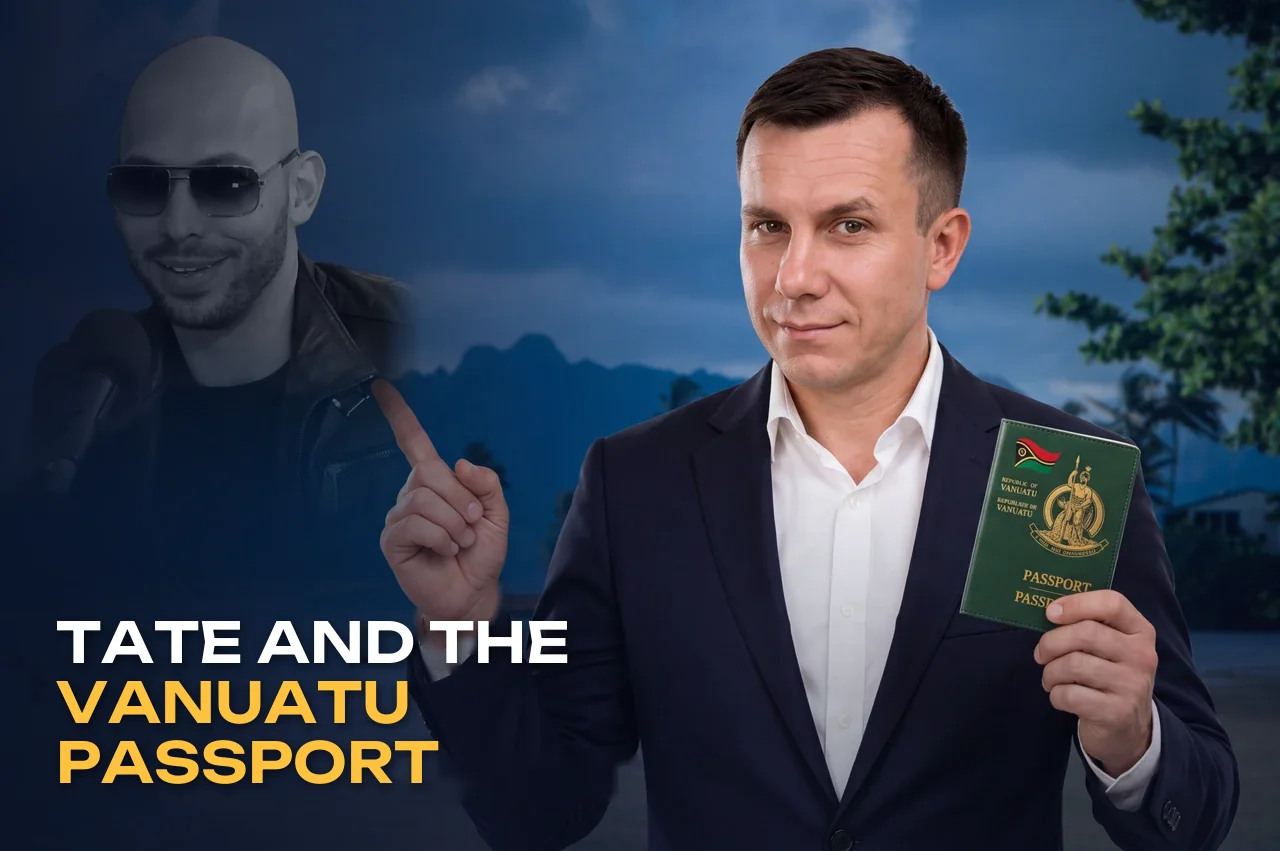
- Photo of Andrew Tate on the cover: James English, licence CC BY 3.0, Wikimedia Commons.
- All facts checked on 9 October 2026.
Related: Vanuatu passport reputation, Is Vanuatu citizenship legal, Due diligence for Vanuatu citizenship, 7 reasons for refusal of Vanuatu citizenship, Rights and duties of a Vanuatu citizen, Vanuatu or Turkey, How to tell the Vanuatu programme from a grey scheme.
Frequently asked
Questions people ask before deciding
01Has Andrew Tate's Vanuatu citizenship been revoked?
No. On 24 September 2026 the Citizenship Commission stated that it had made no decision to revoke and that its records contained no grounds. ABC published a correction to its original story on 28 September.
02On what grounds can Vanuatu citizenship be revoked?
If a court finds that citizenship was obtained by deception or by concealing a material fact; if the Commission finds that it was granted in breach of the law; if the citizen breaches the Act's restrictions; if the citizen is sentenced to 10 years in prison or more.
03Can citizenship be revoked because of a media article or an investigation?
No. A publication, an investigation or an allegation does not end citizenship by itself. It takes a sentence or a court finding of deception at the time of the grant.
04How many Vanuatu citizenships have been revoked?
According to the Citizenship Office, the current Commission has revoked about 30 citizenships granted contrary to the Act and the Constitution.
05Does the family lose citizenship if it is revoked from the head of the family?
If the head of the family obtained citizenship by deception, the status of relatives who received it through the same application is also called into question. That is why a complete main application protects the whole family.
06Can I lose Vanuatu citizenship by not living in the country for a long time?
No. The law sets no residence requirements after citizenship is granted.
07Where is the revocation risk higher: Vanuatu or Turkey?
Most of Turkey's 2026 revocations relate to fake property valuations. In Vanuatu the contribution is fixed and paid directly to the state, so that risk does not exist. The risk common to both is inaccurate information in the application.
About the author
Related materials
What to read next
 ArticleBanks in Vanuatu and accounts abroad: what a bank checks for a Vanuatu citizen
 ComparisonSecond citizenship in 3-6 months: Caribbean, Türkiye or Vanuatu in 2026
 AnalysisWhat is due diligence and why the Caribbean is rejecting applications
Personal programme selection is conducted by Anna Kovalevskaya, Head of Legal, BRIDGES.
We will help you obtain Vanuatu citizenship without risks
We will check the application before filing and take it through to the passport on the programme's current terms.