News · Turks and Caicos Islands
Turks and Caicos: investors to get 25-year permits with no route to residence or a passport

Updated: October 2026·10 min read·Expert reviewed
Terms and costs verified: October 2026
Contents
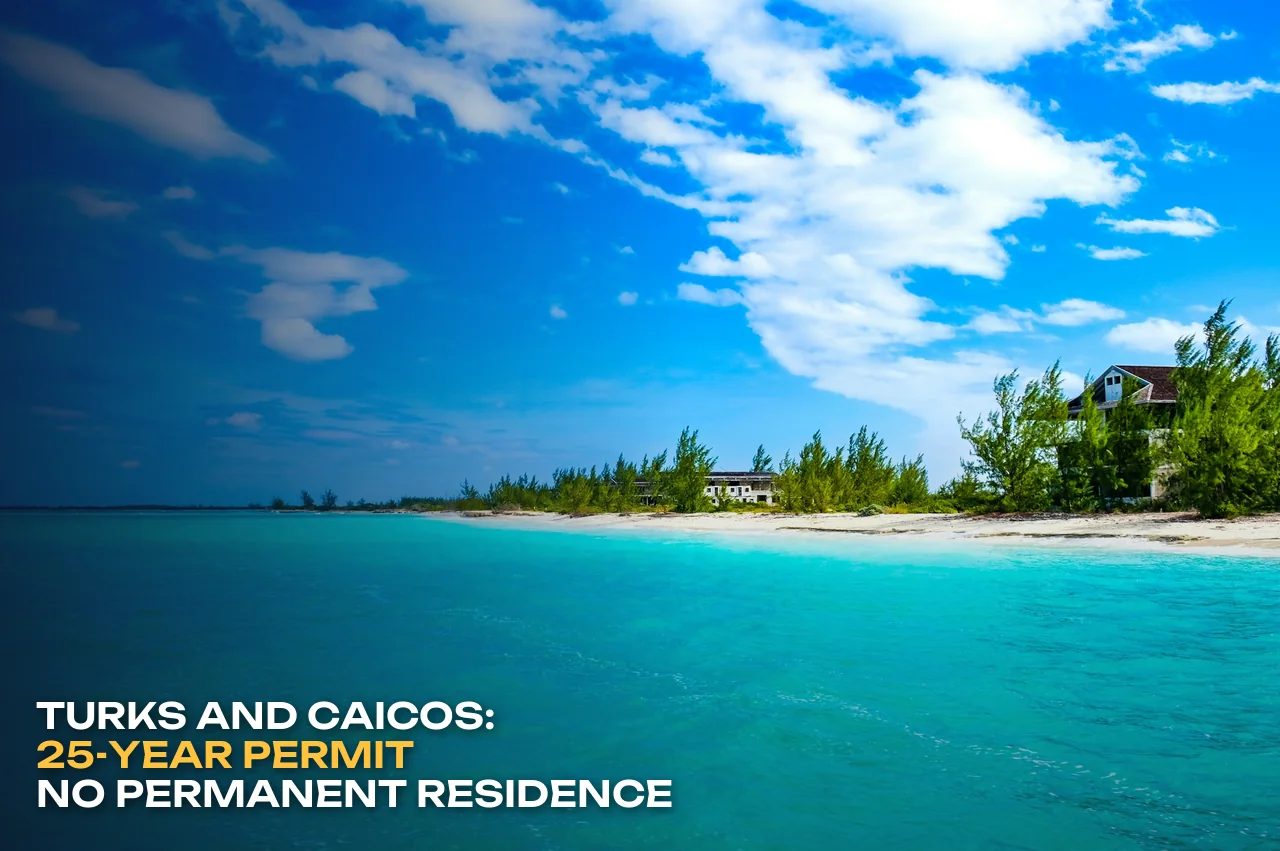
The Parliament of the Turks and Caicos Islands has passed the Immigration Bill 2026. For investors it replaces the indefinite Permanent Residence Certificate with a renewable 25-year permit that carries no right to permanent residence and, in all likelihood, no route to British Overseas Territories citizenship. On 26 October Deputy Premier Jamell Robinson named 1 December 2026 as the target commencement date. I explain what changes, who the transitional rules protect and what to do if you have already invested.
In brief
- The Immigration Bill 2026 was tabled on 22-23 September and, according to the immigration minister, has been passed. The target commencement date is 1 December 2026, with 14 November also under consideration.
- Investors will receive a renewable 25-year Long Term Residence Permit. Its holders are expressly excluded from permanent residence and from the new ten-year rights certificate.
- Investment amounts will be set by regulations; the government promises lower thresholds on Grand Turk, Salt Cay, South, Middle and North Caicos.
- Permanent Residence Certificates already issued are preserved. Applications filed before the law takes effect will be decided under the old rules.
- For other residents the route to permanent residence lengthens from 10 to 20 years. The minister stressed that citizenship is not for sale.
What has been passed
The Turks and Caicos Islands are a British Overseas Territory in the Caribbean, popular with wealthy buyers of villas on Providenciales. The islands have no citizenship by investment programme of their own. An investor received a Permanent Residence Certificate and could then apply for British Overseas Territories citizenship under the general naturalisation rules. It is precisely this chain that the new law breaks.
Cabinet approved the Bill on 22 September 2026, and the first reading took place on 23 September. On 19 October the local newspaper published the parliamentary presentation of Deputy Premier and Immigration Minister Jamell Robinson: a separate renewable 25-year permit is being introduced for investors, and its holders are "expressly excluded" from the Residence and Employment Rights Certificate and from permanent residence. On 26 October the minister told the same newspaper that the law had been passed and that the government aims to bring it into force on 1 December 2026, all parts at once.
| Item | Now: permanent residence certificate | Under the 2026 Act |
|---|---|---|
| Investor document | Permanent Residence Certificate (PRC) | renewable 25-year Long Term Residence Permit |
| Duration | indefinite unless revoked | 25 years, then renewal |
| Route to permanent residence and naturalisation | after 12 months, an application for British Overseas Territories citizenship is possible with 5 years of residence | permit holders expressly excluded from permanent residence |
| Amounts | homes from USD 300,000 on five islands, from USD 1 million elsewhere; business from 750,000 or 1.5 million | to be set by regulations; lower thresholds promised on five islands |
| Revocation | possible if the investment is not kept | possible if the investment is not maintained as prescribed |
| Certificates already issued | - | preserved by transitional provisions |
As of 27 October we could not find the official text of the Act and regulations on the parliament or government websites, and the parliament's bill tracker still shows the first reading. We therefore report details from the minister's statements as covered by the local press and from previously published rules. The authorities have not named the new thresholds.
What this means for you. If you were considering the Turks and Caicos as a route to a British passport through investment, that route is closing. The 25-year permit gives the right to live on the islands but does not lead to citizenship.
How investor permanent residence works now
Under the current rules an investor has four routes to a Permanent Residence Certificate. The first is buying a home: from USD 300,000 on Grand Turk, Salt Cay, South, Middle and North Caicos and from USD 1 million on the other islands, including Providenciales. The second is a business: from USD 750,000 on the five smaller islands or USD 1.5 million elsewhere, with at least 60% of employees not on work permits, that is, local people. The third is a contribution of at least USD 1 million to an approved public sector project. The fourth is an investment of USD 1 million or more in any home or business without the Governor's prior undertaking.
In the first three routes the investor first obtains the Governor's undertaking to grant the certificate once the investment is completed, and then applies for the certificate itself. The certificate fee is USD 25,000. A property-based certificate carries no right to employment; holders of business-based certificates may work only in their own company. The investment must be kept: if it is sold, the certificate can be revoked. This condition will carry over to the new 25-year permit.
The main difference in the new regime lies not in the amounts or revocation, but in duration and consequences. The certificate was indefinite and after a year opened the way to naturalisation with five years of residence. The 25-year permit is renewable but remains time-limited and does not count towards permanent residence. For a villa buyer on Providenciales who wants a home on the islands, the difference is small. For someone who bought property for a future British Overseas Territories passport, it closes off the main goal.
Why a permit holder will not get citizenship
British Overseas Territories citizenship is governed by the British Nationality Act 1981. Naturalisation requires five years of residence in the territory and no restriction on the period of stay during the 12 months before applying. The Permanent Residence Certificate provided exactly that: the right to live without a time limit. A 25-year permit, however long, in effect restricts the period of stay. Industry lawyers consider that this shuts naturalisation for its holders, however long they live on the islands.
Back in May the immigration minister told the local press that the islands' citizenship "is not for sale" and that there is no citizenship by investment in the Bill. The new law takes this position to its conclusion: money buys the right to live, not status. It is an important signal for the whole market: jurisdictions are increasingly separating residence by investment from a route to a passport. We see a similar shift in Europe, where Portugal has extended the wait for citizenship to 10 years.
What this means for you. A 25-year permit is a long residence permit, not a step towards a passport. If you need a second passport, look at citizenship programmes rather than residence in British territories.
Transitional rules: who is protected
The law preserves Permanent Residence Certificates already issued. According to the minister, permanent residence applications filed before the law takes effect will be decided under the current rules. Those who would qualify under the old conditions within 12 months of commencement will have time to meet the requirements and a further 12 months to apply. The minister's example: a person with nine and a half years of residence under one permit completes ten years in six months and then applies.
For investors the practical conclusion is this: if you have already bought property or invested in a business and intended to apply for a Permanent Residence Certificate, it is important to do so before the law takes effect. Time is short: the target date is 1 December, and possibly 14 November. An application needs a full pack: investment documents, due diligence, family details. Before any filing it is worth doing a legal check of the property if this has not been done already.
What this means for you. If you have invested in the Turks and Caicos and have not yet applied for permanent residence, assume you have a few weeks. File before the law takes effect, or you will only get a 25-year permit.
Invested in the Caribbean and choosing a status? We will tell you what to do
A lawyer will assess the timing and documents for your situation.
What changes for other residents
The law also restructures the islands' general immigration system. A ten-year Residence and Employment Rights Certificate is introduced; it will be granted taking into account good character, financial independence, knowledge of the islands and, where relevant, English. This certificate leads to permanent residence, but slowly: the minister said eligibility for permanent residence would come after 10 years of legal residence plus a further 10 years holding the certificate. Previously 10 years was enough. Work permits will be limited to 10 years.
Separately, the law requires employers with many foreign staff to show how they recruit and train local people. The government's logic is that Turks and Caicos Islanders come first in hiring. For investors who set up a business on the islands, this means more staffing and reporting requirements.
What this means for you. If you plan to live and work on the islands, the route to permanent status becomes twice as long. For a business on the islands, factor in requirements to hire local staff.
Alternatives for investors
If the goal is residence in a warm country with property, there are many options on the market without a route to citizenship but with clear rules. The Greece golden visa gives a renewable five-year permit with no residence requirement. Cyprus permanent residence is issued indefinitely; a comparison with the Caribbean is in Cyprus permanent residence or the Caribbean. UAE residence through property gives long-term status in a country with no personal income tax. The Portugal golden visa still leads to citizenship, but after 10 years.
If the goal is a passport, the Caribbean has citizenship programmes in Saint Kitts and Nevis, Grenada, Dominica and Saint Lucia. But they too are under EU pressure: see our analysis of Caribbean passports under EU pressure and our news story on a possible pause of the Antigua programme. Programmes are compared in the article on Caribbean passports, the real price in the true cost of Caribbean citizenship, and common mistakes in Caribbean passport myths.
For families it matters who the status covers: rules differ by country; the general approach is in the guide to residence for the whole family. How buying property and residence are linked is explained in the guide to real estate and residence, and presence requirements by country are compared in the guide to presence requirements.
What this means for you. Choose by goal. If you need a home and the right to live, residence through property with clear rules will do. If you need a passport, look at citizenship programmes, taking visa-free risks into account.
What to do
If you have already invested
Check whether you meet the conditions for a Permanent Residence Certificate under the current rules, and apply before the law takes effect.
If you already hold a certificate
It is preserved. Keep your investment documents: revocation is possible if the investment is not kept.
If you are only choosing
Bear in mind that the new 25-year permit does not lead to permanent residence or citizenship. Amounts and conditions will be set in regulations.
If your family needs status
Find out how the new rules will define family members. This will be in the regulations under the Act.
Watch for official publication
The commencement date will appear in a Governor's notice in the Gazette. We will update this story.
The terms permanent residence, residence permit, naturalisation and citizenship by investment are explained in the glossary. A selection of Caribbean programmes is in the Caribbean guide, and a comparison with Europe in Greece golden visa or the Caribbean. An online consultation will help assess your situation; all BRIDGES services are on the home page.
Need a passport, not just residence? We will compare programmes
We will send a short table of programmes for your goal.
Sofia MendesInvestment Programs Expert, BRIDGES
How this article was prepared
Sources: the official Hansard report of the Parliament of the Turks and Caicos Islands for the sitting of 23 September 2026 (first reading of the Immigration Bill 2026); statements by Deputy Premier and Immigration Minister Jamell Robinson as reported by the local newspaper on 19 and 26 October 2026; current requirements for investment-based Permanent Residence Certificates on the islands' government website; the British Nationality Act 1981. The text of the Act as passed and the regulations had not been officially published as of 27 October 2026; the conclusion that naturalisation is closed is an assessment based on the Nationality Act. This article does not replace a consultation.
Share this article
Frequently asked
Questions people ask before deciding
01Can investors still get Turks and Caicos permanent residence?
No. Investors will receive a renewable 25-year permit, and its holders are expressly excluded from permanent residence. Applications filed before the law takes effect will be decided under the old rules.
02When will the law take effect?
The immigration minister named 1 December 2026 as the target date; 14 November is also being considered. The date will appear in a Governor's notice.
03What happens to Permanent Residence Certificates already issued?
They are preserved under the law's transitional provisions.
04Will the 25-year permit lead to British citizenship?
In lawyers' assessment, no: naturalisation requires residence without a time limit, and the permit is time-limited.
05How much will the new permits cost?
Amounts will be set by regulations and have not been named. Lower thresholds than on Providenciales are promised on the five smaller islands.
About the author
Related materials
What to read next
 AnalysisCaribbean passports under EU pressure: what happens to issued passports and how to choose a programme now
 ComparisonCaribbean Passport: 5 Citizenship Programs Through Investment in 2026
 ComparisonGolden Visa of Greece or Caribbean citizenship 2026: EU residence permit versus second passport
News+10 stories on 27 October
Related news
 Malta · 27 OctMalta: the 2027 budget raises charges for non-EU residents
 Latvia · 27 OctLatvia to check whether foreign nationals obtained residence through fictitious investment
 United States · 27 OctUS: the November visa bulletin leaves EB-5 unchanged, but new fees and amounts are a month away
Personal programme selection is conducted by Anna Kovalevskaya, Head of Legal, BRIDGES.
Need a passport, not just residence? We will compare programmes
We will send a short table of programmes for your goal.
