Comparisons · Argentina
Argentine passport or Greek golden visa: which to choose with a $350,000 budget

Updated: October 2026·18 min read·Expert reviewed
Terms and costs verified: October 2026
Contents
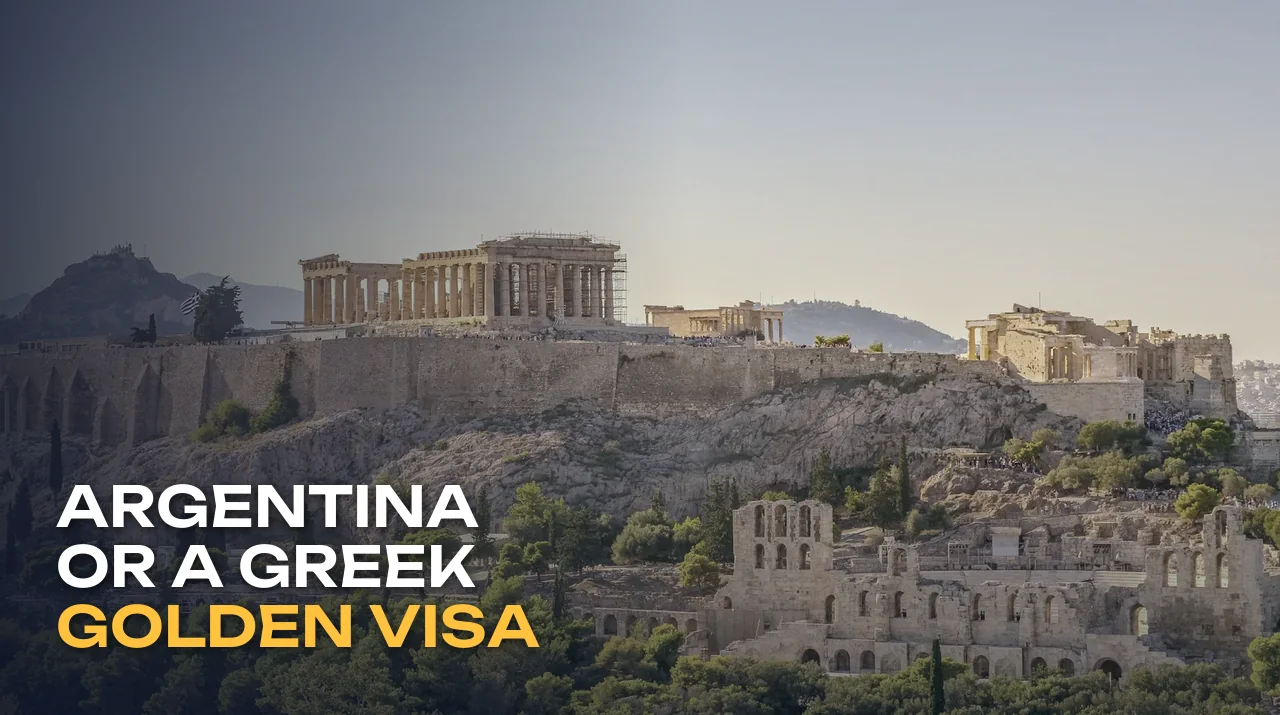
An Argentine passport and a Greek golden visa cost a comparable amount: a $350,000 contribution against property from €250,000. But they are different statuses. Greece gives the right to live in an EU country, the property stays in the family's ownership, and a single investment covers three generations. Argentina gives citizenship and a passport with 168 visa-free destinations, but the contribution is not refunded and it does not allow living in the EU. Below is a comparison by money, rights, family and taxes, and the scenarios in which families take both statuses. Terms, cost and procedure of the programme are on the page Argentina's citizenship programme.
Argentine passport or Greek golden visa: in brief
In brief: if the family wants to live in Europe and keep its money in an asset, the Greek golden visa fits. If it needs a second passport for travelling the world, the UK and Latin America, Argentina fits. For some families the best answer is both statuses, one after the other.
BRIDGES programme database, Ministry of Economy of Argentina, BRIDGES index
The main difference is visible in the first rows. A golden visa is a residence permit, not citizenship: the family keeps its own passport and depends on it for travel outside Schengen. Argentine citizenship is a new passport, but it does not give the right to live in the EU. So comparing the programmes in terms of "which is better" is misleading: the right question is which goal the family is pursuing.
The second difference is the money. In Greece the investment remains an asset: the property can be let on a long-term lease and sold, with the residence permit kept or lost depending on the conditions. In Argentina the $350,000 contribution goes to the Treasury irrevocably, and the $800,000 bond is repaid after seven years without interest.
Money: an investment versus a contribution
In brief: in Greece the family buys property from €250,000 and keeps it as an asset. In Argentina the family pays a non-refundable $350,000 or buys an $800,000 bond for seven years.
Greece offers three thresholds. From €250,000: a property whose main premises are converted from commercial to residential use, or a listed building for restoration. From €400,000: a home outside the main zones with a floor area of at least 120 sq m. From €800,000: Attica, Thessaloniki, Mykonos, Santorini and islands with more than 3,100 inhabitants. On top of the price come a 3.09% transfer tax, a €2,016 residence permit fee and legal and notary services.
The property stays in the family's ownership and can generate income from long-term letting. Legal and notary services are calculated separately.
BRIDGES programme database, Greece - Golden Visa - cost
The calculation shows the difference in the nature of the money. In Greece, of the €414,376 about €400,000 stays in the asset, and the non-recoverable costs, tax and fee, come to about €14,400. In Argentina the entire $350,000 is non-recoverable. If you compare non-recoverable costs, the Greek golden visa is several times cheaper. If you compare the amount that has to be taken out of circulation, they are comparable.
Property has its own risks: liquidity, maintenance costs, property taxes and the euro exchange rate. On yields and property taxes in Greece, see the articles rental yields in Greece and property taxes in Greece. A detailed calculation for Argentina is in the article the cost of Argentine citizenship. The Argentina programme estimate shows the total for the contribution or bond for your family.
Rights: living or travelling
In brief: the golden visa gives the right to live in Greece and travel around Schengen. An Argentine passport gives visa-free travel to 168 destinations and the right to live in Argentina and MERCOSUR countries, but not in the EU.
A golden visa holder lives in Greece with no limit on duration and may spend up to 90 days in any 180-day period in other Schengen countries. The residence permit does not allow employment in Greece and does not give the right to live in other EU countries. An Argentine citizen gets the same 90 days in 180 in Schengen, but needs a separate residence permit to live in Europe.
Outside Schengen the difference favours Argentina. A golden visa holder travels to the UK, Japan and other countries on their own country's passport, which for a Russian citizen means visas. An Argentine citizen enters the UK with an ETA and Japan without a visa. The list of countries is in the article visa-free countries for the Argentine passport.
Family: three generations or two
In brief: the Greek golden visa on a single property extends to the spouse, children under 21 and the parents of both spouses. In Argentina a separate amount is paid for each family member, and parents are not included in the application.
For a large family Greece is considerably more advantageous: the parents of both spouses obtain residence on the same property with no additional investment. In Argentina each parent is a separate main applicant with a $350,000 contribution. A family of six with two grandmothers would pay $1,200,000 in contributions in Argentina, and in Greece the price of one property plus taxes and residence permit fees.
| Family | Greek golden visa | Argentine citizenship, contribution |
|---|---|---|
| Single applicant | Property from €250,000 | $350,000 |
| Spouses | The same property | $450,000 |
| Spouses and two children under 18 | The same property | $500,000 |
| Spouses, two children and the parents of both spouses | The same property | $500,000 plus $350,000 for each parent |
Argentina has its own advantage when it comes to children: unmarried children under 25 without children of their own are included in the application, whereas in Greece the limit is 21. Greece no longer gives family-route residence to a child aged 22-25, while in Argentina that child is included in the application for $100,000.
Property as an asset: letting, sale, inheritance
In brief: a property in Greece generates income from long-term letting, passes by inheritance and can be sold. On sale the residence permit is retained only if the new owner takes over the investment or the family buys another property.
For a family that chooses Greece, the property is not an expense but an investment with income and risks. Long-term letting in Athens, Thessaloniki and on the large islands generates income that is taxed in Greece. Short-term holiday letting is restricted for golden visa properties, so income is planned on long-term leases.
The property passes by inheritance under Greek rules, and on sale the family must maintain the investment if it wants to keep the residence permit. This limits the freedom to dispose of the capital for as long as the status is held. In Argentina there is nothing to dispose of: the contribution goes to the Treasury, and the bond ties up $800,000 for seven years with no return. For a family thinking about inheritance and passing capital to its children, a property in Greece offers more flexibility than a contribution that, once paid, stops being the family's money. On buying and checking a property, see the articles buying property in Greece and property due diligence in Greece.
Passport and citizenship in the long run
In brief: the golden visa leads to Greek citizenship only with actual residence: seven years of living in the country. The family obtains Argentine citizenship immediately after the decision, without residence.
Years holding a golden visa without living in Greece do not count towards the citizenship period. To become a Greek citizen you must actually live in the country for seven years, pass an exam in the language, history and culture and undergo vetting. For families who move to Greece this is a real route to an EU passport. For families who use the residence permit for travel, Greek citizenship remains out of reach. More in the article permanent residence or citizenship in Greece.
Argentine citizenship requires no residence. After the migration service's decision the family receives identity cards and passports in Buenos Aires. But the programme's legal basis is being challenged in the Supreme Court, and until there is a court ruling or a law passed by Congress, the programme carries a risk that the Greek golden visa does not. More in the article the legal basis of Argentina's programme.
Maria StavruReal Estate Analyst, BRIDGES
Argentine passport or Greek residence? We will help you choose
We will compare the price, the timing and what each option gives your family.
Timelines and predictability
In brief: the Greek golden visa follows a well-established procedure: choosing a property, the purchase, filing and issue of the cards. Argentina's programme will begin accepting applications in Q4 2026.
In Greece most of the time goes on choosing a property and checking its legal standing. After the purchase the family files its documents, receives a filing certificate that allows it to live in the country, and then five-year residence cards. The procedure has worked for years, the rules are known, and the government announces changes in advance. For a family this means the plan can be built around dates: when to choose the property, when to transfer the money and when to travel for biometrics.
In Argentina the terms were announced on 2 October 2026, but the programme's regulations have not been published and the amounts have not been fixed by resolution. How long the Agency's vetting will take before a recommendation is unknown; the migration service's decision is due 30 working days after the recommendation. On the procedure in Greece, see the article the Greek golden visa.
Taxes
In brief: neither the golden visa nor an Argentine passport by itself makes the family tax resident. Tax residence depends on where you live: in Greece, more than 183 days a year.
A golden visa holder who does not live in Greece pays the Greek taxes linked to the property: property tax and tax on rental income. If the family moves and spends more than 183 days in Greece, it becomes tax resident and pays tax on worldwide income, with the option of a flat-tax regime for major investors. More in the article the non-dom regime in Greece.
An Argentine citizen who lives abroad and holds a permanent status there pays no tax on worldwide income in Argentina. Taxes arise on moving to Argentina. More in the article taxes in Argentina.
The risks of each option
In brief: in Greece the risks relate to the property and the programme rules; in Argentina, to the legal basis and the non-refundable contribution.
Greece
The golden visa's risks lie in the property: its price may fall, it requires maintenance costs and taxes, and it cannot always be sold quickly. Greece has raised the programme thresholds several times, but the changes applied to new applicants, and existing residence permits were preserved. Before buying, the property's legal standing, permits and compliance with the programme's requirements on floor area and use are checked.
Argentina
Argentina's main risk is the legal basis: Decree 366/2025 has been declared null and void by the National Electoral Chamber, and the dispute is before the Supreme Court. The second risk is that the money is non-refundable: the $350,000 will not come back whatever the outcome, and the terms of any refund on refusal or annulment of the legal basis will be set by the regulations. The third is the bond: its repayment after seven years depends on the solvency of the state.
For Russian citizens: banks and transfers
In brief: both options require transferring a large sum from abroad. For Russian citizens the payment route and proof of funds are prepared in advance, often via an account in a third country.
Greek banks check the property buyer and the source of funds, and for a Russian citizen the checks are enhanced. The Greek golden visa is open to Russian citizens, but transferring money from Russian banks to Greece is practically impossible, so the money comes from an account in a third country. In Argentina, too, money arrives only through the banking system with checks on its origin, and the requirements for payments from Russia will be specified in the regulations.
In both cases the work starts with the history of the funds: where the money came from, where it is held and through which countries the transfer will go. BRIDGES does this work once, and it serves both programmes. On accounts, see the article a bank account in Argentina.
How the process works
In brief: in Greece the route starts with choosing a property; in Argentina, with documents and vetting of the applicant. Preparing the documents and funds is shared. What we do and what remains for you is shown on the page an Argentine passport by investment.
Greece
- Choosing a property and legal checks.
- A tax number, an account at a Greek bank, transferring the funds.
- Purchase before a notary and registration of title.
- Filing for residence, the filing certificate, biometrics.
- Issue of five-year residence cards to all family members.
Argentina
- Preliminary vetting of the applicant and the source of funds.
- Documents with an apostille and translation into Spanish.
- Application to the Citizenship by Investment Programmes Agency.
- Checks by the services, a recommendation, the migration service's decision.
- Payment under the regulations, DNI and passport in Buenos Aires.
Both statuses: how families combine them
In brief: an Argentine passport and a Greek golden visa complement each other: the passport for travelling the world and for banks, the residence permit for living in the EU.
The combination works like this. The family buys a property in Greece and obtains residence for all three generations: the right to live in the EU and a fallback place to live. The main applicant or the whole family obtains Argentine citizenship: a passport for the UK, Japan and Latin America, and a passport that banks handle in the ordinary way. In Schengen the family lives on its residence permit and does not count days, and it travels the world on Argentine passports.
The order depends on urgency. If the right to live in the EU is needed now, start with Greece: the legal basis is stable and the timelines are known. Argentina is added once the programme is up and running and the dispute is resolved. If the passport is the priority and the family is prepared to wait, the order is reversed, but either way the documents and proof of funds are prepared once.
Two examples
In brief: a family with grandparents chooses Greece; an entrepreneur who travels to London often chooses Argentina.
A three-generation family
A couple with two children aged 10 and 15 and the wife's parents want a fallback place to live in Europe. A €400,000 property in Greece gives residence to all six, and the flat can be let on a long-term lease. In Argentina the same family would pay $500,000 for the couple and children and $700,000 for the two parents. The choice is obvious: Greece, with an Argentine passport later and only for those who need it.
An entrepreneur travelling to London and Asia
A company owner travels to the UK once a month and to Japan and Singapore several times a year, and does not plan to live in Europe. Greek residence will not solve his visa issues outside Schengen, but an Argentine passport will: the UK with an ETA, Japan and Singapore without a visa. Here the choice favours Argentina, once the programme is ready to accept applications.
How to choose: five questions
In brief: five answers decide the choice: living or travelling, who is in the family, which destinations, whether an asset is needed and how urgent it is.
- Will the family live in Europe in the coming years? Yes: Greece. No, only travel: Argentina.
- Does the plan include parents or children over 21? Parents favour Greece, children aged 22-25 favour Argentina.
- Do you need the UK, Japan and Latin America without visas? Yes: that favours Argentina.
- Is the family prepared to hold capital in property? Yes: Greece. If capital freedom matters: Argentina's contribution, provided the non-refundable amount is acceptable.
- How urgently is the status needed? Urgently: Greece, the programme is running. Without urgency: Argentina, after the regulations and the court ruling.
If the answers diverge, a combination suits the family: Greek residence for living and an Argentine passport for travel. Urgency determines the order, and the documents and history of funds are prepared once for both programmes.
Where families go wrong
In brief: they confuse residence with citizenship, treat Argentina's contribution as an asset and count on Greek citizenship without relocating.
- They think of the golden visa as a passport. It is a residence permit: you keep your own passport.
- They think an Argentine passport gives the right to live in the EU. It gives travel only.
- They compare the total amount rather than the non-recoverable costs. In Greece the money stays in the property.
- They count on Greek citizenship after five years of residence. Seven years of actual residence are required.
- They forget the parents. In Greece they are included on a single property; in Argentina each costs $350,000.
What to check before deciding
In brief: whether the family needs to live in the EU, who is included in the application, which trips matter most and how urgently the status is needed.
- Whether the family plans to live in Europe or only to travel.
- Whether there are parents and children over 21.
- Which destinations matter: Schengen, the UK, Asia.
- Whether the family is prepared to hold money in property or prefers a contribution.
- How urgently the status is needed and whether the family is prepared to wait for Argentina's regulations.
Programme terms are on the pages Argentine citizenship by investment and in the article the cost of the Greek golden visa.
Which works out better on a $350,000 budget? We will work it out
We will break the costs down by item: mandatory payments, fees and services, with no hidden amounts.
Maria StavruReal Estate Analyst, BRIDGES
Share this article
Frequently asked
Questions people ask before deciding
01Which is better: an Argentine passport or a Greek golden visa?
It depends on the goal. If you need to live in the EU and keep your money in an asset, Greece fits. If you need a second passport for travelling the world, Argentina fits.
02Does an Argentine passport give the right to live in Greece?
No. It gives visa-free Schengen travel for 90 days in any 180. Living in Greece requires a residence permit, such as the golden visa.
03How much does the Greek golden visa cost?
Property from €250,000, €400,000 or €800,000 depending on the zone and the property, plus a 3.09% transfer tax and a €2,016 residence permit fee.
04Can parents be included?
In Greece, yes: the parents of both spouses on a single property. In Argentina parents are not part of the application and apply separately with a $350,000 contribution.
05Does the golden visa lead to Greek citizenship?
Only with actual residence: citizenship requires seven years of living in Greece. Years on a residence permit without living there do not count.
06Is the money returned?
In Greece the money stays in the property. In Argentina the $350,000 contribution is not refunded, and the $800,000 bond is repaid after seven years without interest.
07Can the property in Greece be let?
Yes, on a long-term lease, generating income. Tax on the rental income is paid in Greece.
08Can you hold both statuses?
Yes. Many families combine Greek residence for living in the EU with an Argentine passport for travelling the world.
09Which is more predictable?
The Greek golden visa has operated under law for years. Argentina's programme has only just been announced, and its legal basis is being challenged in the Supreme Court.
10Do you have to live in the country?
Neither Greece nor Argentina requires residence for these statuses. Greek citizenship does require residence.
11Can you sell the property and keep the residence permit?
Only if the family maintains the investment under the programme rules, for example by buying another property. Otherwise the golden visa permit is not renewed.
12Is the Greek golden visa open to Russian citizens?
Yes. But transferring money from Russian banks to Greece is practically impossible, so the money comes from an account in a third country.
13What if both statuses are needed?
Start with the one you need more now. If the right to live in the EU is needed, start with Greece. Documents and the history of funds are prepared once and work for both programmes.
14What to choose if the family has a 23-year-old child?
In Greece a child over 21 is not included in the family residence permit. In Argentina an unmarried child under 25 without children of their own is included in the application for $100,000.
15Which option is better for children studying in Europe?
For study in Greece the golden visa fits: children under 21 live in the country on the residence permit. For study elsewhere in the EU both statuses require a student residence permit, but with an Argentine passport children enter for exams without a visa.
Transparency
How this material was prepared
- Author
- Maria Stavru, real Estate Analyst, BRIDGES
- Terms and costs last verified
- October 2026
- Sources
- official government authorities of the relevant country and state publications
- Methodology
- government minimum requirements are stated separately from due diligence charges, state fees, legal and banking costs
Sources and methodology
Figures, terms and timelines are checked against official sources as of October 2026. Link availability verified in August 2026. Third-party blogs and agent websites are not used as a source of programme terms.
- [1]EUR-LexOfficial texts of European Union legislationeur-lex.europa.eu/homepage.html
- [2]European Commission - Migration and Home AffairsEntry and residence rules in the EUhome-affairs.ec.europa.eu/index_en
Methodology: tables and charts state government minimum investment requirements; due diligence charges, state fees, legal, banking and other costs are calculated separately and are not included in the minimum thresholds.
About the author
Related materials
What to read next
 ComparisonGolden Visa of Greece or Caribbean citizenship 2026: EU residence permit versus second passport
 ArticleHow Much Does the Greece Golden Visa Cost in 2026: A Full Cost Breakdown for a Family
 ComparisonCitizenship by investment or golden visa: passport immediately or residence permit in 2026
News+1 story on 3 November
Related news
 Argentina · 11 OctArgentina citizenship by investment ban bills: risks for investors
 Greece · 3 NovGreece: the 15% home purchase tax will depend on tax residency, not on your passport
 European Union · 1 NovEuropean Union: updated social security rules for living and working in two countries enter into force
Personal programme selection is conducted by Anna Kovalevskaya, Head of Legal, BRIDGES.
Want a second passport or residence in Europe? We will help you get it
We will set out the steps from the first documents to the final status, with the timing of each.
