Citizenship · Vanuatu
Where is Vanuatu: 83 islands in the Pacific Ocean and the capital Port Vila

Updated: September 2026·29 min read·Expert reviewed
Terms and costs verified: September 2026
Contents
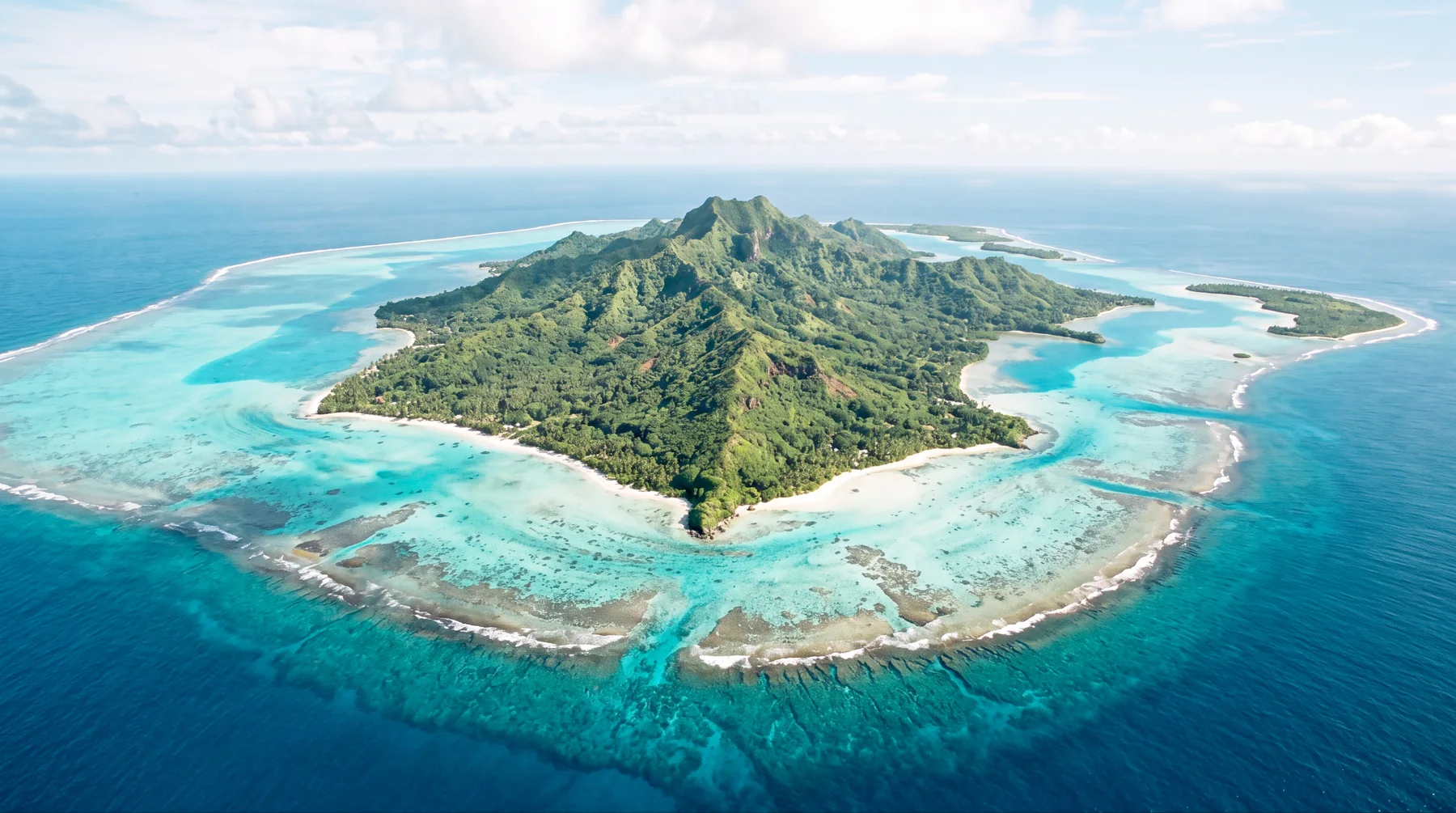
Vanuatu lies in the South Pacific, about 1,750 km east of Australia and 500 km north-east of New Caledonia. It is a republic of 83 islands in Melanesia with its capital, Port Vila, on Efate island. The country has 343,320 inhabitants, the official languages are Bislama, English and French, and the currency is the vatu. Below: Vanuatu on the world map and its neighbours, islands and provinces, the capital, flag and coat of arms, currency, population, climate and time, the state and economy, how to get there and what Vanuatu citizenship gives.
Vanuatu: the country in brief
In short: the Republic of Vanuatu is an island state in Oceania between Australia, Fiji, New Caledonia and the Solomon Islands. Until independence on 30 July 1980 the archipelago was called the New Hebrides and was jointly administered by Britain and France.
| Parameter | Value |
|---|---|
| Official name | Republic of Vanuatu |
| Capital | Port Vila, Efate island |
| Region | Oceania, Melanesia |
| Land area | 12,199 km² |
| Population | 343,320 as of 1 June 2025 |
| Official languages | Bislama, English, French |
| Currency | vatu (VT, code VUV) |
| Time zone | UTC+11 |
| Dialling code | +678 |
| Power supply | 230 V, 50 Hz, three-pin plug with flat pins |
For many readers the country becomes familiar through its citizenship by investment programme: a Vanuatu passport is obtained in 2-3 months without travelling to the islands. The terms are covered in the article Vanuatu citizenship by investment, and below is reference information on the country itself.
Where Vanuatu is on the world map
In short: Vanuatu lies in the south-western Pacific, in the Southern Hemisphere. The archipelago stretches as a chain from north to south between 13 and 20 degrees south, and Port Vila is at roughly 17.7 degrees south and 168.3 degrees east.
To find Vanuatu on the world map, look east from Australia’s east coast, past New Caledonia, towards Fiji: the chain of islands between them is Vanuatu. The country belongs to Melanesia, one of the three parts of Oceania along with Micronesia and Polynesia. Vanuatu is not part of Micronesia, although the names are often confused in search.
The islands lie on the Pacific Ring of Fire, so most of them are mountainous and volcanic. The country’s exclusive economic zone is 860,000 km², 70 times its land area: the state consists mainly of ocean.
Vanuatu lies south of the equator and west of the International Date Line, so the new day begins here earlier than in Europe and the Americas. The seasons are the reverse of the north: summer from December to February, winter from June to August, but because of the tropical climate the seasons differ in rainfall rather than temperature.
Vanuatu on the map of Oceania: Melanesia, Polynesia and Micronesia
In short: Oceania is divided into three parts. Vanuatu belongs to Melanesia together with Fiji, the Solomon Islands, Papua New Guinea and New Caledonia. Samoa and Tonga are in Polynesia; Nauru, Palau and Kiribati in Micronesia.
| Country or territory | Part of Oceania | Capital |
|---|---|---|
| Vanuatu | Melanesia | Port Vila |
| Fiji | Melanesia | Suva |
| Solomon Islands | Melanesia | Honiara |
| Papua New Guinea | Melanesia | Port Moresby |
| New Caledonia (France) | Melanesia | Nouméa |
| Samoa | Polynesia | Apia |
| Tonga | Polynesia | Nuku’alofa |
| Tuvalu | Polynesia | Funafuti |
| Kiribati | Micronesia | South Tarawa |
| Palau | Micronesia | Ngerulmud |
| Nauru | Micronesia | no official capital; the government sits in Yaren district |
The names of the parts of Oceania relate to the people and the location of the islands. Melanesia lies north-east of Australia, Polynesia covers a huge triangle in the centre and east of the Pacific, and Micronesia lies further north, closer to the equator. Vanuatu is sometimes confused with Micronesia and with the Federated States of Micronesia, but they are different countries in different parts of the ocean.
Vanuatu shares a common Melanesian culture and regional cooperation with Fiji, the Solomon Islands and Papua New Guinea, and history and proximity with New Caledonia: some Vanuatu residents work there. In Oceania, Vanuatu and Nauru run citizenship by investment programmes; they are compared in the article Vanuatu or Nauru.
Vanuatu’s neighbours: New Caledonia, Fiji, the Solomon Islands, Australia and New Zealand
In short: the nearest neighbour is New Caledonia, 541 km south-west of Port Vila, then Fiji 965 km to the east and the Solomon Islands 1,290 km to the north-west. Brisbane is 1,904 km away in a straight line, Auckland 2,216 km and Sydney 2,473 km.
| Neighbour | Direction from Vanuatu | From Port Vila in a straight line | Worth knowing |
|---|---|---|---|
| New Caledonia (France) | south-west | 541 km to Nouméa | flights from Nouméa; about 2,000 ni-Vanuatu live and work in New Caledonia |
| Fiji | east | 965 km to Nadi | a major hub for long-haul connections |
| Solomon Islands | north-west | 1,290 km to Honiara | flora and fauna close to Vanuatu’s |
| Australia | west | 1,904 km to Brisbane | 2.5 hours’ flight from Brisbane, 3.5 hours from Sydney |
| New Zealand | south and south-east | 2,216 km to Auckland | just over 2 hours’ flight |
Vanuatu claims two uninhabited islands in the south of the archipelago, Matthew and Hunter, but they are also claimed by New Caledonia, an overseas territory of France. Vanuatu admits citizens of most countries without a visa for short trips; the permitted stay depends on nationality. Port Vila is about 16,500 km from London and 11,000 km from Los Angeles in a straight line, and all long-haul routes involve a connection.
The islands and provinces of Vanuatu
In short: the archipelago has 83 islands, 14 of them larger than 100 km². The largest is Espiritu Santo, with an area of 3,956 km² and the country’s highest point, Mount Tabwemasana at 1,879 m. Since 1994 the country has been divided into six provinces.
| Province | Main islands |
|---|---|
| Torba | Banks and Torres Islands |
| Sanma | Espiritu Santo |
| Penama | Maewo and Pentecost |
| Malampa | Malekula and Ambrym |
| Shefa | Epi and Efate with the capital Port Vila |
| Tafea | Erromango, Tanna and Aneityum |
Most islands are mountainous and covered in tropical forest, surrounded by coral reefs with species close to those of Australia’s Great Barrier Reef and New Caledonia’s reefs. Tanna has the active Mount Yasur volcano, which you can approach closely, and there are several underwater volcanoes in the archipelago’s waters. Vanuatu is recognised as a separate tropical forest ecoregion, and the flora of the northern islands differs noticeably from the southern ones: the boundary runs north of Efate.
People travel between the islands by domestic flights and by sea. From Port Vila there are flights to Espiritu Santo, Tanna, Malekula and other large islands, and cargo-passenger ships link the archipelago’s ports and call at islands without airstrips. Schedules to remote islands depend on the weather, so trips there are planned with time to spare, especially in the cyclone season. Most people on the remote islands live in villages, and their livelihoods rely on gardens, fishing and coconut plantations.
Island names are often spelled in different ways: Espiritu Santo is shortened to Santo, Efate is called Vila island after the capital, and some islands also have local names. Maps and flight schedules use the English spelling, so it is worth checking in advance when planning a trip.
The capital Port Vila and the towns of Vanuatu
In short: the capital of Vanuatu, Port Vila, is on Efate island. The second town, Luganville, is on Espiritu Santo, 276 km to the north-west. Each town has tens of thousands of residents; the rest of the population is rural.
Port Vila is home to parliament, the government, the Reserve Bank of Vanuatu, the Citizenship Commission and the Immigration and Passport Services. It also has Bauerfield International Airport, served by flights from Australia, New Zealand, New Caledonia, Fiji and the Solomon Islands. The town sits on a bay and has banks, hotels, clinics and schools teaching in English and French.
During the Second World War Luganville on Espiritu Santo was an Allied military base, as was Efate. Today it is the centre of Sanma province. You can travel between the towns by domestic flight. Tanna island, with Mount Yasur, lies 223 km south of the capital and is also linked to it by domestic flights.
Port Vila is compact: the centre runs along the bay, and government offices, banks and the central market are a few blocks apart. The town has bank branches, private clinics and pharmacies, supermarkets with imported goods, schools teaching in English and French, and the Emalus campus of the University of the South Pacific. Mobile service and internet are available in town; coverage on the remote islands is weaker.
For a citizen under the programme the capital matters in practice: the Citizenship Commission, the Immigration and Passport Services and the designated agents work here. There is no need to live in Port Vila: citizenship is obtained without travelling to the islands. For those who want to live in the country there is a residence permit, whose terms are covered in the article Vanuatu residence.
We will obtain Vanuatu citizenship for you without moving to the islands
A passport in 2-3 months under the investment programme: terms, documents and cost for your family.
The flag and coat of arms of Vanuatu
In short: Vanuatu’s flag was adopted at independence in 1980: red and green horizontal stripes, a black triangle at the hoist and a yellow Y shape edged in black. The triangle shows a boar’s tusk and two crossed namele fern leaves.
The colours are usually interpreted as follows: red stands for blood, green for the riches of the islands, black for the ni-Vanuatu people, and the yellow Y follows the layout of the archipelago. In island tradition the curled boar’s tusk stands for prosperity and the namele leaves for peace. The coat of arms shows a Melanesian warrior with a spear against a volcano, the same tusk and namele leaves, and the Bislama motto “Long God yumi stanap”, “In God we stand”. The national anthem is “Yumi, Yumi, Yumi”, “We, we, we”.
A Vanuatu passport is recognised by its dark green cover with gold lettering in English. State symbols are used on official documents and government websites. A Vanuatu citizen receives a 10-year passport, and the citizenship certificate is issued by the Citizenship Commission.
The currency of Vanuatu: the vatu
In short: the national currency is the vatu, symbol VT, international code VUV. It is issued by the Reserve Bank of Vanuatu. On 15 September 2026, 1 US dollar was worth 116.54 vatu, 1 euro 134.61 vatu and 1 Australian dollar 83.17 vatu.
| Currency | Reserve Bank rate on 15.09.2026 |
|---|---|
| US dollar | 116.54 VT |
| Euro | 134.61 VT |
| Australian dollar | 83.17 VT |
| New Zealand dollar | 67.34 VT |
| Pound sterling | 157.33 VT |
The country imports most goods, including from Australia and New Zealand. Bank cards are accepted in the towns; on remote islands you need vatu in cash. Vanuatu government fees are set in vatu, while the contribution and fees of the citizenship programme are paid in US dollars. Which banks operate in the country is covered in the article banks in Vanuatu.
The vatu has been issued since 1981, after independence. For a trip it is convenient to carry US or Australian dollars and a card from an international payment system: Port Vila and Luganville have ATMs and exchange offices, while markets and remote islands work in vatu cash. Check in advance that your bank card works abroad, as cards from some countries are restricted internationally.
Calculate Vanuatu citizenship for your family
The calculator works out the DSP programme and the CIIP fund for your family: the contribution, the FIU fee and the all-in total.
Population, languages and religion
In short: according to the National Statistics Office estimate as of 1 June 2025, Vanuatu has 343,320 inhabitants. 98.5% are indigenous Melanesian ni-Vanuatu, the official languages are Bislama, English and French, and most residents are Christian.
The population is mainly rural: only Port Vila and Luganville have tens of thousands of residents. Besides Melanesians, the country is home to Europeans, people of Asian origin and people from other Pacific islands, and several islands are inhabited by Polynesians. The people of Vanuatu are called ni-Vanuatu, and the word Vanuatu means “our land” in local languages.
Bislama serves as the common language for people from different islands, and English and French remain from the condominium era, when British and French schools ran in parallel. Besides the three official languages, over 100 local languages are spoken on the islands. According to the government portal, 84% of residents are Christian and 16% follow traditional beliefs.
Vanuatu’s official documents, including the citizenship certificate and the passport, are issued in English, so a citizen does not need to translate them for travel or banks. Traditional culture is preserved: land diving from wooden towers takes place on Pentecost, and communities on Tanna keep to a traditional way of life.
The education system has kept the dual basis of the condominium era: some schools teach in English, some in French. Higher education is provided by the University of the South Pacific campus in Port Vila, which has a law school, and many students go to study in Australia, New Zealand, Fiji and New Caledonia.
Culture and traditions: kava, laplap and land diving on Pentecost
In short: Vanuatu’s culture rests on customs that residents call kastom: the authority of chiefs, exchange ceremonies, traditional food and drink. The country’s best-known symbols are the kava drink, the laplap dish, sand drawings and land diving from wooden towers on Pentecost.
- Kava. A drink made from the root of the kava plant, drunk in the evening in traditional meeting houses, nakamals, and in kava bars. Kava relaxes and is part of custom; it is served at ceremonies and meetings.
- Laplap. The national dish: grated root vegetables with coconut milk, baked in banana leaves on hot stones. It is prepared for celebrations and family events.
- Sand drawings. Complex patterns drawn with a finger in one continuous line. They pass on stories, knowledge and ways of communicating between communities with different languages, and UNESCO has inscribed the tradition on its list of intangible heritage.
- Land diving on Pentecost. Men jump from tall wooden towers with vines tied to their ankles. The rite is linked to the yam harvest and takes place in the dry season.
Chiefs retain great influence in villages and in settling land disputes, and at national level the Malvatumauri council of chiefs, recognised by the Constitution on matters of custom and language, is in operation. Land in Vanuatu belongs to its customary owners, so foreigners take it on a long-term lease rather than into ownership.
What to see in Vanuatu
In short: the country’s main sights are volcanoes, reefs and Second World War history: Mount Yasur on Tanna, the caves and blue holes of Espiritu Santo, the wreck of the SS President Coolidge off Luganville, and the waterfalls and villages around Port Vila.
- Tanna. The active Mount Yasur volcano, whose crater you approach with a guide, and villages with a traditional way of life.
- Espiritu Santo. Freshwater blue holes in the forest, Champagne Beach and dive sites off Luganville.
- SS President Coolidge. A troopship that sank off Espiritu Santo in 1942, a well-known scuba dive site among divers from many countries. Nearby is Million Dollar Point, where Allied equipment was dumped into the sea after the war.
- Efate. The Mele Cascades near Port Vila, lagoons, villages and the capital’s market.
- Pentecost. Land diving from wooden towers in the dry season.
A trip is easy to plan from Port Vila: there are flights from the capital to Tanna and Espiritu Santo, and Efate has enough to fill several days. The dry season from May to October suits the volcano and diving; in the rainy season some trails and roads on the remote islands are washed out.
Climate, time and nature
In short: the climate is tropical and subtropical; the rainy and cyclone season usually runs from November to April, and the drier season from May to October. Vanuatu time is UTC+11, and there is no daylight saving time.
When it is 9:00 in London (GMT), it is 20:00 in Port Vila; Sydney is one hour behind in the southern winter. For business calls from Europe, the morning suits best, as it coincides with the evening in Vanuatu. Government offices work Monday to Friday, so replies from Port Vila to emails sent on Friday afternoon European time arrive after the weekend. The dry season from May to October is best for a trip: less rain and a lower risk of cyclones.
Natural risks come from the archipelago’s position on the Ring of Fire and in the tropical cyclone zone. Cyclone Pam in March 2015 and Cyclone Harold in April 2020 caused serious damage, and in December 2024 a magnitude 7.3 earthquake damaged buildings in Port Vila. For a passport holder who does not live on the islands these risks do not affect citizenship, and those planning to move take them into account when choosing housing. Details are in the article life and prices in Port Vila.
A few simple rules are enough for a traveller. In the cyclone season follow the Vanuatu Meteorological Service warnings and keep a spare day in your flight plans, choose insurance that covers medical evacuation, and in an earthquake follow the hotel’s instructions. The tropical sun is strong all year, so sun protection and drinking water are needed even in the dry season.
The history of Vanuatu: from the New Hebrides to independence
In short: the islands have been inhabited for thousands of years. The first European here was Pedro Fernandes de Queirós in 1605, James Cook named the archipelago the New Hebrides, from 1906 it was jointly administered by Britain and France, and on 30 July 1980 the country gained independence.
- 2000 BCThe oldest archaeological finds on the islands
- 1605Pedro Fernandes de Queirós, the first European on the islands
- 1774On his second voyage James Cook names the archipelago the New Hebrides
- 1906The Anglo-French Condominium of the New Hebrides
- 30.07.1980Independence of the Republic of Vanuatu
- 1981Admission to the UN
Government of Vanuatu, gov.vu portal as of 15.09.2026
In 1887 the islands came under an Anglo-French naval commission, and in 1906 the two sides agreed a condominium: the archipelago had two administrations, two legal systems and two education systems. During the Second World War Efate and Espiritu Santo served as Allied bases. In the 1960s the ni-Vanuatu began to seek self-government, and in 1980 both countries recognised the independence of the Republic of Vanuatu. It joined the UN in 1981 and the Non-Aligned Movement in 1983.
Public holidays in Vanuatu
In short: the main national holiday is Independence Day on 30 July. Most residents are Christian, so Christmas and Easter are also public holidays, and in villages celebrations come with traditional ceremonies and laplap.
On Independence Day, Port Vila and the provincial centres hold parades, string band concerts and sports competitions, and the festive week brings people from different islands to the capital. Public holidays are taken into account in advance for trips and business meetings: government offices, including the Immigration and Passport Services, are closed on these days, and document timelines shift.
Vanuatu in international organisations
In short: Vanuatu has been a member of the UN since 1981, the Commonwealth since 1980, the World Trade Organization since 2012 and Interpol since 20 November 2018. The country takes part in regional groupings of Pacific states.
Membership of international organisations shows the country’s place in the world system: Vanuatu is a recognised sovereign state with diplomatic relations, trade agreements and participation in international police cooperation. Interpol membership since 2018 disproves the common myth that Vanuatu is beyond the reach of international searches.
In the region Vanuatu cooperates with neighbouring island states on trade, fisheries, climate and security, and it has long-standing ties with Australia and New Zealand in education, labour mobility and development assistance.
The state and political system
In short: Vanuatu is a parliamentary republic. A single-chamber parliament of 52 members is elected for 4 years, the leader of the largest party usually becomes prime minister and heads the government, and the president is elected for 5 years by parliament and the chairs of the six provincial governments.
The president’s role is mainly ceremonial; executive power lies with the prime minister and the government. The Constitution sets three official languages and recognises dual citizenship, but a citizen with two citizenships cannot hold public office or take part in politics. Citizenship is managed by a constitutional body, the Citizenship Commission, and passports are issued by the Immigration and Passport Services.
The official websites of Vanuatu’s government bodies use the gov.vu domain, and the government warns separately about fake websites. How the Citizenship Commission works and the programme’s legal basis are covered in the article the law and the authority behind the citizenship programme.
Vanuatu’s legal system combines three sources: English common law, French civil law inherited from the condominium, and the customary law of communities. Above them stands the 1980 Constitution. The courts include the Supreme Court and the Court of Appeal, and disputes over custom and land are heard with the participation of chiefs and special land tribunals.
The economy of Vanuatu
In short: the economy rests on agriculture, which supports about 65% of the population, tourism, fisheries and financial services. In December 2020 Vanuatu graduated from the UN group of least developed countries, and the Reserve Bank forecasts GDP growth of 3.8% in 2026.
Agriculture is mostly small-scale and subsistence; copra, kava, cocoa and beef are exported. Tourism depends on air links and cruises: in June 2026 the statistics office recorded 14,081 arrivals. The country has no oil or significant mineral reserves, and small light industry serves the domestic market. The statistics office put consumer price inflation for the first quarter of 2026 at 1.0%.
The budget is funded by 15% VAT, customs duties, licence fees and the citizenship programmes. There is no personal income tax, capital gains tax or inheritance tax. The tax system is covered in the article taxes in Vanuatu, and the housing market and land ownership in the article property in Vanuatu.
The financial sector is regulated by the Reserve Bank of Vanuatu and the Financial Services Commission: they license banks, insurance and trust companies and keep the companies register. A Vanuatu passport does not by itself exempt you from tax in the country where you live; this is covered in detail in the article why the passport does not exempt you from tax at home.
We will obtain a second passport of Vanuatu for you
We will explain how to obtain Vanuatu citizenship without travelling to the islands, what it costs for a family and how to use the passport to obtain residence in Europe.
Vanuatu and Russia
In short: Russian citizens do not need a visa for Vanuatu for trips of up to 90 days, there are no direct flights, and the time difference with Moscow is 8 hours. Russia allows a second citizenship and requires notification of the Interior Ministry about Vanuatu citizenship within 60 days.
For a trip, a Russian citizen needs a passport valid for more than 6 months, a return ticket and an accommodation booking. English is enough to communicate in Port Vila, in hotels, banks and government offices. Money for the trip is taken in cash dollars or on a card from a foreign bank, because Russian bank cards do not work in Vanuatu.
A Russian citizen who obtains Vanuatu citizenship enters Russia on the Russian passport and files a notification of the second citizenship. For travel in Asia and Oceania the Vanuatu passport complements the Russian one, and for Europe families obtain residence in Greece or Hungary.
How to get to Vanuatu
In short: there are no long-haul direct flights to Vanuatu. Travellers from Europe, the Middle East, Asia and the Americas fly via a hub to Brisbane, Sydney, Auckland or Nadi in Fiji and on to Port Vila. Citizens of most countries do not need a visa for a short trip to Vanuatu.
It is a 2.5-hour flight from Brisbane to Port Vila, 3.5 hours from Sydney and just over 2 hours from Auckland. A connection in Australia or New Zealand may require a transit visa or electronic authorisation depending on your nationality, and New Caledonia, as a French territory, follows French entry rules. Travellers who need a visa for Australia often find the route through Fiji simpler.
At the border you show a passport valid for more than 6 months, a return or onward ticket, an accommodation booking or address and proof of funds for the stay. Port Vila is 11 hours ahead of GMT, so after a long journey allow a day to adjust. Entry documents and flight options for Russian citizens are covered in the article a Vanuatu visa for Russian citizens.
Bauerfield International Airport is a few kilometres from the centre of Port Vila, and you reach town by taxi or minibus. You can buy a local SIM card and change money at the airport and in town, and it is convenient to book the first night in advance, as flights from Nadi and Brisbane often arrive in the evening. When connecting to a domestic flight to Tanna or Espiritu Santo, leave time between flights: small aircraft schedules depend on the weather.
Vanuatu citizenship and passport
In short: Vanuatu citizenship is obtained by investment without travelling to the islands: under the DSP programme the contribution starts at $130,000 for one person, and a family of three or more can choose the CIIP fund at $157,000 with $50,000 returned after 5 years. The timeline is 2-3 months, and the route to Europe runs through residence in Greece or Hungary.
Besides the investment programme, Vanuatu’s Constitution and laws provide for naturalisation after 10 years of continuous residence, citizenship by marriage with a lawful marriage and at least 2 years of residence in the country, and citizenship by birth and descent. For a foreigner with no ties to Vanuatu, the investment programme is the route: the passport is issued for 10 years, citizenship passes to children, and there is no need to give up your first citizenship.
The Vanuatu passport opens 93 countries and territories without a prior visa, with a visa on arrival or an electronic authorisation, including Hong Kong, Singapore and Malaysia. There has been no visa-free entry to the Schengen area since 4 February 2023, so Vanuatu citizens obtain Greek residence under the Golden Visa programme or the Hungarian programme. The list of destinations is in the article visa-free countries for the Vanuatu passport, the procedure in the article how to obtain Vanuatu citizenship, and the cost for your family in the cost calculator.
How the passport of an ocean state simplified visas for a couple who have lived at sea for years, moving from country to country, is shown in the case a couple who live at sea. Applying with a designated agent, documents and support through to the passport is described on the page Vanuatu citizenship with BRIDGES.
Frequently asked
Questions people ask before deciding
01Is Vanuatu in Micronesia?
No. Vanuatu belongs to Melanesia together with Fiji, the Solomon Islands and Papua New Guinea. Micronesia lies further north, closer to the equator.
02How does Vanuatu differ from Fiji?
They are different Melanesian states: Vanuatu lies 965 km west of Fiji, and each country has its own capital, currency and passport. Many nationalities can visit both countries without a visa for short trips.
03What is there to see in Vanuatu?
Mount Yasur volcano on Tanna, the blue holes and the wreck of the SS President Coolidge on Espiritu Santo, the Mele Cascades near Port Vila and the land diving on Pentecost.
04How many islands does Vanuatu have?
83 islands, 14 of them larger than 100 km². The largest is Espiritu Santo with an area of 3,956 km².
05What time zone is Vanuatu in?
UTC+11, 11 hours ahead of London in winter and 16 hours ahead of New York. There is no daylight saving time.
06What is kava in Vanuatu?
A traditional drink made from the root of the kava plant. It is drunk in the evening in meeting houses and kava bars and served at ceremonies.
07Which international organisations is Vanuatu a member of?
The UN since 1981, the Commonwealth since 1980, the World Trade Organization since 2012 and Interpol since 2018.
08Can you buy land in Vanuatu?
Land belongs to its customary owners, so foreigners take it on a long-term lease rather than into ownership.
09What is Vanuatu’s main public holiday?
Independence Day on 30 July: on that day in 1980 the New Hebrides became the Republic of Vanuatu.
10Where is Vanuatu?
In the South Pacific, in Melanesia: about 1,750 km east of Australia, 500 km north-east of New Caledonia, west of Fiji and south of the Solomon Islands.
11What is the capital of Vanuatu?
Port Vila on Efate island. It is home to parliament, the government, the Reserve Bank and Bauerfield International Airport.
12How many islands are there in Vanuatu?
83 islands, 14 of them larger than 100 km². The largest is Espiritu Santo with an area of 3,956 km².
13What is the area of Vanuatu?
12,199 km² of land and an exclusive economic zone of 860,000 km².
14How many people live in Vanuatu?
343,320 people according to the National Statistics Office estimate as of 1 June 2025. 98.5% of residents are indigenous Melanesian ni-Vanuatu.
15What language is spoken in Vanuatu?
The official languages are Bislama, English and French. Over 100 local languages are also spoken on the islands.
Transparency
How this material was prepared
- Author
- Darya Melnik, senior Investment Programs Advisor, BRIDGES
- Terms and costs last verified
- September 2026
- Sources
- official government authorities of the relevant country and state publications
- Methodology
- government minimum requirements are stated separately from due diligence charges, state fees, legal and banking costs
Sources and methodology
Figures, terms and timelines are checked against official sources as of September 2026. Link availability verified in August 2026. Third-party blogs and agent websites are not used as a source of programme terms.
- [1]Vanuatu Citizenship OfficeOfficial conditions of the citizenship programmevancitizenship.gov.vu
- [2]Vanuatu Department of ImmigrationEntry, visas and statusesimmigration.gov.vu
Methodology: tables and charts state government minimum investment requirements; due diligence charges, state fees, legal, banking and other costs are calculated separately and are not included in the minimum thresholds.
About the author
Related materials
What to read next
 ComparisonSecond citizenship in 3-6 months: Caribbean, Türkiye or Vanuatu in 2026
 AnalysisWhat is due diligence and why the Caribbean is rejecting applications
 ArticleBanks in Vanuatu and accounts abroad: what a bank checks for a Vanuatu citizen
Personal programme selection is conducted by Anna Kovalevskaya, Head of Legal, BRIDGES.
We will obtain a Vanuatu passport for you
We will show you the terms of Vanuatu citizenship, an estimate for your family and the timeline to the passport without a trip to the islands.
